In 1876 Isabella was firmly established in her new role as editor of The Pansy magazine, although the entire enterprise was a family affair. Isabella’s husband, sister, brother-in-law, and friends all contributed articles and stories to each issue of the magazine.
Isabella’s husband, the Rev. G. R. “Ross” Alden, wrote Bible study lessons, stories, and poems for the magazine. His talent was creating lovely rhymes with messages that were meaningful for both children and adults.
Here’s one of Rev. Alden’s poems that expertly blends a message on kindness with a celebration of the first day of spring:
You can read more of Rev. Alden’s poems in these previous posts:
On the surface, it may seem that Isabella led a charmed life. Her husband was beloved a minister and a leader in the Presbyterian Church.
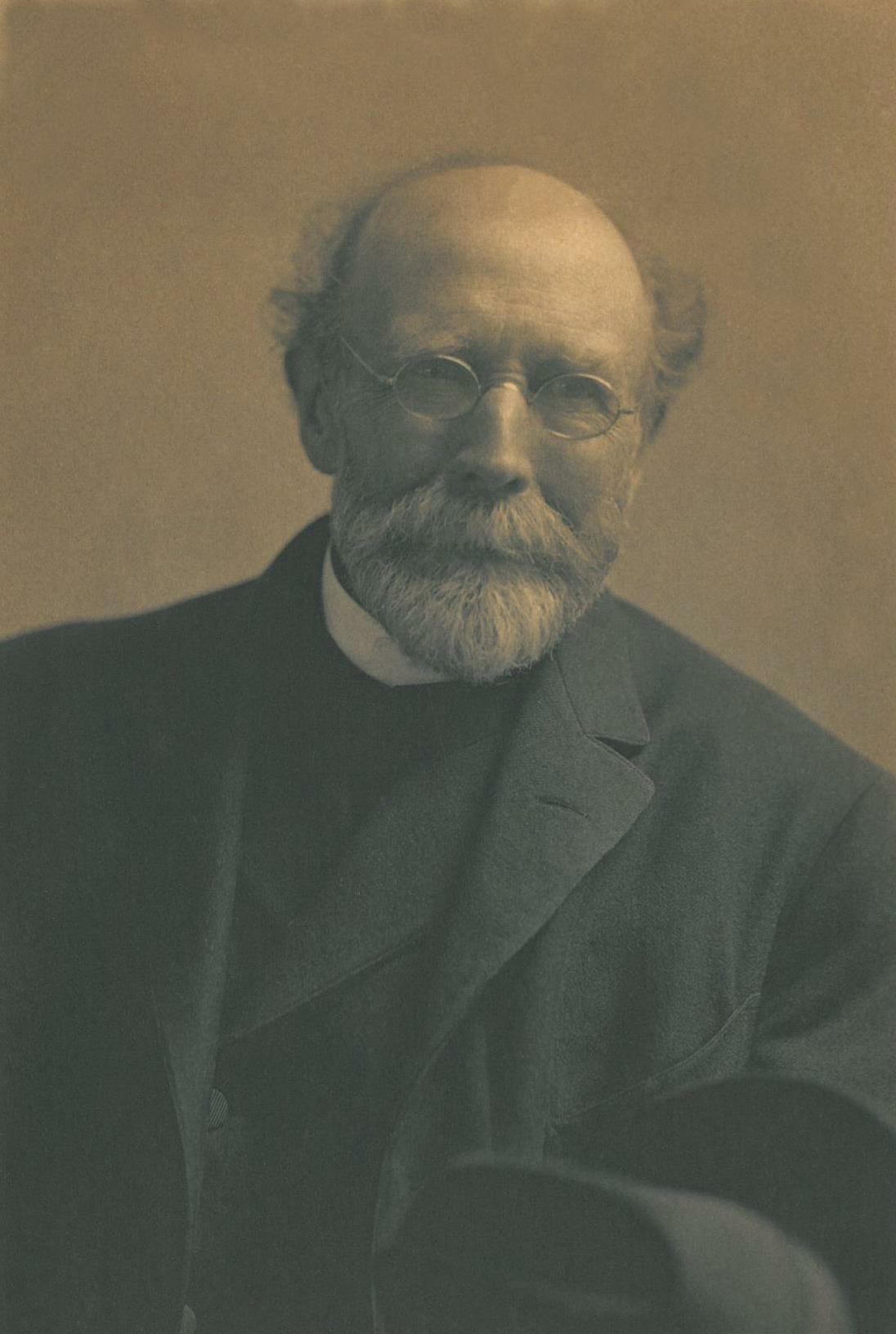
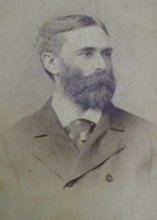
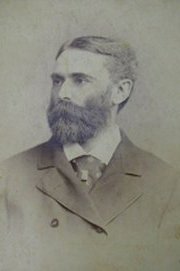
Gustavus “Ross” Alden in later years (about 1912)
Her son Raymond was a talented writer, a beloved teacher, and an esteemed academic.
Isabella Alden, about 1895.
Isabella, herself, had been a successful author for decades, as well as an influential editor of various Christian magazines for young people and adults.
With so many proud accomplishments in her life, it’s hard to remember that Isabella had her share of heartache and loss.
Some of those losses were made all the more difficult because they occurred almost in a back-to-back fashion during one six-month period in her life. And it happened one-hundred years ago.
The year 1924 began on a positive note for the entire Alden family. Isabella’s son Raymond—who was head of the English Department at Stanford University in California—was on sabbatical so he could teach courses at Columbia University in New York. It was an exciting career opportunity for Raymond.
Undated photo of Raymond Macdonald Alden.
His topics during that Spring Session at Columbia were:
English Literature from 1780 to 1830.
Shakespeare
Versification
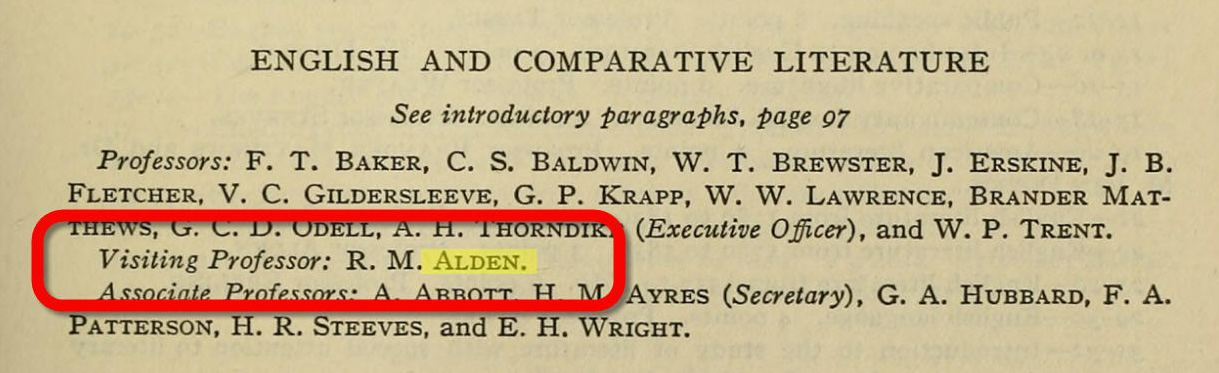
Raymond Alden listed as a Visiting Professor in the English and Comparative Literature department, Columbia Course Catalog for 1923-1924.
Raymond, his wife Barbara, and their five children (ages 2 to 14) made the move east together and rented a home within an easy commute to Columbia’s campus.
Barbara Hitt Alden, in her early twenties.
Isabella and her husband Ross went, too. Ross was 92 years old and had been officially retired from the ministry for some time, but he still enjoyed excellent health and a quick wit and intellect. Isabella was still writing novels, but she too had “retired” and had adopted a much slower pace when it came to her work.
Isabella and Ross moved into the Swarthmore, Pennsylvania home of Isabella’s sister Marcia Livingston and niece Grace Livingston Hill. Grace often described Marcia and Isabella as “inseparable” sisters, and for the majority of their lives, the Aldens and the Livingstons spent much of their time together.
It was while the Aldens were staying with Marcia and Grace in Swarthmore in the spring of 1924 that tragedy struck.
Grace Livingston Hill’s Home, Swarthmore, PA.
At that time Philadelphia was dealing with an influenza epidemic. The particular strain that prevailed during the spring of 1924 often caused pneumonia.
From The Philadelphia Inquirer, February 18, 1924.
Unfortunately, antibiotics like penicillin and sulfonamides were not as widely available as they are today; so doctors could offer little in the way of treatment for pneumonia, beyond recommending bed rest, and drinking fluids. Almost every day newspapers reported new outbreaks of the influenza virus, as well as the number of deaths, and it often seemed as if no one was safe.
From The Philadelphia Inquirer, March 1, 1924.
Health officials warned that a common cold or a mild case of the flu could quickly turn into a deadly case of pneumonia. Unfortunately, that is exactly what happened to Rev. Alden. At ninety-two years of age he was particularly susceptible to pneumonia, and although the family brought in a physician in to treat him, he died on March 29, 1924.
From The Peninsula Times Tribune, April 14, 1924.
His death was reported in newspapers across the country and the tributes and remembrances came pouring in. People wrote about their memories of when he was their church minister. They related the anecdotes he used to illustrate his sermons and teachings; and they mentioned the close friendships they formed with him in the Sabbath School classes he taught.
Perhaps Isabella had a chance to read some of those tributes. And she no doubt relied upon her sister Marcia’s support, as well as the tender care that Raymond, Barbara and Grace would have provided.
Isabella made the decision to remain in Swarthmore until summer, so Raymond could fulfill his teaching responsibilities at Columbia. Then, the Alden family planned to travel together back to their home in Palo Alto, California, where Rev. Alden’s remains would be laid to rest.
In her remembrances of her uncle, Grace recalled a poem he wrote and had printed as a New Year greeting card. He sent the cards to the members of his Bible class the last winter he was with them before going to Swarthmore. It reads:
TODAY
We are living today—not tomorrow, For no morrow was ever yet seen; And for joy, or for pain, or for sorrow, Only yesterdays ever have been.
God gives us duties—just for today; And His strength He bestows by the hour, “Grace is sufficient” we still hear Him say, So we trust Him for wisdom and power.
And since today is all that He gives, Let us treasure the day as it stands. It matters, then, much how everyone lives For tomorrow God holds in His hands.
Few people know that Isabella’s husband, the Reverend G. R. Alden, was an accomplished poet. He wrote several poems for The Pansy magazine, including this one that celebrates the coming of spring:
Isabella was surrounded by writers. Her sister, niece, son, and friends all wrote stories, articles and lessons for publication.
Her husband, the Reverend Gustavus Rossenberg Alden—“Ross” for short—was no exception. In addition to writing his Sunday sermons, he wrote many short stories for The Pansy magazine, authored a memoir of stories about his boyhood while growing up in Maine, and (with his brother-in-law Charles Livingston) wrote a series of weekly Bible study lessons.
Ross was also an accomplished poet. He created lovely rhymes about a wide variety of subjects.
Here’s Ross’s poem “April” to help us welcome a new month:
APRIL
O Spring is coming now, don’t you see?
The birds will be followed by the humble bee.
The frogs are singing their evening song,
The lambs are skipping with their dams along,
The buds are out on the pussy-willow tree,
On the bough of the birch sings the chickadee.
The cows come lowing along the lane,
With suppers all ready for us again.
Old Speckle scratches for her chickens ten,
New piggies are squealing in their pen,
From the top of the tree the robin calls,
From the top of the dam the water falls,
And everything to the eye or ear,
Tells to old and young that April is here.
One day, when Isabella was a single young woman in her early twenties, she was chatting with three friends about a recent wedding they had all attended.
Their talk soon turned to the contrasts between what Isabella called “old times” and the present. She said:
“Weddings are among the few social events that do not change their customs much with the passing years; there is a sort of regular program that gets carried out as a matter of course. Don’t you think so?”
Isabella Alden later conceded that when she made that statement, she was rather ignorant about life and the havoc it can wreak upon a simple wedding ceremony.
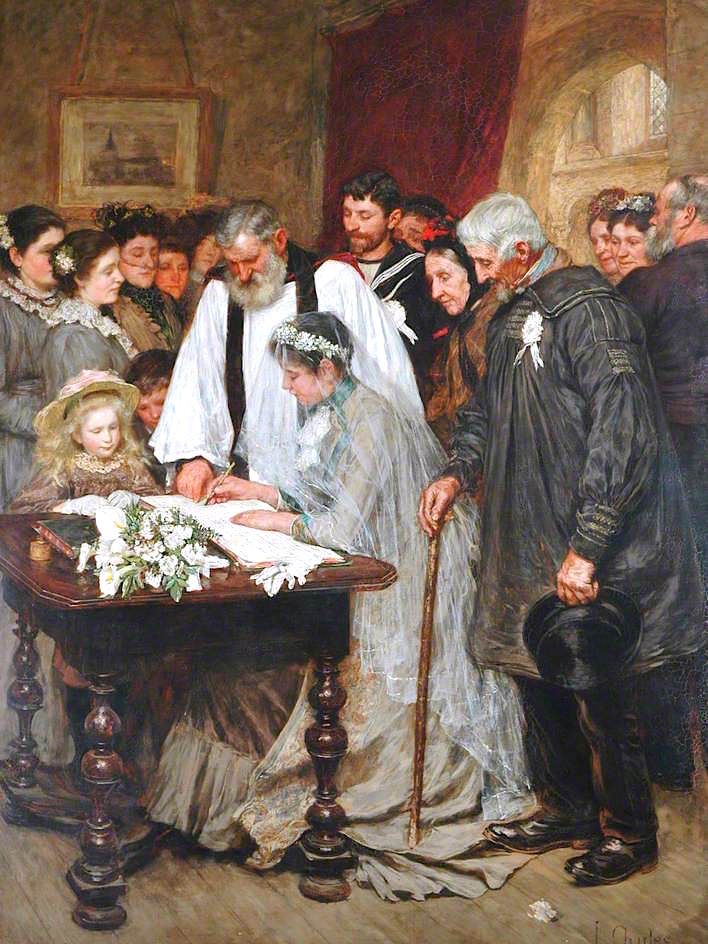
Signing the Marriage Register, by James Charles (undated)
Her friends soon set her straight, telling her stories of their own weddings that did not go off as planned. One friend—whom Isabella identified only as Mrs. H.—told how she had orchestrated “a very swell wedding” with “all the flowers and furbelows planned in their fullness.”
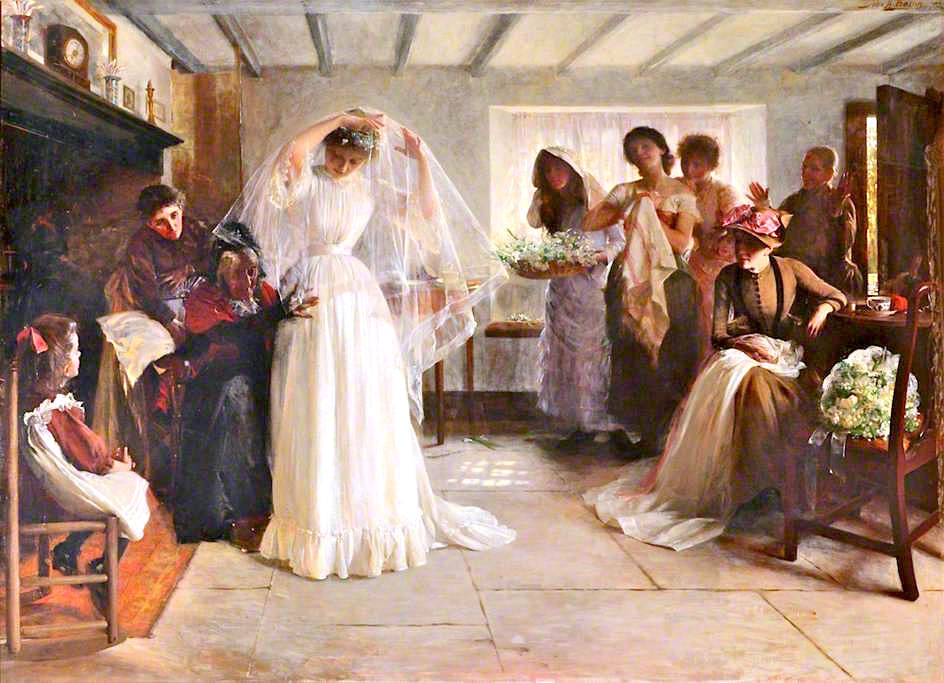
The Wedding Morning, by John Henry Frederick Bacon (1892)
But all Mrs. H.’s plans were for naught. Instead of a grand church wedding with a reception after, she was married in a rush with as many members of the family as could be found at a moment’s notice. Instead of her wedding gown, she was married in the gingham dress she had put on in the afternoon, because there had been no time to change it.
Why the sudden rush? Because her intended husband, a soldier in the Union Army, “had appeared unexpectedly on the eight o’clock train, and he had to be back at the station again two miles away, for the midnight train, in order to join his regiment, for a hurry call to the front.”
A hand-colored photo of a Civil War soldier and his sweetheart.
Isabella never forgot Mrs. H.’s story. As a minister’s wife, Isabella must have attended hundreds of weddings over her lifetime, and observed for herself that there really was no “regular program” to follow when it came to weddings.
The Wedding, by Johann Hamza (undated)
Isabella’s own wedding was relatively simple. She married Gustavus “Ross” Alden in her home town. She spent the night before her wedding in her old bed in her family home. Her mother woke her on her wedding day with a tender kiss.
The Wedding Morning by John Henry Frederick Bacon (1892)
Isabella and Ross were married in the Presbyterian church she and her family had attended for decades. Afterward, the bridal party and guests returned to the house to celebrate the day with food and well wishes.
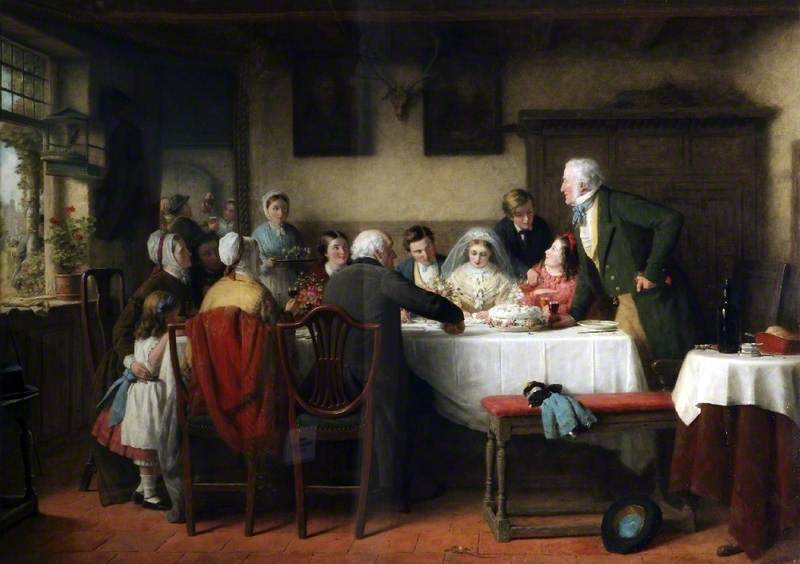
The Wedding Breakfast, by Frederick Daniel Hardy (1871)
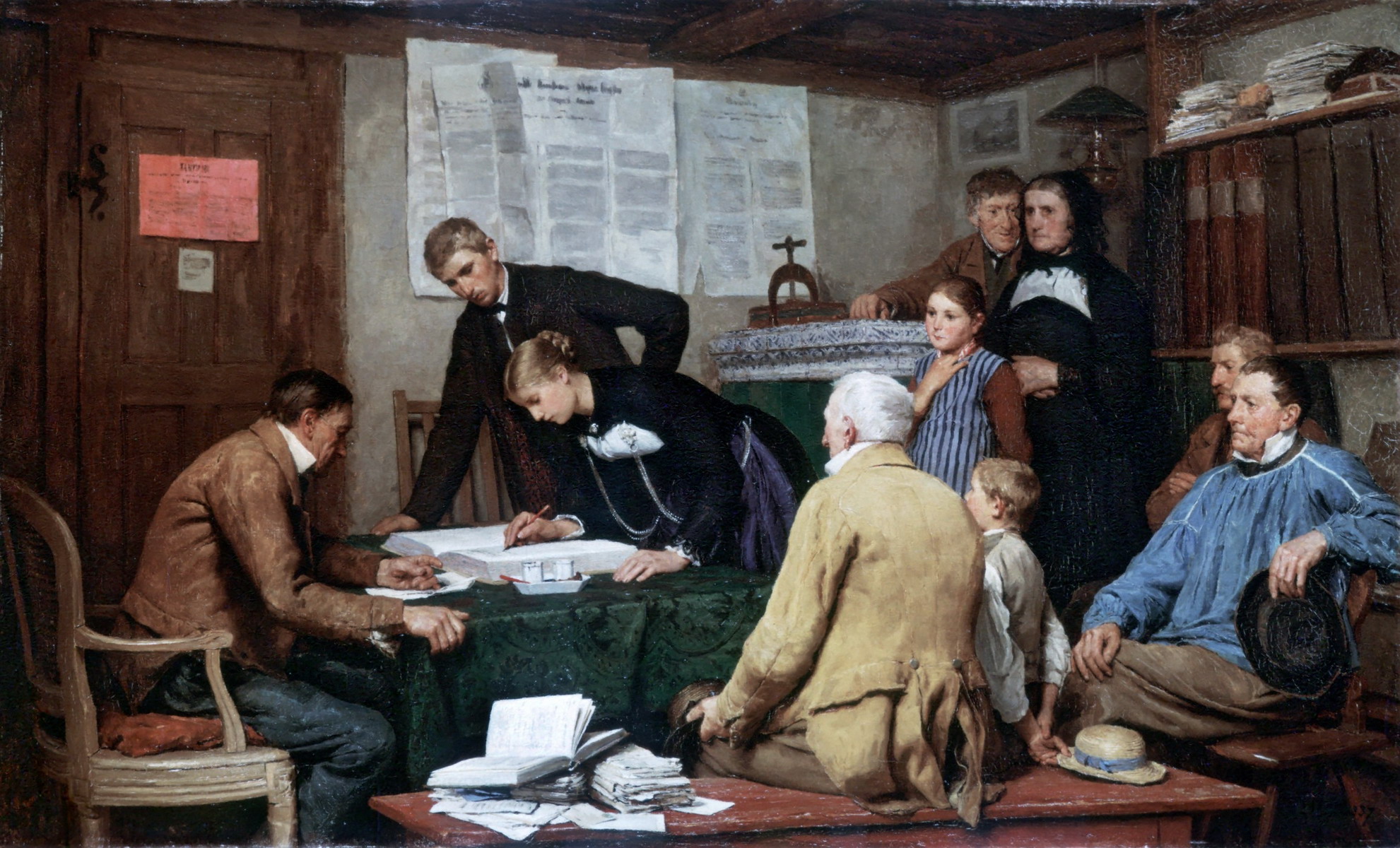
As Isabella matured and gained more life experience, she did indeed learn that not all weddings were similar to her own. While many couples were married in a church as she was, quite a few were married by a justice of the peace in a civil ceremony.
The Civil Wedding, by Albert Anker (1887)
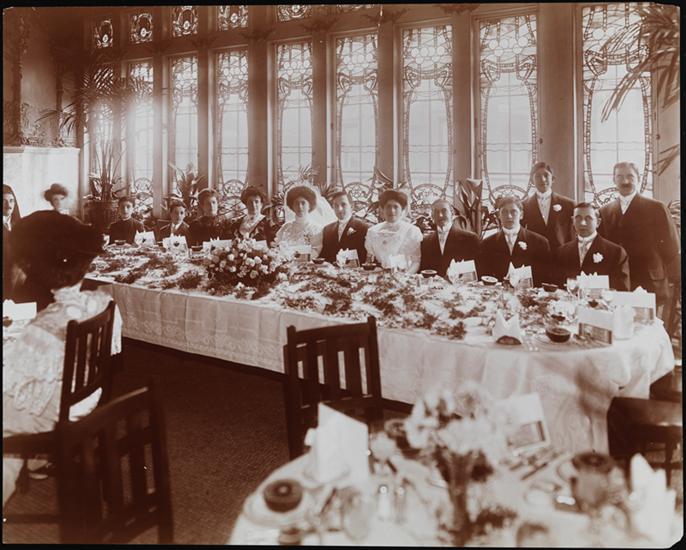
And while Isabella and Ross held their reception in her parents’ home, other couples chose more formal settings that could accommodate hundreds of invited guests.
A wedding party seated at the head table in the banquet hall at the Hotel Belleclaire, New York City, 1908.
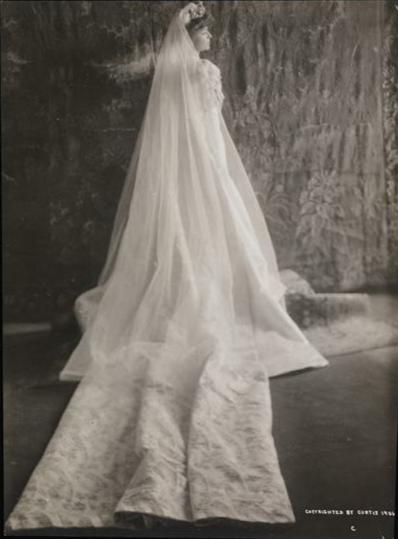
In fact, Isabella probably read newspaper accounts of the most spectacular wedding America had ever seen when Alice Roosevelt, the daughter of President Theodore Roosevelt, married Nicholas Longworth III in Washington, D.C. Their wedding, which took place in February 1906, was the social event of the season. More than a thousand guests attended, while many thousands of spectators gathered outside the church, hoping for a glimpse of the bride. Alice wore a soft blue wedding dress instead of the traditional white. Later, she dramatically cut the wedding cake with a sword, borrowed from a military aide attending the reception, thereby sparking a tradition many military couples still follow today.
Alice Roosevelt in her wedding gown, 1906.
Much has changed since that day in the early 1860s when Isabella uttered those innocent words about weddings always staying the same. Do you wonder what she would think about the creative ceremonies that are so popular with couples today?
What’s the most unusual wedding you ever attended?
Have you ever attended a wedding where everything went wrong, like the wedding Mrs. H. described?
In addition to writing stories and novels, editing a children’s magazine, and giving lectures on women’s topics that were dear to her heart, Isabella wrote Sunday-school lessons for children.
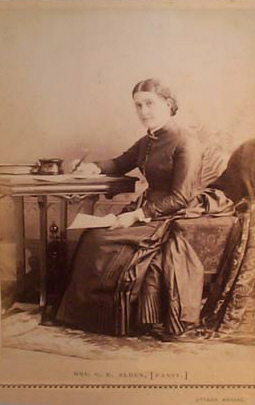
Photo of Isabella Alden about 1880 (age 39)
.
Her published lessons were well-regarding and widely adopted by many denominations. Several publications printed her lessons each month, and dedicated Sunday-school teachers across the country employed them every Sunday morning.
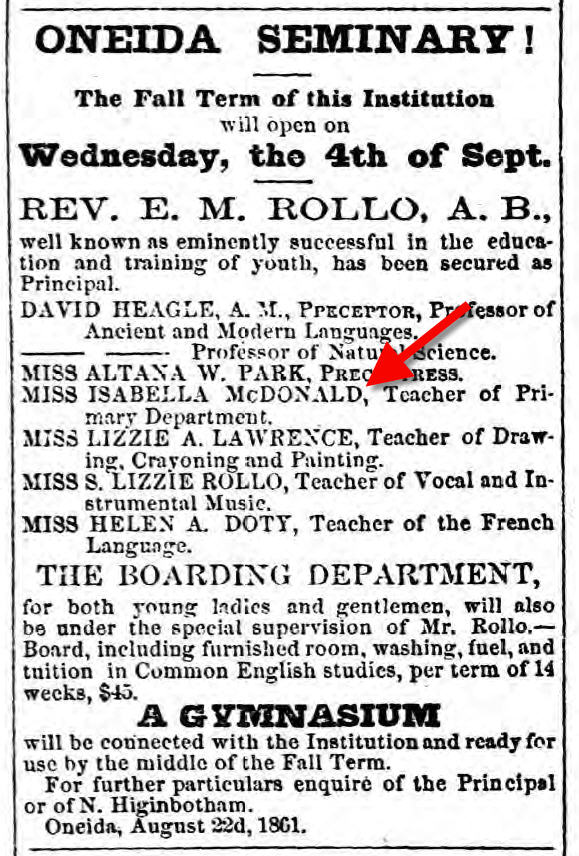
Isabella had been trained as a teacher; that’s how she earned her living prior to her marriage to the Reverend Gustavus Alden.
An August 1861 ad in the Oneida (NY) Sachem for Oneida Seminary
.
It’s little wonder, then that Isabella was regarded as an expert in her field, and often found herself giving impromptu talks about the proper methods of teaching Sunday-school, particularly for younger children (which were often called the “infant class”).
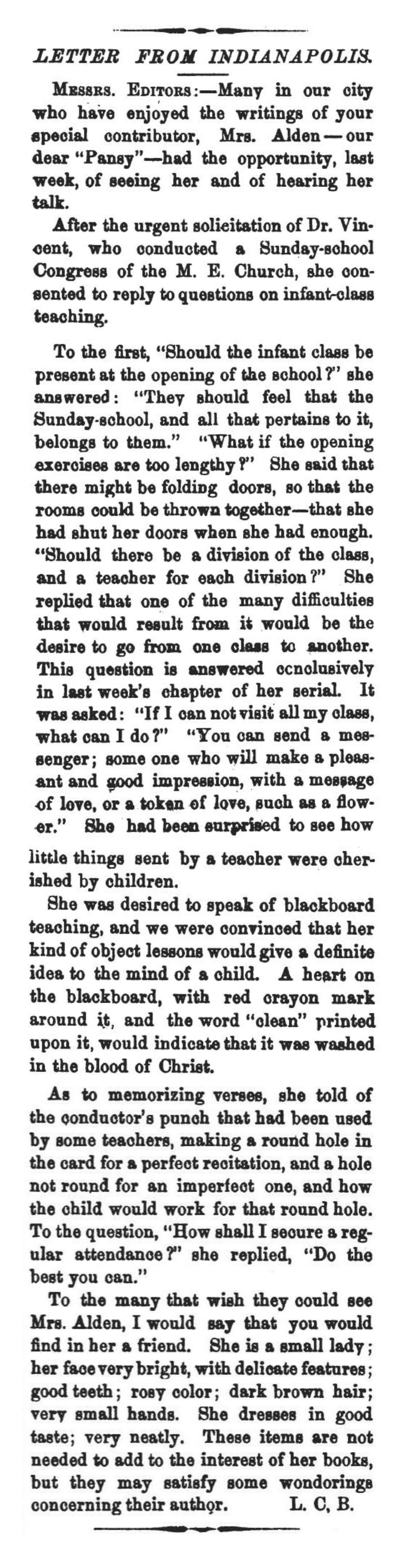
The May 1877 issue of Sabbath School Monthly magazine printed a letter submitted by a reader who had the pleasure of hearing Isabella give just such a talk. The reader had been at the Sabbath School Conference in Indianapolis earlier in the year, and was in the audience when Isabella was brought on stage to answer questions.
You can read the letter to the editor by clicking on the image below, or scroll down to read a transcript:
.
LETTER FROM INDIANAPOLIS
Messrs. Editors: Many in our city who have enjoyed the writings of your special contributor, Mrs. Alden—our dear “Pansy”—had the opportunity, last week, of seeing her and of hearing her talk.
After the urgent solicitation of Dr. Vincent, who conducted a Sunday-school Congress of the M. E. Church, she consented to reply to questions on infant-class teaching.
To the first, “Should the infant class be present at the opening of the school?” she answered: “They should feel that the Sunday-school, and all that pertains to it, belongs to them.”
“What if the opening exercises are too lengthy?” She said that there might be folding doors, so that the rooms could be thrown together—that she had shut her doors when she had enough.
“Should there be a division of the class, and a teacher for each division?” She replied that one of the many difficulties that would result from it would be the desire to go from one class to another. This question is answered conclusively in last week’s chapter of her serial.
It was asked: “If I can not visit all my class, what can I do?” “You can send a messenger; some one who will make a pleasant and good impression, with a message of love, or a token of love, such as a flower.” She had been surprised to see how little things sent by a teacher were cherished by children.
She was desired to speak of blackboard teaching and we were convinced that her kind of object lessons would give a definite idea to the mind of a child. A heart on the blackboard, with a red crayon mark around it, and the word “clean” printed upon it, would indicate that it was washed in the blood of Christ.
As to memorizing verses, she told of the conductor’s punch that had been used by some teachers, making a round hole in the card for a perfect recitation, and a hole not round for an imperfect one, and how the child would work for that round hole.
Three different train conductor ticket punches and the hole shapes they make.
.
To the question, “How shall I secure a regular attendance?” she replied, “Do the best you can.”
To the many that wish they could see Mrs. Alden, I would say that you would find in her a friend. She is a small lady; her face very bright, with delicate features; good teeth, rosy color; dark brown hair; very small hands. She dresses in good taste; very neatly. These items are not needed to add to the interest of her books, but they may satisfy some wonderings concerning their author.
Don’t you love the writer’s physical description of Isabella (she has “good teeth”!)?
When Isabella gave her impromptu talk in 1877 she was 35 years old, and a seasoned public speaker who seemed to make a very good impression on her audience.
You can read these previous posts about Isabella’s experiences as both a student and a teacher at Oneida Seminary:
On May 30, 1866, twenty-four-year-old Isabella Macdonald married Ross Alden. Ross (whose full name was Gustavus Rossenberg Alden) was a thirty-four-year-old seminary student.
Six months later, Ross was ordained by the Presbyterian Church, and they embarked on a life together of ministering to congregations and sharing their Christian faith.
You can read more about Isabella and Ross’s early years of courtship and marriage in these posts:
When Isabella Macdonald married Gustavus “Ross” Alden, she was 24 years old. She had been earning her own living as a teacher for years; and though she remained very close to her family—especially her sisters Marcia and Julia—she considered herself a very independent and grown-up young woman.
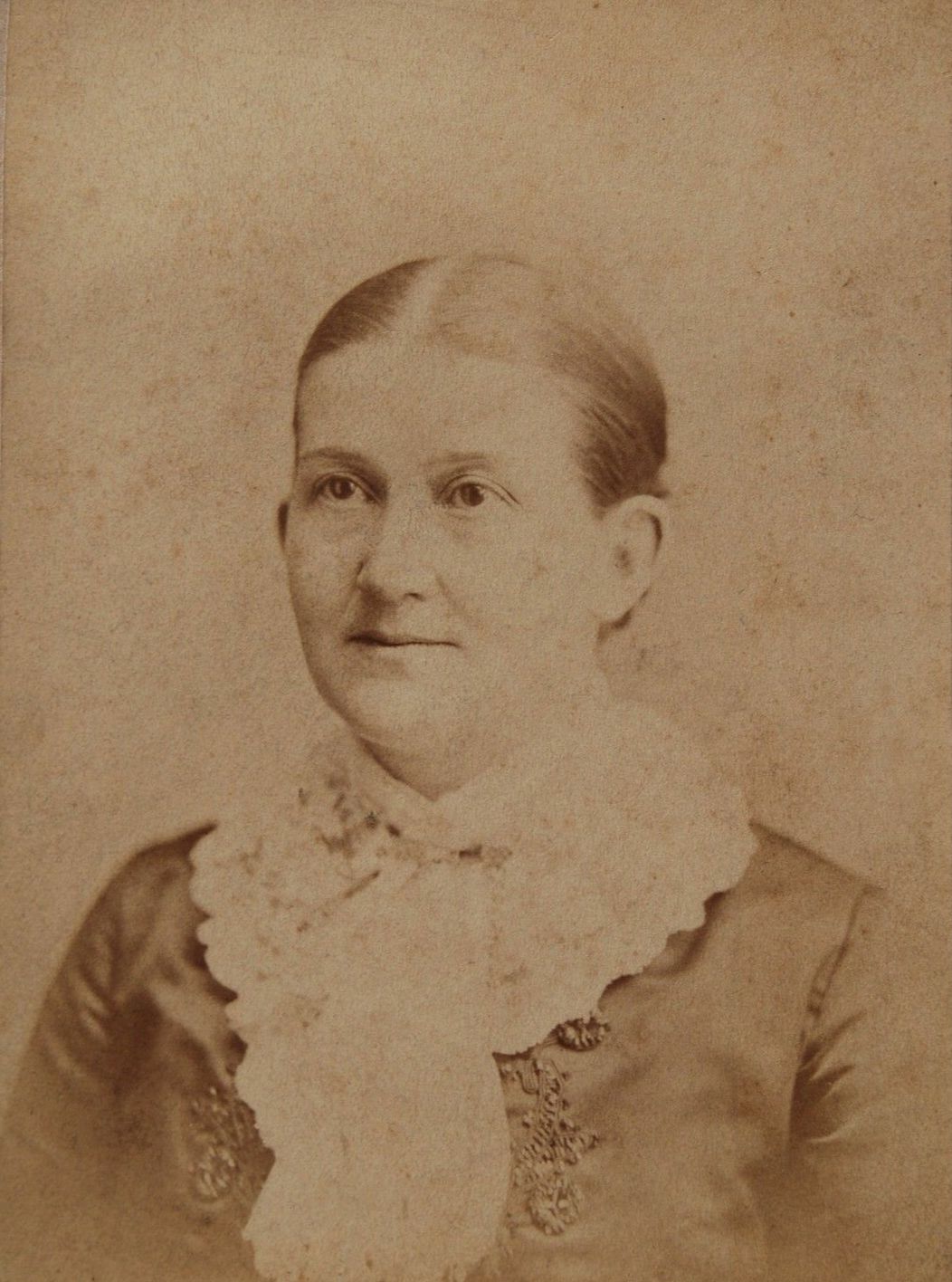
Young Isabella Alden in an undated photo
But when her relationship with Ross Alden began to blossom, so, too, did Isabella’s realization that many people thought she was too young to marry Ross. Isabella wrote:
“I was very sensitive about my age at that time. I seemed always to be guessed much younger than I really was.”
Even a friend of Isabella’s—a lady Isabella described as an intimate acquaintance—was surprised to find out that Isabella was only ten years younger than Ross. The friend would have guessed that Isabella was even younger than 24.
That ten year age difference never bothered Isabella; but it did bother her that people thought she was too young to marry Ross and too young to take on the responsibilities of a pastor’s wife.
“I certainly allowed it to worry me, perhaps because I had at that time nothing more important to worry over.”
It didn’t help matters when Isabella overheard a man and woman walking slowly down her street shortly after she and Ross settled into their first home together.
“Isn’t this where the Presbyterian minister is staying?” asked the woman.
“Yes,” said the man, “and I hear that he has brought back a baby for a wife!”
Reverend Gustavus Rossenberg Alden
Isabella suffered yet “another thrust,” as she called it, a few days later. She had been with Ross in a book store, where a clerk helped them find a copy of a popular book on theology. Two days later, Isabella returned to the same store alone, where the same clerk came forward to wait on her. He bowed and very courteously asked if her father was pleased with the book on theology he had bought earlier in the week. Isabella recalled that she stood on her toes and replied in a voice of stunning dignity, “My husband was!”
Unlike Isabella, Ross took such encounters in stride. When he introduced Isabella to a middle-aged woman he knew, the woman stared at Isabella and said, “Your wife looks very young to take charge of a parish.”
Ross replied, philosophically, that Isabella “will be gaining on that youthfulness every day, you know.”
Isabella thought the woman would laugh; instead she just stared at Isabella, sighed and said, “Yes, that’s so.”
Years later, Isabella wrote in her memoirs:
“Even at this late day I feel almost ashamed to confess the dismay which this little word of criticism gave me.”
But she soon shook off that criticism when she realized that for every person who doubted her because of her youth, there were just as many who embraced her and welcomed her into their homes and hearts. Isabella worked hard to support her husband’s ministry and to silence her critics . . . and she succeeded.
Gustavus “Ross” Alden in later years (about 1912)
In 1892, after 26 years of marriage, the Ladies’ Home Journal interviewed Isabella for an article they were running on women writers. The interview was conducted in the Alden home (they were living in Washington D.C. at the time) and the magazine’s writer had ample opportunity to observe Isabella and Ross together. When the article was published, he included this assessment of the Alden’s marriage:
“It would be difficult to find two people better suited to each other, more tenderly devoted, or more thoroughly one, in all their interests and aims.”
The young man who Isabella Alden served pumpkin pie to on Thanksgiving day, 1863 would have a decided impact on her life (you can read about their first meeting in a previous post). That young man was Gustavus Rossenberg Alden, but everyone called him Ross.
Gustavus “Ross” Alden
When they met that Thanksgiving day, Ross was 31 years old and Isabella was 22. She was a teacher, living with her sister, Marcia and brother-in-law Charles Livingston while Charles attended Auburn Theological Seminary.
Isabella later wrote that her first impression of Ross was that he “was uncommonly tall.” He was also nine years older than she, in the process of changing careers, and he had weathered many life events that Isabella had yet to experience.
Ross came from a rather distinguished family. He was a direct descendent of John Alden and Priscilla Mullens, the first Mayflower Pilgrims to land at Plymouth Rock. You can learn more about John Alden by viewing the video below:
John and Priscilla’s love story was immortalized in the Hendry Wadsworth Longfellow poem, The Courtship of Miles Standish, which you can read here.
Ross’s grandfather, Benjamin Alden, was a founding father of Greene, Maine and a prominent citizen of the surrounding county. Here’s a simple genealogy chart showing Ross’s direct line of descent from John Alden;
When Ross was 23 years old, he married a woman named Hannah Bogart. Within a year they had a daughter they named Anna; two months after Anna’s birth, Hannah passed away.
Very little is known about Ross and his life after his wife died; but seven years later, he was in New York. At the age of 31 he was ready to begin a new chapter in his life, and he enrolled at Auburn Theological Seminary. There he met fellow student, Charles Livingston, who introduced Ross to Isabella on Thanksgiving day, 1863.
Isabella wrote very little about the early days of their relationship, but she did hint at the make-up of the man she fell in love with. She described him as “a most unusual Christian.”
While he would argue good-naturedly over comparatively unimportant matters, or could with equal good nature often drop his side of the question and give himself heartily to the carrying out of the other’s plans, when it came to a matter of principle or conscience he was adamant, although still maintaining his habitual kind courtesy.
Also clear from her writings is the fact that Isabella loved and admired Ross Alden. She looked up to him, and enthusiastically partnered with him in his ministry.
Three years after they met, Ross and Isabella married, and they embarked upon a long and happy life together.
Reviews and giveaways for Christian fiction and sweet, clean fiction. Bringing readers information on great stories and connecting authors with their readers.

















 Isabella Alden