Mr. Moody’s Bible Class: Lesson Two

Decorative banner from the magazine that reads "MR. MOODY'S BIBLE CLASS." To the left of the text is an open Bible set against the petals of a flower. Across the top of the banner is a repeating pattern of half-circles and spires to add visual interest.

In his first lesson, evangelist D.L. Moody diagnosed humanity’s deepest problem: the universal reality of sin and its separating power. Now, in this second lesson, Mr. Moody presents the remedy: the Gospel of Jesus Christ.

Through scripture and stories, including a powerful account from a Civil War hospital, Mr. Moody shows how Christ came to heal the broken-hearted, deliver captives, restore sight to the blind, and liberate the bruised. As he reminds us, “The Gospel of Jesus Christ is all that we choose to make it.”

You can read Lesson Two for free! Click here to download a PDF version you can print or share with friends.

Then, join us next month for Lesson Three of Mr. Moody’s Bible Class: “The Three Doctrines of the Christian Faith.”

If you missed Lesson One, you can find it by clicking here.

Mr. Moody’s Bible Class

Isabella had a special bond with evangelist Rev. D.L. Moody. They were contemporaries who shared a common mission: bringing biblical truths to everyday Americans through accessible, compelling writing.

While Isabella wove Christian principles into her novels and short stories, Mr. Moody taught them directly through his preaching and writing.

In 1896, Mr. Moody published a twelve-part Bible study series in The Ladies’ Home Journal, a magazine that regularly published sermons, essays on religion and faith, and stories with Christian themes. He called his series, “Mr. Moody’s Bible Class.”

Decorative banner from the magazine that reads "MR. MOODY'S BIBLE CLASS." To the left of the text is an open Bible set against the petals of a flower. Across the top of the banner is a repeating pattern of half-circles and spires to add visual interest.

Each month for twelve months, Mr. Moody filled the pages of the magazine with lessons on the fundamental doctrines of Christianity, from sin and redemption to prayer and Heaven. His accessible writing style and practical approach made theological truths understandable to every-day readers, while he challenged them to examine their own faith.

Magazine announcement: Mr. Moody's Bible Class by Dwight L. Moody. The famous Northfield evangelist begins, in the November Ladies' Home Journal, a series of popular Bible studies in the form of a great National Bible Class, destined to prove the most helpful religious department ever sustained by a magazine.
From The Ladies’ Home Journal, October 1896.

“Mr. Moody’s Bible Class” is now available for a new generation. Each of his lessons has been carefully formatted for modern readers, with added reflection questions and organized Scripture references.

Magazine announcement showing a drawing of Mr. Moody sitting in a chair with his open Bible in his lap. He is surrounded by men and women, young and old, sitting and standing. Text beneath the drawing reads: "Mr. Moody's Bible Class. A New Religious Department by Dwight L. Moody."

Whether you’re studying alone, with a small group, or teaching a Sunday school class, Mr. Moody’s lessons offer rich yet practical insights into the foundations of Christian doctrine. Click on the link below to view or download the first lesson:

Lesson One: Understanding Sin

You can read more about the friendship between Isabella’s family and Mr. Moody by clicking on the links below:

Isabella’s Uncle and the Hymn that Changed America

Horatio Spafford’s Second Chapter

Marking Ester’s Bible

How to Have a Good Prayer Meeting

Proof of Our Allegiance to Christ

Isabella was a teacher at heart, and one of the things she enjoyed teaching the most was how to read and study the Bible.

From an early age she developed a life-long habit of reading the Bible every morning, and she encouraged others to do the same. She regularly made notations and shared Bible verses that helped strengthen her daily walk with God, and she shared those notations to inspire her readers to make a study of their own.

One example was “Daily Thoughts,” a monthly list of Bible verses she personally selected, to be read individually, one per day, for an entire year. (You can read “Daily Thoughts” for January by clicking here.)

Her “Daily Thoughts” differed from other Bible devotionals of her time because Isabella didn’t print the actual verse; she only gave the citation, so her readers would have to open their Bibles to read the verses themselves. She did, however, include a brief question or comment about each verse to help her readers better understand it.

Other times, she paired her study of the Bible with an interesting biography, novel or sermon she recently read. For example when her studied I John, 4:1-21, she gave the Bible chapter a title: “The Proof of Our Allegiance to Christ.”

Then, beside individual verses in the chapter, she noted a word or two about how that verse instructed her to act as someone who loved and followed Jesus:

v. 1.           Thoughtfulness
v. 2.           Confession
v. 4.           Victory over error
v. 5.           Unworldliness
v. 6.           Willingness to hear and heed the truth
v. 7.           Love
v. 8.           Love
v. 9.           Our lives
v. 11          Love  
v. 13          Love
v. 14.         The spirit that is in us
v. 15.         Confession
v. 16.         Love
vs. 17, 18 Fearlessness or courage
v. 21          Love

To this she added a beloved quotation from a sermon she had read by Rev. Charles Stanford, and which she felt perfectly summarized I John, chapter 4:

“Jesus asks not that our love should equal his, but resemble his; not that it should be of the same strength, but of the same kind. A pearl of dew will not hold the sun; but it may hold a spark of its light. A child by the sea, trying to catch the waves as they dash in clouds of crystal spray upon the sand, cannot hold the ocean in a tiny shell; but he can hold a drop of the ocean-water.”

WHAT DO YOU THINK OF THE METHODS ISABELLA USED TO STUDY THE BIBLE?

DO YOU HAVE A FAVORITE WAY TO READ AND STUDY THE BIBLE?

A Hard Text about Gifts

Isabella’s brother-in-law Reverend Charles M. Livingston wrote several articles for The Pansy magazine in which he explained Bible verses that might seem confusing to children. Here’s one he wrote in 1892:


Matthew 13:12:

For whosoever hath, to him shall be given, and he shall have more abundance; but whosoever hath not, from him shall be taken away even that he hath.

No, it does not seem fair at all to give to him that has something, and to refuse it to one that hasn’t anything scarcely, and even to take away what little that one has! Just think of giving a rich Pansy five hundred dollars more, and then snatching away the last penny from a poor Pansy!

Surely you don’t suppose the loving, gentle, merciful Lord Jesus meant any such thing? Of course he didn’t.

What did He mean?

Why, simply this, my dear: that one who makes good use of his gifts will have more gifts. He will grow wiser and better, and go up higher all the time, just like a tree that uses well the good ground and good air and good dew around it.

And the tree that, for some reason, won’t send its roots down this way and that, and set every one of its leaves to breathing—such a lazy tree will lose all its life and die, the first wide-awake tree sucking up that very life.

It may be just so with two Pansies. One is good, true, active; the other one isn’t—how one will go up and the other down; how one will increase and the other decrease until one seems to have all the good, even the little the other started out with.

Think on it in this way:

You borrow from a bank one hundred dollars and pay it back with interest when your note is due, and quite likely the bank will loan you two hundred dollars then, if you want it, and so on, increasing it just as you are faithful.

But if you don’t pay as you promised, your one hundred dollars will be taken from you and loaned to one who may have ten thousand dollars, because he makes good use of it.

We are all on trial. How happy we should be to be trusted by the Lord! It’s a fearful thing when he will not loan us any more.

What do you think of Rev. Livingston’s explanation?

You can click on the links below to read more of Rev. Livingston’s “Hard Text” articles:

A Hard Text about Burdens

A Hard Text about Swearing

A Hard Text in Matthew

A Hard Text: Matthew, Mark and Luke

A Hard Text

Advice to Readers about Dissatisfied Lives

For many years Isabella wrote a popular advice column for a Christian magazine. She used the column to answer readers’ questions on a wide variety of topics.

This question came to Isabella in a letter from a woman named Jessie:

What is the meaning of the Bible verse: “He satisfieth the longing soul, and filleth the hungry soul with goodness”?

I am not satisfied and I don't know what I want. I have asked God to help me find out, but I don't get help. I try to do what I think is right, but I seem to be as badly off today as I was yesterday. The soul hunger is still there, and I don't know where to look in the Bible, or out of it. How can I satisfy this hunger, or this longing for something that I haven't got? Can you help me? 
          Jessie

Here is Isabella’s advice:

I think the Bible verse you quoted means exactly what it says; it is the out-pouring of a glad heart in thankful song because God has made good his promise.

“Blessed are they that hunger and thirst after righteousness, for they shall be filled.”

That is the promise, and there are multitudes who can testify to its truth. The first step in securing its fulfillment to the individual soul is to believe it unquestioningly.

As to the reasons why some Christians (who think they are hungry for righteousness) continue from day to day to be “as bad off today as they were yesterday,” they are various. There is a state of longing, of unrest, of desire for something—one hardly knows what—that has very little to do with God. It merely represents a dissatisfied heart that thinks itself willing to take God, or anything else, in order to find happiness; but that is not hunger for righteousness.

The Bible verses quoted have to do, I think, with those who have already had an actual Christian experience that abides. They have settled it once and for all that they belong to the Lord Jesus Christ in covenant relations. That is, they have seen themselves as sinners, and Christ as the only Savior, and have definitely accepted him as their substitute. They recognize that they are not their own, that they have been “bought, with a price,” and have ratified the transaction; that henceforth their time, their talents, their possessions are his—lent to them for use, but absolutely under his control. Such an experience leaves no room for dissatisfaction and vague unrest.

Their days begin with prayer, real prayer—a definite commitment of each hour and each bit of work, each responsibility, each “thorn in the flesh,” each trifle to God, asking and expecting his minute and continuous attention.

Old photo of a woman kneeling in her bedroom in front of her dressing table, her hands are clasped together in prayer.

.

Sometime during the progress of their day there is definite Bible study. Not simply the reading of a few verses in succession, or scattered here and there, without giving careful attention to their meaning, but a real feeding of the mind:

“Whose word is this that I am reading? Is it my Lord’s?”

“Just what does he say here, and how?”

“What part of this is assuredly for me? Is it a promise? Can I claim it? Have I done so, definitely?

“Is there a direction here? Am I obeying it?”

“Is the meaning obscure?

“Am I using my best endeavors to find out just what he meant me to get from this portion?

“Has he explained it somewhere else in my Bible?”

Remember that he will work no miracles for you except those of which you stand in need. He has given you the book and a capacity for studying it; he will no more do the studying for you than he will make the bread in your kitchen while you fold your hands and wait for it.

I speak intentionally of daily Bible study, remembering, as I use the phrase, that there are some lives so crowded with what are known to be duties, that not even a small portion of their day can be claimed for what they call actual study.

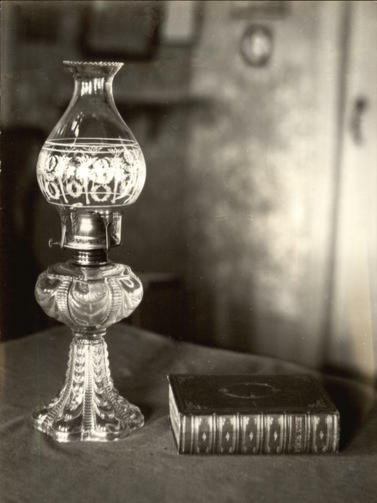
Old photo of a Bible on a table. Beside it is an old oil wick lamp made of etched glass.

.

In those situations there is a delightful and helpful “study,” which one dear saint calls “feeding upon a Bible verse.” Take a little verse, or a piece of a verse, into the duties and perplexities and pin-pricks of the busiest day, and it will often prove a veritable armor.

Think of going into the thick of a Monday morning with a cantankerous parent to appease, with a wide-awake and deeply interested baby at the mischievous age to watch, with two or three heedless and belated children to be buttoned and brushed and smoothed and sent happily off to school; with door bells and telephone bells to answer, with luncheon to manage for seven or eight persons, with a tardy announcement that a friend is coming for luncheon and to spend the afternoon with the neighbor next door running in to borrow, and chat and hinder, with the thousand and one besetments of a wife, and mother, and housekeeper. Think of her as taking hold of all these duties, freshly armored with the verse:

There hath no temptation taken you but such as man can bear; God is faithful who will not suffer you to be tempted above what ye are able: but will, with the temptation, make also the way of escape that ye may be able to endure it.

You can imagine one’s temptations to the hasty word, to undue fault-finding, to feeling sure that she simply cannot endure any more of this.

“No,” says the Word upon which she is feeding, “you must not say that. God will not suffer you to be tempted above what you are able. He says so. He knows the temptations; he will make the way of escape. He says so.”

Did he mean her? Oh, yes, indeed! He had her in mind. “Neither pray I for these alone,” said Jesus, “but for them also which shall believe on me.” That includes her, and she knows that “he ever liveth to make intercession for her.”

Who is going to estimate the effect on the world of that day’s soul-food, as the busy daughter, wife and mother, with quiet face and sweet, low voice, meets and endures her multiform temptations with the armor that her Lord has supplied!

Such Bible reading is Bible study reduced to living. Such a life will grow; will feel more intimate acquaintance with the Lord today than it had yesterday, more joy in his service.

Such a soul will learn to long after fellowship with Jesus Christ, and will daily be given more and more of his felt presence.

Such a soul will “hunger and thirst after righteousness,” not in a sickly, sentimental, dissatisfied way, but with an eagerness and a hopefulness born of experience, and an experience that will refuse to be satisfied with anything less.

I believe real soul-hunger to be a pleasant experience: as when one with a healthy, normal appetite sits down to a well-filled table, knowing that he is very hungry, and knowing, also, that his hunger will be satisfied.

What do you think of Isabella’s advice?

Have you ever tried her method of memorizing a single Bible verse to carry with you throughout the day?

Isabella based some of her novels on the advice she gave here about “feeding upon a Bible verse.”

In Frank Hudson’s Hedge Fence, for example, Frank learns that memorizing one Bible verse a day, and keeping it top of mind all day long, can make a big difference in his outlook and his walk with God. You can get your copy of the book by clicking here.

She used a variation of the method in A Dozen of Them, where a boy named Joseph promised his sister he would choose one Bible verse a month and make it a rule to live by. You can read the book for free by clicking here.


A Hard Text about Burdens

Isabella’s brother-in-law Reverend Charles M. Livingston wrote several articles for The Pansy magazine in which he explained Bible verses that might seem confusing at first. Here’s one he wrote in 1888:


Bear ye one another’s burdens. (Galatians 6:2)
Every one shall bear his own burden. (Galatians 6:5)
Cast thy burden upon the Lord. (Psalms 4:22)
Old illustration of a hand holding up a Bible surrounded by rays of light.

How do we reconcile these verses that conflict one with another? Think in this way:

One day Martha went over the way to the pump with a four-quart pail for some water, and soon returned to her mother with it.

An hour later she went with an eight-quart pail and, filling it, tried to carry it back, but could not. Her neighbor, Mark, happened to be there with his three-quart pail. He offered to carry hers and let her carry his, and so they did and got on nicely.

Some time after they were both at the pump again, each with an extra pail. They were soon filled, but when they tried to lift them all and go forward they could not. Just then their good friend Moses came along and, seeing their trouble and their pleading looks, came to them, and with his two strong arms took up the extra heavy pails of water and easily and cheerfully carried them to their homes, while they followed with their other pails.

Maybe this will aid you to see that those three texts are not so hard, after all; that they do not go against each other, but go rather hand in hand.

What do you think of Rev. Livingston’s explanation?

A Hard Text about Swearing

Isabella’s brother-in-law Reverend Charles M. Livingston wrote several articles for The Pansy magazine in which he explained Bible verses that might seem confusing at first. Here’s one he wrote in 1889:


Matthew 5: 33-37:

33. Again, ye have heard that it hath been said of them of old time, Thou shalt not forswear thyself, but shalt perform unto the Lord thine oaths:

34. But I say unto you, Swear not at all; neither by heaven; for it is God’s throne:

35. Nor by the earth; for it is his footstool: neither by Jerusalem; for it is the city of the great King.

36. Neither shalt thou swear by thy head, because thou canst not make one hair white or black.

37. But let your communication be, Yea, yea; Nay, nay; for whatsoever is more than these cometh of evil.

Image of open Bible

With these words in mind, how, then, do good men swear on the witness stand in the court-room?

That is intended to be a solemn, religious thing, for the sake of truth and law and justice. It sets the fear of God before the witness to deter him from falsehood, and the love of God to lead him to tell the truth.

The spirit of prayer is in it.

Our Hard Text refers to profane, wicked, idle swearing. It is taking the name of the Lord, thy God, in vain. It is very common in ordinary conversation among many people. They curse and swear “by” this and “by” that, just for fun, or to make folks believe them, usually when they are telling a lie. At last it becomes a vile, dreadful habit, and in almost every sentence they swear. Many little children do this. It is an awful sin. It leads to destruction.

Shun the first step in that direction. Have a character for truth. Consecrate your tongue to Christ as He died on the cross to redeem your entire body and soul from all sin.

Have you ever wondered if swearing a solemn oath was the same as swearing in ordinary conversation?

What do you think of Rev. Livingston’s explanation?


Click on the links below to read more of Reverend Livingston’s “Hard Text” articles:

A Hard Text

A Hard Text in Matthew

A Hard Text: Matthew, Mark and Luke

The Many Names of Jesus

Isabella had a wonderful way of using her own personal experiences to show people how relevant the Bible could be in their everyday lives. In 1895 she wrote this uplifting piece for a Christian magazine:


Have you ever noticed how many beautiful names Jesus has?

One of the pleasantest Sunday afternoons I remember was spent with my dear father, looking up some of them, and trying to find what they meant.

We began with that one in Zechariah 3:8, where it says:

“Behold, I will bring forth my servant the Branch.”

Graphic with Bible verse: I will bring forth my servant the BRANCH. Zechariah 3:8

I suppose I was not old enough at the time to understand much of its meaning, but I liked the sound of the verse; and I like now to think of Jesus as a part of God, a branch from the divine one, broken off from the great tree and sent to earth for us.

Then we looked at Isaiah 9:6, and found that he was not only a branch from God, but that one of his names was “Everlasting Father.”

And Isaiah 7:14 called him “Emmanuel,” which means, God with us.

And Paul, in Romans 11:26 called him the Deliverer; and Peter called him the Corner-Stone, and John, the Good Shepherd, and the Lamb of God, and the Light, and the King, and the Word, and the Why. John has so many names for him!

Graphic with Bible verse: There shall come out of Sion the Deliverer. Romans 11:26

Take your Bible some day, and try and find out all the names of Jesus; if you have not thought about it before, you will be astonished at the number of them. I do not think you can imagine a great or helpful name which has not been given to him.

So many times he is called the Savior! Then he is the Mighty One, the Maker of all things; the Prince of Life, the Prince of Peace, the Morning Star, the Redeemer, the King of Kings.

I wonder if you will have a preference among these names? If some of them will seem to make him come nearer to you than others?

One day I was very much afraid of something which I feared was coming to me; I did not see how I could escape it, and I was glad to remember that Jesus was the Deliverer.

Graphic with Bible verse: The Lord is my rock, and my fortress, and my deliverer. II Samuel 22:2

Then, when my father died, and my heart felt as heavy as lead, and it seemed to me as though I could never be happy again, I found this name for Jesus in Revelation 1:5:

“The first-begotten of the dead.”

Graphic with Bible verse: Jesus Christ, who is the faithful witness, and the first begotten of the dead. Revelation 1:5

Then  I remembered that Jesus died, and was the first one to rise from the dead by his own power, and had promised to raise all others, and that my father would surely live again.

Oh, this is a beautiful thing to study about! Who will try it? See how many names you can find.

What do you think of Isabella’s idea for Bible study?

Do you have a favorite among the different names for Jesus? one that—as Isabella said—makes him feel nearer to you than others?

A Hard Text in Matthew

Isabella’s brother-in-law the Reverend Charles M. Livingston wrote several articles for The Pansy magazine in which he explained some of the Bible’s most challenging verses in terms young people could understand. Here’s one he wrote in 1888:


A Hard Text

Matthew 10:34: I came not to send peace, but a sword.
Photo of open Bible.

In Luke 2:14 the angels sing of Jesus when He was born, “On earth peace.” At first sight these verses in Matthew and Luke seem to contradict each other. They do not. The blessed Book never does that. Remember:

When one thing in one part of the Bible seems to conflict with another part, or say something which seems to be wrong, you are to conclude that a little better understanding will set it all to rights in your mind.

“I come not to send peace” to a sinner if he stay in his sins. “There is no peace to the wicked.” There ought not to be. But as soon as a sinner asks Jesus for forgiveness, he gets peace. That’s the way peace comes on earth; it is the peace of God in the heart; peace and joy in believing.

Now, when one gets this peace, it seems so good that he wants some other one to get it, too. So he speaks to his other one and urges him to confess his sins and seek Jesus; and in most cases this other one gets angry and talks against Jesus or Christians. That often happens in a family where one is a true Christian and the others are not. You see how trouble will come. There will be war in that family. It may not be a war of swords, but it will be a war of words. Jesus does not want the war, and there wouldn’t be any if the sinner would give up. But he does not usually surrender till after a hard battle with Jesus. So Jesus is said to send a sword or war. It simply means, “I am come to fight against the wrong; and people who are on the wrong side and stay there, will fight against me and my soldiers.”

My dear, dear children, I wish you may never be found with a sword in your hand, or mouth, or heart, fighting against the Lord. Let Him put His sweet peace into your heart, and when you draw the sword, draw it against sin.


Did you know? … Reverend Livingston’s daughter was beloved Christian novelist Grace Livingston Hill.

Click on the links below to read more “A Hard Text” columns:

A Hard Text

A Hard Text: Mathew, Mark, and Luke

A Hard Text: Matthew, Mark and Luke

Isabella’s brother-in-law the Reverend Charles M. Livingston wrote several articles for The Pansy magazine in which he explained some of the Bible’s most challenging verses in terms young people could understand.

Rev. Livingston wrote the following article for an April 1891 issue of the magazine:


A Hard Text

Matthew 8:28: And when he was come to the other side into the country of the Gergesenes, there met him two possessed with devils, coming out of the tombs, exceeding fierce, so that no man might pass by that way.
Mark 5:1-2: And they came over unto the other side of the sea, into the country of the Gadarenes. And when he was come out of the ship, immediately there met him out of the tombs a man with an unclean spirit;
Luke 8:26-27: And they arrived at the country of the Gadarrenes, which is over against Galilee. And when he went forth to land, there met him out of the city a certain man, which had devils long time, and ware no clothes, neither abode in any house, but in the tombs.
Photo of open Bible.

They don’t seem to agree. How to account for that?

But don’t you see that if the writers wanted to cheat the readers they wouldn’t contradict each other?

The truth in this case is that they mention different cities but in the same region or neighborhood. Christ went into the same neighborhood.

“There met him two … ” says Matthew.

But Mark and Luke mention one, so then here’s another seeming contradiction. Two cannot be one. How to account for this?

Easily enough.

Mark and Luke do not deny that there were two; they simply call special attention to the very furious one. He was a man of some standing before this and so his cure from such dreadful violence by the power of Christ would be so much the more noticeable.

This may be a key to many other “hard texts.” The writers only seem to contradict each other, whereas they may be telling different things about the very same person or thing, or calling special attention to one of several persons. When writers try to deceive, they do not give names and dates, [but] you will find them in the Bible.

It may not always be possible to harmonize all things as you read along in the Bible; but do not therefore conclude that those things cannot be harmonized.

Remember:

When one thing in one part of the Bible seems to conflict with another part or say something which seems to be wrong, you are to conclude that a little better understanding will set it all to rights in your mind.


[break or line]

Did you know? … Reverend Livingston’s daughter was beloved Christian novelist Grace Livingston Hill.

Click here to read another “A Hard Text” article by Rev. Livingston.