Advice to Readers about Marriage Proposals

For many years Isabella edited a Christian magazine for which she wrote a very popular advice column. In 1896 she responded to a letter from an unmarried woman who had just received a proposal of marriage.

Despite his profession of love to her, the woman confessed she did not feel the same way about him. Yet she was tempted to accept his offer because she thought he’d make a fine husband; but her biggest concern was that because she was getting older, she was afraid his proposal may be her last chance for marriage.  

In closing, she asked Isabella: How could she tell if the Lord meant for her to marry such a man?

Image of man and woman about 1910 in an embrace, holding hands.

Here is Isabella’s advice:

My Dear Friend, I can understand the state of bewilderment into which you are thrown, but at my age the light is plainer. As I read your letter, I find myself wishing that all questions were as easily answered as yours.

In the first place, let me beg you never to allow any chain of circumstances or specious reasoning to persuade you that it is right to marry one that you are not sure beyond the shadow of a doubt is the man above all others that you believe your heart would have chosen under any conceivable circumstances. Any other marriage than this I believe to be a mockery in the sight of God. I can conceive of one loving another in this way, and yet not marrying from motives of duty; but I cannot conceive of any duty that would make it right for one not so loving to marry. Do you not see how simple a matter such conviction of right and wrong as this makes your query?

Image of bride and groom holding hands as they kneel in church about 1905. Behind them are three bridesmaids dressed in pink gowns and holding bouquets of pink flowers.

Be sure, dear friend, that what “the Lord means” for you is that you should do right, even if in doing so you are compelled to grieve someone that has given you the best his heart has to offer. It would be but a sorry return to give back to such a man mere dregs of feeling.  

I know it is the fashion in certain circles to talk a great deal about “Platonic affection.” I have often been tempted to think that many people use the term without having a clear idea of what it means; but the fact remains that with honest, earnest, well-trained young men and women exclusive and long-continued companionship means, other things being equal, companionship for life; and when two persons arrange to set aside this rule of nature, it generally means sorrow for one of them.

Image of bride and groom about 1910 in tender embrace.

Let me still further say that it seems to me you are perhaps making the very common mistake of thinking of marriage almost as a necessity to a woman’s life. Does it not occur to you that possibly God may not mean you to marry at all?

In saying this I do not want to be understood to speak lightly of marriage; on the contrary, I believe a true marriage to be the crown of a woman’s life. But there are many honorable exceptions; there is blessed work in the world being done by women with warm affections and motherly hearts, who have no home ties, and so are able to do that which—but for them—would be left undone. Who can estimate how many homeless and motherless ones rise up to call such women blessed? Possibly your work lies in this direction. Whether it does or not, let me repeat the admonition with which I began:

Never mistake friendship for love; never stand before the marriage altar with one of whom you could not say, “My heart chose him alone from all the world.”
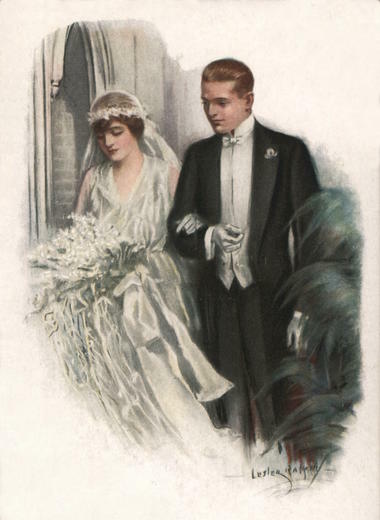
Image of a bride and groom outside a church about 1918. Bride is dressed in white gown and veil and carrying a bouquet of white flowers. Groom is dressed in formal black tux with white shirt, tie and waistcoat.

My dear girl, I want to emphasize this as much as possible because I believe in it so thoroughly. The world is full of wrecked homes and ruined hearts that need not have been so if friendship had not been so often mistaken for love, and marriage relations entered into so carelessly.

I wonder whether I have fully answered your thought. I have no doubt that you consider your circumstances peculiar—we all do—but the letters that I have received lead me to believe that a large number of your sisters are thinking along much the same lines.

What do you think of Isabella’s advice?

Do you agree with her that marriage is not always “a necessity to a woman’s life”?

You can read more of Isabella’s advice columns by clicking on the links below:

Advice to Anxious Mothers of Daughters

Advice to Readers on Learning to Cook

Advice to Readers about Keeping Confidences

Isabella’s Advice about Christmas Possibilities

Advice about Righting the Wrong Marriage Proposal

Advice to Readers about Shortcomings

Advice to Readers on Managing the World

Advice to Readers on Memorizing Bible Verses

Advice to Readers on Praying Aloud in Public

Advice to Readers Living Humdrum Lives

Advice to Readers on Bashfulness

Advice to Readers about Boys and Books

Advice to Readers about Forgiveness

Advice to Readers about Ornaments

The Many Names of Jesus

Isabella had a wonderful way of using her own personal experiences to show people how relevant the Bible could be in their everyday lives. In 1895 she wrote this uplifting piece for a Christian magazine:


Have you ever noticed how many beautiful names Jesus has?

One of the pleasantest Sunday afternoons I remember was spent with my dear father, looking up some of them, and trying to find what they meant.

We began with that one in Zechariah 3:8, where it says:

“Behold, I will bring forth my servant the Branch.”

Graphic with Bible verse: I will bring forth my servant the BRANCH. Zechariah 3:8

I suppose I was not old enough at the time to understand much of its meaning, but I liked the sound of the verse; and I like now to think of Jesus as a part of God, a branch from the divine one, broken off from the great tree and sent to earth for us.

Then we looked at Isaiah 9:6, and found that he was not only a branch from God, but that one of his names was “Everlasting Father.”

And Isaiah 7:14 called him “Emmanuel,” which means, God with us.

And Paul, in Romans 11:26 called him the Deliverer; and Peter called him the Corner-Stone, and John, the Good Shepherd, and the Lamb of God, and the Light, and the King, and the Word, and the Why. John has so many names for him!

Graphic with Bible verse: There shall come out of Sion the Deliverer. Romans 11:26

Take your Bible some day, and try and find out all the names of Jesus; if you have not thought about it before, you will be astonished at the number of them. I do not think you can imagine a great or helpful name which has not been given to him.

So many times he is called the Savior! Then he is the Mighty One, the Maker of all things; the Prince of Life, the Prince of Peace, the Morning Star, the Redeemer, the King of Kings.

I wonder if you will have a preference among these names? If some of them will seem to make him come nearer to you than others?

One day I was very much afraid of something which I feared was coming to me; I did not see how I could escape it, and I was glad to remember that Jesus was the Deliverer.

Graphic with Bible verse: The Lord is my rock, and my fortress, and my deliverer. II Samuel 22:2

Then, when my father died, and my heart felt as heavy as lead, and it seemed to me as though I could never be happy again, I found this name for Jesus in Revelation 1:5:

“The first-begotten of the dead.”

Graphic with Bible verse: Jesus Christ, who is the faithful witness, and the first begotten of the dead. Revelation 1:5

Then  I remembered that Jesus died, and was the first one to rise from the dead by his own power, and had promised to raise all others, and that my father would surely live again.

Oh, this is a beautiful thing to study about! Who will try it? See how many names you can find.

What do you think of Isabella’s idea for Bible study?

Do you have a favorite among the different names for Jesus? one that—as Isabella said—makes him feel nearer to you than others?

Advice to Anxious Mothers of Daughters

How often have you thought—or heard someone say—“Our little girls are growing up too fast!”

We tend to think of it as a modern-day problem, but in 1897 mothers were coping with the very same concern. Isabella received so many letters on the topic, she dedicated one of her advice columns to “anxious mothers of daughters.”

Here’s what Isabella wrote:

I have a package of letters from anxious mothers. I hold them tenderly, for there are heart-throbs in every line. I study and pray over them and wish—Oh, so earnestly!—that I knew how to help. Instead, I have resolved to tell our girls what some mothers fear: That their daughters—their young, sweet daughters, whom they would guard with jealous care from every form of the world’s contamination—are having the bloom of their beautiful girlhood brushed away by too early friendships with young men, or, as they frankly put it, with “the boys.”

One mother writes that her fourteen-year-old daughter’s mind is in danger of being taken up with the thought of “beaux.” She lives in the country, and associates almost of necessity with those who talk much about “beaux” and about “keeping company” with this or that boy. Not only this, but she has for associates those who believe in “kissing games” and all such practices.

What can you do?

Ah, dear, I don’t know. Except this—the same thing that I have said before, only I want to say it more emphatically, if I can:

Will you not use every inch of influence you possess to help anxious mothers, and to protect young and oftentimes motherless girls from the sort of harm that comes from playing with ideas that should be held sacred?

Sometimes uncultured guests do harm in this way:

A merry-faced couple—girl and boy aged perhaps ten and twelve—were hurrying down the street side by side, swinging their book-bags and chatting and laughing.

“Hasn’t Alice come yet?” asked the mother in a home.

“Here she comes,” said a guest who was in the doorway. “Here she comes with her little beau. Dear me, Alice, why didn’t you kiss each other? When I was of your age, and had little beaux come home with me, I always kissed them good-by.”

The mother came forward swiftly, a spot of red glowing on each cheek. “Alice does not know even the meaning of the word beau,” she said, “and she keeps her kisses for her father and brothers.”

Oh, the infinite harm that coarse and careless tongues can do to these young buds before their time of blossoming! Remember how much influence older sisters have in these directions. Nor is their influence confined to the young people of their own homes, if they are wise-hearted Christian workers.

What do you think of Isabella’s advice?

Have you ever seen someone tease a child about boyfriends, like the “coarse and careless guest” Isabella described?

You can read more of Isabella’s advice columns. Just type “advice” in the search box on the right.

A Hard Text in Matthew

Isabella’s brother-in-law the Reverend Charles M. Livingston wrote several articles for The Pansy magazine in which he explained some of the Bible’s most challenging verses in terms young people could understand. Here’s one he wrote in 1888:


A Hard Text

Matthew 10:34: I came not to send peace, but a sword.
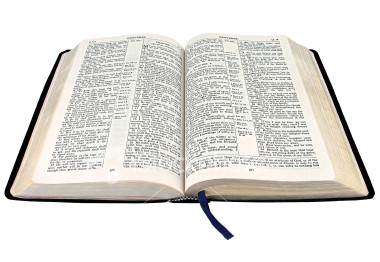
Photo of open Bible.

In Luke 2:14 the angels sing of Jesus when He was born, “On earth peace.” At first sight these verses in Matthew and Luke seem to contradict each other. They do not. The blessed Book never does that. Remember:

When one thing in one part of the Bible seems to conflict with another part, or say something which seems to be wrong, you are to conclude that a little better understanding will set it all to rights in your mind.

“I come not to send peace” to a sinner if he stay in his sins. “There is no peace to the wicked.” There ought not to be. But as soon as a sinner asks Jesus for forgiveness, he gets peace. That’s the way peace comes on earth; it is the peace of God in the heart; peace and joy in believing.

Now, when one gets this peace, it seems so good that he wants some other one to get it, too. So he speaks to his other one and urges him to confess his sins and seek Jesus; and in most cases this other one gets angry and talks against Jesus or Christians. That often happens in a family where one is a true Christian and the others are not. You see how trouble will come. There will be war in that family. It may not be a war of swords, but it will be a war of words. Jesus does not want the war, and there wouldn’t be any if the sinner would give up. But he does not usually surrender till after a hard battle with Jesus. So Jesus is said to send a sword or war. It simply means, “I am come to fight against the wrong; and people who are on the wrong side and stay there, will fight against me and my soldiers.”

My dear, dear children, I wish you may never be found with a sword in your hand, or mouth, or heart, fighting against the Lord. Let Him put His sweet peace into your heart, and when you draw the sword, draw it against sin.


Did you know? … Reverend Livingston’s daughter was beloved Christian novelist Grace Livingston Hill.

Click on the links below to read more “A Hard Text” columns:

A Hard Text

A Hard Text: Mathew, Mark, and Luke

Advice to Readers on Learning to Cook

For many years Isabella had an advice column in a popular Christian magazine. In the column she answered readers’ questions—from a Christian perspective—on a variety of topics.

In 1910 she received this letter from a young woman:

Can you tell some of us girls—who never had a chance to learn much about real, practical, beautiful housekeeping—some way of learning? Are there not schools in cities for this purpose? Or are there not books from which we can learn what we need to know?

We want to understand all kinds or planning and arranging and beautifying and economizing.

We want to be excellent cooks, and to learn much that people whose time is largely spent in school or shop know very little about.

Can you help us with this practical need of ours?”

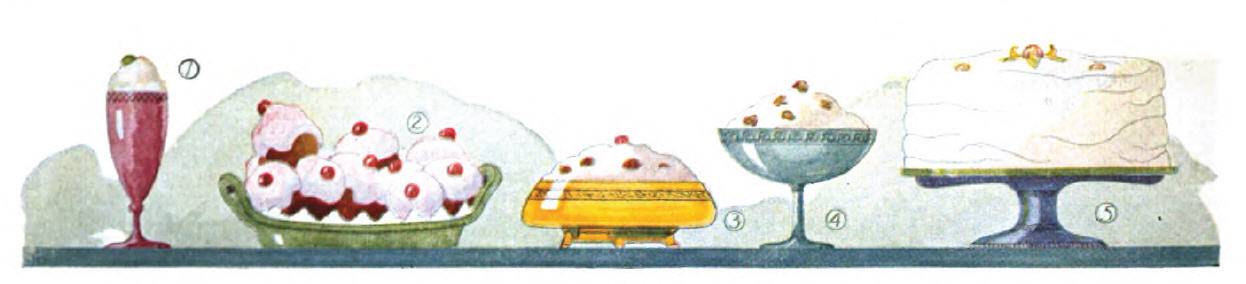
Illustration of different desserts: A sundae in a tall glass, cupcakes, a merangue, and a cake.

Here is Isabella’s reply:

It shall be my delight to do so.

Let me first express what a pleasure it is to find that one who can write so charming a letter as accompanied these questions is able to turn her thoughts to this practical subject, and to feel the “need” of knowledge.

Also, I rejoice in the thought that a large number of the letters awaiting attention deal with the same subject. Our lovely, cultured girls, who have had “advantages,” are beginning to feel the importance of understanding the art of home-making.

Newspaper clipping:
HOUSEKEEPERS HAVE TROUBLES.
Have Miss Peet help you in them at cooking school.
The school opens next Monday.
Ask her any questions any time - Wants Fort Scott women to feel it is their school.
From The Fort Scott Daily Tribune, October 31, 1913

Schools? Certainly there are. Every city of rea­sonable size now sends out its circulars announcing a “cooking-school” in regular session through the school year, or in extra session during vacation, or for the winter months.

Photo of about a dozen young women gathered around a table where they are preparing peaches to make into peach rolls.
A cooking school at the Indiana State Fair, about 1917

Better than these opportunities, especially for school­girls and those employed in regular work of any kind during the winter, are the cooking-schools that have sprung up in connection with the larger summer “as­semblies.”

I am told that every well-established summer resort organized under the peculiar rules that belong to the word “assembly” now has its own fairly well-appointed cooking class or classes. I am, however, most familiar with the one at Chautauqua, N. Y., which is, of course, the mother of all the Chautauquas, and is and must always be the first in all ways.

Photo from the early 1900s of a large classroom full of cooking students and teachers. The students are wearing caps and full aprons. The teachers wear caps and are dressed in white. Some students are preparing vegetables, others are setting a table, while others are at different stages of the cooking process.
A cooking school at the Battle Creek, Michigan resort and sanitarium.

Mrs. Emma P. Ewing, who, as everyone knows, has no superior in her department, conducts regularly at Chau­tauqua, N. Y., during the eight weeks’ season, a thor­oughly equipped cooking-school, with its normal depart­ment, its “practice class,” its lecture course, and its final examination.

Black and white head-and-shoulders photograph of Emma P. Ewing. She is wearing spectacles. She is wearing a bodice with a high neck and sleeves that puff at the shoulder.
Emma P. Ewing, from Wikipedia.org

Nothing more fascinating than the way in which Mrs. Ewing manages the entire matter can well be imagined. It has been my pleasure to be often in her classroom, to admire the white table set out with all the belongings for the day, sometimes arranged for the pur­pose of making delicious soups and white sauces and delicate desserts, sometimes planned for the purpose of showing what a study in refinement and beauty and excellence a breakfast of lamb chop and creamed pota­toes and corn puffs may become.

Newspaper article:
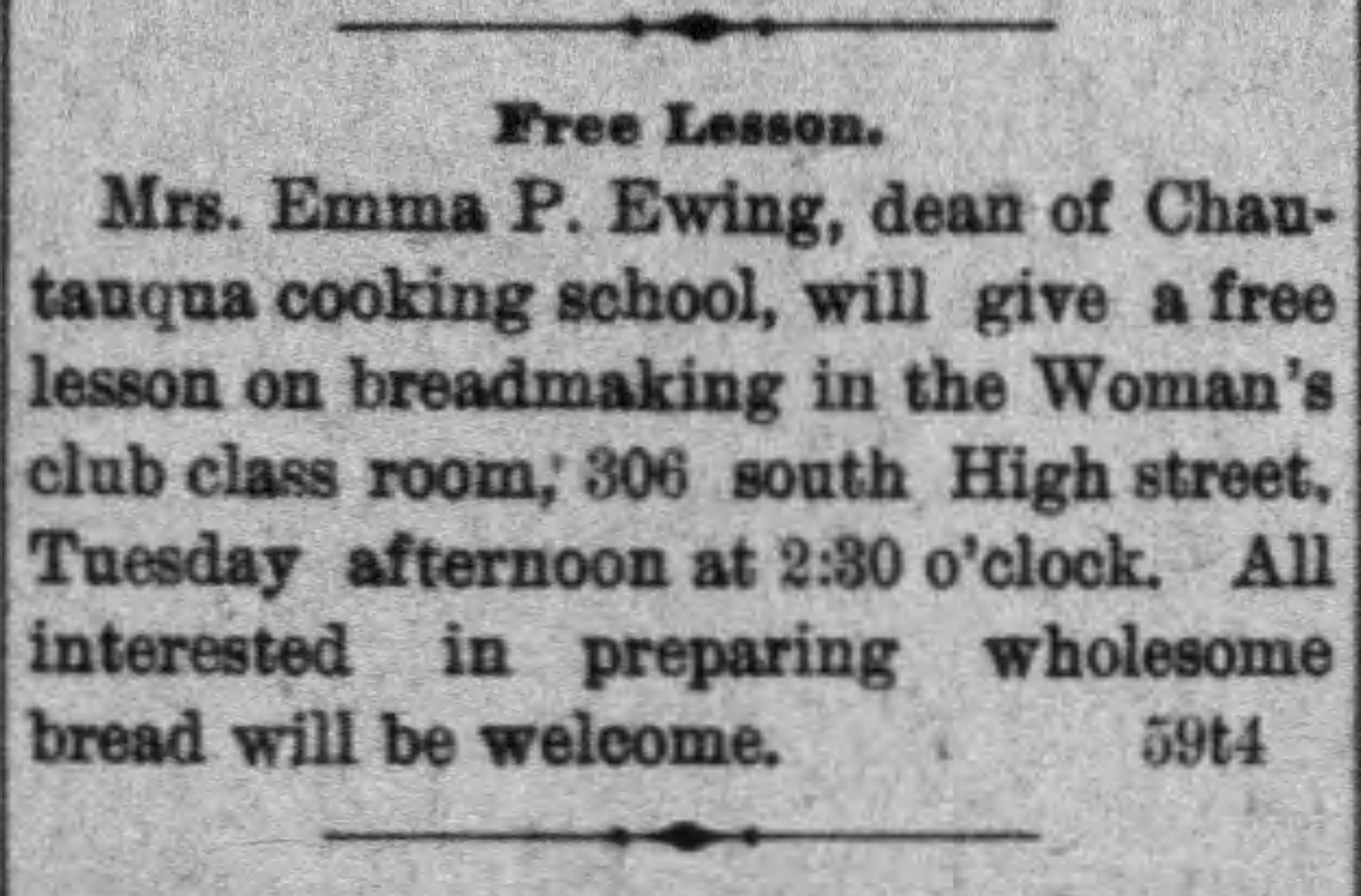
FREE LESSON
Mrs. Emma P. Ewing, dean of Chautauqua cooking school, will give a free lesson on breadmaking in the Woman's club class room, 306 south High street, Tuesday afternoon at 2:30 o'clock. All interested in preparing wholesome bread will be welcome.
The Muncie Daily Times, October 5, 1896.

Every conceivable branch of the culinary art is taught here. Pies, pud­dings, cakes, sauces, gravies, roasts, fries, stews, each come in for a full share of careful consideration.

Illustration from about 1912. A woman is in her kitchen looking down on a turkey in a roasting pas she has just taken from the oven.

Let me confess just here that a very fascinating part of the daily class exercise is the careful “tasting” of whatever article of food has been prepared before our eyes. For this purpose scholars go to the class armed each with a silver spoon, or fork, as occasion may require, and a napkin.

Illustration of a young woman about 1918. She is holding a bowl on a saucer just below her nose as if she is enjoying the smell of the contents.

Delicious beyond description are the spoonfuls of broth or “white soup” or bouillon that one thus enjoys, to say nothing of the marvellous concoctions made with a spoonful or two of cream, a cup of fruit-juice, a dash of sugar, and a little gelatine; to say nothing, moreover, of the delicious creams and ices and “foams” and innumerable other forms to delight the palate.

Illustration of different desserts, including a cake, a plum pudding, a molded gelatine, a cake decorated with gelatine, and a mousse.

Not only can the making and cooking of all these dishes be thoroughly learned at this summer school, but there are classes formed for the special purpose of train­ing the pupils in the art of setting the table neatly and gracefully, of clearing away skillfully, of selecting dishes that harmonize with others, of explaining the difference between a refined abundance and a sinful waste.

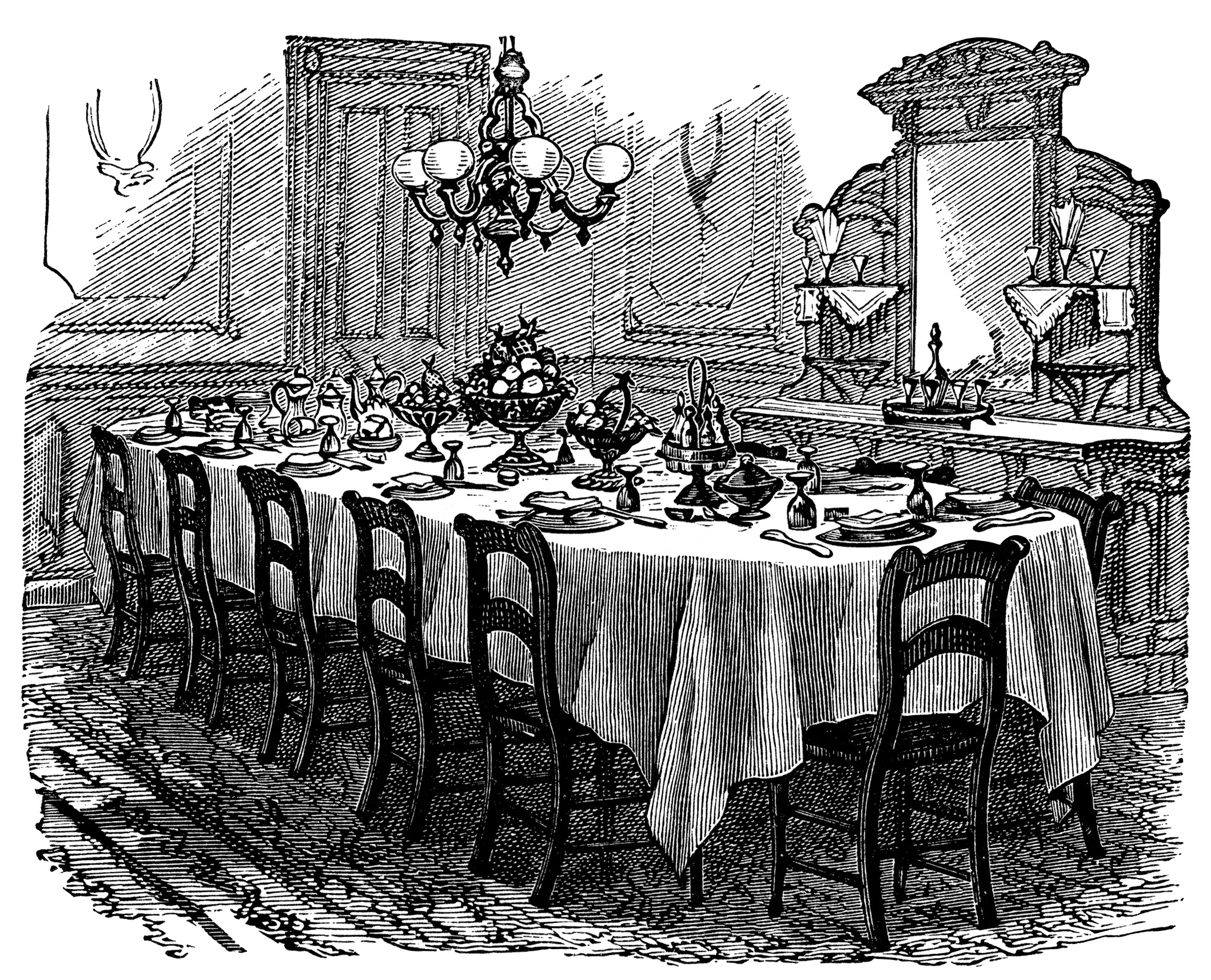
Illustration of a dining room with a table for 12. The table is covered with a white tablecloth. Each place is set with plate, silverware, glasses and napkins. In the center are large bowls of fruits, a cruet, and a coffee service.
A proper Victorian-era table set for dinner.

There are bills of fare arranged for summer, for winter, for the trying springs and falls. There is careful attention paid to the novice who does not know whether to buy steak “by the yard” or piece, or whether to try to have strawberries and green peas in February, or to wait until they are less flavored with money.

Illustration of a woman reading a cookbook in her kitchen about 1920. On the table before her is a colander full of berries, a large empty bowl, a can of Crisco and a rolling pin.

In short, anything that one needs to learn about housekeeping, as connected with the kitchen and storeroom, may be acquired at this summer cooking-school. Moreover, the teacher is so gentle voiced and sympathetic, and so thoroughly ladylike, that it is simply a pleasure to watch her and listen to her. It would be difficult to imagine anyone farther removed from the “fussy” or the hurried and nervous stage of housekeeping than Mrs. Ewing.

Illustration from about 1918. A mother and daughter are in the kitchen standing side-by-side at the stove. The mother is reading from a cookbook while the daughter adds ingredients to a pot on the stove.

No matter how much it may sound like it, my dear girls, this is not an advertisement of the Chautauqua cooking-school. The truth is, that favored spot needs no advertising; its classes are always full, and application has to be made some time in advance. It is simply an honest effort to answer an honest and often repeated question about learning how.

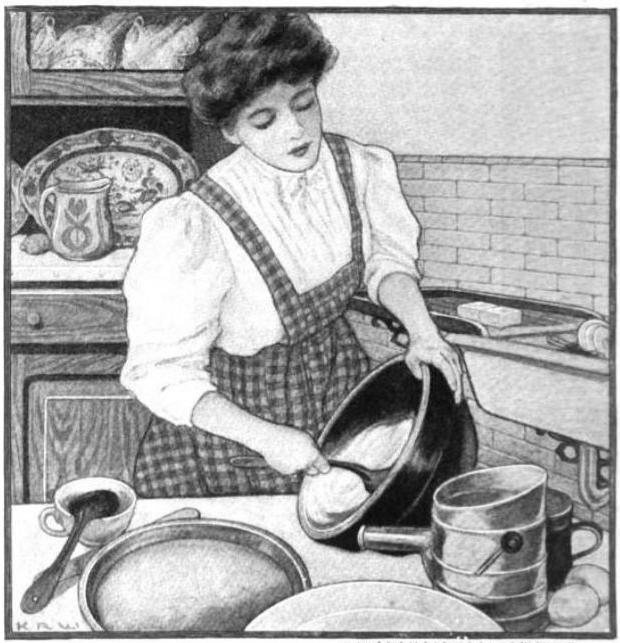
Illustration of a woman from about 1910. She is in a kitchen, wearing an apron, stirring the contents of a large bowl. On the table before her are a variety of pans and cooking utensils.

Meantime, do you know, dear girls, what delightful institutions home cooking-clubs are? Why not organize one in your own circle?

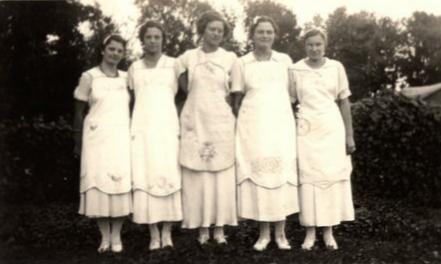
Black and white photo of five ladies standing arm-in-arm in a row. Each is wearing an apron.
Members of a cooking club in their aprons.

Select one evening or afternoon a week out of your busy lives. Meet around at one another’s homes; find out the specialty of each mother or grandma or auntie; and petition for a lesson in her line—a “normal” lesson, where you can have the privilege of furnishing your own materials, and doing exactly what the teacher does, and carry home the result in triumph. Some of the most fascinating evenings I have ever known were spent in this way.

Newspaper article:
AFTERNOON TEA
The Muffin Cooking Club Entertains the Young Ladies' Cooking Club.
Yesterday afternoon the members of Muffin Cooking Club entertained the members of the Young Ladies' Cooking Club with an afternoon tea at the beautiful home of Miss Mayne Sprankle, South Liberty street. The spacious rooms of the house were beautifully decorated and presented a unique appearance, especially the dining room and table, over which flowers and candles were artistically arranged. Dainty refreshments were served and all were delightfully entertained.
From The Muncie Morning News, September 22, 1892.

Try it, and see how much, at the end of a year, you will have added to your stock of practical knowledge.

What do you think of Isabella’s advice?

Where and when did you learn to cook? Have you ever taken a cooking class or joined a cooking club?

You can read some of Emma P. Ewing’s cookbooks for free! Just click on any of the titles below to view them on Archive.org.

The Art of Cookery; a Manual for Homes and Schools

A Textbook of Cookery for Use in Schools

Cooking and Castle-building

Soup and Soup Making

Vegetables and Vegetable Cooking

A Hard Text: Matthew, Mark and Luke

Isabella’s brother-in-law the Reverend Charles M. Livingston wrote several articles for The Pansy magazine in which he explained some of the Bible’s most challenging verses in terms young people could understand.

Rev. Livingston wrote the following article for an April 1891 issue of the magazine:


A Hard Text

Matthew 8:28: And when he was come to the other side into the country of the Gergesenes, there met him two possessed with devils, coming out of the tombs, exceeding fierce, so that no man might pass by that way.
Mark 5:1-2: And they came over unto the other side of the sea, into the country of the Gadarenes. And when he was come out of the ship, immediately there met him out of the tombs a man with an unclean spirit;
Luke 8:26-27: And they arrived at the country of the Gadarrenes, which is over against Galilee. And when he went forth to land, there met him out of the city a certain man, which had devils long time, and ware no clothes, neither abode in any house, but in the tombs.
Photo of open Bible.

They don’t seem to agree. How to account for that?

But don’t you see that if the writers wanted to cheat the readers they wouldn’t contradict each other?

The truth in this case is that they mention different cities but in the same region or neighborhood. Christ went into the same neighborhood.

“There met him two … ” says Matthew.

But Mark and Luke mention one, so then here’s another seeming contradiction. Two cannot be one. How to account for this?

Easily enough.

Mark and Luke do not deny that there were two; they simply call special attention to the very furious one. He was a man of some standing before this and so his cure from such dreadful violence by the power of Christ would be so much the more noticeable.

This may be a key to many other “hard texts.” The writers only seem to contradict each other, whereas they may be telling different things about the very same person or thing, or calling special attention to one of several persons. When writers try to deceive, they do not give names and dates, [but] you will find them in the Bible.

It may not always be possible to harmonize all things as you read along in the Bible; but do not therefore conclude that those things cannot be harmonized.

Remember:

When one thing in one part of the Bible seems to conflict with another part or say something which seems to be wrong, you are to conclude that a little better understanding will set it all to rights in your mind.


[break or line]

Did you know? … Reverend Livingston’s daughter was beloved Christian novelist Grace Livingston Hill.

Click here to read another “A Hard Text” article by Rev. Livingston.

What Does it Mean to be a Christian?

In 1891 a Christian weekly magazine mailed letters to America’s most prominent Christian authors and ministers asking one question:

What is it to be a Christian?

Many of the replies from ministers and church elders spoke about adhering to New Testament doctrines. Some replied that being a Christian meant following the example set by the Divine Master.

A famous Unitarian pastor answered that to be a Christian was “to do the will of my father who is in heaven.”

Of course, Isabella was one of the Christian authors who received the letter.

Photograph of Isabella Alden in profile.
Isabella Alden, about 1900.

Here is her answer, which was printed in newspapers across the country on Sunday, March 20, 1892:

“To be a Christian is to love the Lord Jesus Christ so much that I shall desire to have him reign supreme in my heart.”

What do you think of Isabella’s answer?

How would you answer the question?

Advice to Readers about Keeping Confidences

For many years Isabella had an advice column in a popular Christian magazine. She used the column to answer readers’ questions—from a Christian perspective—on a variety of topics.

In an 1897 column Isabella wrote that she had received several letters in one week about “imprudent confidences.” The letters were from young women who regretted something they said or wrote.

Two or three girls wrote about their mothers in ways they wished they had not.

One young wife wrote “with utmost frankness” about the failings of her husband to a lady friend!

Several young ladies were very harsh in their criticisms of “certain gentleman acquaintances.”

Each ended their letter to Isabella with the same two questions:

“Ought I to take back the words I wrote? And ought I to tell the persons of whom I wrote what I have done?”

Here is Isabella’s advice:

There are really two questions. Let me so divide them.

With regard to the first, I answer: By all means, YES. Perhaps there is no more common error than that of giving vent to one’s anger by putting on paper words concerning others that in our cooler moments we would not even think, much less say.

Moreover, in nearly (if not quite every) case of the kind, the written words are more or less untrue. For the hour they may seem to us strictly true and justifiable; but the next morning, after the mail has been sent, and it is too late, what would we not give to be able to recall them? How sure we are to remember entire sentences that we no know to be false, or—at the very least—to convey entirely false impressions!

In all such cases, what better can we do than to write promptly and frankly:

“I am sorry I told you what I did. I was angry at the time, or so strangely hurt that I did not realize what I was doing. My mother meant what she said in an entirely different way from what I translated it; she did not speak the words in the manner which I ascribed to her; she did not speak quite those words. I see it all now. Please burn my letter, and forgive me.”

Or:

“Dear Friend, I have been unjust to my husband; he is not what I have led you to infer. It is I who was angry, and misinterpreted him.”

Some such reparation as this we owe to our own sense of honor, even though we are quite sure that our mistaken confidences will go no further. Every true correspondent will approve such a course, and think more highly of her friend that she can possibly do without this frankness.

Especially should this course be urged in the case of husband and wife. In a very peculiar and solemn sense these two are pledged to each other, and no third person should be permitted, save in the cases of gravest necessity, to step between them even in thought.

As to the second question, there may be individual cases where confession would be wise; but as a rule I see no reason why the heart of a husband or friend should be made sore by explanations of what they would otherwise never hear. A good general rule in such matters seems to be:

If you are quite confident that silence will do no one any harm, and reasonably certain that speaking would give pain, be silent.

I think I would make one exception to this, in the case of mother and young daughter. Between these two there should be not only implicit confidence, but such deference on the part of the duaghter that it would wound her conscience to keep even such a matter secret. In nine cases out of ten the good mother would rather be told the exact truth, and would be able to help her child to grow stronger.

There is one potent reason why it is best always to take back, so far as possible, confidences of the kind named; and that is because it is a humiliating thing to do, and helps one to be more careful in the future.

The fact is, confidences are very important and choice and troublesome matters. They need to be guarded with great care, and bestowed warily.

What do you think of the advice Isabella gave?

Does it sound like the kind of advice that applies today, too?