Isabella Alden and her entire family were actively involved in the Young People’s Society of Christian Endeavor, a movement that promoted Christian service and ideals to its teen and young adult members.
Isabella believed in the Endeavor program so much, she founded the Pansy Society for Christian Endeavor, a similar organization specifically designed for children. The Pansy Society focused on teaching children to use Jesus’ life and words as a guide to live by.
This month’s free read is a story by Marcia Livingston that illustrates some of the values The Pansy Society sought to teach children: forgiveness, patience, and kindness toward others.
It was a simple act of kindness when Lily Haines offered Cindy Barker a rose from her garden; but neither young lady could predict how much of a difference the presence of that single rose could make in the Barker family home.
Our August free read by Faye Huntington is a delightful story about two topics very close to the author’s heart: the Christian Endeavor movement, and how sowing seeds of good can result in a bountiful harvest of blessings.
Like everyone in impoverished Castle City, twelve-year-old Tom Gates has given up hope of making a better life, until he has a chance encounter with a group of stranded Christian Endeavorers. Their kindness and faith inspire Tom; for the first time in his life he wants something the town has never had before: A Sunday school.
With his sister Lucy and their friends, Tom uses his wits to raise money and secure a building; and along the way, he ignites a fire of change that will shape the town for generations to come.
Our December Free Read is a short Christmas story Isabella wrote in 1893.
a.
Poor Miss Parker! She’s a young woman of limited means, but she prays for God to show her a way she can make Christmas special for someone in need. Could the girls in Miss Parker’s Sunday Bible class provide the very help that’s needed to answer her prayers?
Our June Free Read is a short story Isabella wrote in 1894 about the way new people can bring fresh ideas to an old institution.
a.
In desperation, the Christian Endeavor Society of the Fifth Street Church appoints Silas Rogers to chair the Temperance Committee. They don’t expect the young man from the country to do much, but Silas Rogers knows his faith will help him succeed where others have failed.
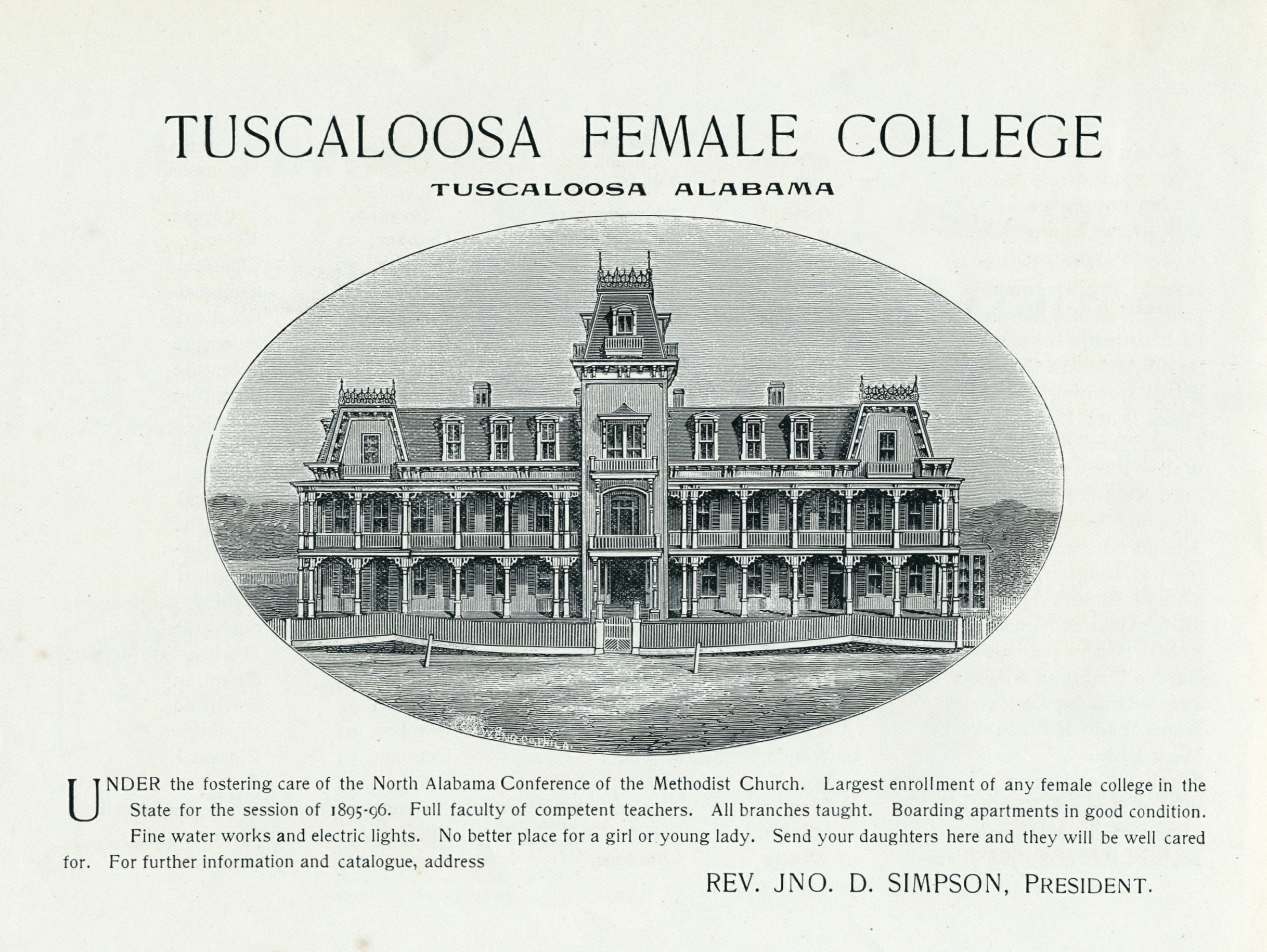
In Alabama the Tuscaloosa Female College was a successful and popular boarding school for girls aged six through sixteen.
Tuscaloosa Female College, from an 1895 brochure.
In addition to classroom studies, the school offered students a variety of different clubs they could join; one club that was available to the youngest students was a chapter of The Pansy Society.
Isabella created The Pansy Society of Christian Endeavor as a children’s version of the Christian Endeavor program that had taken teens and young adults by storm in the 1880s.
Logo for The Pansy Society of Christian Endeavor
She wrote about The Pansy Society in stories and articles she published The Pansy magazine. Children who joined the society pledged to do good works and live their daily lives “For Jesus’ sake.”
That motto—For Jesus’ Sake—was a motto the students at the Tuscaloosa Female College took to heart. Under the mentorship of teacher Eloise Hemphill, the school’s Pansy Society chapter took a special interest in some newspaper articles written by a local reporter about an orphanage in Tuskegee that was in need of help.
From The Tuskaloosa Gazette, September 20, 1888.
So when it came time for the school’s Pansy Society to perform their annual Christmas cantata, they invited the same reporter who wrote the articles to attend so he could write about their performance for the newspaper.
Unfortunately, the reporter arrived late, after much of the performance was over, and after Santa Claus had distributed all of the presents under the Christmas tree. So he was very surprised when, as soon as he arrived, the students immediately halted the program and called him up on the stage.
Wary, he did as he was asked, expecting to “receive a ten-cent comic toy placed on the tree by some little girl, to have a good laugh at his expense.”
“Imagine, therefore, his surprise and gratification when old Santa Claus handed him an envelope, tied with a piece of pink floss, with the following inscription:
“A Christmas offering of five dollars to the orphans of Tuskegee; presented by the Pansy Society in the Primary Department of the Tuskaloosa [sic] Female College, December 25, 1887.”
From The Tuskaloosa Gazette, Thursday, January 5, 1888.
In 1887, five dollars was a lot of money for little girls to raise; it was the equivalent of about $160 in today’s economy.
The reporter was so surprised and gratified, the gesture caused him “to lose his head and eyesight at the same time” as he stammered out his thanks.
Of course the editor of The Tuskaloosa Gazette printed the story of the evening’s events, and added:
“Miss Eloise Hemphill and the sweet little Pansy Society have acted nobly. Out of their own little savings, in the midst of the festivities of Christmas, these little girls have contributed the handsome sum of five dollars for the little orphans whom God hath bereft of father and mother. It was one of the most delicate little acts of kindness it has ever been our pleasure to witness.”
Miss Eloise Hemphill (from Ancestry.com)
The editor added:
“The seeds of charity that have this Christmas been planted in their hearts by their noble teacher, Miss Eloise Hemphill, will take root and grow and bloom as they develop into lovely womanhood, until, like angels of mercy, they will go about doing good as long as they live.”
Isabella encouraged every member of The Pansy Society to plant similar “seeds of charity.” Each Christmas she asked them to pause amid the merry bustle of the season to “make some little gift as a loving reminder to one who otherwise would have none,” and to do it “For Jesus’ Sake.”
Do you have a similar Christmas tradition of giving a christmas gift to someone who otherwise wouldn’t have one?
What’s your favorite way to share a small act of kindness “For Jesus’ Sake”?
You can read more about The Pansy Society of Christian Endeavor in these posts:
Last week’s free story “A Christian Endeavor Picnic” ended with this interesting sentence:
When the merry party from the city completed their six weeks’ vacation and went home, they left a Christian Endeavor Society in the quiet seaside village fully organized and Henry Myers and Katrine Hempel are both on the lookout committee.
What, exactly, was a “lookout committee”?
As the name suggests, the Lookout Committee was responsible for bringing new members into a Christian Endeavor Society, but the committee members did so much more!
They were also responsible for educating potential members about their responsibilities. Joining a C.E. society was a major commitment, and it was the members of the Lookout Committee who ensured applicants understood everything membership entailed.
The most important requirement for a member was signing the C. E. covenant, which read:
Trusting in the Lord Jesus Christ for strength, I promise Him that I will strive to do whatever He would like to have me do; that I will pray and read the Bible every day; and that, just as far as I know how, I will try to lead a Christian life. I will be present at every meeting of the Society when I can, and will take some part in every meeting.
The Lookout Committee’s job wasn’t over once a new member joined. They called on members who missed even one prayer-meeting to encourage them to honor their commitment. They counseled members who were unfaithful to the covenant, and sometimes they had to make crucial decisions about when and how to drop members from their society.
At times, Lookout Committee members must have had a very difficult job!
But, as Rev. Clark summed it up, it was the Lookout Committee’s duty to keep the society active, earnest, efficient, and spiritually minded. A difficult task? Yes, but he regularly reminded Lookout Committee members that . . .
“You can do it through Him who strengtheneth you.”
Did you know Christian Endeavor Societies had such strict requirements for joining?
What do you think of the pledge new Christian Endeavor members were required to sign?
You can read more about Isabella’s involvement with Christian Endeavor in these previous posts:
As a popular author, Isabella received plenty of publicity and media coverage, and she was probably used to seeing her name in print.
In 1893 her niece, Grace Livingston Hill was just beginning to garner some publicity of her own. A few of Grace’s stories had been published in magazines, including The Pansy, so she was already building a following of loyal readers.
Then, in April 1893, the following article about Grace appeared in a Christian magazine:
THE REVEREND AND MRS. FRANKLIN HILL
Pansy’s niece, Grace Livingston (now Mrs. Franklin Hill) has perhaps almost as warm a corner in the hearts of our readers as their older friend “Pansy,” and therefore we are glad to give the photographs of herself and her husband. Mr. Hill. [He] is pastor of a flourishing church in one of the suburbs of Pittsburgh, Pennsylvania—a young man of noble character and fine intellectual gifts.
To quote from a paper giving an account of their recent marriage:
“When two souls such as these, energetic, consecrated, and peculiarly gifted, unite their lives and aims, there is promise of much good work for the Master.”
Doubtless thousands who never saw Grace Livingston’s face, feel acquainted with her, and really are acquainted with her through her writings, for a true author’s true self goes into her works. She has a bright and charming style, which reminds one of that of her aunt, Mrs. Alden (“Pansy”), and of her mother, Mrs. C. L. Livingston, who is often a collaborator with Mrs. Alden.
Mrs. Hill is not an imitator, however, or an echo of anyone else, but has a genuine style and literary character of her own. She is, moreover, much more than a mere writer. The daughter of a Presbyterian Minister, trained from her earliest days to work for the Master, she has thrown herself enthusiastically into His service.
“She has,” writes a friend, “a passion for soul-saving, and will not give up a bad boy when all others do, but pleads with him, and prays, and has patience, and often has the joy of reward, in the changed character of boys who will remember her gratefully through life. She sometimes gathers about her on Sabbath afternoons a group of older boys, and leads them on to discuss Christian evidences and the moral questions of the day, amusements, etc. On these subjects she takes high ground, setting them to search for the opinions of master minds in religious thought, and to learn what Scripture teaches on the themes under discussion. This will go on for months, each of the informal meetings delightful to the boys.”
The work of the Christian Endeavor Society is very near her heart, and she has given much time and strength to it, as her writings prove. Of late she has been especially identified with the Chautauqua Christian Endeavor reading course, whose success in the future will be largely due to her energy. While in Chautauqua during the summer, she spends much of her time in promoting the interests of the Chautauqua Christian Endeavor Society.
How can we end this brief sketch better than by quoting the words of a friend, who says:
“She loves dearly to have her own way, and yet she is one of those rare characters who knows how to yield her will sweetly for peace sake, and so for Christ’s sake.”
What a lovely article! It gives readers hints of the great work (in addition to her writing) that Grace would accomplish in the years to come.
The article appeared only four months after Grace and Thomas Franklin “Frank” Hill were married. After their marriage they both stayed involved in the Christian Endeavor Society. Together they wrote The Christian Endeavor Hour with Light for the Leader, a guide book that contained lessons and Bible verses CE societies could use in conducting their meetings. The book was published in 1896.
Grace’s “passion for soul-saving” flourished, as well. In later years she established a mission Sunday School for immigrant families in her community. It was just one of the many endeavors Grace undertook that resulted in “good work for the Master.”
Isabella Alden was deeply involved in the Christian Endeavor movement that took root in America and swept around the world in the late 1800s. She regularly contributed to the Christian Endeavor newspaper; and she wrote about Christian Endeavor in of her novels Chrissy’s Endeavor, Her AssociateMembers, and others.
Isabella’s family was involved in Christian Endeavor, as well. Her niece, Grace Livingston Hill, served as president of a Christian Endeavor chapter. One of Grace’s early novellas was a Christian Endeavor story called “The Parkerstown Delegate;” and with her husband Grace published a guide for Christian Endeavor leaders that was widely used by C. E. chapters.
The Christian Endeavor Society held regular annual conventions in the U.S. that were very well attended by people from all over the country; but in 1896 the society held an international convention in Washington D.C. Thousands of Christians of all ages, nationalities, and denominations, descended upon the U.S. Capitol for five days of non-stop meetings, worship services, training classes, and Bible studies.
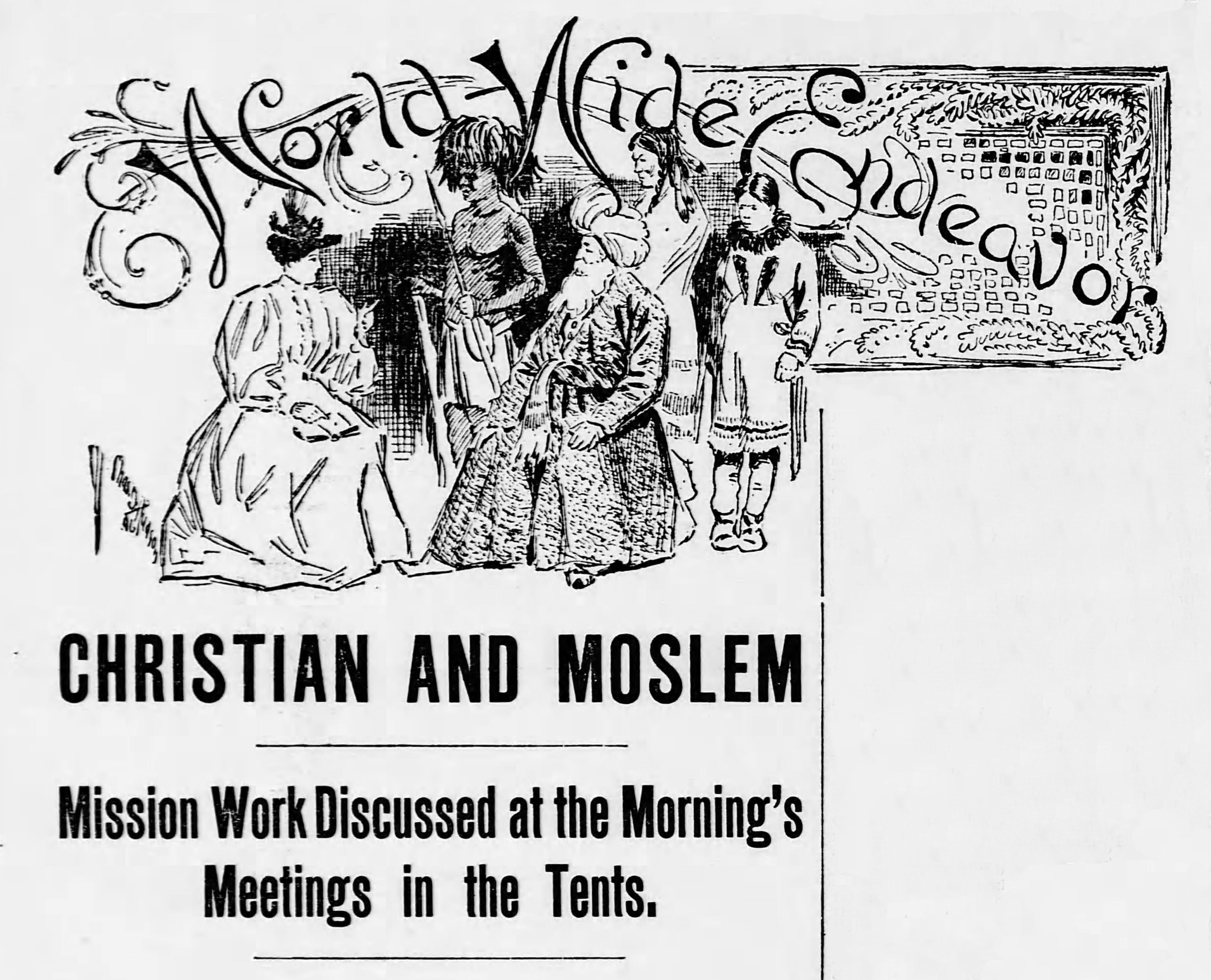
Newspaper headline about the convention, from the Evening Star, Monday, July 13, 1896.
Isabella knew Washington, D.C. very well. She and her family lived there for three years when her husband served as assistant pastor of The Eastern Presbyterian Church, located just blocks from the Capitol building (read about her D.C. home here). In early 1896 the Aldens moved to New Jersey, just a short train ride away from Washington; so it’s entirely possible the Aldens attended all or part of the international convention that year.
The convention opened on Thursday, July 9 and ended the following Monday. Convention attendees were given a schedule of events and a map to help them travel from venue to venue, most commonly by foot.
The Christian Endeavor Society distributed this map of Washington, D.C. to conventioneers in 1896.
Attendees braved the heat, the humidity, and the stifling crowds of fellow Endeavorers that thronged the mall from the Lincoln Memorial to the Capitol building.
“The Army of the King.” Christian Endeavorers crowd Washington, D.C. in 1896. From the New York Public Library Digital Collection.
On The Ellipse, located between The White House and the Washington Monument, enormous tents were erected where meetings and lectures were held.
A newspaper photo of the meeting tents, with the Washington Memorial in the background.
Each tent was designed to hold hundreds of people, but some evening gatherings drew enormous crowds. At times there were so many people, and the interiors of the tents became so hot, the tent sides had to be raised to allow fresh air to circulate.
A tent interior layout, printed in the Evening Star on Wednesday, July 8, 1896.
But of all the activities that took place over the five-day convention, there was one event that stood out and was talked about for months afterward.
On Saturday evening, July 9, a patriotic service was planned to take place on the east front of the Capitol Building.
The east front of the United States Capitol building, photographed in 1904.
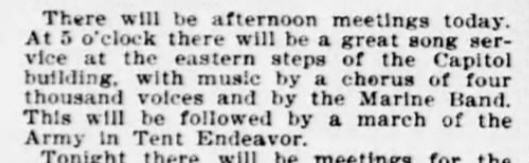
The service was described as “a great song service” of patriotic songs and hymns led by a chorus of four thousand voices.
An announcement of the service in the Evening Star on July 11, 1986.
A photographer captured this image of the chorus assembling on the steps of the Capitol:
One newspaper enthusiastically wrote that the patriotic service was “grand music to listen to, and something to remember.”
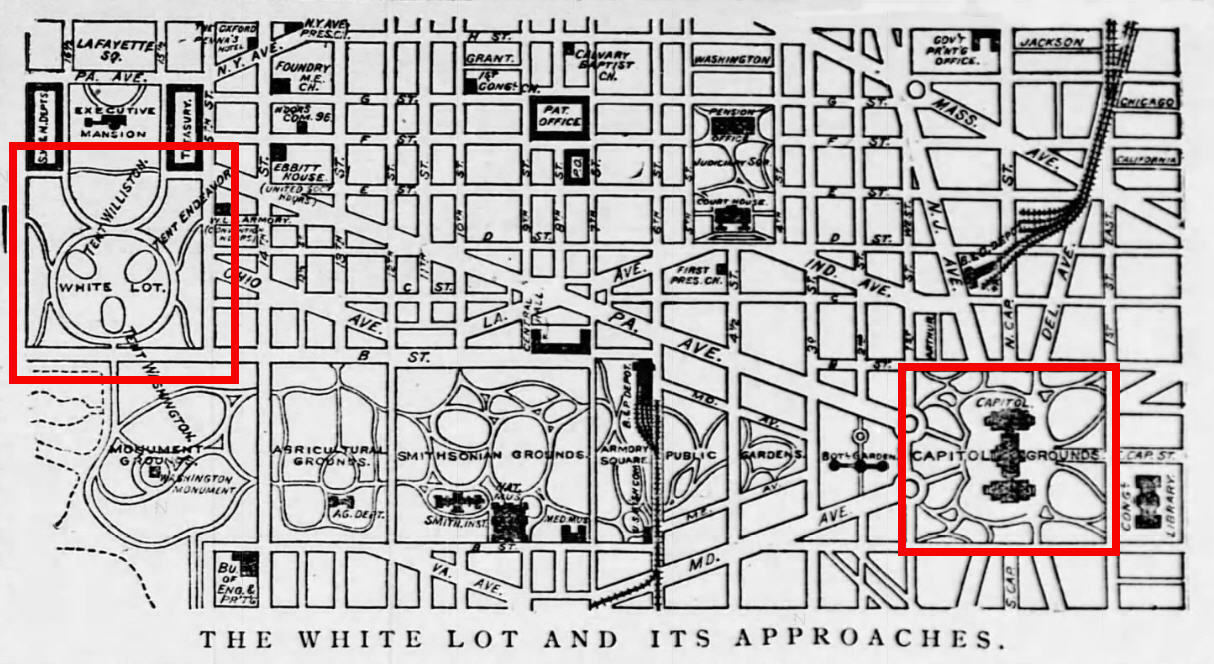
At the conclusion of the service, the chorus, the Marine band, and the audience left the Capitol steps to march down the National Mall to the Ellipse, where they gathered at Tent Endeavor.
The Ellipse and the Capitol Grounds shown on a map published in the Evening Star.
The song service was a tremendous success! While there was no official count, attendees believed there were just as many singers among the audience as there were on the Capitol steps.
If that’s true, there were over eight thousand people at the service, all raising their voices together in songs of praise!
What do you think it was like to sing hymns with thousands of other people?
Have you ever participated in an outdoor sing-a-long where your voices could be heard for blocks?
Reviews and giveaways for Christian fiction and sweet, clean fiction. Bringing readers information on great stories and connecting authors with their readers.

















 Isabella Alden