Flossy and the Street Children

Isabella Alden never actually said so, but there’s an argument to be made Flossy Shipley Roberts may very well have been her favorite character. Of all the characters Isabella created, Flossy made the most appearances in her novels.

Flossy first appeared in Four Girls at Chautauqua. She was also a key character in The Chautauqua Girls at Home, Ruth Erskine’s Crosses, Four Mothers at Chautauqua, and Echoing and Re-echoing.

Cover of Ester Ried Yet Speaking showing a close-up of a young woman with blonde hair dressed in a high-neck red gown. In the background is a large three-story home set amid trees and gardens.

And while she was only mentioned in Judge Burnham’s Daughters and Ruth Erskine’s Son, Flossy made her final appearance—and played a major role—in Ester Ried Yet Speaking.

Perhaps one reason Flossie was so well-loved—by Isabella and by her readers—was that she was honest and truthful, yet deceptively strong. People constantly underestimated Flossy because she was soft spoken and was willing to please others.

But Flossy also had a strong moral sense of right and wrong. She relied on her Christian faith to give her the strength she needed to always do right rather than what others wanted her to do.

She was also kind hearted, especially when it came to children. Flossy was just as willing to teach a Sunday school class full of ragged orphaned street boys as she was to serve tea on her best china to a wealthy church deacon and his wife.

That was the case in Esther Ried Yet Speaking, when Flossy took on the task of teaching a Sunday-school class of rough street boys. During the first class, Flossy took an interest in one of those boys, Dirk Colson and his sister Mart. In the story, Flossy’s concern for them and the rest of the boys—and the actions she took to help them—reflected Isabella’s own principles.

Black and white photo of a narrow alley between two multi-story brick buildings. In the foreground are trash cans and debris, a water pump and buckets. A group of six boys stand in the center of the photo. Behind them are two women wearing long dresses and aprons  from the time period, as well as more children. On the left side of the photo are two young girls, wearing short dresses that appear to be patched.
Boys in Mullens Alley, New York, 1888, by Jacob A. Riis

Isabella was keenly interested in the problem of street children living in large urban areas like New York City. In 1889 she wrote:

There is, in New York City, a meeting known as the “Woman’s Conference.” On the second Friday of every month they meet together to discuss matters of importance and see what they can do to help along the good work which is being done in this world. A few weeks ago they took for their subject the “Street Children’s Sunday,” their object being to see what they can do to help these miserable, neglected, almost forgotten, children to something better than their sorrowful lives have yet known.

The Sun (a New York newspaper) covered that women’s conference and published an account of the meeting, including this paragraph:

At the meeting, which was presided over by Mrs. Lowell of the State Board of Charities, Mrs. Houghton, literary editor of the Evangelist, introduced a subject of the Sunday Life of tenement-house children, a large class of whom do not attend the Sunday schools, and whose Sundays, owing to the drunkenness of their parents, which is more general on that day than any other, and also to the overcrowding of the small rooms in which they live by the presence of the entire family on that day, are full of wretchedness and discomfort. “The children do not laugh enough,” Mrs. Lowell said. “They did not know how to play or to be happy.” This subject has been long of great interest to Mrs. Houghton, and out of this discussion germinated a plan to do something for those little wretched waifs of humanity to brighten their lives, and ultimately to make of them better men and women and more intelligent and worthy citizens.

Isabella strongly believed in the last line of the article: that making the lives of poor boys and girls better will ultimately help them grow to be better men and women.

Black and white photo of three young children sleeping close together in an outdoor alcove of a stone-facade building. The children are barefoot and two are wearing short pants with patches on the knees, as they sleep with their arms around each other.
Children sleeping on Mulberry Street, 1890, by Jacob A. Riis

She also had the example of Jacob Riis, a newspaper reporter who documented living conditions in New York slums. Through his written articles and photographs, he almost single-handedly educated Americans about the necessity of better living conditions for the poor. He advocated for clean drinking water, public parks, and child labor laws, and he was instrumental in implementing these and many other reforms in New York City. Riis and Isabella both attended Chautauqua Institution at the same time, and Riis was close friends with Bishop John Vincent, one of Chautauqua’s co-founders.

Black and white photo of a middle-aged man seated in a chair. He has short, light-colored hair and a mustache, an wears wire-rimmed glasses. He wears a tie and three-piece suit. The chain of a pocket watch is visible on his vest.
Jacob A. Riis in 1904 (from Library of Congress)

Isabella may very well have been thinking of Riis when she wrote about Flossy’s efforts to reach and influence the street boys in her Sunday-school class.

Black and white photo of a row of three two-story attached houses in dilapidated condition, with broken windows and clothes-lines strung from one building to another. The roof of the center home sags dangerously. In the background, a multi-story building hows broken windows and objects cluttering the metal fire escape.
Dwellings of Death by Jacob A. Riis

In one scene, Flossy gets lost in the slums while trying to visit Dirk, and a street boy named Nimble Dick helps her find Dirk’s house.

Mrs. Roberts uttered an exclamation. The house was one of the most forlorn in the row, seeming, if the miserable state of the buildings would admit of comparison, to be more out of repair than the others. It came home to her just then, with a sudden, desolating force, that human beings such as she was trying to reach, and such as she hoped would live in heaven forever, called such earthly habitations as these homes. What possible idea could they ever get of heaven by calling it “home”?

“Do they have the whole of the house?”

She asked the question timidly, for the building looked very large, but she was utterly unused to city tenement life.

“The whole of that house?” Dick fairly shouted the sentence, and bent himself double with laughter. “Well, I should say not, mum! As near as I can calculate, about thirty-five different families have that pleasure. The whole of the house! Oh, my! What a greeny!” And he laughed again.

Mrs. Roberts exerted herself to laugh with him, albeit she was horror-stricken. Thirty-five families in one house! How could they be other than awful in their ways of living?

“I know almost nothing about great cities,” she said. “My home was in a much smaller one.”

This was the truth, but not the whole truth. Instinct kept this veritable lady, in the truest sense of the word, from explaining that she knew nothing about the abject poor, when she was speaking to one of their number.

But Flossy quickly set about learning all she could about Dirk, his sister, and their neighbors because she felt a distinct calling to help them. When she returned a second time to Dirk’s tenement building—this time accompanied by her husband—other residents of the tenement warned her to stay away from Dirk.

It was strange, she could not herself account for it; but with every added word of misery that set poor Dirk Colson lower and lower in the scale of humanity, there seemed to come into this woman’s heart, and shine in her face, an assurance that he was to be a “chosen vessel unto God.”

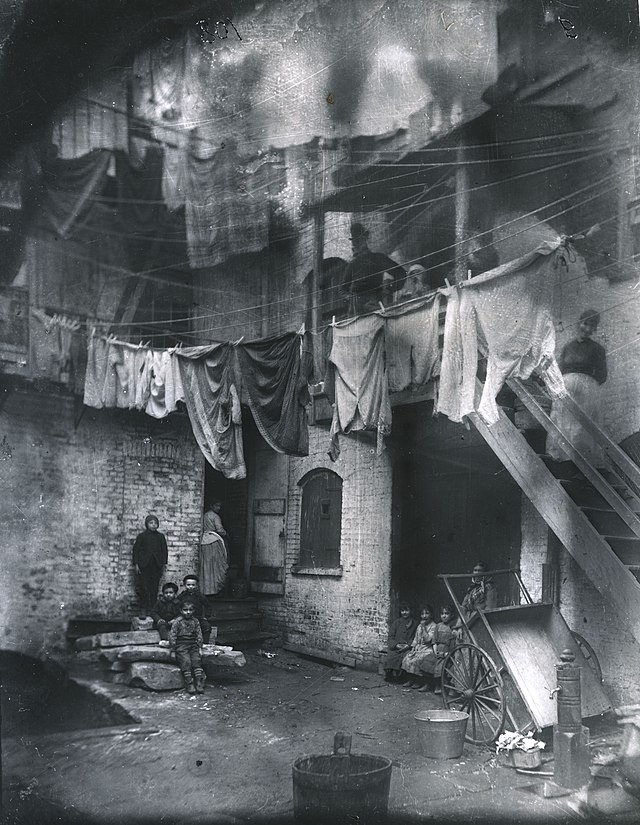
Black and white photo showing a small open area surrounded by four brick buildings. A shaft of light from above illuminates several clothes lines where clothing and blankets have been hung out to dry. On an upper balcony a man stands with children behind him. A woman wearing an apron stands on the stairs leading from the balcony to the count. On the ground an apron-clad woman stands in the doorway with four children of different ages nearby. In another doorway stands a woman with three little girls seated beside her. In the foreground is a two-wheeled pushcart, buckets, a water pump, a and debris.
A Tenement Yard by Jacob A. Riis

To Flossy, helping Dirk and the rest of “her boys” was essential. And when someone tried to change her mind by asking what good Flossy could possibly do for such creatures, she replied:

“Don’t you think that Jesus Christ died to save them? And don’t you think he wants them saved? And will he not be pleased with even my little bits of efforts if he knows that my sincere desire is to save these souls for his glory?”

Her “little bits of efforts” may seem small at first, but Flossy soon begins to see results with “her boys.”

You can read all about the plan Flossy came up with, and how the boys responded, in Isabella’s novel, Ester Ried Yet Speaking.

You can read Isabella’s novel Ester Ried Yet Speaking for only 99 cents! Choose your favorite e-book retailer. (Your purchase from The Pansy Shop helps support this blog.)

A Kiss at Chautauqua

The 2025 Chautauqua Institution officially opens on June 21. Much has changed at the institution in the last 151 years, but thanks to Isabella Alden and her contemporaries, we can piece together what it was like to spend a summer at Chautauqua in its early days.

Before there were cottages and meeting halls, Isabella and her family spent their summers sitting on rough wooden benches as they listened to lectures in the open air, and sleeping under the stars or in tents.

The photo below was taken about 1876, which was the second year of Chautauqua’s existence. Isabella was only thirty-five years old, but she was already quite famous.

She was the best-selling author of over a dozen novels, including the first four books of her “Ester Ried” series. And The Pansy magazine was in its third year of publication, with Isabella as editor and chief contributor of stories and articles.

In those early years The Pansy magazine was sent every month (it later became a weekly magazine) to thousands of children. Isabella called each of her young subscribers her “Pansies.”

While at Chautauqua one day that summer of 1876, Isabella was walking through the grove, which was one of her favorite spots at Chautauqua. She wrote:

Chautauqua is so beautiful this year. Don’t you know, I met today one of the little Pansies! As I was walking through the grove, there came a sweet-faced little girl to me, and she said in a low, sweet voice:

“If you please, I live in Ohio, and I’m going home today, and I’d like so very much to kiss you, then I could tell all the little girls that I kissed Pansy.”

You may be sure that I gave her the very warmest kiss I had, and told her to tell all her little Pansy friends that part of the kiss was for them.

A ladies’ magazine once printed an article about Isabella and commented that one of the strongest and most attractive elements of her character was her humility in regard to the great good she accomplished through her writing. But in truth, she was keenly aware of the power she had over her readers, and she always used that power to help them come to know and love the Lord Jesus Christ. Just think of the story the little girl in the grove told to her friends back in Ohio! How many of her little friends do you think were influenced to know and love Jesus, all because of Isabella’s kindness to a child and that one little kiss?

A New Chautauqua

Isabella Alden had strong ties to Chautauqua Institution in New York. She and her husband Ross were early contributors to the assembly’s success. For years Isabella served as president of the Chautauqua Missionary Society and was superintendent of the Primary Department of the Sunday-school.

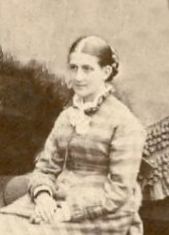
Profile photo of Isabella Alden at about age 35. Her hair is parted in the middle and pulled back to a large braided bun at the back of her head. She wears no jewelry. She is dressed in a garment with a high neckline, with a ruffle at the base of the collar. A lace jabot peaks out above the high collar and spills down the front of her bodice.
Isabella Alden, in an undated photo.

Several years later, in 1885, the Aldens were instrumental in opening a new Chautauqua in Florida. You can read more about that here.  

So it’s no surprise that Isabella was among the first to get involved when a new Chautauqua assembly was organized in Ohio.

News clipping: FROM LAKESIDE. An Inter-State Sunday School encampment is now being held at Lakeside. This place is on the peninsula twelve miles south of Put-in-Bay and about the same distance from Sandusky. This is the second meeting of the kind that has been held here. The other one held last year was a success. There were present able teachers and lecturers. The present meeting has been a success so far.
Excerpt from The Tiffin (Ohio) Tribune, August 1, 1878.

Much like the original New York Chautauqua, the Lakeside Chautauqua (established on the shore of Lake Erie) began as a camp meeting in 1873 with a series of revival meetings.

Photo of a promontory point of land on the shore of the lake. a short pier extends from the land out onto the water. Beside the pier is a white building with a tower. To the right along the shore line is a grove of mature trees and a park.
View of the Tower and Park 1909. Caption: This 1909 photo shows the Lakeside tower and dock where steam boats delivered passengers every summer. The dock tower is similar to the one at the original New York Chautauqua.

The early meetings were so successful, attendance grew by leaps and bounds the following years.

Old sepia photo about 1910 of an open park area with children playing and standing in groups. Behind them is an elevated band stand. Behind the band stand and to the left is a grove of mature trees. People sit in groups in the shade or walk under the trees.
An early band stand in the park at Lakeside Chautauqua (courtesy Lakeside Heritage Society)

In 1877 Lakeside officially joined the Chautauqua movement and held its first Sunday-school training session.

Old photo about 1899 of a family posing on the steps of their cottage. The porch has numerous flowering vines that weave in and out of gingerbread trims. On the steps stand two women and a little boy in a sailor suit. Behind them, two men stand and one man sits; each wears a full suit and hat.
Family on a Lakeside cottage porch 1909 (courtesy Lakeside Heritage Society)

The following year, Isabella visited Lakeside Chautauqua to conduct training sessions for children’s Sunday-school teachers.

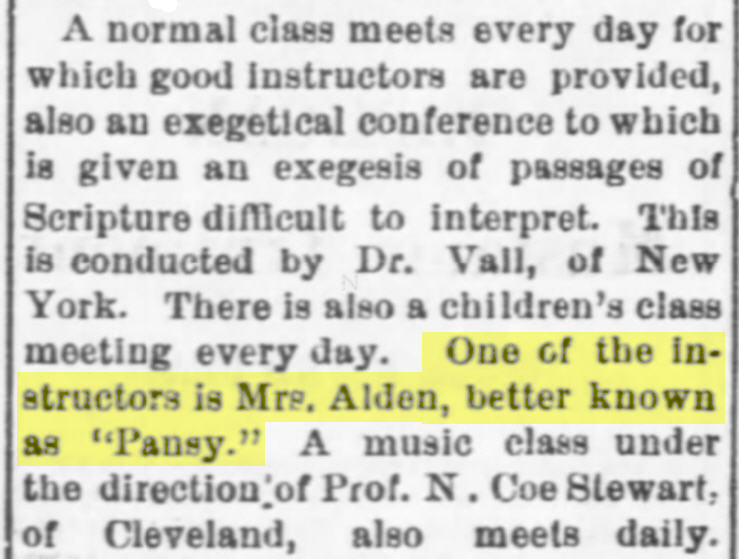
A normal class meets every day for which good instructors are provided, also an exegetical conference to which is given an exegesis of passages of Scripture difficult to interpret. This is conducted by Dr. Vall, of New York. There is also a children's class meeting every day. One of the instructors is Mrs. Alden, better known as "Pansy." A music class under the direction of Prof. N. Coe Stewart, of Cleveland, also meets daily.
An excerpt from The Tiffin Tribune, August 1, 1878.

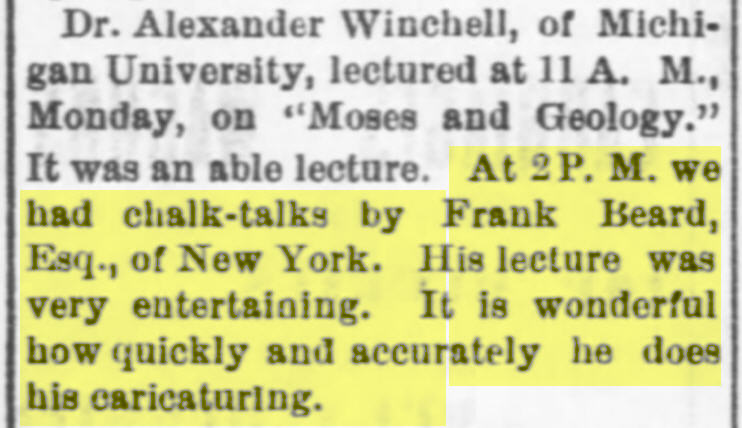
Lewis Miller (one of the founders of the original New York Chautauqua) and “Chalk Talk” artist Frank Beard also participated in the Lakeside summer program of 1878.

At 2 P.M. we had chalk-talks by Frank Beard, Esq., of New York. His lecture was very entertaining. It is wonderful how quickly and accurately he does his caricaturing.
Excerpt from an article in The Tiffin Tribune, August 1, 1878.

Frances Willard, President of the Women’s Christian Temperance Union, was also a featured speaker that summer.

Frances Willard in an undated photo
At 3 P.M. Miss Frances E. Willard, of Chicago, delivered an address on "Our danger and deliverance." It was a priviledge [sic] to listen to her. She is a great temperence [sic] worker. God speed all such.
Excerpt from an article in The Tiffin Tribute, August 1, 1878.

Add to this the daily lectures and Bible studies conducted by leading theologians and academics of the day, and the new Lakeside Chautauqua was off to a brilliant start!

Lakeside Chautauqua is still a operating today and offers a thriving summer program. You can learn more about Lakeside Chautauqua by visiting their website here.

And the Lakeside Heritage Society has many charming historical photographs of Lakeside Chautauqua, which you can view here.

Have you ever visited a Chautauqua?

There are 18 Chautauquas still operating today in the U.S. and Canada. Click here to find one near you.

Read Along with the C.L.S.C.

Much like the on-line college degree courses we have now, The Chautauqua Literary and Scientific Circle (C.L.S.C.) was a method of self-education people could obtain in the privacy of their own homes. Isabella was a graduate of the C.L.S.C. program and actively promoted in articles and stories.

Every three months C.L.S.C. students received “The Chautauquan,” a 400-plus page “magazine of system in reading” with articles and lessons that covered various topics such as:

The Rehabilitation of the Democratic Party

Food, the Farmer, and the City

Polar Exploration and Moral Standards

Women in the Progress of Civilization

A Reading Journey through Egypt.

History and classic literature were also major components of the curriculum. Bishop John H. Vincent, Chancellor of the C.L.S.C. believed:

The study of classical literature, art, and philosophy supplies a training of the mind based upon models which have stood the test of time [and are] considered universal.”

Aside from obtaining the books for reading, the only other tools required to complete the course were a pencil, some paper, and a good dictionary. 

But while the tools were basic, the coursework was not always easy. In 1909 students were required to read Homer’s Iliad. If you’ve ever tried to read this epic poem about the Trojan War, you know what a challenge it can be!

Illustration of two Trojan soldiers fighting. Both wear casques and capes,, and carry shields. Behind them is a portrait of Helen of Troy.

Not to worry; the C.L.S.C. published the following tips to help students successfully complete the required reading:

  • Think of this volume as a story book and read it for the sake of the stories.
  • Keep in mind the tales woven about Achilles and Odysseus are typical of the passionate rivalry of war and the steadfast love of country and family we identify with today.
  • Don’t make reading these stories hard. Relax yourself to the swing of them. Let them carry you along as if you were hearing them recited by a story teller.
  • These are tales of valiant deeds and daring adventure from beginning to end— “action stories”; and there is no easier reading in the world.
Illustration of Achilles and Paris in battle. Paris has a long spear and shield. Achilles holds a long knife while an arrow protrudes from his right heel. Behind them is the outline of a stone fortress over the top of which is the head of the Trojan horse.

Bishop Vincent knew the value of reading Homer’s Iliad, because he recognized the influence Greek history—and Homer’s epic poem, in particular—had on the formation of the United States and the development of our constitution.

Those influences are still visible today. A mural in the Library of Congress in Washington D.C. depicts one of the stories in the Iliad after Achilles’ mother disguised him as a school girl and sent him to a distant court so he would not be enlisted in the Trojan War. Wily Ulysses set out to find Achilles; dressed as a peddler, he displayed his wares. The girls chose feminine trinkets, but Achilles was attracted to a man’s shield and casque, thereby revealing his identity.

Mural depicting Achilles disguised as a girl admiring a man's shield and casque. Behind him, Ulysses, watches as other girls sit and examine the trinkets displayed on the floor.

Greek history and mythology influence many murals, statues, and architectural design throughout the U.S. capital.

Have you read Homer’s Iliad? Did you find it difficult reading?

If you haven’t read Homer’s Iliad, you can get a taste for what this reading assignment was like. Click here to read an 1891 version of the epic poem, which would have been similar to the version Isabella and other C.L.S.C. students read.

Summer at Monteagle

Now that summer is here and the temperatures are climbing, do you ever find yourself wondering what people did before air conditioning? Isabella hints at the answer in some of her stories, when a few of her lucky fictional characters got to leave their hot, humid city homes for cooler locations, such as beaches or mountains.

Isabella knew of which she wrote. She frequently spent her summers at Chautauqua Institution in New York, where she could enjoy the lake and cool breezes; and in Florida, where she had a large family home in Winter Park, and a smaller cottage in Defuniak Springs.

Then, in the summer of 1883 Isabella traveled to Tennessee, where she was one of the first visitors to the newly-opened Monteagle Sunday-school Assembly.

The cover of an 1893 pamphlet about Monteagle. Click on the image to see the entire pamphlet.

Monteagle was situated on 100 acres of land atop a mountain in Tennessee’s Cumberland range. Its location quickly made it a favorite resort for people from all over the American south.

Antique postcard showing the view looking west from atop the Cumberland Mountains

Bishop John Heyl Vincent, one of the co-founders of the original Chautauqua Institution of New York, visited Monteagle, too. He hailed it for supplying “recreation for tired men, women and children by gathering them on the mountain top where pure air and good music and earnest lectures would rest and entertain them.”

A portion from Bishop Vincent’s interview with The Tennessean about Monteagle, published May 10, 1883.

In many ways Monteagle Assembly was very similar to its northern cousin. Like Chautauqua it initially began as a training convention for Sunday-school teachers. In its early days Monteagle was just as rustic as Isabella described the early days of the New York assembly in Four Girls at Chautauqua. Tents provided the only sleeping accommodations, the dining hall had few dishes and cutlery, and lectures and sermons were held out of doors at the whim of Mother Nature.

Even the offices of the Monteagle Chautuaqua Literary and Scientific Circle were first housed in a modest tent until a permanent building for the C.L.S.C. could be erected.

An artist’s rendering of the proposed C.L.S.C. office building at Monteagle Assembly.

But Monteagle did not stay rustic for long. The assembly planned to erect an amphitheatre, a hotel, a dining hall, a library, meeting halls and classrooms.

In 1883 the organizers published their ambitious plan for the property in the local newspaper. (You can click on the map to see a larger version.)

An 1883 drawing of the proposed layout for the Monteagle Sunday-School Assembly Grounds, published in The Tenneseean on May 10, 1883.

..

The amphitheatre that was ultimately built was modeled after the Grand Opera House of Paris and could hold 2,000 people.

Early photograph of the Monteagle Assembly amphitheatre.

The designers also included plenty of room for charming cottages, colorful gardens, and rambling walking paths.

Photo of a gazebo set under the trees near a walking path.
A pretty gazebo at Monteagle

There’s no record to tell us how many times Isabella visited Monteagle; but we do know she enjoyed the place so much, she published a novel about it in 1886, titled simply, Monteagle.

Image of the cover of Monteagle by Isabella Alden

In her story, city girl Dilly West—whose health suffered terribly because of hot summer tenement living conditions in the city—blossomed when she had the chance to go to Monteagle.

When asked what she liked most about Monteagle Assembly, Dilly immediately credited the fresh mountain air:

“Why, I fancy everything; the trees, and the flowers, and the birds, and the lovely breeze. There wasn’t ever any breeze in the city; at least, there never came any down where we lived. It was just like an oven all the time; it makes me feel faint to think how hot it must be there this morning; and only see how the curtains blow here!”

Through Dilly’s story Isabella was able to describe the beauty of Monteagle’s location. Dilly wrote home to her father to describe her hike up to the top of Table Mountain to see the sunset:

Father, I do just wish I could tell you about it! All gold, and crimson, and purple mountains all around, and red streaks away up into the sky, and castles in the sky made of glory color, and angels hurrying around to get ready for the sun to come home; that is the way it seemed, you know.

Dilly described other experiences in her letters home, including the things she learned on nature walks, at lectures in the amphitheater, and—most importantly—during Sunday-school classes:

Dear father, something very wonderful has come to me; I decided yesterday that I would belong to the Lord Jesus Christ.

When Isabella wrote those words she knew Dilly’s fictional experience was similar to the real-life experiences many visitors had at Monteagle.

In fact, Monteagle Sunday School Assembly was so successful, it remains a thriving Chautauqua community today!

You can find out more about Monteagle, their programs and events by clicking here.

Or click here to take a look at their latest newsletter that describes the many activities, lectures, Bible studies and sermons they have to offer.

You can find out more about Isabella’s novel Monteagle by clicking here.

Have you ever visited Monteagle or a similar summer assembly? Please share your experience!

Advice to Readers on Learning to Cook

For many years Isabella had an advice column in a popular Christian magazine. In the column she answered readers’ questions—from a Christian perspective—on a variety of topics.

In 1910 she received this letter from a young woman:

Can you tell some of us girls—who never had a chance to learn much about real, practical, beautiful housekeeping—some way of learning? Are there not schools in cities for this purpose? Or are there not books from which we can learn what we need to know?

We want to understand all kinds or planning and arranging and beautifying and economizing.

We want to be excellent cooks, and to learn much that people whose time is largely spent in school or shop know very little about.

Can you help us with this practical need of ours?”

Illustration of different desserts: A sundae in a tall glass, cupcakes, a merangue, and a cake.

Here is Isabella’s reply:

It shall be my delight to do so.

Let me first express what a pleasure it is to find that one who can write so charming a letter as accompanied these questions is able to turn her thoughts to this practical subject, and to feel the “need” of knowledge.

Also, I rejoice in the thought that a large number of the letters awaiting attention deal with the same subject. Our lovely, cultured girls, who have had “advantages,” are beginning to feel the importance of understanding the art of home-making.

Newspaper clipping:
HOUSEKEEPERS HAVE TROUBLES.
Have Miss Peet help you in them at cooking school.
The school opens next Monday.
Ask her any questions any time - Wants Fort Scott women to feel it is their school.
From The Fort Scott Daily Tribune, October 31, 1913

Schools? Certainly there are. Every city of rea­sonable size now sends out its circulars announcing a “cooking-school” in regular session through the school year, or in extra session during vacation, or for the winter months.

Photo of about a dozen young women gathered around a table where they are preparing peaches to make into peach rolls.
A cooking school at the Indiana State Fair, about 1917

Better than these opportunities, especially for school­girls and those employed in regular work of any kind during the winter, are the cooking-schools that have sprung up in connection with the larger summer “as­semblies.”

I am told that every well-established summer resort organized under the peculiar rules that belong to the word “assembly” now has its own fairly well-appointed cooking class or classes. I am, however, most familiar with the one at Chautauqua, N. Y., which is, of course, the mother of all the Chautauquas, and is and must always be the first in all ways.

Photo from the early 1900s of a large classroom full of cooking students and teachers. The students are wearing caps and full aprons. The teachers wear caps and are dressed in white. Some students are preparing vegetables, others are setting a table, while others are at different stages of the cooking process.
A cooking school at the Battle Creek, Michigan resort and sanitarium.

Mrs. Emma P. Ewing, who, as everyone knows, has no superior in her department, conducts regularly at Chau­tauqua, N. Y., during the eight weeks’ season, a thor­oughly equipped cooking-school, with its normal depart­ment, its “practice class,” its lecture course, and its final examination.

Black and white head-and-shoulders photograph of Emma P. Ewing. She is wearing spectacles. She is wearing a bodice with a high neck and sleeves that puff at the shoulder.
Emma P. Ewing, from Wikipedia.org

Nothing more fascinating than the way in which Mrs. Ewing manages the entire matter can well be imagined. It has been my pleasure to be often in her classroom, to admire the white table set out with all the belongings for the day, sometimes arranged for the pur­pose of making delicious soups and white sauces and delicate desserts, sometimes planned for the purpose of showing what a study in refinement and beauty and excellence a breakfast of lamb chop and creamed pota­toes and corn puffs may become.

Newspaper article:
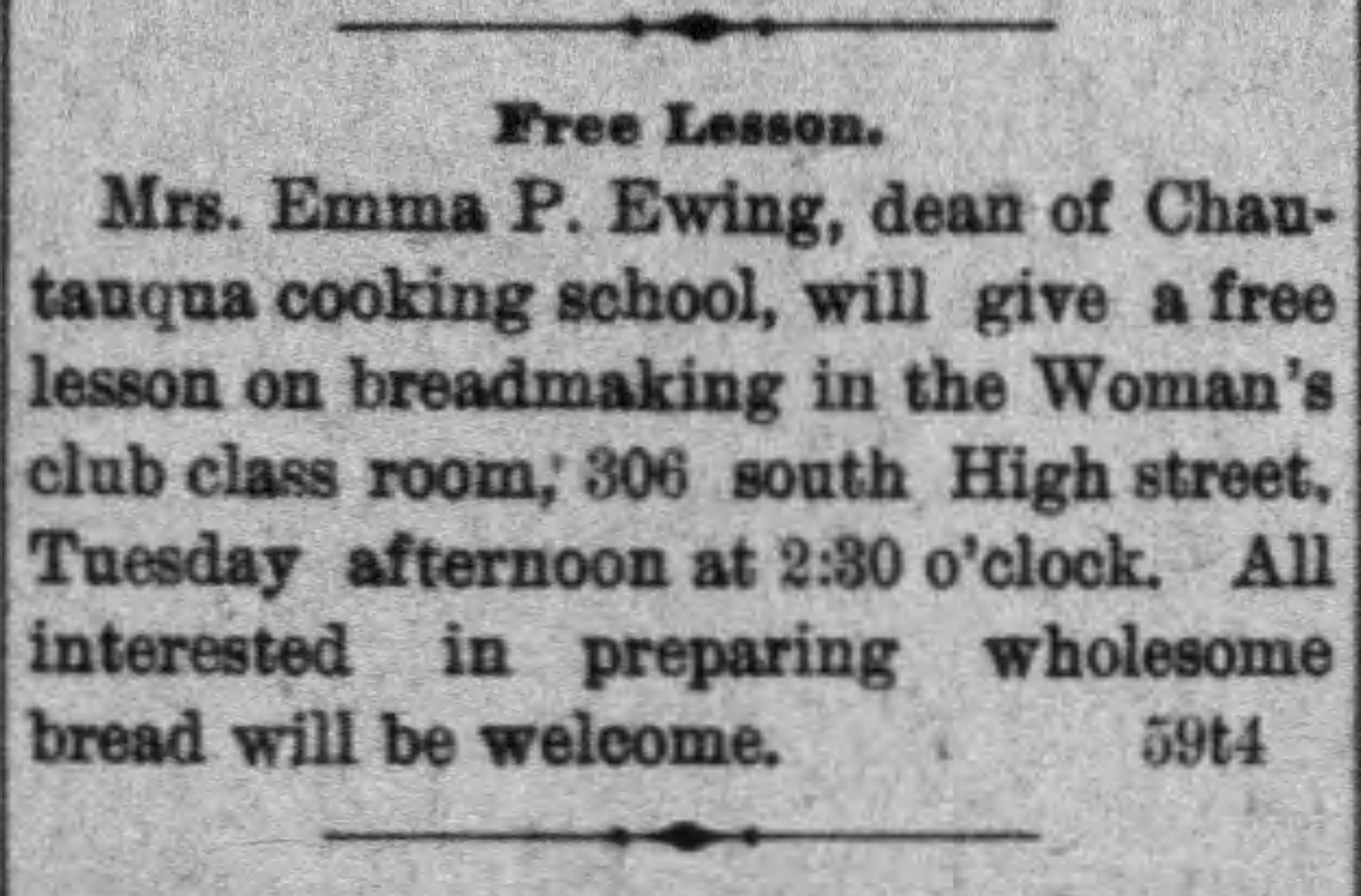
FREE LESSON
Mrs. Emma P. Ewing, dean of Chautauqua cooking school, will give a free lesson on breadmaking in the Woman's club class room, 306 south High street, Tuesday afternoon at 2:30 o'clock. All interested in preparing wholesome bread will be welcome.
The Muncie Daily Times, October 5, 1896.

Every conceivable branch of the culinary art is taught here. Pies, pud­dings, cakes, sauces, gravies, roasts, fries, stews, each come in for a full share of careful consideration.

Illustration from about 1912. A woman is in her kitchen looking down on a turkey in a roasting pas she has just taken from the oven.

Let me confess just here that a very fascinating part of the daily class exercise is the careful “tasting” of whatever article of food has been prepared before our eyes. For this purpose scholars go to the class armed each with a silver spoon, or fork, as occasion may require, and a napkin.

Illustration of a young woman about 1918. She is holding a bowl on a saucer just below her nose as if she is enjoying the smell of the contents.

Delicious beyond description are the spoonfuls of broth or “white soup” or bouillon that one thus enjoys, to say nothing of the marvellous concoctions made with a spoonful or two of cream, a cup of fruit-juice, a dash of sugar, and a little gelatine; to say nothing, moreover, of the delicious creams and ices and “foams” and innumerable other forms to delight the palate.

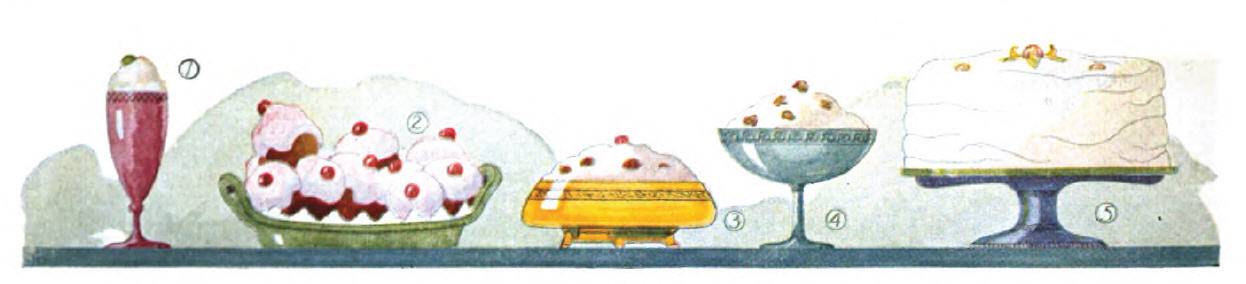
Illustration of different desserts, including a cake, a plum pudding, a molded gelatine, a cake decorated with gelatine, and a mousse.

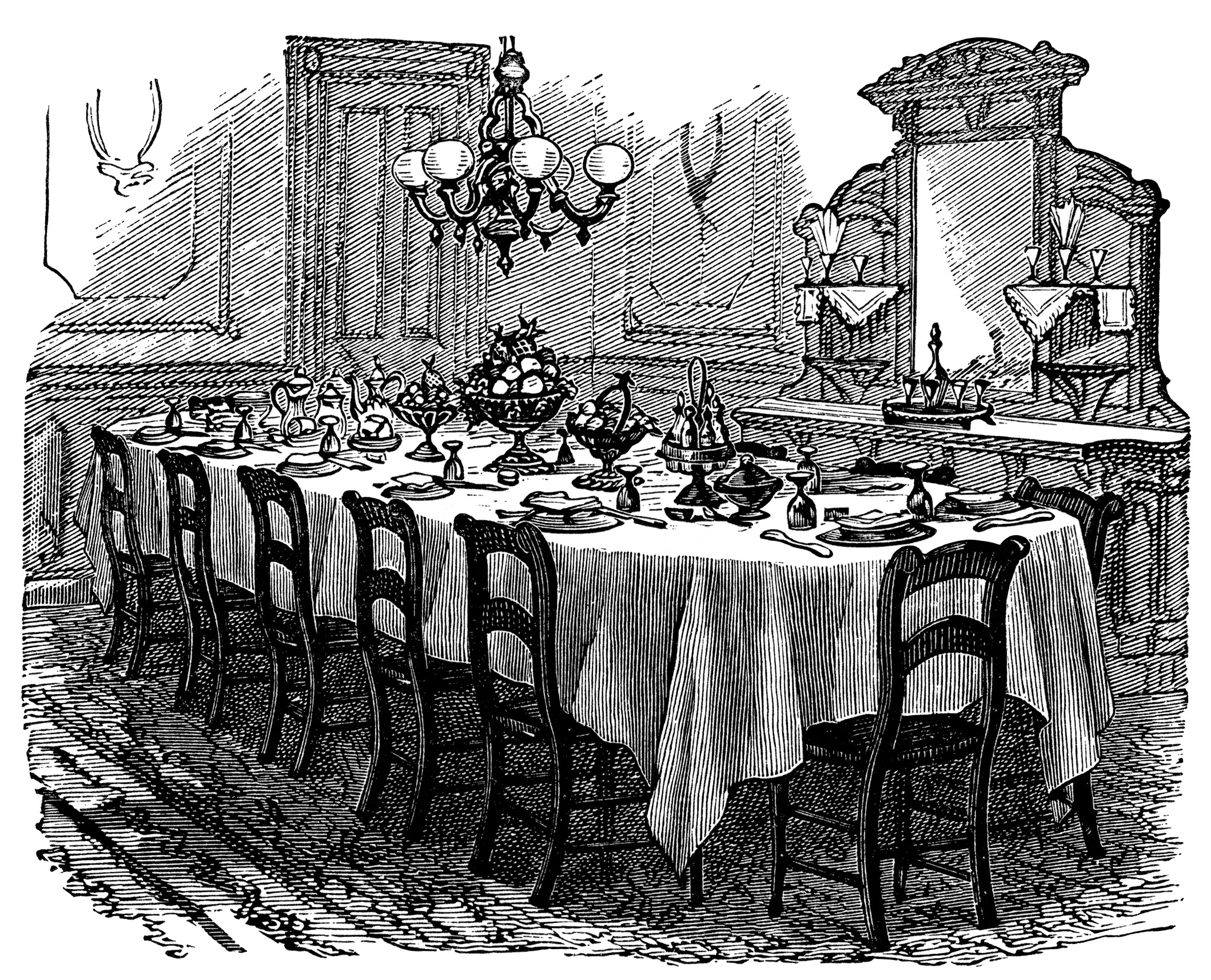
Not only can the making and cooking of all these dishes be thoroughly learned at this summer school, but there are classes formed for the special purpose of train­ing the pupils in the art of setting the table neatly and gracefully, of clearing away skillfully, of selecting dishes that harmonize with others, of explaining the difference between a refined abundance and a sinful waste.

Illustration of a dining room with a table for 12. The table is covered with a white tablecloth. Each place is set with plate, silverware, glasses and napkins. In the center are large bowls of fruits, a cruet, and a coffee service.
A proper Victorian-era table set for dinner.

There are bills of fare arranged for summer, for winter, for the trying springs and falls. There is careful attention paid to the novice who does not know whether to buy steak “by the yard” or piece, or whether to try to have strawberries and green peas in February, or to wait until they are less flavored with money.

Illustration of a woman reading a cookbook in her kitchen about 1920. On the table before her is a colander full of berries, a large empty bowl, a can of Crisco and a rolling pin.

In short, anything that one needs to learn about housekeeping, as connected with the kitchen and storeroom, may be acquired at this summer cooking-school. Moreover, the teacher is so gentle voiced and sympathetic, and so thoroughly ladylike, that it is simply a pleasure to watch her and listen to her. It would be difficult to imagine anyone farther removed from the “fussy” or the hurried and nervous stage of housekeeping than Mrs. Ewing.

Illustration from about 1918. A mother and daughter are in the kitchen standing side-by-side at the stove. The mother is reading from a cookbook while the daughter adds ingredients to a pot on the stove.

No matter how much it may sound like it, my dear girls, this is not an advertisement of the Chautauqua cooking-school. The truth is, that favored spot needs no advertising; its classes are always full, and application has to be made some time in advance. It is simply an honest effort to answer an honest and often repeated question about learning how.

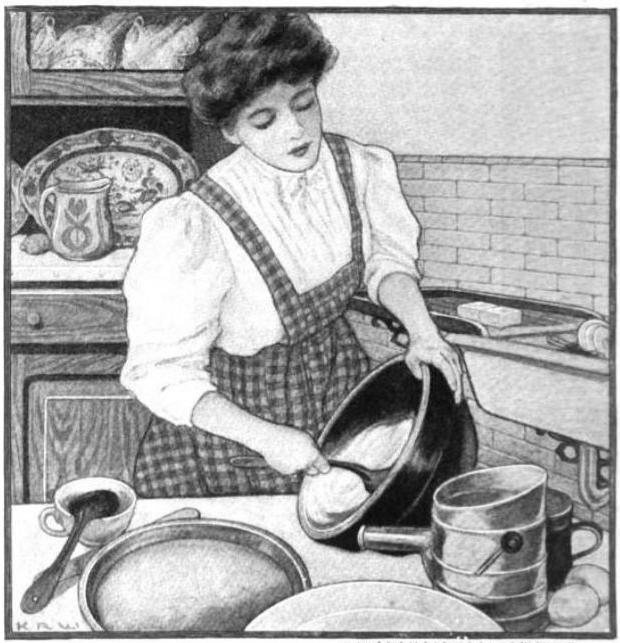
Illustration of a woman from about 1910. She is in a kitchen, wearing an apron, stirring the contents of a large bowl. On the table before her are a variety of pans and cooking utensils.

Meantime, do you know, dear girls, what delightful institutions home cooking-clubs are? Why not organize one in your own circle?

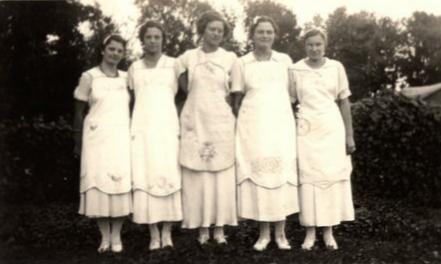
Black and white photo of five ladies standing arm-in-arm in a row. Each is wearing an apron.
Members of a cooking club in their aprons.

Select one evening or afternoon a week out of your busy lives. Meet around at one another’s homes; find out the specialty of each mother or grandma or auntie; and petition for a lesson in her line—a “normal” lesson, where you can have the privilege of furnishing your own materials, and doing exactly what the teacher does, and carry home the result in triumph. Some of the most fascinating evenings I have ever known were spent in this way.

Newspaper article:
AFTERNOON TEA
The Muffin Cooking Club Entertains the Young Ladies' Cooking Club.
Yesterday afternoon the members of Muffin Cooking Club entertained the members of the Young Ladies' Cooking Club with an afternoon tea at the beautiful home of Miss Mayne Sprankle, South Liberty street. The spacious rooms of the house were beautifully decorated and presented a unique appearance, especially the dining room and table, over which flowers and candles were artistically arranged. Dainty refreshments were served and all were delightfully entertained.
From The Muncie Morning News, September 22, 1892.

Try it, and see how much, at the end of a year, you will have added to your stock of practical knowledge.

What do you think of Isabella’s advice?

Where and when did you learn to cook? Have you ever taken a cooking class or joined a cooking club?

You can read some of Emma P. Ewing’s cookbooks for free! Just click on any of the titles below to view them on Archive.org.

The Art of Cookery; a Manual for Homes and Schools

A Textbook of Cookery for Use in Schools

Cooking and Castle-building

Soup and Soup Making

Vegetables and Vegetable Cooking

A Letter from Chautauqua

Isabella’s novels about Chautauqua Institution inspired adults from across the country (and around the world) to attend the summer assembly in New York.

But children also dreamed of going. In 1883 Isabella received a letter from a twelve-year-old girl named Faith who made an unexpected trip to Chautauqua. Faith’s letter to Isabella was reprinted in an 1883 issue of The Pansy magazine. You can read Faith’s enthusiastic account of her summer below:

Chautauqua, Aug. 1, 1883.

DEAR READERS: A wonderful thing has happened to me! It will do to put in that long list of modern events that I had so much trouble remembering in my history lesson. I am quite sure I shall remember this one, though, as long as I live.

I wanted to go to Chautauqua, and here I am!

I talked about it, and dreamed about it, but all the time I thought it was of no use, for mamma said she didn’t know as we could ever afford to go. I put it among the things, though, that I meant to do some time, when I grew up. I thought it would be years and years first, but don’t you think, that very night, Uncle John and Auntie May came. They were on their way to Chautauqua. Almost the first thing Uncle John said to me was, “Come, Faithie, pack your trunk, we are going to carry you off with us.”

I thought it was only some of his jokes, but after tea, when we all sat on the piazza together, Uncle John began to coax mamma in real earnest to let me go. Mamma said that a little girl only twelve years old was too young to go away from her mother, but Auntie May said she would take the best possible care of me, and Uncle John said I would have a real good time, and it shouldn’t cost me a cent, and it was a pity if they couldn’t borrow a child once in a while, when they had none of their own.

Papa hadn’t spoken yet. He looked at me and he saw that my eyes were saying, “Please, please, do let me go!” Then he said to mamma, “Suppose we let her go. It will do the child good.”

Mamma said then that she would think about it, and decide by morning.

I almost knew before I went to bed that I was going, for mamma said two or three times, “If you go, you will do so and so.” Then she came into my room and looked my clothes over, and said, “If you go, you can take the smallest trunk. Let me see, there is your white dress, and your gingham, and your black and white check. The one you have on, with your brown hat and sack, will do nicely for travelling. You can put your best hat in the trunk.”

I had on my brown cashmere skirt, and white waist, and I thought myself I would look nice, with my brown sacque and hat, with a clean linen collar. I was glad I happened to have a brown hair ribbon, too.

I couldn’t get asleep very soon that night, and when I did I dreamed that Chautauqua was at the top of a high, steep hill, and I was trying to climb up, but every step I took I fell back two or three. It wasn’t true at all, though. Chautauqua is not on such a very high hill, and I did not have a hard time getting here.

Mamma said “yes” in the morning, without any ifs and ands, except that I had to promise to wear my rubbers when it was damp, and carry my umbrella when it looked like rain, and not go out on the lake, and do just as Auntie May told me.

The only bad thing about getting here was saying good-by. I didn’t think I would feel bad, going away for just a little while, but the minute I kissed mamma, I felt as if I were going to choke. I was determined not to cry, so I never said good-by at all. I was afraid after I got started mamma would think I did not care anything at all about leaving her.

Where shall I begin to tell you about this wonderful, beautiful place?

Chautauqua is just ten years old. Yes, ten years ago this was just like any other piece of woods on the shore of a lake. Now, it is a large, beautiful grove, the underbrush is all cleared away, and streets and avenues wind in and out among the tall old trees. There are pretty cottages—whole streets of them—and there are white tents sprinkled about, fixed out with red curtains, and lace curtains, and hanging-baskets, too pretty for anything.

A row of four tents set up in a clearing, with small houses in the background. A woman stands in the opening of the first tent; a wooden chair is beside her. Families pose at the openings of the other tents.
Chautauqua tents and cottages, 1910

A great, handsome hotel stands not far from the lake, and the lawn, sloping down to the water, looks as if it were covered with green velvet.

Hotel Athenaeum, 1908

The pretty blue lake is smuggled into green woodsey shores, and steamboats are coming and going all the time; then there are row boats and sail boats flitting about.

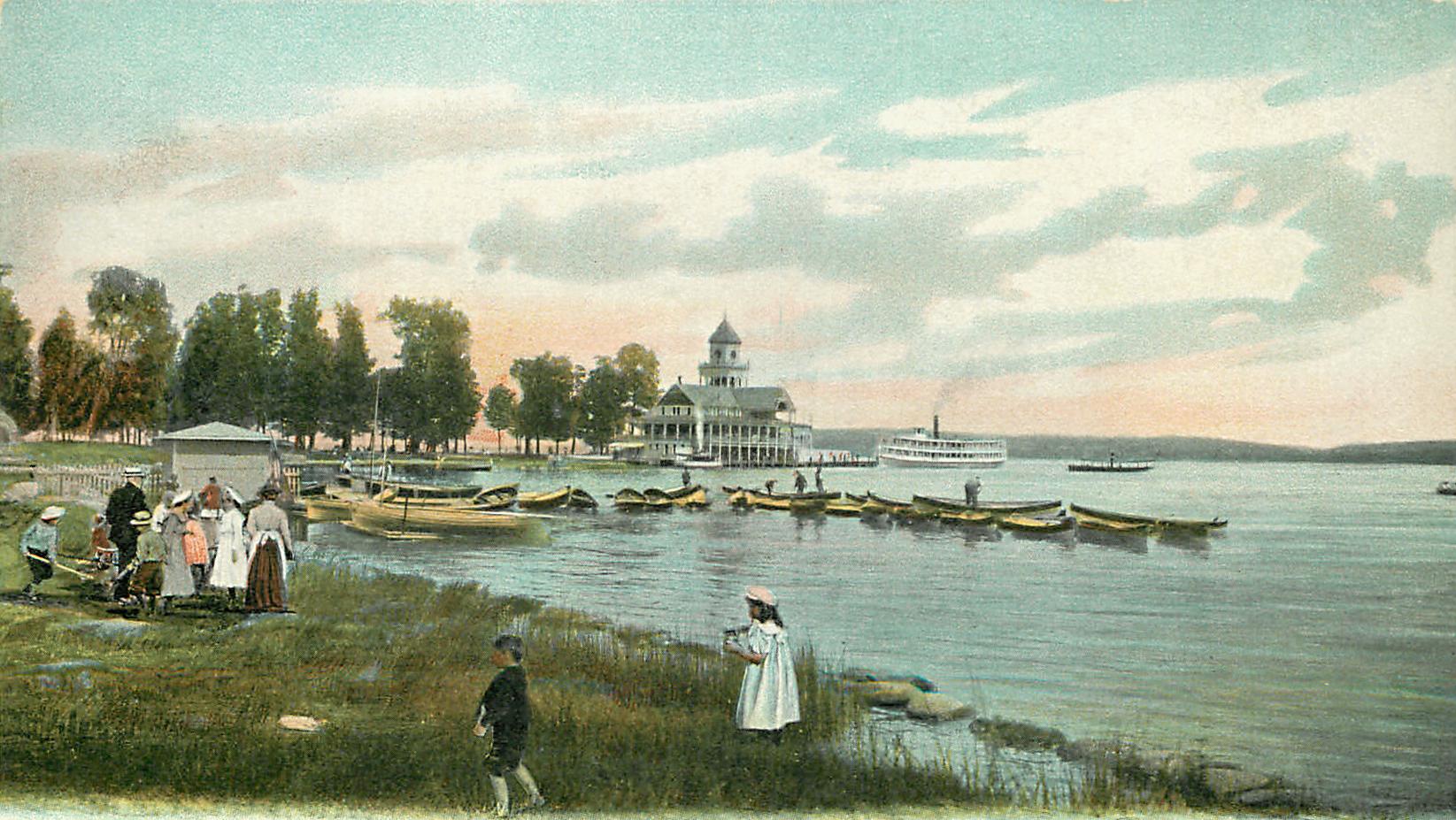
Row boats for rent on the shore of Lake Chautauqua, as a steamer docks at Chautauqua.

Whichever way you look you see people dodging here and there behind the trees. It looks as if all the grown folks were playing live. I like it. I wish they would do so always, and I don’t see why they can’t go on doing these pretty things when they get home. Life wouldn’t be half so dull if we could always get up, and go to bed, and go to dinner, at the sound of a chime of bells, and hear the grand organ every morning rolling through the air, and great burst of song coming through the trees. Why, it seems half the time as if I was one of the people in a lovely poem. Then, don’t you think the robins hop right about the door, great, lovely robins, and cunning little squirrels chase each other up and down the tree trunks.

A group of small children play in the grace near the lake shore. A couple sits on a wooden bench, looking about upon the lake, where there are sail boats, row boats and a steamer.

To think of my seeing robins and squirrels so near by! But I suppose you have met those delightful people scampering and flying about at your own house this summer, so I needn’t take up room telling you about them.

The people are not all playing, though it might look so. Almost everybody is studying something. There are classes in French, and German, and Latin, English literature, music, clay modeling, drawing, and ever so many other things.

A group of about thirty girls sit on the grass. Each girl weaves a holds a length of straw or small
A girl’s class in basket making at Chautauqua.

Uncle John says I may take drawing lessons.

Lectures and concerts are going on in the great amphitheatre nearly all the time. The amphitheatre is such a place as you never saw in your life. Let me see if I can make you understand just how it is. It is just as if the water was all dipped out of Simmon’s pond, a floor laid in the bottom, making a room as large is three or four churches, in one. Then imagine the sides of the pond, made hard and smooth, sloping down to this floor and filled with seats beginning low and going, one above another, up, up to the very top. There are aisles every little way from top to bottom (it’s the greatest fun to scud down them when all the people are away.)

Photo of the inside of the amphitheatre, a large wood structure with a stage at one end with about 12 rows of raised seating behind. The floor and 3 remaining sides of the theatre are filled with rows of wooden benches.

At one end of the great room is a high platform for speakers, and back of it and higher up still, is the orchestra with a beautiful organ.

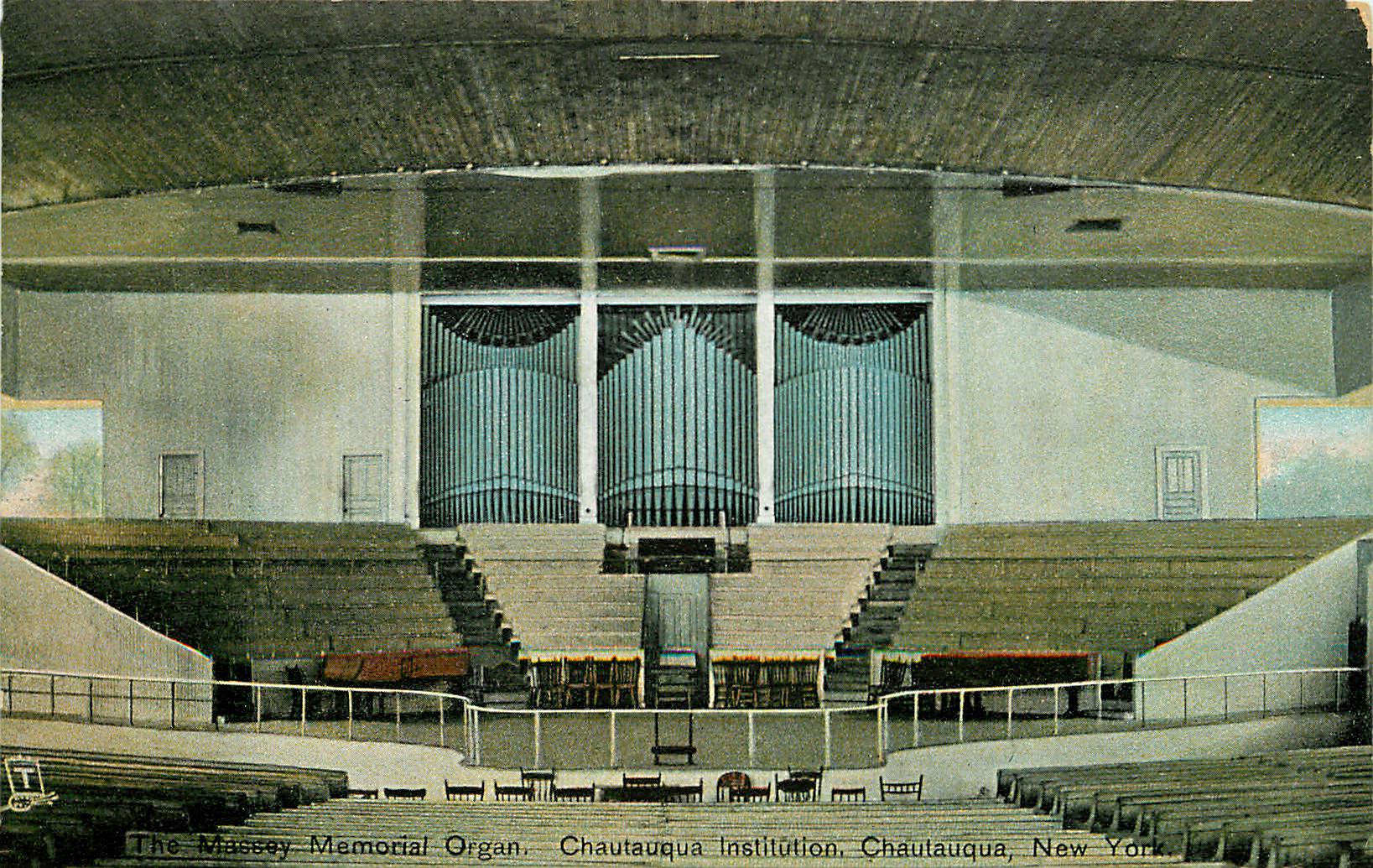
Photo of the amphitheatre stage. In the middle is an elevated platform for the organist and three large banks of organ pipes.
The Massey Memorial Organ, 1908.

This alone is large enough to hold a thousand people. It is a great sight to sit up there evenings, when the electric light makes it all as light as day and lighter, too—and see the audience. Every seat filled; six or seven thousand people making a huge half circle about the platform; then the red and blue and pink and green and white and black dresses, and shawls and ribbons and feathers and fans is just wonderful; it all looks like a very big bouquet—at least, that is the way it looked to me; but I am beginning to think that people see everything with different eyes. I heard Auntie May ask Uncle John if it did not make him think of that verse in Revelations, xx. “So a great multitude which no man could number, of all nations and kindreds and people, and tongues, stood before the throne and before the Lamb.” And Uncle John said he wondered if God saw the seal in the foreheads of all this company.

A view of the Amphitheatre from the stage in 1937.

It certainly seems as if we had got somewhere away from this world, at night, when the electric light streams far out and lights up the trees and cottages so beautifully.

I saw a lovely picture when I came home last night, only it was not painted and hung up, it was a live picture. It was a cunning little white tent with a light like sunshine on it. The red curtain was parted in front, the shadows of the leaves danced over it, and on the porch sat two pretty ladies, leaning back in their rocking-chairs resting.

It’s queer about things, isn’t it? If a great artist were to paint that and put it in a gallery how all the people would run to see it. Why don’t they gather round and wonder over pretty pictures before they are made up is what I would like to know.

Here I have written a long letter, and I have not told you yet how Chautauqua came to be. The man who thought it out and got it up, is Dr. Vincent. He and some of his friends came here one summer to study the Bible together in quiet. They thought it was a nice place, so they decided to hold a Sabbath-school assembly here the next year; from that it grew and grew to this great grand Chautauqua, where for six weeks in summer you can study anything, I think, from cooking up to all the ‘ologies and philosophies and dead languages and live languages that ever were heard of in the world, though the Bible is the chief book studied, by some of the people at least. Such grand lectures as I have been to!— not dry a bit. All the great orators speak in Chautauqua. Then the concerts, with all sorts of instruments and beautiful choruses and lovely solos. Oh, I tell you,  I’m having a good time!

The Chautauqua Regional Chorus performs at the Amphitheatre.

Uncle John says Dr. Vincent is a genius, and that the day will come when this will be a great university open the year round.

If you have any patience left after you read this, write to me, and if you want to hear more about Chautauqua I will write it, for there are whole books-full left.

Your loving friend,

Faith.

Pansy Approved Bicycles

Did you know Chautauqua Institution had its own commercial printing office? It produced brochures, maps of the grounds, programmes, daily schedules, and a newspaper called The Chautauqua Assembly Herald.

Published six days a week, The Chautauqua Assembly Herald filled eight to ten pages of every issue with news about Chautauqua, including the comings and goings of some of its residents and visitors.

On July 24, 1895 one of the newspaper’s reporters spotted Isabella’s familiar face at a concert in Chautauqua’s amphitheater:

Pansy’s placid, pleasant face was seen in the veritable sea of faces at the concert in Chautauqua’s amphitheater Wednesday. From her very looks one would judge Mrs. Alden as a woman who loves little people, even if one had never heard of the famous Pansy books.

Naturally, the reporter sought Isabella out as soon as the concert was over, and asked about her summer plans and whether she was writing anything special. Isabella confirmed she was indeed working on a story, and added:

“All of my stories, you know, are published in serial form in my magazine before they are put out in book form. My magazine work occupies most of my time.”

“For the past 19 years we have spent every summer at Chautauqua. We have our summer home here, but for many years past I have had to give up my Assembly work. I am much interested, however, in the Woman’s Club here.”

Knowing the Woman’s Club was to meet the next day, the reporter asked Isabella if she was going to read a new, unpublished story to club members.

“It is a story which not only has not been published, but which is not yet all written,” replied Pansy smiling.

Their conversation drifted into other topics, including an observation about the new phenomenon of women using bicycles as a means of getting around Chautauqua.

Studio photograph from late 1890s of young woman posed beside her bicycle. She is wearing a long dark dress with long sleeves and a high collar, and a bonnet.

Progressive-thinking Isabella had no problem with the new “wheelwomen” (as lady cyclists were called in 1895):

“I think the bicycle must offer a pleasant, healthful form of recreation to women, but I do like to see them dress inconspicuously and neatly when riding, and I do not like to see them wear bloomers.”

Photograph dated 1912 of woman standing beside her bicycle. She is wearing a long skirt, long-sleeved shirt with high collar, and a bonnet.

Any guesses which story Isabella was writing and publishing as a serial in The Pansy magazine during the summer of 1895?

It was Reuben’s Hindrances! Chapter eight of Reuben’s Hindrances appeared in the July 1895 issue of The Pansy; monthly installments continued into 1896 until all twenty-four chapters appeared in the magazine.

Grace’s Chautauqua Delights, Part 5

This is the fifth and final installment of Grace Livingston Hill’s 1894 article about Chautauqua. If you missed them, you can read Part 1 here. Read Part 2 here. Read Part 3 here. Read Part 4 here.

Recreations at Chautauqua

The Chautauqua Christian Endeavour Society should not be forgotten as a helpful influence in bringing not only the young, but all classes of people together, and making them acquainted. This society not only includes all members of the Young People’s Society of Christian Endeavour who visit at Chautauqua, but also members of any denominational societies doing similar work.

A Christian Endeavor group, 1905

Here, in the white-pillared Hall of Philosophy, they meet for an hour just at early evening, every week, and hold their prayer-meeting; and the voice of prayer and song or words of cheer, of comfort, of consecration, come from many. One other hour each week is also given to a conference, where the members compare notes on the best ways of working in various lines.

In 1892 Grace was president of the Chautauqua Endeavor Society.

Last summer the plan was enlarged and a Working Committee formed. The grounds were divided into districts, and each Member of the Executive Committee became responsible for the work in one district; putting a topic card and notices in every cottage on the grounds, and giving to all strangers invitations to Meetings and Socials of the Society. Much good work was accomplished, and many strange young people made to feel at home.

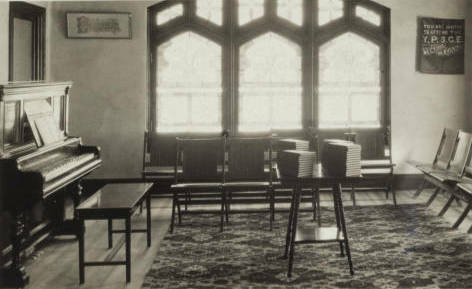
The banner on the wall reads, “You are invited to attend the Y.P.S.C.E. meeting this evening.”

There was also a room used as Headquarters, where were books and other literature relative to young people’s Christian work, and where could be found stationery and a quiet place to write or read. The registry book showed that a goodly number of young people availed themselves of this privilege.

A quiet place to read.

This Society held an Autograph Social during the season in the parlours of the hotel, which was a great success.

The Athenaeum Hotel, about 1915

Here and there you might have seen some favourite professor backed up against the wall with a double semicircle of his devoted students about him, eagerly holding their cards up, and he writing as if for dear life. But it was everywhere noticeable with what heartiness each one entered into the spirit of the hour, and demanded a name on his own card in return for every one he gave.

A collection of autographs from the early 1900s.

From this gathering it was difficult to send the people home, even after the solemn night-bell had rung; and the small boy who collected the pencils was very sleepy when the last couples left the parlour, smiling and chatting of the pleasant evening spent.

And the chimes make a beautiful ending to a day at Chautauqua. Whether you are wandering by the lake shore, or through the lovely avenues, it matters not; they are sweet. Sweeter, perhaps, just a little, as they ring out over the water, calling you in from a moonlight row or yacht ride. “Bonnie Doon,” “Blue Bells of Scotland,” “Robin Adair,” “Long, Long Ago,” all the old airs, and by-and-bye growing more serious— “Softly Now the Light of Day,” “Silently the Shades of Evening,” “Glory to Thee, my God, this Night,” and the “Vesper” hymn for good-night.

The Miller Bell Tower.

In 1894, when Grace wrote this article, collecting autographs was a popular way to preserve memories of an event. It wasn’t until 1900 when Kodak introduced their Brownie box camera that the average American could commemorate travels, celebrations, and other events with photos they took themselves.

Did you enjoy this tour of Chautauqua through Grace’s eyes?

Hopefully, her words gave you a sense of what it must have been like to visit Chautauqua 127 years ago!

Grace’s Chautauqua Delights, Part 4

This post is Part 4 of an article Grace Livingston Hill wrote about the delightful offerings for young women at Chautauqua Institution. The article was published in an 1894 issue of the YWCA newspaper.

If you missed them, you can read Part 1 here. Read Part 2 here. Read Part 3 here.

Recreations at Chautauqua

Chautauqua has attractions and social possibilities all her own. There are innumerable receptions and class gatherings, where one meets not only one’s own associates, teachers and leaders, but also many distinguished men and women from all parts of the land.

The gymnasium holds its annual reception generally with some entertainment.

The choir, under Dr. Palmer, has a reception.

Occasionally a class in botany or geology takes a day off and goes in a body to Panama, or some other interesting place, for a good time with a little study mixed in.

A Natural Science class trip, 1906.

There are receptions of all sorts and descriptions. Two years ago, one was given in honour of several returned missionaries.

To the members of the Chautauqua Literary and Scientific Circle—and there are many—there is no more interesting night on the whole programme than the one given up to their class receptions.

CLSC Class of 1913 and grads of earlier years in the Hall of Philosophy, 1913.

One of the latest developments of this place of many new ideas is the Girls’ Outlook Club.

Five mornings in a week last summer, the girls and young women gathered in a pleasant room and discussed things useful, ornamental, or nonsensical, about “Ourselves, Our Homes, and Our Neighbours.” There they compared notes on all sorts of hobbies, and carried away many helpful hints for life, the gaining of which had been but the pleasant passing of an hour together; their talk interspersed with music by some of their number, or bright, interesting speeches of a few minutes from different notable men and women.

This club filled a long-felt need in the heart of every girl who attended it. But this was not all. The entire membership was divided into small circles, with a leader at the head of each, and with some certain work for each to do. These circles were named from well-known women.

A girls’ club in 1911.

And this charming company did not keep all their good times to themselves. Once a week they had a social; a Colonial Tea, or a Cap and Gown Tea, or a Musical Tea, or a Tennis Tea, to which they invited all their friends, men and women. These were most delightful occasions. At the Cap and Gown Tea a number of college girls were attired in their caps and gowns, and were ranged in a row and called a library. The volumes were all named, and anyone in the room was allowed to draw a book and talk with her for five minutes, provided the theme of conversation was her college. Each girl had bits of ribbon in her college colours to give as souvenirs to the friends with whom she had conversed. Tiny paper caps were given as badges to all college people. The tea was voted a success.

None the less so were the entertainments which followed in the next few weeks. The Colonial Tea, where all the girls were transformed into ladies of that old-time period, with high powdered hair and short-waisted dresses, and where one circle had some mysterious symbolic puzzles arranged, was most charming.

A 1906 Colonial Tea, with guests dressed in period costume.

Indeed, both the young women and young men of Chautauqua were delighted with the Girls’ Club.

wasn’t it a clever idea to arrange college grads in a row like a library? what’s the most clever party idea you’ve ever encountered?
join us tomorrow for the final post in the series when Grace focuses on a subject dear to her heart: the young people’s society of Christian endeavor.