A Letter to the Pansy Society

In previous posts we’ve talked about the great number of letters Isabella received on a regular basis from parents and children. She made a point of answering each of them, and one of the innovative methods Isabella used to keep up with the demand was to print her replies to their letters in The Pansy magazine.

The Pansy was a weekly publication she edited, with stories, poems, Bible verses for children of all ages. In almost every issue of the magazine, Isabella encouraged her young readers to join The Pansy Society, and pledge to overcome their faults, “in Jesus’ name.”

Here’s an example from an 1883 issue of The Pansy where she encouraged Pansy Society members to continue their good deeds, and charmingly replied to children who wrote to tell her of their progress.

DEAR PANSY SOCIETY:

My thoughts toward you this summer day — my good wishes and my hopes. Do you know where the book is that holds them? It is a wide-open book. I did not write it, and yet, the thoughts and pictures it holds just express what I would like to say to you.

Open your eyes and look above, beneath, around, and see if you cannot guess my riddle.

Does not the blue sky bend in blessing over you? the trees rustle out soft, loving words? the little birds sing “cheer up, cheer up?” The clear brook, gurgling over the stones, says “be true.” The buzzing bee says “be busy.” The daisies smile up into your faces, saying “be glad, be glad,” and the white lily bell re-echoes God’s own word, “be pure.” Then the rare fragrance from mountain-top and tree and flower floating all about you this sweet day— could it say anything but, “I love you, I love you, I love you”?

And these are my thoughts toward you; these too are God’s thoughts about you, written clear and plain in the book his own hands have made.

In the springtime just passed I presume many of you have made gardens and now have lovely blossoms as rewards.

Some of our boys and girls have been hard at work sowing pansy seeds; not those royal velvet or creamy white pansies, alone —they may have sown those, too —but I am talking now about our magazine.

Among those who have done faithful work in this way, is Fanny, a little Indiana girl. When those Western girls take hold of a thing they do it with their own souls.

Some new members have come into the Society; let me introduce them. Here are two little city boys, Eddie and Bertie. They both want to be “better boys.” They can, if they go and whisper that wish to Jesus.

Here is Maggie, a little Maryland girl, Maude, too, from Maryland. She writes a plain, clear hand. May her life be as free from faults.

Bessie sends us a pretty letter three inches square, very small, but holding more and better things than we’ve sometimes found in a whole sheet of foolscap. May the dear Lord help Bessie to be a true disciple of his. We are glad to welcome her to the Pansy Society.

Then there are Willie Porter, Claire Colman, Mabel and Lena and Addie; a little Pansy by the name of Lulu in Wisconsin, and Clarence Lathrop.

Minnie is working hard to put her “bonnet and books” in their place. If she keeps on she will someday be an orderly housekeeper, and maybe some of the Pansies will go and take tea with her. Won’t that be nice?

Lillie’s teacher says she is improving. Good news!

“Speaking back” has annoyed a certain little fellow in Philadelphia by the name of Jamie. But he “has made up his mind” to drop it. Stick to that, my dear boy. Remember, too, that if you must speak back, “a soft answer turneth away wrath.”

How many Pansies, I wonder, say to their tired mothers, “wait a minute,” and want their own way every time? Amy thinks them very bad habits and proposes to have no more to do with them; that is good.

But I really must stop, so good-by.

Lovingly,
Pansy.

How exciting it must have been for a child to see their name in print in their favorite magazine! Do you think Isabella’s brief words of encouragement helped the children in their daily struggles to conquer their faults, “for Jesus’ sake”?

You can read more about the letters Isabella received in these posts:

Fan Mail and Ester Ried
Pansy’s Typical Day
A Summer Poem
A Letter from Ida White
Pansy’s Letter-Box
The Pansy Society

Talk Over What You Read

In 1891, Isabella wrote this bit of advice for parents, adults and children:

Too many readers are all eyes for what they are reading, but have neither ears to hear the questions of those who notice their absorption, nor lips to tell to others the good things they are absorbing.

There is no better training of the memory than to talk over what you read. Try it in your home. Encourage the children to give, in their own language, the substance of the last story they have read, or the last book that has been given to them. When public lectures were the “fashion,” many a home intellect was encouraged and strengthened by the request to sketch, in brief, the points and conclusions of the last lecture. The same thing can be done with books and with even more lasting and beneficial results.

Isabella’s timeless wisdom encourages us to actively engage with what we read. Her call to action — “Try it in your home” — is as relevant today as it was over a century ago.

She knew that when children are encouraged to retell a story or narrative in their own words, they strengthen their memory of what they read, and their understanding of it.

It’s interesting that Isabella mentioned public lectures. She delivered quite a few lectures herself — at Chautauqua, at church meetings and schools, and in front of small gatherings in private homes. She knew that the practice of having a post-lecture discussion wasn’t just about sharing information; it was about analytical thinking and comprehension. And she knew the same benefits apply to books. When you talk through what you’ve read, you’re not just recounting facts; you’re processing ideas, forming connections, and perhaps even challenging your own understanding.

So when you think about it, many of us have been following Isabella’s advice without even realizing it!

If you’ve ever read a book with a child, then asked them to tell you about their favorite part … If you belong to a book club where you can discuss a book’s theme, characters, or plot with others … If you keep a reading journal to jot down thoughts and questions about a book you’re reading … you have followed Isabella’s advice!

What methods do you use to deepen your understanding of what you read? Share your tips in the comments section below.

What’s one book or article you’ve discussed recently that truly stuck with you, and why?

Isabella’s Favorite Author: Elizabeth Barrett Browning

Isabella was a great reader and regularly read a variety of magazines, books, and newspapers. She enjoyed fiction, poetry, and biographies, and in the evenings, when her day’s work was done, she often read aloud to her family; she even read aloud in a Scottish brogue or other accents, depending on the characters in the book she was reading!

Being a teacher at heart, it’s not surprising Isabella would want to share her favorite stories and authors with the young subscribers of the magazine she edited, The Pansy. Several times she shared poems by one of her favorite writers, Elizabeth Barrett Browning.

Elizabeth Barrett Browning (Wiki Commons)

She frankly admitted that some people found Mrs. Browning’s poems too difficult for young people to understand or enjoy. “It is true that many, especially of her longer works, require a good deal of study, and were written for older readers” she wrote. But Isabella encouraged her young readers to try, and recommended Mrs. Browning’s “The Poet and The Bird” and “The Cry of the Children,” because they had always been favorites of hers.

In another issue of The Pansy, Isabella printed portions of Barrett’s poem “Aurora Leigh,” along with this illustration of the title character.

In 1892 she published a biography of Elizabeth Barrett Browning in The Pansy for her young readers, and it’s apparent that she admired Mrs. Browning a great deal. In the biography, Isabella tells the story of how Elizabeth was injured in a fall from her horse because she was over-eager “to do the thing she wanted to do, the moment she wanted it, and not wait for anybody.” Perhaps Isabella felt Elizabeth was a bit of a kindred spirit, because in her younger years Isabella was also impatient and had a tendency to want her own way.

She ended her biography by hinting at the admiration she had for Mrs. Browning, saying, “I have told you very little about the sweet, strong poet whose writings I hope you will learn to know and love. All I hoped to do was to introduce her and get you interested.”

You can read Isabella’s biography of Elizabeth Barrett Browning by clicking here. Please note that near the end of the biography, Isabella references an illustration for Browning’s poem “Mother and Poet,” but the illustration did not, in fact, appear in The Pansy magazine.

What do you think of Isabella’s choice of Elizabeth Barrett Browning as one of her favorite poets? Have you ever read any of Mrs. Browning’s poems? Do you share Isabella’s appreciation for her work?

A Summer Poem

As editor of The Pansy magazine, Isabella Alden received a lot of mail. Some of it was business related; some letters were from adults or from parents of children who were influenced by her books. But the majority of correspondence she received was from the children who read The Pansy magazine.

Children wrote to Isabella for all sorts of reasons. They asked her for advice, and told her what they wanted to be when they grew up. They wrote to tell her about the kindnesses they did for others in Jesus’ name, and how well they took care of their pets. Just about anything one friend might tell another friend, they told Isabella.

Some of the things children shared in their letters, wound up in the pages of The Pansy. When Isabella began publishing acrostic puzzles each month in the magazine, her young readers made up acrostics of their own and sent them in, hoping to see them published someday in the magazine. And some of them were!

Others children sent stories, essays about their travels, and poems. Isabella read them all and selected the best to publish.

In 1887 Isabella published this sweet poem that captures the essence of the summer season. It was written by fifteen-year-old Mollie Gerrish.

Wandering in the meadows,
Playing in the woodlands,
Clambering o’er the hilltops
In the summer sun,
With the little squirrels
Chasing one another—
Truly it is summer
That brings the children fun.

Summer at the seaside,
Summer in the mountains,
Summer in the country,
Summer everywhere;
How the people hasten
Soon as summer cometh,
Going far away
From city’s bustling cares.

Yes, it’s truly summer
That brings the happiest pastimes,
Though sometimes dark clouds
O’ercast the lovely sun.
But soon vacation’s ended,
And all return to duties,
For the autumn dawns upon us,
And our pleasant summer’s gone.

Mollie Gerrish

A Kiss at Chautauqua

The 2025 Chautauqua Institution officially opens on June 21. Much has changed at the institution in the last 151 years, but thanks to Isabella Alden and her contemporaries, we can piece together what it was like to spend a summer at Chautauqua in its early days.

Before there were cottages and meeting halls, Isabella and her family spent their summers sitting on rough wooden benches as they listened to lectures in the open air, and sleeping under the stars or in tents.

The photo below was taken about 1876, which was the second year of Chautauqua’s existence. Isabella was only thirty-five years old, but she was already quite famous.

She was the best-selling author of over a dozen novels, including the first four books of her “Ester Ried” series. And The Pansy magazine was in its third year of publication, with Isabella as editor and chief contributor of stories and articles.

In those early years The Pansy magazine was sent every month (it later became a weekly magazine) to thousands of children. Isabella called each of her young subscribers her “Pansies.”

While at Chautauqua one day that summer of 1876, Isabella was walking through the grove, which was one of her favorite spots at Chautauqua. She wrote:

Chautauqua is so beautiful this year. Don’t you know, I met today one of the little Pansies! As I was walking through the grove, there came a sweet-faced little girl to me, and she said in a low, sweet voice:

“If you please, I live in Ohio, and I’m going home today, and I’d like so very much to kiss you, then I could tell all the little girls that I kissed Pansy.”

You may be sure that I gave her the very warmest kiss I had, and told her to tell all her little Pansy friends that part of the kiss was for them.

A ladies’ magazine once printed an article about Isabella and commented that one of the strongest and most attractive elements of her character was her humility in regard to the great good she accomplished through her writing. But in truth, she was keenly aware of the power she had over her readers, and she always used that power to help them come to know and love the Lord Jesus Christ. Just think of the story the little girl in the grove told to her friends back in Ohio! How many of her little friends do you think were influenced to know and love Jesus, all because of Isabella’s kindness to a child and that one little kiss?

A Feast of Good Things

Have you ever wondered what it would be like to be famous?

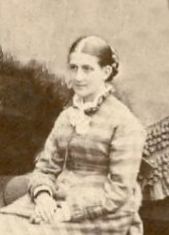
Black and White photo of a woman almost in profile. Her hair is a light color, parted in the middle of her head, and pulled back to form a large braided bun at the back of her head. She wears a dress with a high ruffled collar trimmed in white lace; a white lace jabot falls from the high collar down the front of her dress.
Isabella Alden circa 1880

Imagine walking into a room filled with people who burst into applause as soon as you enter. Then imagine that you’ve agreed to speak at an assembly that’s filled to overflowing with people, seated and standing in every available space, who hang on your every word.

That’s a little taste of what life was sometimes like for Isabella Alden. Today it might be hard for us to understand just how famous and beloved she was by people across the country. In a time before social media, television, and radio, Isabella had a nation-wide reputation as both an author and as a respected and knowledgeable public speaker on a variety of topics, including the development of Sunday-school lessons.

In 1886 Isabella and her husband, Rev. G. R. Alden, were living in Cleveland, Ohio, where Rev. Alden was pastor of a Presbyterian church. But when he wasn’t preparing sermons, and she wasn’t writing novels and stories for Christian magazines, the Aldens traveled the country to help churches design and implement well-organized, robust Sunday-school curriculums.

In June of that year they were invited to attend a conference in Wellington, Kansas, where the local churches hoped to find a way to better manage their Sunday-school offerings to children and adults. The Aldens accepted.

Newspaper clipping: A Sunday school institute will be held at the Presbyterian church June 13th, 14th, and 15th. The services of Mrs. Alden of Cincinnati, the well-known authoress of the "Pansy" books, has been secured, and it is expected that the interest of the institute will be greatly increased by her presence. She will also take part in the celebration of children's day on Sunday, the 13th. All Sunday school workers of the city and country are invited to attend and participate in the work of the institute.
From The Conway Springs Star (a Kansas newspaper) on June 11, 1886

As soon as the local newspapers announced that Isabella Alden would be among the featured speakers, the churches were guaranteed to have an excellent turnout for their conference.

Newspaper clipping: The committee in charge of the arrangements make this further announcement: “We desire again to call the attention of all parents, Sunday School workers, and especially all young people, to this unlooked for opportunity to meet and greet Mrs. G. R. Allen [sic], “Pansy.” She is known and loved as the author of such helpful and thrillingly interesting books as “Ester Ried,” “Four Girls at Chautauqua,” “The Hall in the Grove,” “One Commonplace Day,” etc. Her engagement with the State Sunday School Assembly at Ottawa, Kansas, brings her west at this time and we trust that a “crowded house” will show our appreciation of the extra effort she is making to come to Wellington. The other speakers from abroad, and those among us who have kindly agreed to assist in these meetings, will give us a feast of good things. Come everybody and enjoy the feast.
from The Monitor-Press (Wellington, Kansas) June 11, 1886

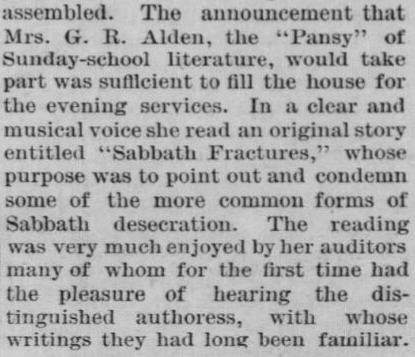
Here’s how the local newspaper described the scene on the first night of the conference when Isabella made her appearance:

Newspaper clipping: The announcement that Mrs. G. R. Alden, the "Pansy" of Sunday-school literature, would take part was sufficient to fill the house for the evening services. In a clear and musical voice she read an original story entitled "Sabbath Fractures," whose purpose was to point out and condemn some of the more common forms of Sabbath desecration. The reading was very much enjoyed by her auditors many of whom for the first time had the pleasure of hearing the distinguished authoress, with whose writings they had long been familiar.
from The Wellington Monitor, June 18, 1886.

The meetings began on a Monday afternoon and Isabella took an active role, according to the agenda:

Newspaper Clipping: "Mention was made last week of the county Sunday school institute which will be held at the Presbyterian church on Monday and Tuesday, June 14th and 15th. The programme as published below shows many features of interest that ought to attract a large attendance of the active Sunday school workers of the county:" Follows an agenda including a "Primary conference" on Monday afternoon and a "Paper" reading Monday evening by Mrs. G. R. Alden, "Pansy."
from The Wellington Monitor, June 11, 1886

In one of the sessions she spoke about how to design Sunday-school lessons for children in the Primary Class age range of four to eight years:

Newspaper clipping: She sketched briefly and clearly a plan of work among the younger classes in the Sunday school that long experience had shown to be attended with the best results. She favored the division of the primary pupils into small classes of not more than seven members each, which should be taught if possible in a room separate from the rest of the school.
from The Wellington Monitor, June 18, 1886

In another session she participated in a discussion on the proper way to prepare teachers for the work of teaching meaningful lessons:

Newspaper clipping: Mrs. Alden conducted a conference on her favorite theme of primary work, of one hour’s duration. The spoke strongly against teaching children misty doctrines of general truth, of which the teacher lacked the skill to make definite application. The children’s quickness of apprehension, even at the earliest age when they enter the primary class should not be underrated. The danger of simply interesting the children with recitations of Bible stories, without bringing out the spiritual lessons they were meant to teach, was one point to be guarded carefully against.
from The Wellington Monitor, June 18, 1886

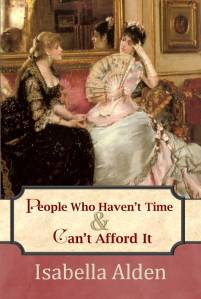
On Monday evening she read one of her short stories, “People Who Haven’t Time and Can’t Afford It,” which, the newspaper reported, “held the close attentions of the audience in spite of the discomforts of the crowded room.”

The rest of the conference was similarly busy for Isabella. The last night of the conference was “attended by an audience larger than the seating capacity of the church.” Isabella closed the evening session by reading a paper she wrote about “the Penn Avenue Church” and the difficulty the church had raising money for Sunday school purposes and for books to stock a small church library.

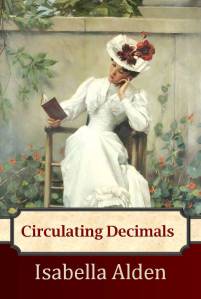
Eventually, Isabella revised that “paper” into a short story called “Circulating Decimals,” which was published two years later.

By every measure, the 1886 Sunday School Institute in Wellington, Kansas was a resounding success.

Newspaper clipping: The institute from every point of view was a great success, both as arousing new interest in the cause on the part of the Sunday-school workers of the city and county, and acquainting them with new methods of instruction. It will undoubtedly lead to the formation of a permanent county organization and the frequent and regular holding of similar institutes and conventions in the future.

And with Isabella’s many contributions—from offering practical advice to reading stories with a message—it truly was a “feast of good things.”

One final note:

Isabella may have been a famous celebrity, but when she and Reverend Alden made these trips, they rarely stayed in a hotel. Instead, they were usually invited to stay in the home of one of the local church members. In Wellington, Kansas, they stayed in the home of George and Laura Fultz. Mr. Fultz was a leading businessman in Wellington, and he and his wife were active members of the Presbyterian church.

Black and white photo of a man in profile. He wears wire rimmed glasses and his hair is wavy and dark. He is dressed in a dark suit of clothes that would have been in fashion in the 1890s. He wears a dark bow tie and has a high starched shirt collar.
George Fultz

How lucky were Mr. and Mrs. Fultz! Isabella and her husband stayed with them for five nights. Imagine having your favorite author sit at your dinner table, join you in a morning cup of coffee, or share an evening on your front porch, relaxing and watching the sun set together after a full day of meetings.

If you were fortunate enough to have Isabella as a guest in your home, what kind of questions would you ask her?

All of the short stories mentioned in the post are available for you to read for free. Just click on any of the highlighted titles or cover images to download your copy from Bookfunnel.com.

Proof of Our Allegiance to Christ

Isabella was a teacher at heart, and one of the things she enjoyed teaching the most was how to read and study the Bible.

From an early age she developed a life-long habit of reading the Bible every morning, and she encouraged others to do the same. She regularly made notations and shared Bible verses that helped strengthen her daily walk with God, and she shared those notations to inspire her readers to make a study of their own.

One example was “Daily Thoughts,” a monthly list of Bible verses she personally selected, to be read individually, one per day, for an entire year. (You can read “Daily Thoughts” for January by clicking here.)

Her “Daily Thoughts” differed from other Bible devotionals of her time because Isabella didn’t print the actual verse; she only gave the citation, so her readers would have to open their Bibles to read the verses themselves. She did, however, include a brief question or comment about each verse to help her readers better understand it.

Other times, she paired her study of the Bible with an interesting biography, novel or sermon she recently read. For example when her studied I John, 4:1-21, she gave the Bible chapter a title: “The Proof of Our Allegiance to Christ.”

Then, beside individual verses in the chapter, she noted a word or two about how that verse instructed her to act as someone who loved and followed Jesus:

v. 1.           Thoughtfulness
v. 2.           Confession
v. 4.           Victory over error
v. 5.           Unworldliness
v. 6.           Willingness to hear and heed the truth
v. 7.           Love
v. 8.           Love
v. 9.           Our lives
v. 11          Love  
v. 13          Love
v. 14.         The spirit that is in us
v. 15.         Confession
v. 16.         Love
vs. 17, 18 Fearlessness or courage
v. 21          Love

To this she added a beloved quotation from a sermon she had read by Rev. Charles Stanford, and which she felt perfectly summarized I John, chapter 4:

“Jesus asks not that our love should equal his, but resemble his; not that it should be of the same strength, but of the same kind. A pearl of dew will not hold the sun; but it may hold a spark of its light. A child by the sea, trying to catch the waves as they dash in clouds of crystal spray upon the sand, cannot hold the ocean in a tiny shell; but he can hold a drop of the ocean-water.”

WHAT DO YOU THINK OF THE METHODS ISABELLA USED TO STUDY THE BIBLE?

DO YOU HAVE A FAVORITE WAY TO READ AND STUDY THE BIBLE?

Things Some People Regret

In 1891 when Isabella Alden was the editor of The Pansy magazine, she took up a very special project on behalf of her readers.

She wrote to several prominent Christian leaders and asked them to share the one thing they wished they had done, or not done, or managed differently in their lives.

Banner that reads "Things Some People Regret" in an old-fashioned Victorian type. Beside the text is a single pink rose.

Quite a few of the replies she received were from well-respected ministers who had regrets about their early Christian life. Here are a few:

“I regret that in my boyhood I did not read the Bible more, and did not memorize a greater number of its most precious promises.”

E. Hez Swem
Pastor, Second Baptist Church, Washington D. C
.

Old black and white portrait photograph from about 1890 of a middle-aged man. He is balding and his hair is closely cut. He wears a dark suit with a vest, white shirt with a high collar, and a white bow-tie.
Pastor E. Hez Swem

“My most painful regret in regard to my early life is, that I did not become a member of the Church before my mother died, that she might have carried into eternity the comfortable knowledge of the fact that her only child was on the Lord’s side, a thing she greatly desired. It was simply postponing my public profession; and she died without the sight!”

Charles F. Deems
Pastor of the Church of the Strangers, New York, New York

“There is nothing in my life that I regret so frequently and so deeply, as that I was not a more earnest and active Christian during the years of my college life. A professed Christian when I entered the institution, though without a thought of the ministry of Christ, my life was largely one of spiritual idleness. It was in the future that I hoped to serve my Master. Present opportunities were neglected.”

Rev. Henry Darling, D. D.
President of Hamilton College

Old black and white portrait photograph from about 1890 of an older man. He is clean shaven and his wavy hair is white or grey and arranged neatly. He wears a dark suit with a white shirt and high collar, and a dark bow-tie.
Rev. Henry Darling

Some of the responses were about not making the most about the time they were given:

“I look back over my life and feel as if I had walked like one with a string of priceless pearls in his hand, and the cord had been carelessly broken, and they had slipped off one by one as I walked, and were forever lost. Only the days are so much more precious than pearls!”

J. H. Ecob, D.D.
Pastor Second Presbyterian Church, Albany, New York

“The great regret of my life is my failure to realize the value of life till the larger part of it has slipped away. I have always been what might be called “a busy man,” but the thing which troubles me is, that I have for the most part been busy with trifles, and have trifled so much with life’s real business.”

P. S. Henson
Pastor, Baptist Church, Chicago, Illinois

A few wrote about not recognizing the value of opportunities they let pass:

“I greatly regret an early want of thoroughness. I was too willing, in my early days, to let a hard thing balk me. Such an enemy of early unthoroughness has been in my late days a miserable and plaguing nuisance.”

Rev. Wayland Hoyt
Pastor, Baptist Church, Minneapolis, Minnesota

 “I regret having failed to understand the value of such accomplishments as may be gained along with a more substantial education. For instance, I do not know music, so useful to a pastor, as well as so important to a father as an aid to making his home pleasant to his children. I might easily have gotten it in spare hours at any time before entering my profession; but now there are no spare hours! This is only one of several things that I once underestimated, but whose value I now see very clearly.”

Dr. Teunis S. Hamlin
Pastor of President William Henry Harrison
Pastor, Church of the Covenant, Washington, D. C
.

Old black and white portrait photograph from about 1890 of a man in his thirties or forties. His hair is closely cut and he wears a neatly trimmed beard and mustache. He wears a dark colored suit with a white shirt and white tie.
Dr. Teunis S. Hamlin

Isabella and her husband were close friends with Rev. George Hays, who wrote the next “regret.” She noted that despite Rev. Hays’ many plans for his life, he was instead “led, as a child, by his Father’s hand.”

“The number of foolish ambitions that entered my head when young was large. The hard work done to fit myself for places from which God’s good providence saved me, is not any part of my regrets. Not one of the positions I wanted did I ever get.”

Rev. George P. Hays, D.D., LL.D.
Pastor Second Presbyterian Church, Kansas City, Missouri

Some “regrets,” like this one, were about showing kindness to others:

“I regret that I have not better acquired the art of pleasantly acknowledging the kindnesses shown me, and of showing my appreciation of people whom I really do appreciate. My influence with many would be greatly increased if I could but make them understand how warmly my heart goes out to them.”

Dr. William J. Beecher
Professor of Hebrew in Auburn Theological Seminary

Old black and white portrait photograph from about 1890 of an older man. His hair is closely cut and he wears a beard, but no mustache. The top button of his suit coat is right below his neck. Beneath it he wears a white shirt with a high collar that covers his neck, and a necktie arranged with a large knot.
Dr. William J. Beecher

Last, but not least, is a letter Isabella received and almost didn’t share, because she didn’t want it to appear she was praising her very own magazine:

“The greatest regret that I have for lost opportunities in my youth is that I did not have the benefit of such magazines as The Pansy. No amount of reading in after years can make up for this serious loss in youth. I feel this so keenly that I seek every opportunity in my lectures and writings to impress upon parents the necessity of feeding the minds as carefully as they are wont to feed the bodies of the young immortals entrusted to their care. So I thank God for The Pansy, which has such a sweet, tender, yet strong way of putting thoughts into the heads and hearts of the young people.”

Helen M. Gougar
Attorney, newspaper journalist, and women’s rights advocate

Old black and white portrait photograph from about 1890 of an older woman. Her hair is white and is styled in a loose arrangement at the top of her head. She wears a dark dress with a high collar that fastens down the front. In between fastenings she has inserted a few flowers.
Helen M. Gougar

There are many adults today who will agree with Mrs. Gougar!

WHAT DO YOU THINK OF THE REGRETS THESE CHRISTIAN LEADERS SHARED?

WHAT REGRETS WOULD YOU ADD TO THIS LIST?

Going West

Isabella Alden and her best friend Theodosia Toll (who wrote novels and stories under the pen name Faye Huntington) were as close as sisters. Although they both lived in New York state—Isabella near Johnstown and Theodosia near Rome—their homes were over seventy miles apart. Despite the distance, they visited each other often, and were well-loved “adopted” members of each other’s family.

Isabella stayed at the Toll family home so often, she came to know the neighbors, and became close and dearly-loved friends with them, as well. From simple family dinners to celebrations of major life events, the Toll family and their neighbors included Isabella among the invitees.

So, when Mr. and Mrs. Hall—one of the Toll neighbors—decided to commemorate their fiftieth wedding anniversary with a party, Isabella received an invitation. At the time, she was a married woman, living with her husband in Indiana, where he was pastor of a Presbyterian church; but Isabella did not want to miss the occasion. She made the journey to New York, and a few years later, she published an account of the family and their remarkable history:

GOING WEST SEVENTY-FIVE YEARS AGO.

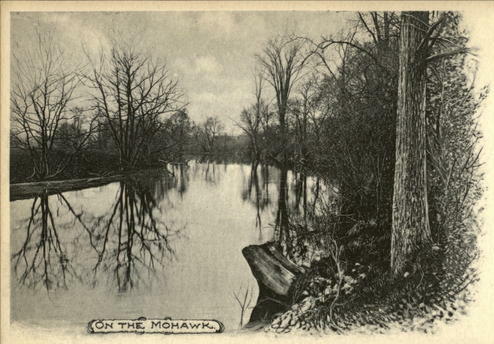
Seventy-five years ago young Samuel Hall left his wife and babies in the old home in the Connecticut Valley and came into what was then “the West” prospecting. If you look on the map, following the Mohawk River along its westward course, to where it seems to turn to the north, you will find its source in that direction.

Old black and white photo of the Mohawk River as it winds through a forest of trees.

Just to the west of this turn you may find the city of Rome set down; not the Rome of ancient and sometimes fabled history, but our quiet little city of Central New York, known before the Revolutionary War as Fort Stanwix, and during the war as Fort Schuyler. It was Fort Schuyler which was besieged by Colonel St. Leger in 1777. He had under his command an army of British soldiers, some Americans who favored the Royal party and were known as tories, and a large number of Indians. About seven miles east of the fort, at Oriskany, a company of American soldiers, on the way to help the people at the fort, fell into an ambush and four hundred of them were killed or taken prisoners by the Indians. General Herkimer was so badly wounded that he died a few days later. I have been upon this old battle-ground and seen what is left of the tree under which they say the brave old general lay after he fell from his horse.

It was here on this historic ground that young Mr. Hall determined to make a home for his little family. Striking out from the then small village of Rome, he passed through, dense and unbroken woods, not only unbroken, but untrodden. A narrow trail led to some small settlements further on. At length his choice was made, the home was located. It was spring, and soon a clearing was made, ground plowed and corn planted. A cabin of logs was built—things made as comfortable as possible. Then he went back for his family, expecting to return in time to harvest his crop of corn and get settled for the winter. With two strong horses and a covered wagon such as was called an “emigrant wagon,” he conveyed his family and all their household goods to the new country.

Pencil and charcoal drawing of a covered wagon pulled by two horses, at a stop beneath a large tree. A man stands at the head of one of the horses, holding its bridal. A woman and a child can be seen riding in the front of the wagon.
Sketch of an “emigrant wagon” Isabella included with her history of the Hall family.

What a sad parting that was which took place as they all left the old home. It was then a long way to Central New York! Farther than half around the world would seems now! Mails were infrequent, so that communication as well as visits must necessarily be rare. Day after day for more than a week they rode until one morning a few hours only after they broke camp, they came out upon a rise of ground where there was a clearing before them, and Mrs. Hall exclaimed, “What a pretty view!”

There was a stream of water winding through the valley, and Mrs. Hall afterwards said:

“I never dreamed it was to be my home, but I thought it was the prettiest spot I had ever seen, and I have never changed my mind about it.”

And it was home. Upon the brow of the hill stood their cabin in which they were soon settled. And after a little the neighbors began to call upon these new-comers. Their nearest neighbor was two miles away! Three miles in another direction was the second! These settlers had helped the young pioneer with his log-rolling and now came with their wives to welcome the family.

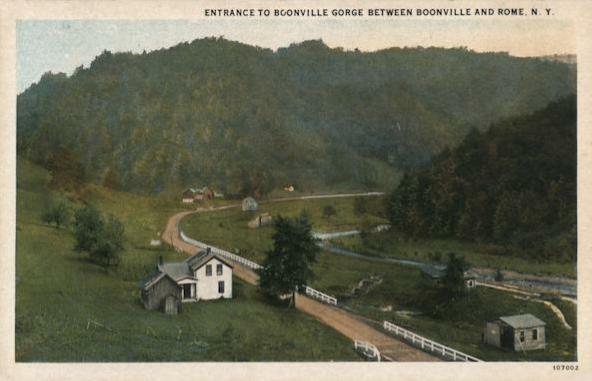
Hand-colored photo (undated) of a farm nestled in a lush green valley between two hills. There is a dirt road bordered by a white picket fence that leads to the white farmhouse. A few outbuildings of different sizes are present.
Undated, hand-colored photo of a farm near Rome, New York.

Soon others came to settle near them, then others, until the whole country was inhabited. A schoolhouse and a church were built, and presently a large frame-house took the place of the little log one, and the children grew up and married, and the old people lived on in the same place till they went to their home above.

Only a few years ago, not many months since, I attended a golden wedding in the old house; one of the little ones who travelled in that emigrant-wagon on that long, slow journey up the valley of the Connecticut, winding through the passes of the range of hills that bounds the New England States on the west, then keeping to the low ground of the Mohawk Valley. One of these had been fifty years married, and relatives and friends came together to celebrate. Some of the guests had likewise travelled in emigrant-wagons and lived in log-cabins, and the younger ones gathered around to listen to their stories of pioneer life, and some way, as we listened to these reminiscences, we seemed to be living in a very tame period.

We said within ourselves, “What wonderful material these people have for story-telling. We shall have nothing like it to tell our grandchildren when we are old.”

We never rode in a great canvas-covered wagon, nor hunted a bear, nor were lost in the woods, nor rode forty miles to mill and the post office. But one old lady summed it all up by saying:

“Marvellous are the ways by which the Lord has led us.” That comforted us; we could say that.

Do you have family stories that have been handed down through generations?

The Voices in Isabella’s Head

There’s no question that Isabella Alden was a talented writer. The plots for her novels were inventive and realistic, and each of her characters were carefully drawn.

Her niece, author Grace Livingston Hill, wrote that when she was old enough to learn to read, she “devoured [Isabella’s] stories chapter by chapter.” And when Isabella wrote the final chapter to one of the novels she’d been writing, the family often crowded around her, knowing Isabella would read her work aloud. Grace said:

“We listened, breathless, as she read, and made her characters live before us. They were real people to us, as real as if they lived and breathed before us.”

Four young women sit in a Victorian era room with bookcases lining one wall. One woman reads a book with her back to the others. Another woman reads a book aoud to two others.

They were probably real people to Isabella, too. When she was interviewed in 1892 for a Philadelphia newspaper, she talked about her writing process. For many years she used a typewriter to write her stories (you can read more about that here), but by the time she was interviewed for the newspaper article, she was using dictation. It greatly increased the speed with which she wrote her books, and added an inadvertent element of entertainment to the task. Here’s how it was described in the article:

“The morning hours are devoted by Mrs. Alden to her literary work, and a person standing in the hall in front of the studio door is highly amused to hear the animated conversation with the varying tones indicative of stern displeasure, then of baby prattle, to be followed soon by the earnest and softened accents of the lover’s pleading; a monologue by Mrs. Alden as she personates her various characters. They are all seen in life, they must all appear in her books.”

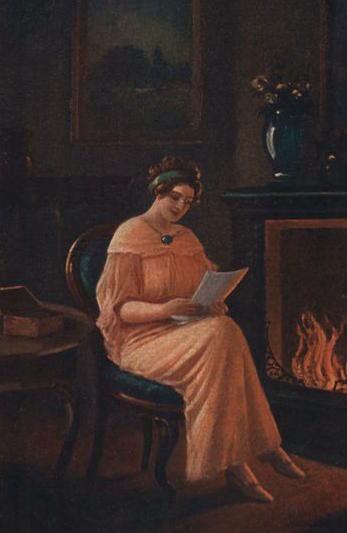
A young woman sits in a room near a fireplace where a fire is burning. She wears an orange dress from about the year 1910 and holds a large sheet of paper she is reading.

Isabella’s characters seem alive and real to us because she wrote about the kind of average people we meet every day; and when her characters come to a crossroads in their lives and face tough decisions, we understand what they’re going through because we (or someone we know) has dealt with similar situations. Her characters cause those of us who read her books to search our own hearts and “see ourselves as God saw us.”

In a dimly lit room, a woman stands near a table with a lamp on it. She holds a piece of paper she is reading. On the table is a tea pot and two tea cups and saucers. Seated at the table is another young woman who is listening.

Grace wrote that Isabella’s characters “still live within our memories like people we have known intimately and dwelt among. Ester Ried and Julia Ried, the Four Girls at Chautauqua, Mrs. Solomon Smith—I almost expect to meet some of them in Heaven.”

Do you have a favorite character from Isabella’s books?