Postcards from Chautauqua: On a Pilgrimage

Karen Noske joins us again to share photos and descriptions of the Chautauqua landmarks she explored this summer, with Isabella Alden’s novels in mind. Welcome back, Karen!


My next objective was the Hall of Christ, as there was an archival lecture to be given momentarily on one of the most influential early religious leaders at Chautauqua, the renowned Shailer Mathews.

I imagined how Isabella might have felt, sitting in this arena, listening to contemporary reflections on the man whose influence changed the course of the Institute in so many ways.
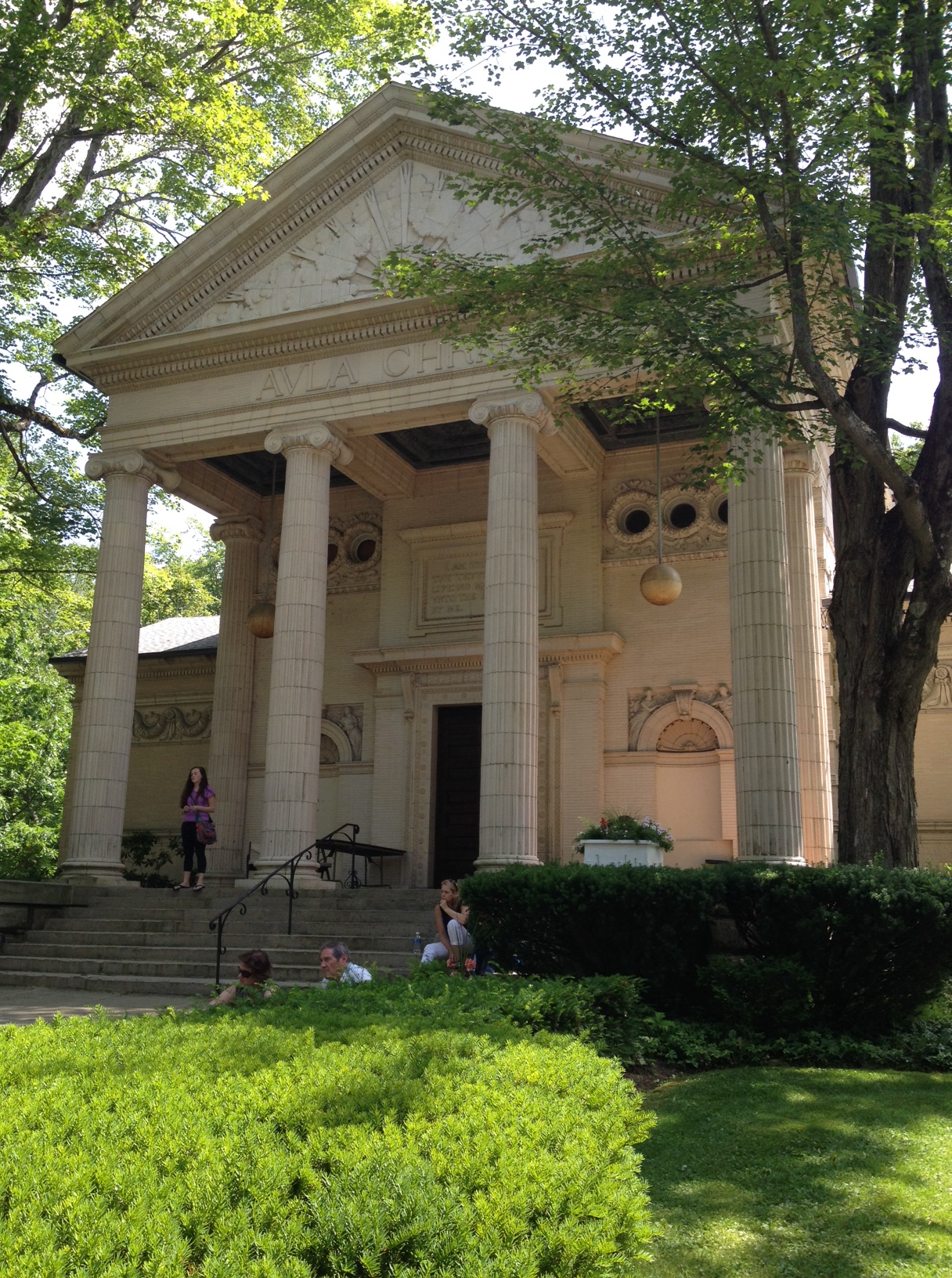
The Hall of Christ, as it appears today.

.

“The Hall of the Christ, is first of all, to stand in the center of Chautauqua to represent Christ as the center of all learning and all true living; the Key to the true and eternal wisdom…a Hall where Jesus Christ is enthroned; where only his story is allowed; told in print and picture and sculpture and the human voice. Isn’t it grand!”

(Four Mothers at Chautauqua)

The workmanlike interior of the unprepossessing Hall of Christ makes me wonder if there haven’t been many changes to it over the years.

The Hall of Christ as it appeared in 1909

.

The general atmosphere is one of beneficent neglect and exhaustion. A magnificent organ dominates the stage—sadly, it was eclipsed by the speaker’s screen and I only got this tantalizing glimpse of it.

.

Engrossing as the lecture was, I was glad to make my way out towards my next objective—the centerpiece of Chautauqua for Isabella and, as it turned out, for me.

The Hall in the Grove

Directly adjacent to the Hall of Christ is the cherished “Hall in the Grove.” I recognized it immediately by its prominence and its beauty:

“If you have up to this time been even a careless reader of this volume, you have doubtless discovered that the center of Chautauqua life was the ‘Hall in the Grove.’ A beautiful grove, with trees old enough and grand enough to be worthy of their baptismal name—”St Paul’s Grove.” White-pillared, simple, plain, yet suggestive of such a brilliant past and hinting of such a glorified future … this bit of green and white, with a glimmer of lake between.”

(The Hall in the Grove, page 286)
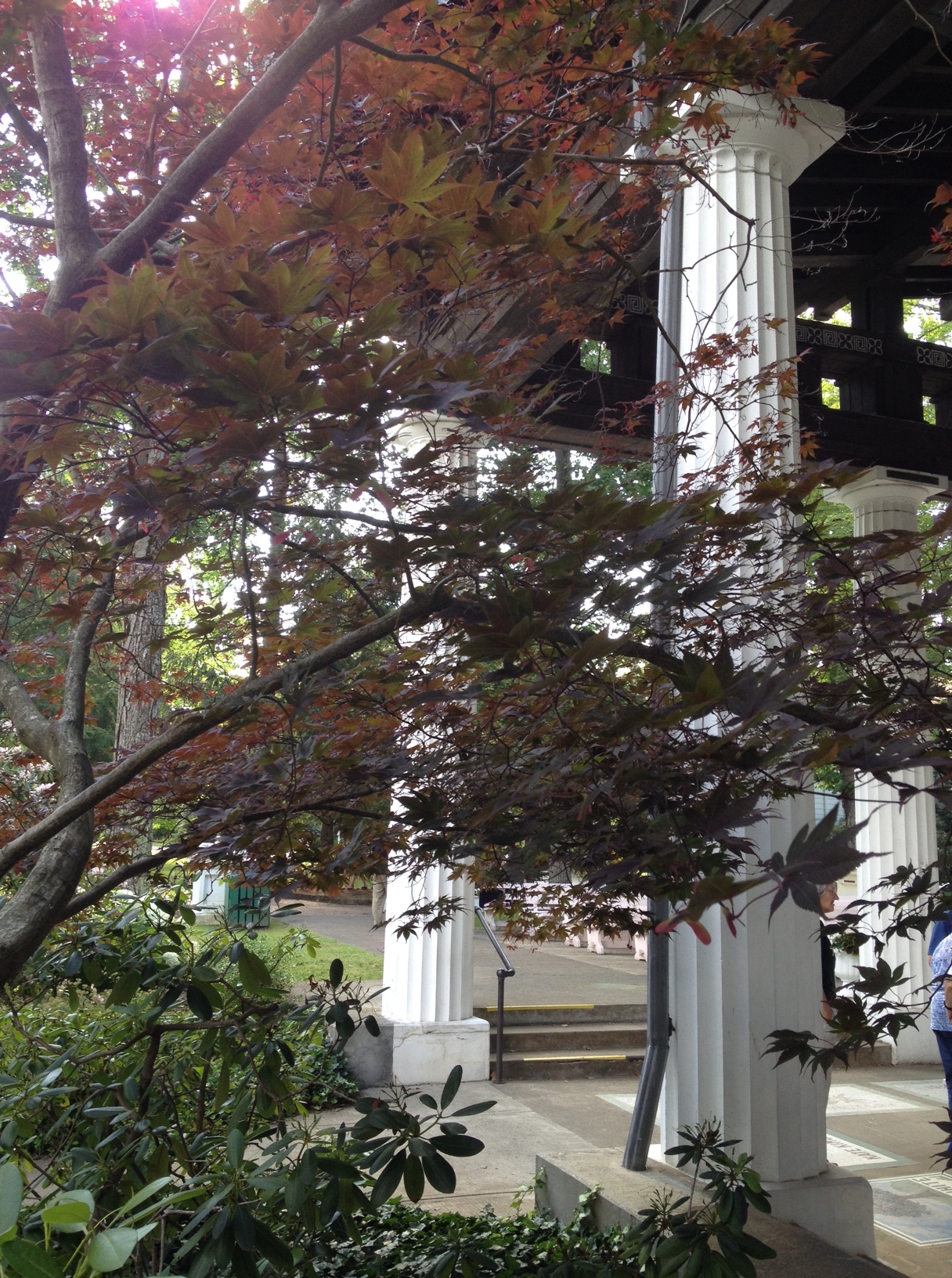
.

The dedication plaque on the “Hall in the Grove” reads, “Erected in 1900 on the site of an earlier wooden hall placed here in 1879. This building was erected by the generous gifts of members of C.L.S.C. classes and other friends of Chautauqua.”

.

A talk by the very popular Bill Moyers (of CBS News fame) was just finishing up, so I crept in around the edges and starting following the elaborate and beautiful mosaics that frame the lecture hall’s floor.

“All was quiet there. The sunset meeting which had been held in that white, still place was closed sometime since, and their feet, as they stepped on the floor, resounded throughout the vacant Hall.”

(The Hall in the Grove, page 240)

I was delighted to find the shield of Pansy’s Class of 1887 in a place of genuine honor—nestled around the corners of the lectern.

The lectern platform itself is still a modest affair, virtually unchanged since Pansy’s class approached to celebrate their graduation. Let’s join Paul Adams from The Hall in the Grove here:

“Arrived at the white, quiet building, he entered it with soft tread, and, under an impulse which he did not in the least understand, uncovered his head. He stepped softly onto the platform, drew the armchair, which was the seat of honor, forward a trifle, and settled himself in it. Then he brought up before him in review the many and varied and wonderful experiences which the weeks had brought him in connection with that spot … Then he got down from the professor’s chair and … after a silent last look at the Hall, he walked home with Joe, they two speaking words together that were better than marble columns or millions of money, for they represented manhood.”

(The Hall in the Grove, page 382)
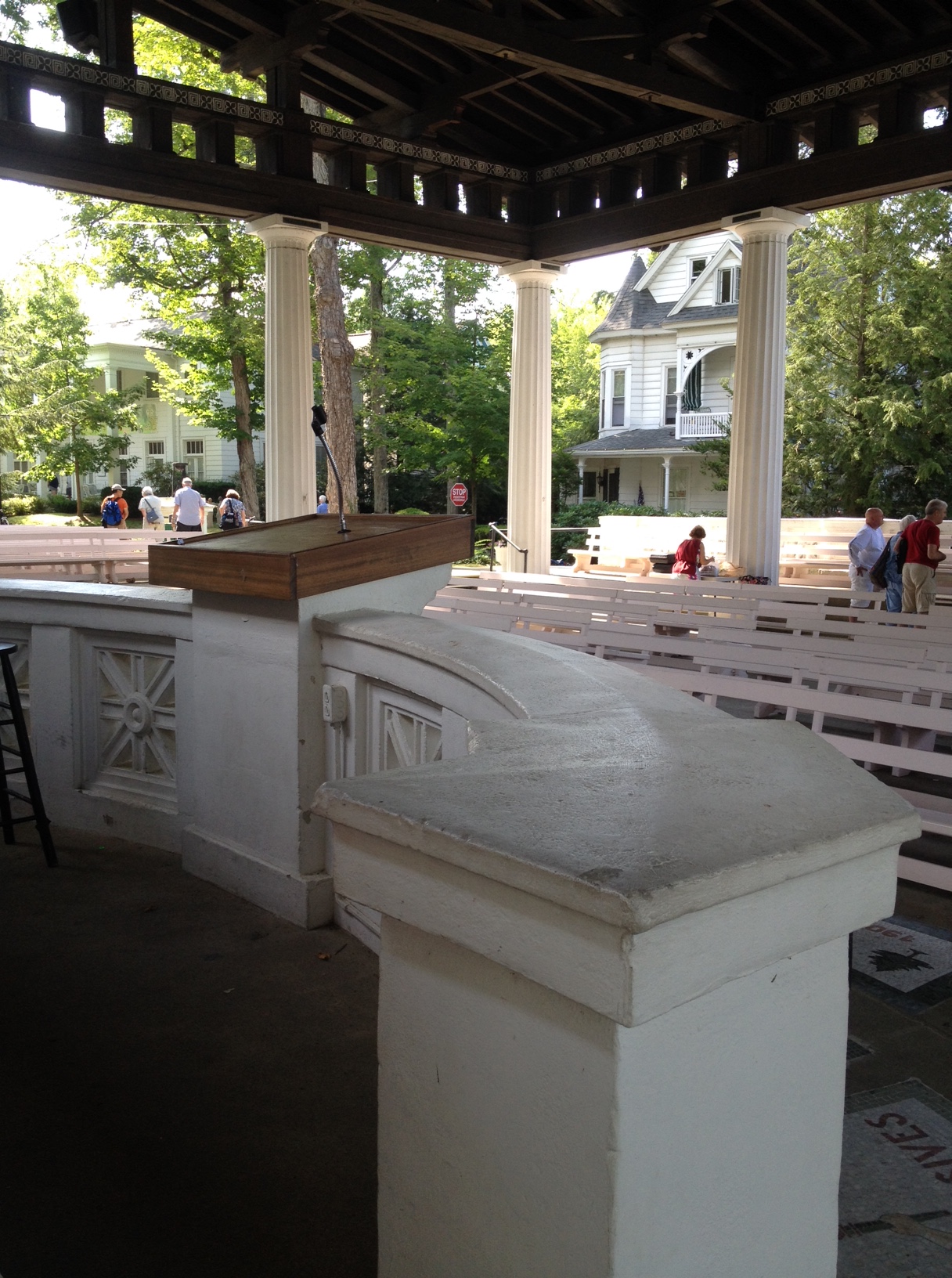
In The Hall in the Grove, Isabella shares a peek into her heart:

“…the gleaming pillars of the Hall of Philosophy rose up before him; something in the purity and strength and quaintness seemed to have gotten possession of him. Whether it was a shadowy link between him and some ancient scholar or worshiper I cannot say … but treading the Chautauquan avenues for the first time … his young heart thrill[ed] with a hope and a determination, neither of which he understood, every time he saw those gleaming pillars.”

(The Hall in the Grove, page 198)

When Caroline Raynor (another character in The Hall in the Grove) objects to the Hall being made in the style of a Temple of Minerva, she is vigorously corrected by her soon-to-be suitor, Robert:

“I like it exceedingly. Let the beautiful white temple be rescued from its heathen desecration and dedicated to the service of the good and true God our Father, and his Son Jesus Christ.”

(page 204)
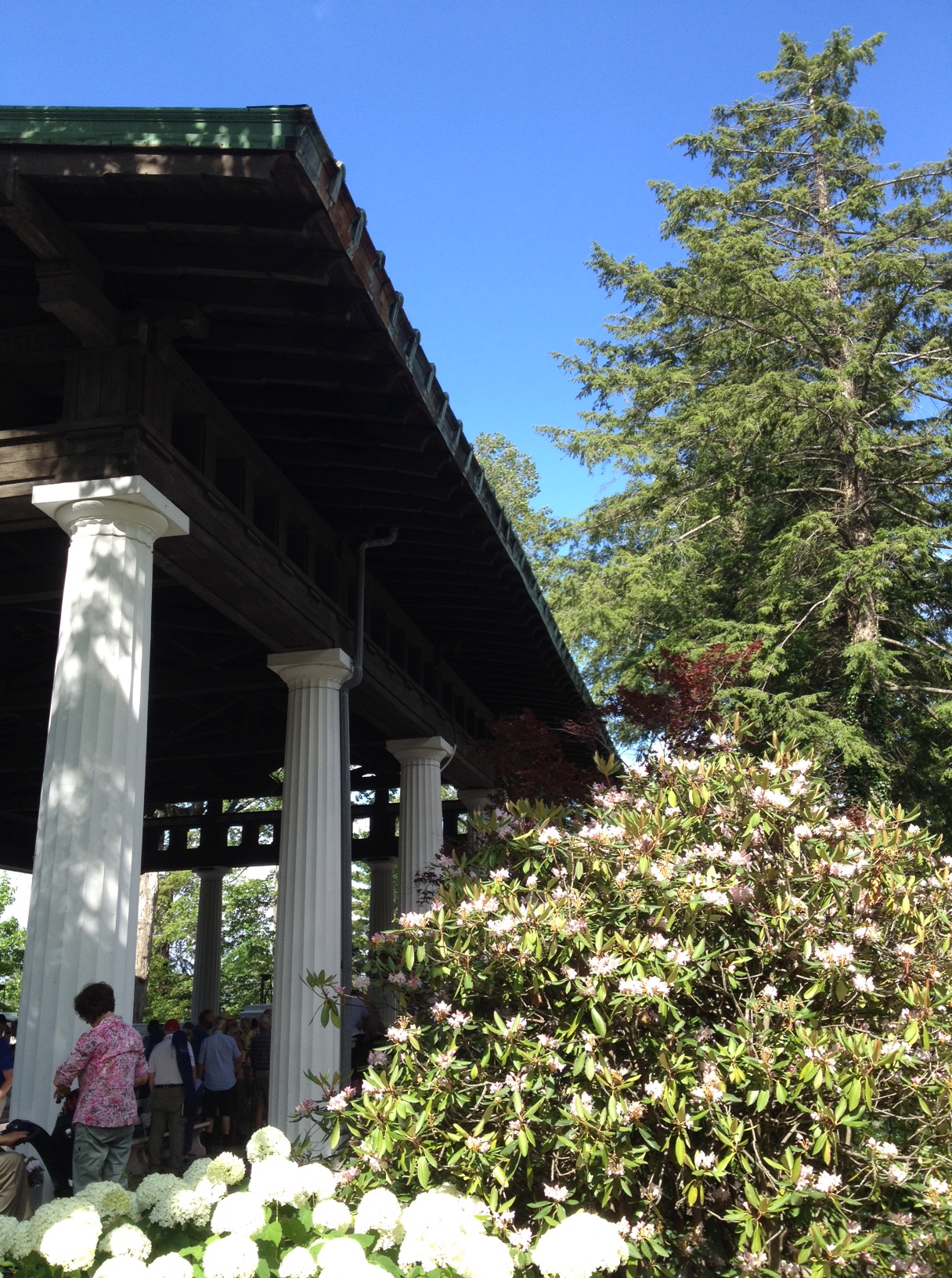
I passed an ancient oak near one of entrances that was garmented in ivy and wondered … if I parted the ivy, would I find a lichen-crusted carving in the tree reading “Vine, 22, 1887”? (EightySeven, page 12.)

I surely saw what Dr. Winter Kelland did when …

“he and Vine walked … around under the hill, and up the hill, and come out beside the white-pillared hall and stopped under one of the tallest trees, and looked about them, and were silent. Dr. Kelland took off his hat and looked up reverently to the very top of the tall tree, beyond the top, into the blue of heaven.”

(Eighty-Seven, page 318)

As I walked reluctantly away from the Hall, I looked up and felt sure I was seeing the same trees, the same sky, the same view Pansy enjoyed in Four Girls at Chautauqua:

.
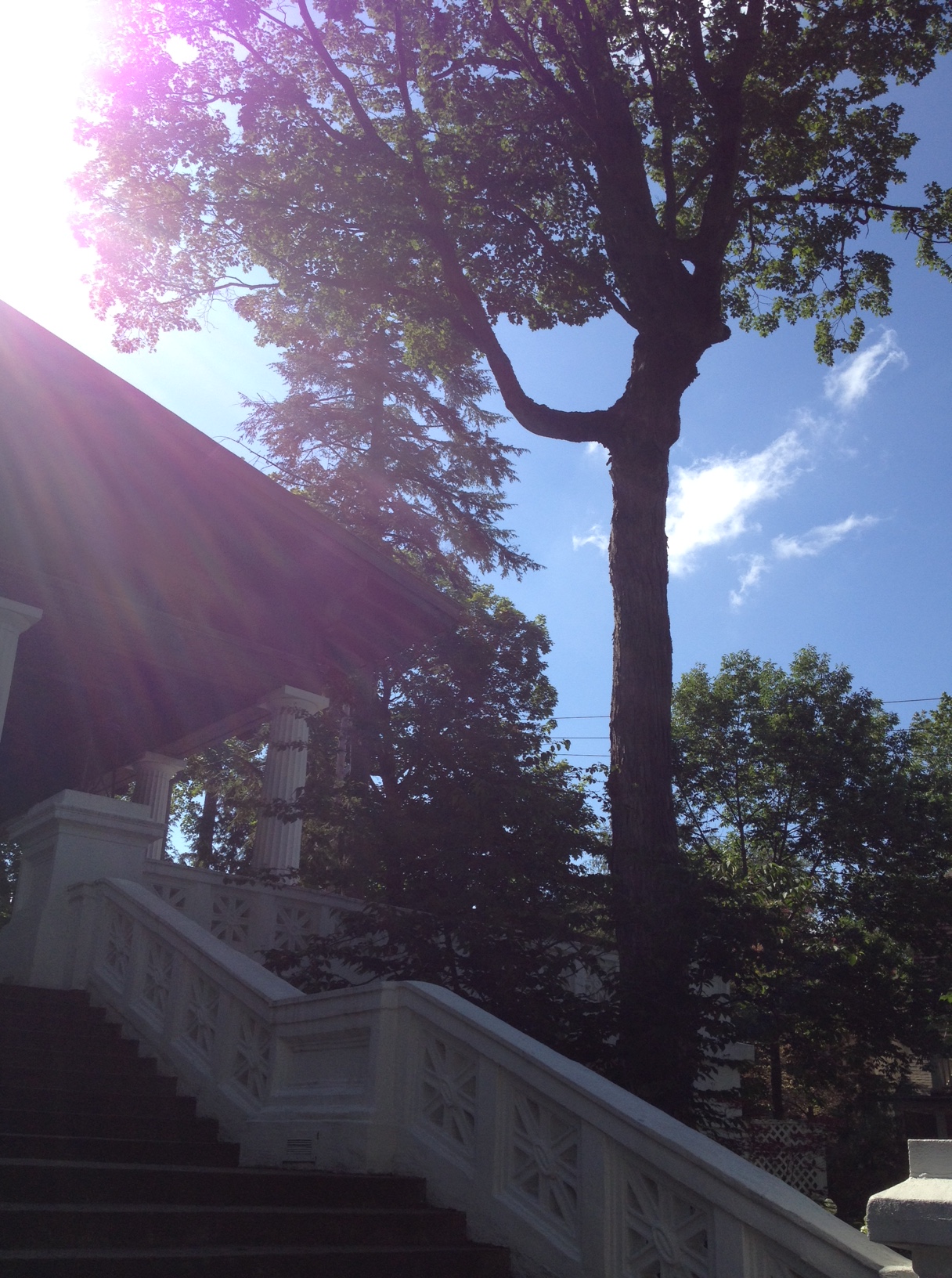
“None of all … who spent the day within the shadow of that sweet and leafy place have surely forgotten how the quaint and quiet beauty of the place and its surrounding fell upon them; they know just how the birds sang among those tall old trees; they know just how still and blue and clear the lake looked as they caught glimpses of it through the quivering green of myriad leaves …”

(Four Girls at Chautauqua, page 180)


Next time, Karen makes a little visit to the Chautauqua Post Office before trekking to the “Holy Land.”


If you missed previous posts about Chautauqua Institution, you can read them by clicking on the links below:

Postcards from Chautauqua – Summer of 2017

A Tour of Chautauqua: Getting There

A Tour of Chautauqua: Strolling the Grounds

A Tour of Chautauqua: Where to Stay

A Tour of Chautauqua: Lectures and Classes

A Tour of Chautauqua: Having Fun

A Tour of Chautauqua: The Teachers’ Retreat

A Tour of Chautauqua: A Healthy Body

A Tour of Chautauqua: Palestine Park

100 Years Ago at Chautauqua

Postcards from Chautauqua—Summer of 2017

For Isabella Alden there were few places on earth more dear to her than Chautauqua Institution. She spent many summers there, and was greatly involved in the Chautauqua Literary and Scientific Circle (C.L.S.C.).

You can judge just how great an impact Chautauqua had on her by the loving manner in which she described the place in her Chautauqua books, which she wrote in the late 1890s and early 1900s.

Chautauqua Institution is still a thriving summer destination for thousands of people. Earlier this month, Karen Noske, a regular reader of this blog, took a trip to Chautauqua. Today she is sharing the highlights of her quest to see for herself  the beloved Chautauqua locations Isabella so dearly loved and faithfully described in her books.

Take it away, Karen!


Like many of Pansy’s fans, I’ve longed to walk the “tree-shaded” avenues of her hallowed Chautauqua, and decided to take the plunge this summer, as I live only about 3 hours east.

For your enjoyment and education, I offer these guest posts as a sort of “now and then” view of many of the places mentioned in her books Eighty-Seven, The Hall in the Grove, and Four Girls at Chautauqua.

I’ve limited my review to those seminal books as they hold some of the richest treasures for modern-day Chautauquans and fans.

(For much more detailed information about this cultural retreat, you can find a list of previous posts about Chautauqua at the end of this post.)

Climbing ever higher

I should have paid more attention to the carefully worded descriptions of Isabella Alden’s favorite summer retreat, Chautauqua. In her marvelously descriptive and touching books about its lakeside, forested environs, she often mentioned that her characters “went down” to the lake or “went up” to the dining tent or the grove.

As I breathlessly labored to keep from running pell-mell down the steep inclines that make up 90% of the avenues here, I realized she’d been remarkably coy about this physical aspect of the grounds. Mountain goats would love this place.

After stowing my meager luggage in one of the many charming cottages that cling defiantly to the nearly vertical hillside, I hiked up to my first stop—the Archives, where I hoped to meet Pansy by way of her works.

This small brick building houses the full complement of the C.L.S.C. volumes, from the year of this reading circle’s inception (1878) to the present day.

Her eyes lighted with pleasure as she recognized it. This, at least, was an old friend: Philosophy of the Plan of Salvation. She did not need to read the letters on the title page to make sure that the book—so like her own—bore that name. “C.L.S.C?” she said, hardly realizing that she said it.

(The Hall in the Grove, pg 202)

.

I was delighted to find Pansy’s The Hall in the Grove (required reading for the C.L.S.C. class of 1881-82) snuggled between weightier academic tomes shown here.

.

I hunted for, and found the impossibly dense (reportedly dry, according to more than one The Hall in the Grove character!) Merivale’s History of Rome … one brief dip into it made me admire “Paul Adams,” “James Ward,” and “‘Pick ‘Em Up’ Caroline Raynor” all the more for virtually memorizing its contents.

How utterly hopeless it looked to him! He read over the first sentences six times without having an idea as to their meaning…

(The Hall in the Grove, pg 90)

.

I learned from the very helpful, very gentlemanly guardian of these treasures that one can indeed become a member of C.L.S.C. without having to limit oneself to the current crop of books! He assured me that I could “graduate” with a future Chautauqua class by reading a specified number of ANY C.L.S.C. materials, from any year!

“We are bound in honor to undertake all manner of work which will develop the spirit of Christian love and fellowship; it is the central feature of our organization … always with a view to reaching hearts as well as intellects. Why don’t you join us?”

(Eighty-Seven, pg 188)

.

Karen’s next Postcard from Chautauqua will feature The Hall of Christ and the Hall in the Grove.


If you missed previous posts about Chautauqua Institution, you can read them by clicking on the links below:

A Tour of Chautauqua: Getting There

A Tour of Chautauqua: Strolling the Grounds

A Tour of Chautauqua: Where to Stay

A Tour of Chautauqua: Lectures and Classes

A Tour of Chautauqua: Having Fun

A Tour of Chautauqua: The Teachers’ Retreat

A Tour of Chautauqua: A Healthy Body

A Tour of Chautauqua: Palestine Park

100 Years Ago at Chautauqua


Let’s Hit the Beach!

Bathing at Chautauqua, 1908, in swim suits popular in Isabella’s lifetime.

.

In 1960 Brian Hyland hit the top of the U.S. music charts with his song, Itsy Bitsy Teeny Weeny Yellow Polka Dot Bikini.

The song, about a woman who was too shy to wear her new bikini on the beach, was an instant hit. Many women at the time identified with the song’s lyrics. Although the bikini had been popular in Europe for years, Americans were slow to adopt it, believing the tiny two-piece was too risqué to be worn in public.

Those who dared to wear a bikini on an American beach or at a public pool quickly found themselves on the wrong side of the law. Some American cities banned the two-piece swimsuits and issued citations to any woman caught wearing one.

Other cities skipped the citation process and immediately took women to jail for violating local decency laws. But even in more progressive areas of the country, modesty and fear made women reluctant to wear bikini swimwear.

It wasn’t until 1962 when Ursula Andress emerged from the surf in the popular James Bond movie Dr. No that opinions began to change.

The original 1962 movie post for Dr. No showing a bikini-clad woman.

.

A modified movie poster for Dr. No, displayed in movie theaters in conservative areas of America.

.

Helping turn the tide was a series of “beach party” movies produced in the early 1960s. They featured wholesome, fun-loving teenagers—like America’s sweetheart Annette Funicello—cavorting on beaches and arguing over boyfriends, all while wearing two-piece and bikini swim suits.

Movie poster for 1963’s Beach Party.

.

Movie poster for Bikini Beach, which hit American theaters in 1964.

.

Then, in 1964, Raquel Welch wore a deer-skin bikini in the movie One Million Years B.C. and caused a sensation. The result: the bikini instantly became must-have swim attire for women across the country.

The early 1960s wasn’t the first time Americans had contended with notions of risqué swimwear. The same thing happened at the turn of the 20th Century.

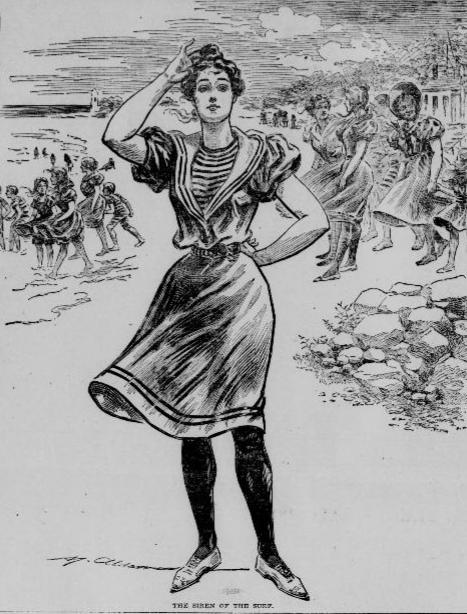
A new design for swimwear, from the Fashion Page of the July 25, 1897 issue of the Los Angeles Herald. Beneath the skirt was a pair of waist-to-knee bloomers.

.

Women’s swimwear in Isabella Alden’s time was designed to hide the woman’s body and protect her modesty. In fact, most public bathing areas at the time were segregated by gender.

From a summer fashion article showing a new style of bathing suit. The San Francisco Call, April 30, 1899.

.

While men boldly walked into the surf and swam freely, some municipalities confined women to specific areas of the beach.

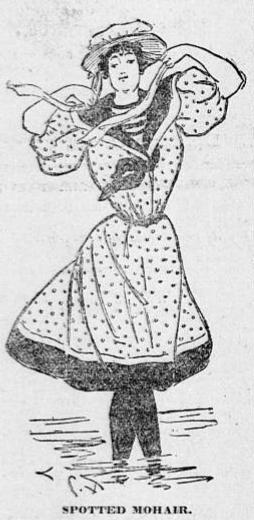
And they required women be covered from head to toe at all times. Swimsuit designers expected women to swim in hats, leggings, bloomers, shoes, and puffy-sleeved dresses.

An 1896 swim suit made of mohair. From an article in the May 24, 1896 issue of the Salt Lake Herald.

.

And because those dresses were usually made of wool, they were heavy when they got wet and weighed women down. Even worse, the long skirts tangled in their legs, preventing women from doing little more than wading into the water.

That began to change in the early 1900s when a professional swimmer from Australia arrived in the United States. Her name was Annette Kellerman, and she brought with her a one-piece swimsuit she had created herself and wore in competitions.

Annette Kellerman in a 1907 photograph.

.

By American standards, Annette’s swimsuit was downright indecent. It showed way too much skin and it hugged the curves of her body. When Annette dared to wear it on a public beach in Boston in 1907, she was arrested for violating indecency laws.

Annette may have run afoul of Boston city ordinances, but she also fired the imagination of American swimwear designers.

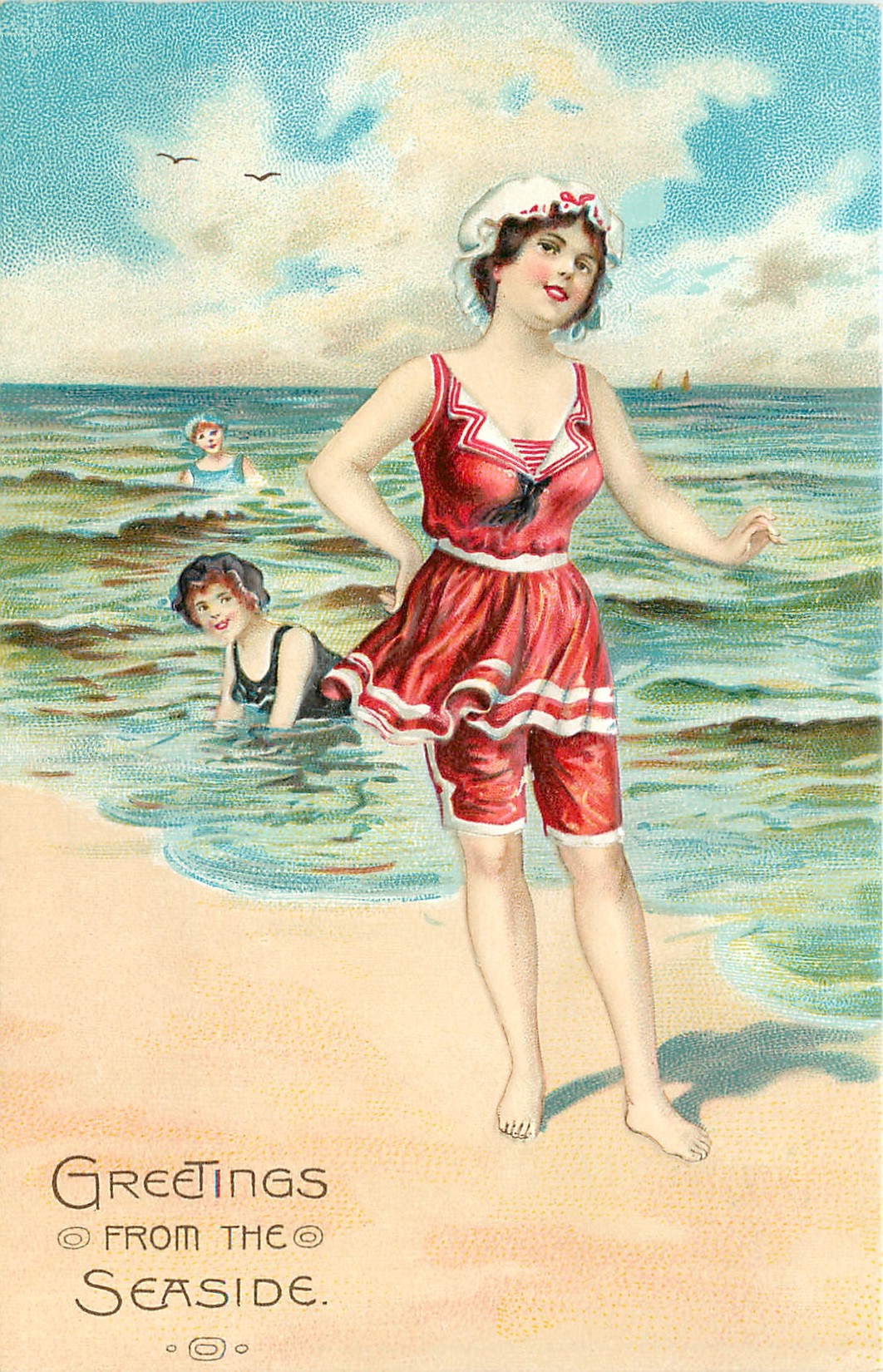
By the following year stores carried new designs in swimwear fashion. Those new designs weren’t quite as revealing as Annette’s one-piece suit, but they were certainly more comfortable and practical.

A 1908 postcard for Atlantic City, New Jersey.

.

Gone were the heavy leggings; the new styles allowed ladies to bare their legs and lose their high-laced shoes. And the skirts were shorter; beneath them bloomers were replaced by fitted shorts that allowed women to move freely in the water.

A 1908 postcard for Atlantic City, New Jersey.

.

Many people didn’t take kindly to the new styles. Americans formed protests on beaches, and newspaper editorials decried the swim fashions as emblems of the breakdown of American morals.

A 1910 editorial cartoon showing women in swim suits carrying Satan, hero-like, on their shoulders.

.

By 1920, some cities had tightened their swimsuit laws. New York recruited female officers to monitor the swim suits worn on beaches and issue citations if women were found in violation of city regulations.

From the New York Times, May 30, 1919.

.

In In Chicago the city by-passed the citation route and—as a precursor to the bikini dust-up of the 1960s—simply took women off to jail if they judged them to be indecently dressed.

Chicago swimmers being forced into police paddy-wagon before being taken to jail in 1922.

.

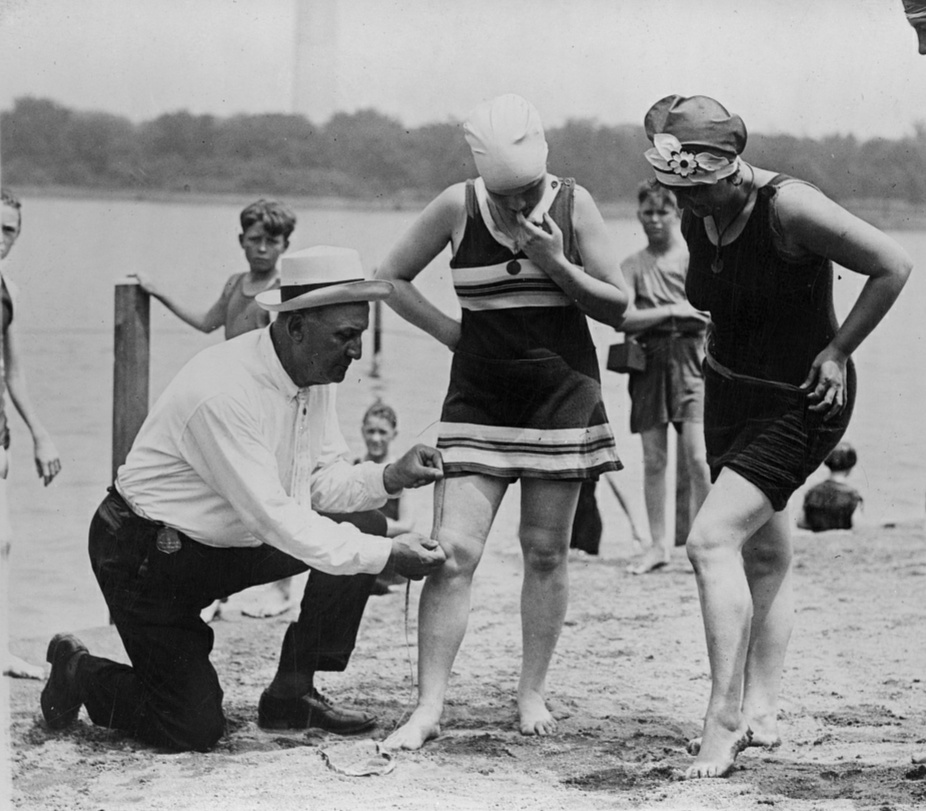
In Washington, D.C. one male officer made a name for himself as The Bathing Beach Cop by using a tape measure to ensure the distance between a female bather’s knee and the bottom of her bathing suit met with local regulations.

Bill Norton, the D.C. Bathing Beach Cop on duty.

.

By the 1930s the hue and cry over women’s bathing suits had, for the most part, shrunk to a whisper. Swim suits that had been scandalously indecent in 1920 became mainstream by 1930. After that, women’s swim suits changed very little through the 1950s.

Then came the 1960s and the little bikini, and Americans have never looked back. But what a far cry today’s swim suits are from the head-to-toe garments Isabella’s contemporaries wore!

You can click here to view more images of Victorian-era bathing suits: