Isabella Alden and her entire family were actively involved in the Young People’s Society of Christian Endeavor, a movement that promoted Christian service and ideals to its teen and young adult members.
Isabella believed in the Endeavor program so much, she founded the Pansy Society for Christian Endeavor, a similar organization specifically designed for children. The Pansy Society focused on teaching children to use Jesus’ life and words as a guide to live by.
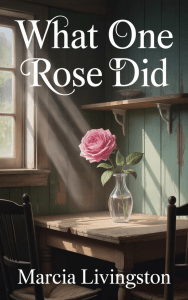
This month’s free read is a story by Marcia Livingston that illustrates some of the values The Pansy Society sought to teach children: forgiveness, patience, and kindness toward others.
It was a simple act of kindness when Lily Haines offered Cindy Barker a rose from her garden; but neither young lady could predict how much of a difference the presence of that single rose could make in the Barker family home.
Isabella often received invitations to speak to Christian organizations and she accepted as many as she could. Sometimes she would speak to the group on a topic that was dear to her heart, but often she would read one of her not yet published short stories.
One day she received an invitation to go to a small town and read one of her stories to the “Y.P.S.C.E.”
“It was the first time I had seen those five letters of the alphabet so grouped,” she said, “and I could not decide what they meant.”
She puzzled over those letters for some time and finally decided that the first three initials stood for “Young People’s Society.” But what about the C and E? Why hadn’t the writer explained what the letters meant? How was she supposed to select the right story for her audience when she had no idea of the purpose of the organization?
At last she went to her husband for help and found him reading a newspaper.
“I was just coming to consult you,” Reverend Alden said. He pointed to an article in the newspaper. “I found a splendid name for our young people! This name suggests the very thought we have been struggling for. ‘Young People’s Society of Christian Endeavor.’”
Suddenly Isabella realized the meaning of the initials on that invitation.
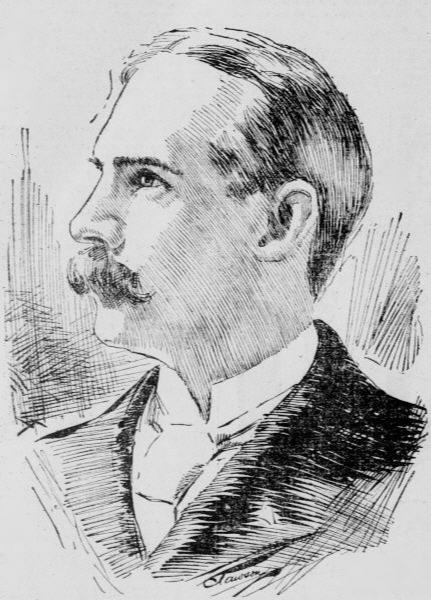
An 1897 artist’s illustration of Reverend Francis E. Clark, founder and president of Christian Endeavor.
The very next day she set out to learn everything she possibly could about the Young People’s Society of Christian Endeavor. She wrote to the Society’s founder, Dr. Francis Clark, or “Father Endeavor Clark,” as he was affectionately called by the young people in the organization. He immediately wrote back with information about the Society, and he invited Isabella attended a Christian Endeavor Convention in Cleveland, Ohio. There she met Dr. Clark in person.
Her first thought as he cordially shook her hand was, “Why, he is just a young man!”
A Christian Endeavor Convention, 1921
But she soon realized, after watching Dr. Clark interact with the young people at the convention, that he was an earnest and deeply spiritual leader who had a special gift for inspiring young people in Christian work.
A 1914 postcard depicting Williston Church, where the first Y.P.S.C.E. meeting was organized on February 2, 1881.
Isabella used her own experiences with the Y.P.S.C.E as the inspiration for her book, Chrissy’s Endeavor. She even incorporated into the story her first encounter with those baffling initials, “Y.P.S.C.E.”
After the book was published, Isabella received an astonishing number of letters praising her book. One such letter read:
“We want to say that we think here that the book ‘Chrissy’s Endeavor’ is doing a work in the world which will be to its author one of the surprises of heaven.”
Isabella remained actively involved in the Y.P.S.C.E, as did her husband and other members of her family. Over the course of many years, she saw the results of the Society’s good works, and she was thankful for having had the chance to know Dr. Clark in person.
In 1897 The San Francisco Call published a full-page article about the Society of Christian Endeavor, with details about how it came to be organized, and it’s growth world wide to over two million members. Click on this link to read the article.
You can find out more about Isabella’s book, Chrissy’s Endeavor. Click on the cover to read reviews and sample chapters.
When Chrissy Hollister arrived to spend the summer with her friend Grace, she was shown to a guest room that was decorated in blue and white and was “just as sweet and cool and charming as it can be.”
Presently her eyes rested on the blue satin pincushion, covered with white lace. Across it lay a ribbon—a badge of some sort. Chrissy laughed as she noticed that even the ribbon, which had evidently been dropped there by accident and forgotten, partook of the general character of the room, being of white satin, and bearing on its surface, painted in delicate tints of blue, five mystic letters: “Y. P. S. C. E.”
Chrissy studied them curiously, admiring the graceful curves of the rustic work, but wondering much what those letters could represent.
As Chrissy would later discover in a rather embarrassing way, those initials stood for Young People’s Society of Christian Endeavor. She would also discover just how important that distinctive pin was.
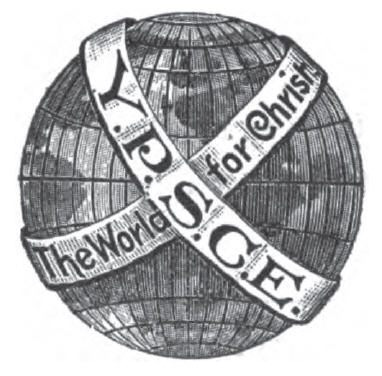
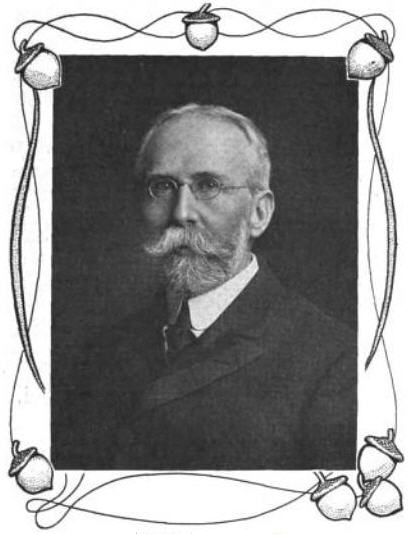
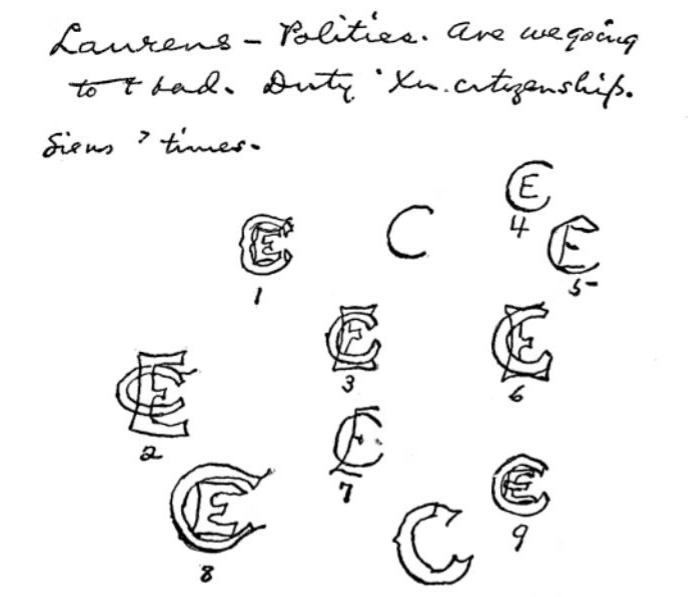
The design of the official Christian Endeavor emblem is attributed to Reverend Howard Benjamin Grose, a Baptist minister and editor of The Home Mission Monthly magazine. As a Christian Endeavor trustee, he felt strongly that the Society needed to adopt an official emblem, but the designs he’d seen were either too elaborate or expensive to produce. He wanted a simple design and felt, given the long name of the organization, the letters C and E should be made prominent.
Reverend H. B. Grose
.
Reverend Grose began to doodle, putting the C and E together in different ways:
He proposed sketch No. 9 to the trustees, and the monogram pin was unanimously adopted in 1887.
The C embraces the E. The Endeavor is all within the Christ.
Many emblems are more showy, more glittering, more ornamental, perhaps; but I see none that satisfies me so well, or that awakens so many feelings of affection, gratitude, consecration, and hope, as the strong, simple, speaking monogram in which the E that means Endeavor is made sublimely significant by the encompassing C that marks it all as Christian.
—Rev. Francis Bell, Founder, the Society of Christian Endeavor
.
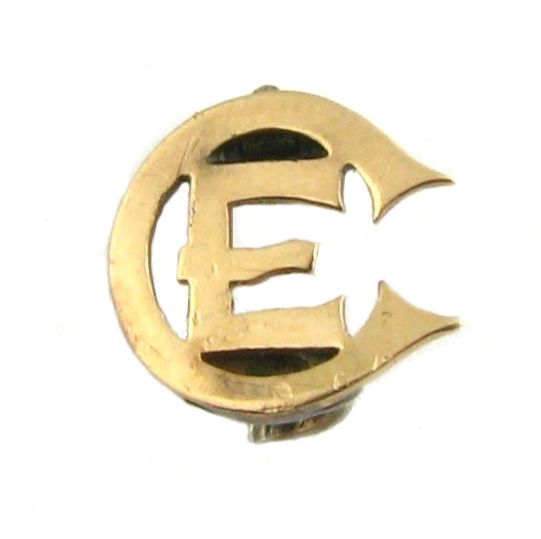
Once adopted, the Christian Endeavor emblem remained unchanged for generations. The distinctive design was enhanced only slightly for pins produced for the children’s society and Christian Endeavor organizations in other countries, such as this pin from Scotland:
The ribbon badge Chrissy saw in the guest room at Grace’s house may have been a local Christian Endeavor badge. Many state and local societies adopted their own unique Christian Endeavor colors, which they wore as ribbons on their lapels. The ribbons were usually printed or embroidered with the state name, as well as the initials Y.P.S.C.E. and the words Christian Endeavor.
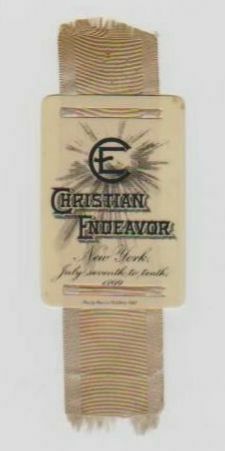
Ribbon badges were also created to commemorate Christian Endeavor annual conferences. Below is an example of the badge worn by attendees at the 1892 annual conference in New York:
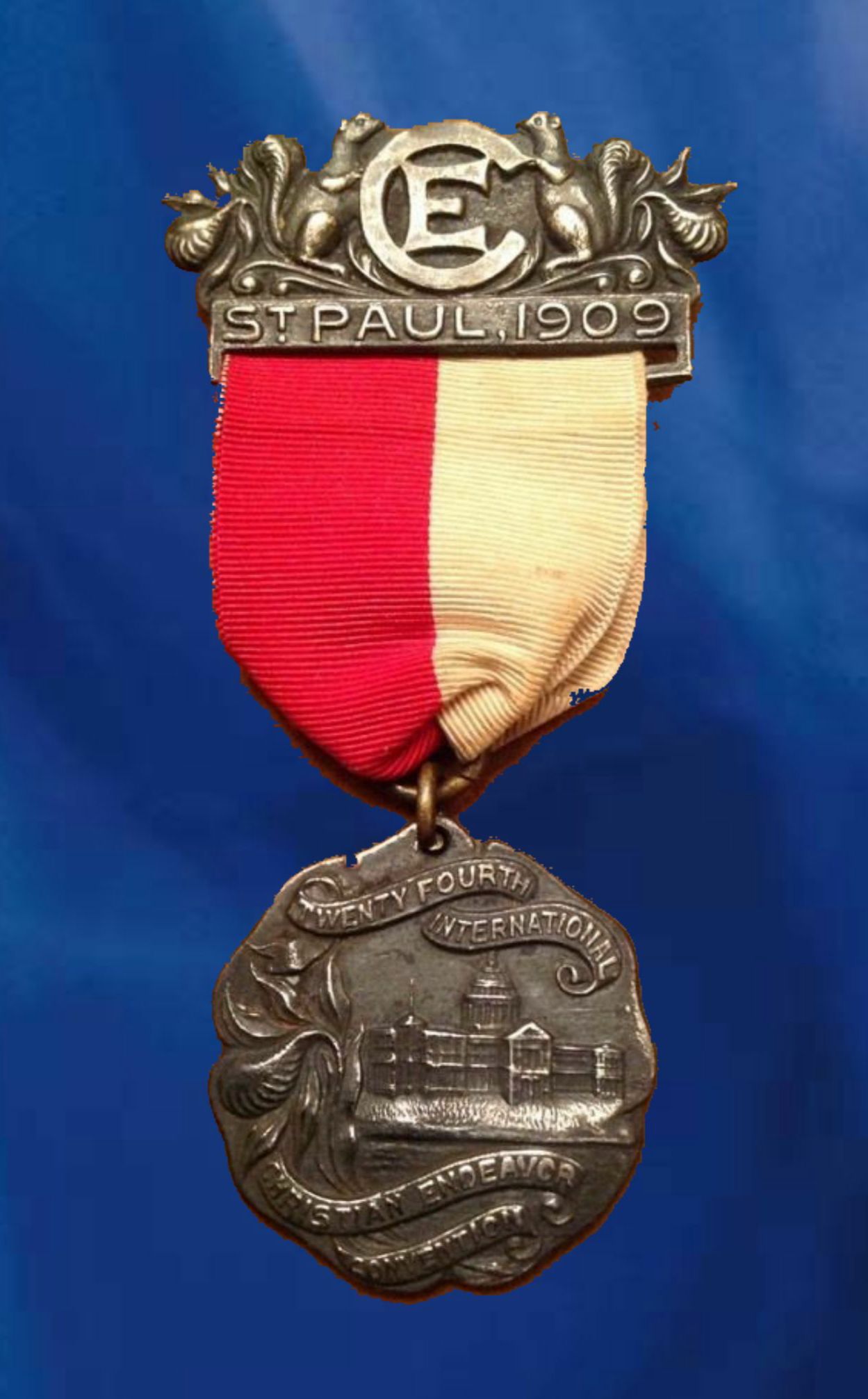
And this badge is from the 1909 national convention in Minnesota:
After Chrissy became a Christian and organized a Christian Endeavor Society in her own town, she learned the power of the little pin while riding the streetcar one day:
A plainly-dressed girl of about her own age, with a good earnest face, sat opposite her, watching her with an intentness that was only excusable because of the absorbed and almost tender light in the girl’s eyes, which lifted her act far above the commonplace stare. At last, seeming to have gathered courage for a resolve, she arose and took a vacant seat beside Chrissy.
“I beg your pardon,” she said in low, well-bred tones, “may I speak to you? I am a stranger, but I see that we are kindred.” Touching as she spoke, the tiny silver badge she wore, bearing the magic letters “C. E.,” and glancing significantly at the corresponding one of gold, which fastened Chrissy’s linen collar.
There was an instant clasping of hands, and an exchange of cordial smiles.
The plainly-dressed girl explained that a friend of hers had attended a Christian Endeavor meeting—the very Christian Endeavor Chrissy organized in her town.
‘And she liked it all so much, that she came home and told about it, and did not rest until she had started a society out of our class in Sunday school. I joined as an associate member, because I was ready to do whatever the others did, but I got acquainted in that society with Jesus Christ. I signed the pledge, and gave myself to Him forever; and I’ve had a good winter.”
Chrissy was surprised and humbled to know that her efforts resulted in a soul being won for Christ. “Unfaithful, unreliable in every way, yet He had used her in the harvest field!” wrote Isabella Alden.
Members of two Christian Endeavor Societies pose on the steps of Antioch College in the shape of the CE monogram, circa 1895.
.
Isabella and her husband, Reverend Alden were tireless workers for Christian Endeavor. Isabella featured the society in her books Chrissy’s Endeavor, Her Associate Members, Pauline, and What They Couldn’t. She also wrote several short stories about Christian Endeavor: One Day’s Endeavoring and A Christian Endeavor Revenge were published in the Christian Endeavor magazine, TheGoldenRule. And her book GraceHolbrook was a compilation of several short stories that illustrated the principles of Christian Endeavor for children.
You can learn more about today’s Christian Endeavor by clicking here to visit their site.
Click on the book covers below to find out more about the books mentioned in this post.
Reviews and giveaways for Christian fiction and sweet, clean fiction. Bringing readers information on great stories and connecting authors with their readers.









 Isabella Alden