Pansy’s Letter-box

In 1876 Isabella Alden was serving her second year as editor of The Pansy magazine. At that time the magazine was published monthly and by all accounts, it was a success!

Children regularly wrote letters to her, telling how much they enjoyed an article or story. Some sent in word puzzles they had made, in hopes their puzzles would be published to delight (or possibly stump) other readers.

They also wrote to Isabella about their birthdays, how they spent a holiday, and the difficulties they encountered in daily life.

A little boy picks up a little girl up so she can put a letter in a post office mailbox. In the foreground is an envelope addressed "To Pansy"

Here’s a letter a boy named Orvie B. Strain wrote to Isabella about the fun he had on April Fools’ Day.

Dear Pansy: 
I will tell you some of the funny things that happened to me April first. I took an empty oyster can, done it up in brown paper, and laid it on the sidewalk. A young man came along, looked at it a minute, and then kicked it off the sidewalk, and I didn’t watch it any longer. Late in the afternoon, I went to look for it, and I found it all mashed fine. 

As I came from the post-office, I forgot about its being April fool-day. I saw a two-cent piece lying on the side walk; I stopped to pick it up, and it was nailed fast. I had lots more fun, but I’ll not write about it this time. I am nine years old. May I belong to your ‘Pansy bed?’ This letter is written with my left hand.
A little girl holding a bundle of letters stands in front of a post office mailbox. Beside her a little dog holds a letter in his mouth.

Not only did Isabella publish many of the letters she received like Orvie’s, she replied to them all! Sometimes she sent individual replies by mail. Other times she simply wrote a quick reply in the next issue of The Pansy magazine.

Here are a few of those replies from the June 1876 issue of The Pansy. They give us a glimpse into Isabella’s personality and how she interacted with children:

LENA DARLING: 
Delighted to hear from you, my darling. The story is good, and will appear in The Pansy one of these days. Give my love to “Rubie.”
NELLIE MILLS: 
Such a nice little printed letter, with three new people in it! I am glad you think the Pansy “very nice.” Do you know, little darling, that you make Ns up-side down?
FRANKIE PAGE: 
I am glad that you have learned to write. Fifteen cows! Oh my! Can you milk any of them?
A large dog holds a letter in his mouth and stands on his hind legs so he can place the letter in a post office mailbox.
LAURA KESSNER: 
Welcome to the Pansy bed. You must wait patiently from month to month. Pansies have to grow, you know.
IDA T. DERBY: 
How many words did you miss at spelling school? Tell us all about it. Are there no little people in your “garden,” to make a Sunday-school of? Can’t you start one?
BERTHA WOLCOTT: 
I am glad to hear you think so much of our paper; but you must not expect Pansies to blossom every week! You have made a splendid selection of verses for your acrostic [puzzle].
A little girl in a pink dress and hat holds a large bouquet of purple and pink flowers in one hand. In her other hand she holds an envelope with a red was seal.
CHARLIE FISK: 
Your puzzle is good. It will appear in The Pansy some time. Are you practicing on your verses?
PUELLA HALBERT: 
Have you enjoyed my visits? May you be one of His “little ones.” We must all keep young hearts. See Matthew xviii. 3.
IDA MAY HATFIELD: 
There was good news in your letter. It is very easy to “live a Christian life,” if we always “love to pray.”
JOSEPH WASSON: 
We too have a pony, and his name is Tony. We haven’t any dog; but our Ray, whenever we ask him what he would like to have for a birthday present, says: “A big, black dog.”
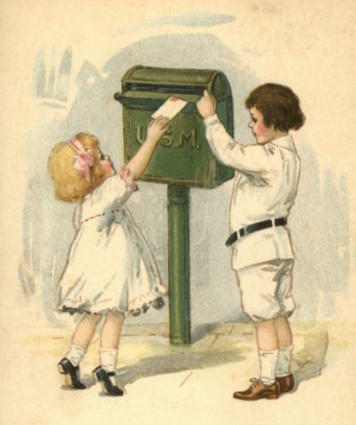
A little boy and girl stand at a mail box. The boy holds open the lid of the mail deposit slot so the girl can slip a letter inside.
WATSON BEAR: 
I’ll answer your questions with pleasure. There’s a lady edits the paper, and her name is Pansy, and ever and ever so many thousands of children take it. You write a letter to all the Pansies, and if it isn’t more than twelve lines long, I’ll publish it. That is a good idea.
HORACE A. STRAIN: 
Yes, indeed; you shall belong to the “Pansy bed.” Will you be a great, purple Pansy, or a little bit of a white one? You got pretty high up in school, didn’t you, and only seven years old? Well done.
EVA HATFIELD: 
Welcome, Eva. We shall not consider you a stranger any longer. We all belong to the same garden. I hope we are all trying for the same home.
A little girl in a blue coat and hat holds a letter close to her chest. She stands beside a post office mail box. A little dog peaks from behind the mail box, watching her.
ALBERT P. OVERMAN: 
Poor little Ralph, or, rather, Ralph’s mamma. How sorry we are for her! You miss him from the Sunday-school, but think what a great army of Sunday-school children he has joined!
MINNIE L. SMITH: 
The puzzle is very nice. It will appear just as soon as we get to it, but there are about twenty-five ahead of you. I am glad you like The Pansy so much. We are going to make it semi-monthly one of these days. What was your prize, and for what was it given? Kiss “Tidy” for me. I think Benny gave her a very pretty pet name. I am glad of the good news about yourself.

You Can Be a Nurse. Yes, You!

“Nurse” was a word that figured often in Isabella Alden’s novels, but not all her nurses were created equal.

In some of her stories, “nurse” was another term for a nanny—a woman who took care of young children.

Nurse and baby, about 1910.

That was the case for Miss Rebecca Meredith in Wanted, who hired herself out as a “nurse-girl” after she applied for the job listed in this newspaper ad:

Wanted—A young woman who has had experience with children, to take the entire care of a child three years of age. Call between the hours of four and six, at No. 1200 Carroll Avenue.”

In other novels, like The Older Brother, nurses were everyday people who knew what to do whenever illness struck, like Aunt Sarah:

Aunt Sarah proved herself a veritable angel of mercy. She was able to lay aside her brusqueness and her sarcasms, and become the skillful practical nurse, taking her turn and indeed more than her turn with the others, and compelling the anxious mother to take such rest as she needed.

Aunt Sarah and Rebecca Meredith developed their nursing skills through practical experience, and a history of caring for neighbors and family members who were ill.

But when Helen Betson’s father fell ill in Echoing and Re-echoing, the doctor insisted on securing the services of a “professional nurse,” which threw Helen into days of anxious waiting:

If she could have done a share of the nursing—but they had been forced to employ a professional nurse who shared the task with her mother, so that it was only now and then a little service that Helen was permitted to do; and she grew weary of the long waiting that seemed so purposeless.

In Isabella’s lifetime, it was common for physicians to train their own nurses, but they often found it difficult to find candidates who already possessed basic knowledge of human anatomy, nursing science, and mixing medicines.

A young nurse in the 1890s.

The best candidates were trained in a hospital setting, but hospital training programs had drawbracks:

Most programs had age limits that disqualified women who were middle-aged and older.

The coursework took years, and tuition was expensive at a time when there was no such thing as tuition assistance or student financial aid.

Portrait of a graduating class circa 1890.

The programs tended to attract only local students because the best teaching hospitals were in large American cities where the high cost of living proved a barrier to outsiders.

Fees charged by graduates of hospital programs meant their services were unaffordable for the majority of Americans, especially those in rural areas of the country, so nursing school graduates tended to live and practice in larger cities.

Four nurses at Samaritan Hospital, Sioux City, Iowa, about 1910.

The result: America had a great shortage of competent, trained registered nurses. Dr. Everett mentioned the problem in Isabella’s novel, Workers Together:

Professional nurses are good when you can get them. It is unfortunate that they are especially scarce just now. I have been on the look-out for one all the morning without success.

Graduates of Roots Memorial Hospital nursing program, Arkansas, about 1908.

A New Yorker named Cyrus Jones decided to do something about it. Because he lived very close to Chautauqua Institution, he was familiar with the Chautauqua Literary and Scientific Circle. The CLSC conducted first-class four-year college degree courses via correspondence. He was certain nurses could be trained using the same methods. He said:

There must be many thousands of bright, earnest women, young and old, who would be nurses if they could learn the profession without going to a hospital. Other branches of knowledge are taught by mail and learned at home. . . . Why not nursing?

An advertisement in Christian Nation magazine, 1915.

Mr. Jones launched the Chautauqua School of Nursing in 1900, and it was immediately successful. Over 200 students enrolled the first year.

Unlike other schools, Chautauqua School of Nursing did not have age limits, welcoming many women who were denied admission to other schools because of their age.

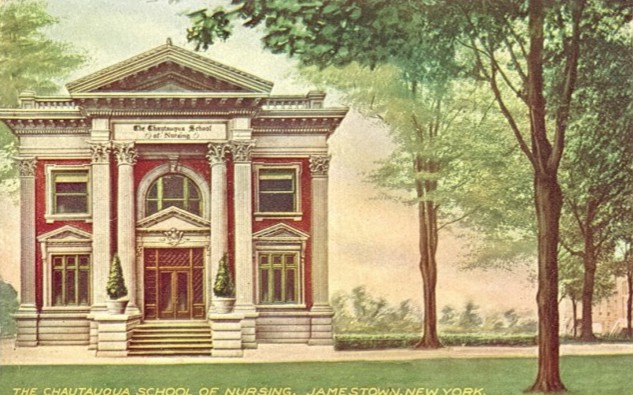
The administrative offices for the Chautauqua School of Nursing in Jamestown, New York.

Since the enrollment fee was only $75.00, women who intended to work as professional nurses knew they would soon earn back that cost because they would earn between $10.00 and $35.00 a week as a registered nurse after graduation.

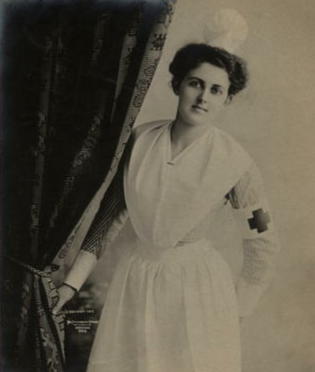
A young woman’s nursing school graduation photo, undated.

But the highest enrollment came from students who lived in rural and isolated areas where conventional hospital training schools didn’t exist.

A 1913 newspaper ad.

Like the hospital-based schools, the Chautauqua School of Nursing bestowed upon its graduates its own pins, caps, and certificates.

A 1913 diploma (from Flickr).

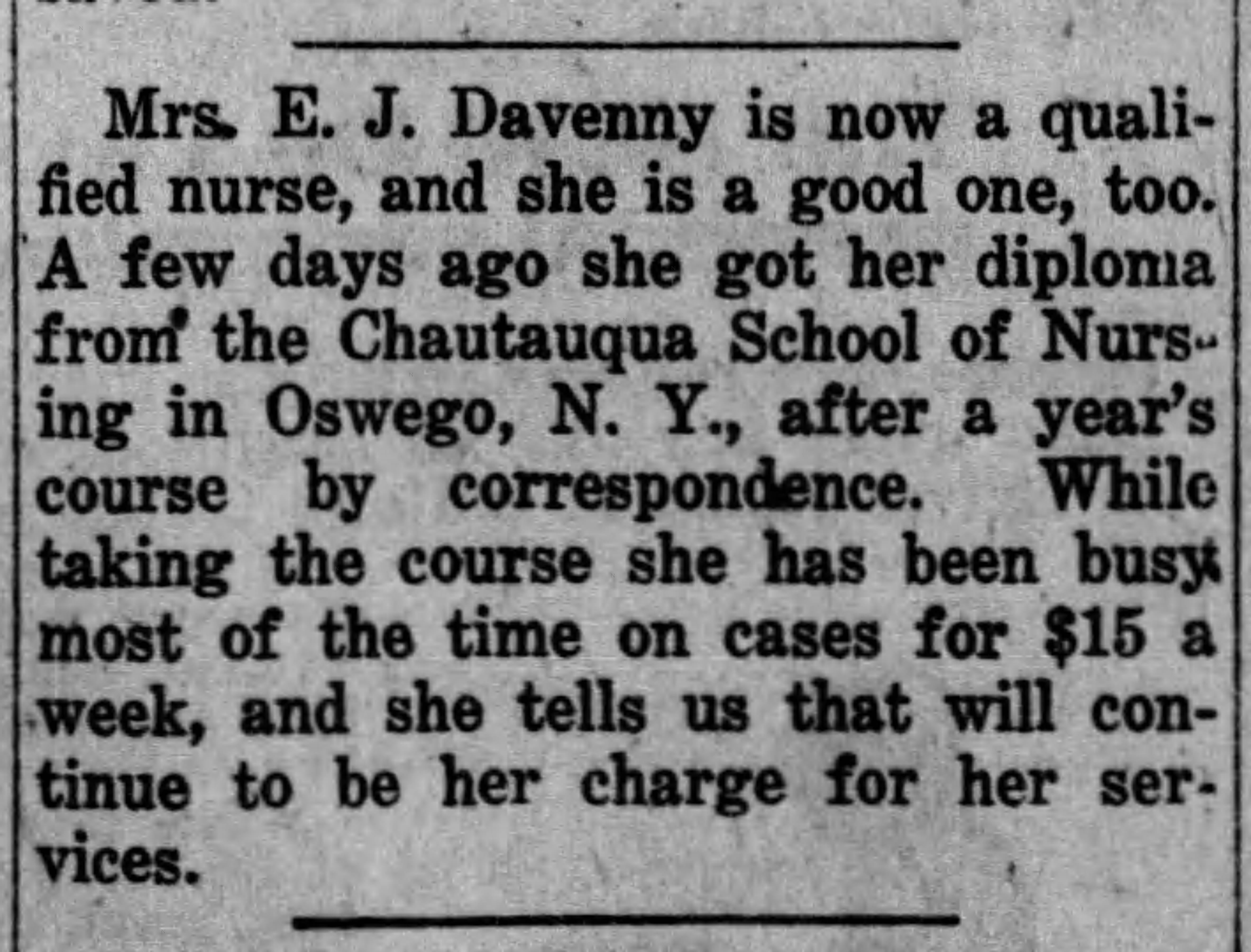
In every respect, its graduates appeared to have the same training and cachet as graduates of hospital programs. The public couldn’t tell the difference.

From the Columbus Weekly Advocate (Columbus, Kansas), November 27, 1913.

They also employed a very unique marketing tactic: They advertised their students.

The school used their real students as models in their print ads in magazines and newspapers.

Print ad for Chautauqua School of Nursing, 1915.

And if a prospective student was unsure whether or not she should enroll in the course, she had only to write the school.

Three Chautauqua nursing graduates, 1910.

In return, the school would provide the prospective student with the name and address of the graduates closest to her, with an invitation to contact any one of them to get more information about the school, the teaching curriculum, and what graduates’ lives were like as professional nurses.

Chautauqua school advertisement, 1909.

By 1910 the school had bestowed diplomas upon 12,000 nursing students; the class of 1911 alone exceeded 3,000 enrollees.

In all respects, the school was a success. Because of the Chautauqua School of Nursing, hundreds of communities had a trained, reliable nurse for the first time . . .

. . . and thousands of women entered into a respected profession that helped their communities, and produced a steady income for themselves.

Click on a book cover to learn more about Isabella Alden’s novels mentioned in this post.