A Treasured Autograph

Have you ever asked a famous person for their autograph?

After seeing a play, did you ever go backstage or wait outside the theater at the stage door to congratulate a performer and ask them to sign the play bill?

Or at a sporting event, have you had a chance to talk to one of your favorite players and ask them to sign your hat or team jersey?

For many people, collecting autographs is an expression of genuine admiration for a person’s talent or achievements. It’s also a way for them to feel closer to someone they admire from afar.

That was the case for Leona McGill, a teenager growing up in Winona, Minnesota in the 1920s. She was an avid reader, and gained fame in her home town by collecting autographed letters from every author whose book she read. In July 1920 her hometown newspaper wrote an extensive article about her efforts.

Newspaper Headline: High School Girl Has Read Several Hundred Books.
Miss Leona McGill, High School Senior, is Record Reader.
Famed Authors Send Suggestions and Good Wishes.

In some of her letters to authors, Leona expressed her admiration for their writing talents. In other letters she asked authors for advice on how to launch her own writing career. She wrote hundreds of letters, and received an almost equal number of replies!

Newspaper clipping: THEIR LETTERS. What well know writers have written to Winona's faithful little reader.

The majority of the replies she received were short and to the point, like this one from Booth Tarkington:

Newspaper clipping: Booth Tarkington, Kennebunkport Maine. I thank you for your letter and for your personal interest in my books.

Zane Grey, famous for his novels about the American West, was a bit more friendly with his reply:
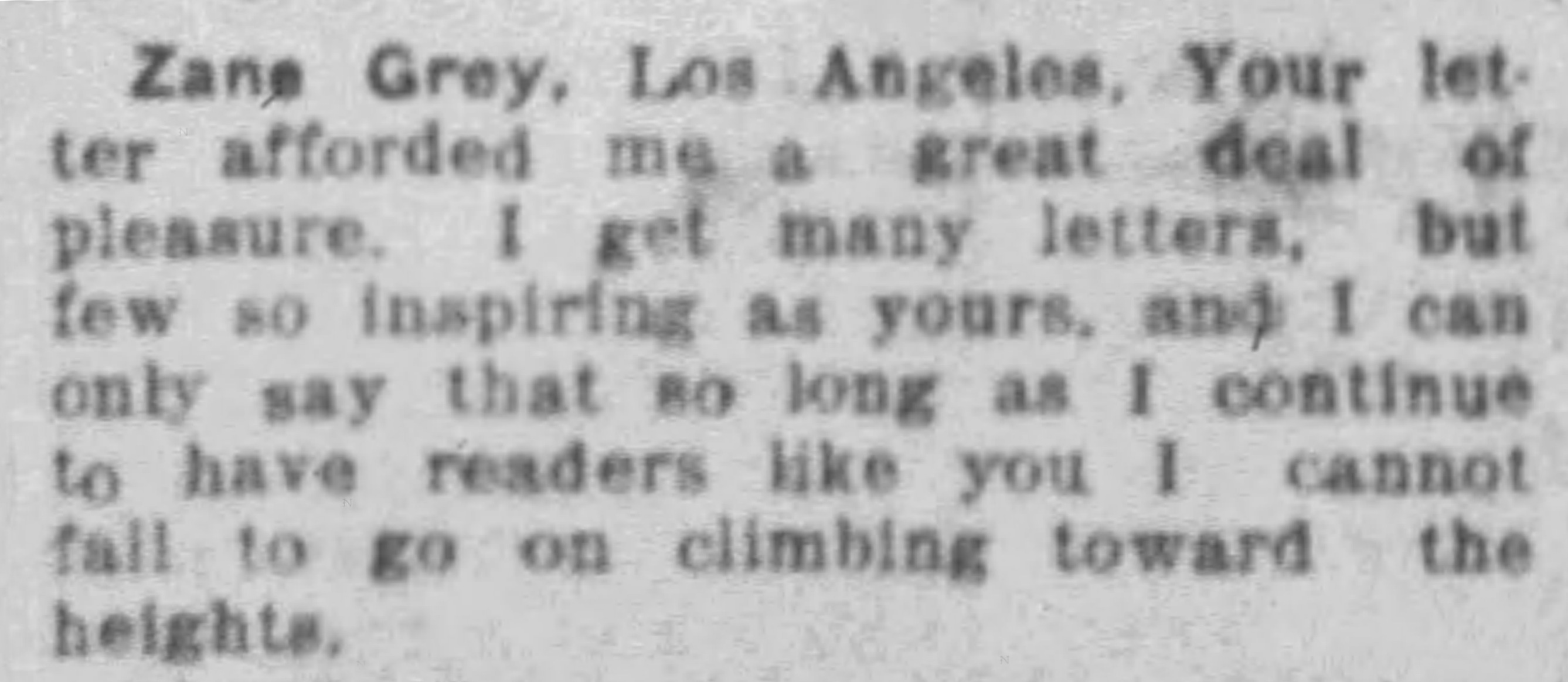
Newspaper clipping: Zane Grey, Los Angeles. Your letter afforded me a great deal of pleasure. I get many letters, but few so inspiring as yours, and I can only say that so long as I continue to have readers like you I cannot fail to go on climbing toward the heights.

Another famous author Leona wrote to was Isabella Alden’s niece, Grace Livingston Hill. In her reply to Leona, Grace sounded very much as if she were writing to an old friend. Here is what she wrote:

I am afraid you will think I have been a long, long time getting an answer to your lovely letter, but if you could see the pile of letters lying on my desk that I have waded thru before I got yours and could know how very busy I have been all this fall and winter I’m sure you would forgive me. I write very few letters by hand because I have not time and the typewriter is so much faster but because you have asked it, I am writing this. Boys and girls are very near my heart and when they want something I know how much they want it.

You ask about “The Mystery of Mary”—yes—that is one of mine—one of what I call my “crazy” stories in distinction from the more serious ones.

I am sure I ought to be very proud to be put in the same list with such distinguished writers as have written you and I want to thank you for your pleasant words about my stories.

Leona must have written a very persuasive letter to receive such a lovely and thorough response! Or perhaps Grace simply knew the sort of letter a teenage girl would love to receive.

You can read the entire article about Leona McGill and see more of the authors’ replies by clicking here.

Grace’s Chautauqua Delights, Part 5

This is the fifth and final installment of Grace Livingston Hill’s 1894 article about Chautauqua. If you missed them, you can read Part 1 here. Read Part 2 here. Read Part 3 here. Read Part 4 here.

Recreations at Chautauqua

The Chautauqua Christian Endeavour Society should not be forgotten as a helpful influence in bringing not only the young, but all classes of people together, and making them acquainted. This society not only includes all members of the Young People’s Society of Christian Endeavour who visit at Chautauqua, but also members of any denominational societies doing similar work.

A Christian Endeavor group, 1905

Here, in the white-pillared Hall of Philosophy, they meet for an hour just at early evening, every week, and hold their prayer-meeting; and the voice of prayer and song or words of cheer, of comfort, of consecration, come from many. One other hour each week is also given to a conference, where the members compare notes on the best ways of working in various lines.

In 1892 Grace was president of the Chautauqua Endeavor Society.

Last summer the plan was enlarged and a Working Committee formed. The grounds were divided into districts, and each Member of the Executive Committee became responsible for the work in one district; putting a topic card and notices in every cottage on the grounds, and giving to all strangers invitations to Meetings and Socials of the Society. Much good work was accomplished, and many strange young people made to feel at home.

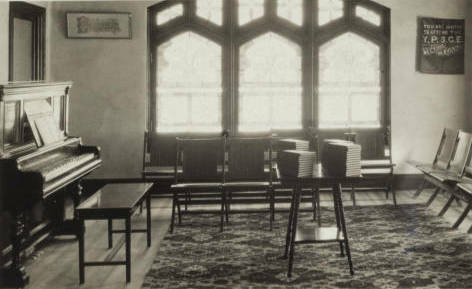
The banner on the wall reads, “You are invited to attend the Y.P.S.C.E. meeting this evening.”

There was also a room used as Headquarters, where were books and other literature relative to young people’s Christian work, and where could be found stationery and a quiet place to write or read. The registry book showed that a goodly number of young people availed themselves of this privilege.

A quiet place to read.

This Society held an Autograph Social during the season in the parlours of the hotel, which was a great success.

The Athenaeum Hotel, about 1915

Here and there you might have seen some favourite professor backed up against the wall with a double semicircle of his devoted students about him, eagerly holding their cards up, and he writing as if for dear life. But it was everywhere noticeable with what heartiness each one entered into the spirit of the hour, and demanded a name on his own card in return for every one he gave.

A collection of autographs from the early 1900s.

From this gathering it was difficult to send the people home, even after the solemn night-bell had rung; and the small boy who collected the pencils was very sleepy when the last couples left the parlour, smiling and chatting of the pleasant evening spent.

And the chimes make a beautiful ending to a day at Chautauqua. Whether you are wandering by the lake shore, or through the lovely avenues, it matters not; they are sweet. Sweeter, perhaps, just a little, as they ring out over the water, calling you in from a moonlight row or yacht ride. “Bonnie Doon,” “Blue Bells of Scotland,” “Robin Adair,” “Long, Long Ago,” all the old airs, and by-and-bye growing more serious— “Softly Now the Light of Day,” “Silently the Shades of Evening,” “Glory to Thee, my God, this Night,” and the “Vesper” hymn for good-night.

The Miller Bell Tower.

In 1894, when Grace wrote this article, collecting autographs was a popular way to preserve memories of an event. It wasn’t until 1900 when Kodak introduced their Brownie box camera that the average American could commemorate travels, celebrations, and other events with photos they took themselves.

Did you enjoy this tour of Chautauqua through Grace’s eyes?

Hopefully, her words gave you a sense of what it must have been like to visit Chautauqua 127 years ago!