The Domestic Problem

Isabella Alden believed that young Christian women who must earn a living would—for the most part—be better off doing so by hiring themselves out as domestic helpers in Christian homes, rather than taking jobs in factories or stores.

Illustration of a young woman about 1910 wearing a long-sleeved, floor-length dress over which is an apron. In one hand she holds a canned grocery item. With her other hand she gestures toward a large, ornately-decorated cast-iron stove. Beside her is a kitchen work table holding a jar, a bowl, a bucket, a spoon and glass.

She used that idea as the premise for her short story “Their Providence” (which you can read for free by clicking here).

Isabella believed a Christian home offered a safer living environment for a single young woman; and that she would be protected from the coarse worldly influences she would find if she lived in a boarding house.

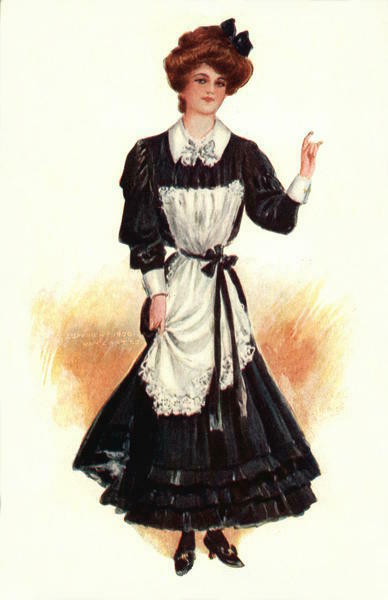
Illustration of a young girl from about 1910. She wears her brown hair up in a loose bun with a large black bow. Her floor-length dress is black with a white collar, cuffs, and a white lace-trimmed apron.

She also believed that living with a Christian family would reinforce the beliefs and principles Christian girls grew up with, such as keeping the Sabbath holy, regularly attending church, having daily Bible readings, and engaging in mission work.

Isabella knew the arrangement could be problematic. In her novel Ester Ried’s Namesake she wrote about a head-strong, quick-tempered young heroine who was hired as a live-in domestic helper for a Christian family that often treated her very poorly. But in true “Pansy” fashion, the characters in her novel eventually recognized their shortcomings and, with God’s help, learned to forgive and influence each other for good.

Illustration of a woman about 1900 wearing a high-necked, long-sleeved shirt and a brown skirt, over which is a white apron. In one hand she holds a recipe book; in the other she holds a pan of backed bread. Behind her another woman wearing a servant's cap pours a liquid from a saucepan into bowls placed on a table. Behind them is a large cast-iron stove. On top of the stove is a kettle with steam coming from its spout.

She also shared her idea of young women working as domestic help in some of her speaking engagements and in magazine articles she wrote.

But the concept was not always a welcome one. In 1911 Isabella received a letter from a young woman in Ohio who disagreed with Isabella’s advice.

I have recently read, in a paper or yours, a remark about “lovely Christian homes” where self-respecting girls could earn their living as helpers. I wonder if you really have any idea how these “lovely” people treat their hirelings? I think you had in mind the comfort of your well-to-do friends, rather than the girls whom you advised.

When you talk about girls finding good “homes” I don’t think you stop to consider both sides. What does “home” mean, if not a place where one has entire freedom to come and go, to plan one’s work, and work one’s plans?

I cannot see how any self-respecting person who has always had her own home could live as a hireling in other people’s homes. Could you? My observation has shown me that a condescending manner is the very best that even “lovely Christian people” have for their domestic helpers.

—Ohio.

Isabella had heard such criticisms before, some of which were “kind and sensible” and others “supercilious and snappy.” Here’s how she responded to the letter writer from Ohio:

“Notwithstanding the letter writer’s opinion, I believe I had in mind the comfort of both employer and employed when I urged self-respecting girls who had their living to earn to choose an average Christian home in which to earn it, in preference to factories, shops, and other public places. You, my dear girls, who have written to me, are starting this argument from the wrong platform.

“The foundation question is not, “How shall I secure me a home where I can have entire freedom to come and go, to plan my own work, etc.” but, “Is doing housework in other people’s homes a good and respectable way for a young woman to earn her living, and can she in this way hope to secure the reasonable conveniences and comforts of a home?”

“To this question I reply with an unhesitating Yes.

Illustration of a young woman about 1895. She wears a black dress with a high collar and puffed sleeves, and a white apron. She is pouring liquid from a copper pan into a soup tureen that rests on a kitchen table beside a variety of vegetables.

“The only—or almost the only—work open to women in which careful previous training is not demanded, nor even expected, is domestic service. Here the demand has been so much greater than the supply that absolutely untrained and ignorant help has rushed in and created the conditions that now exist.

“The attitude of the average employer toward her servant is endurance: she is unable to commend her work, she can only tolerate it. She has learned to conduct herself accordingly; and the multitude of decently educated, reasonably well brought up American girls who cannot be artists nor teachers nor stenographers, but must, nevertheless, earn their living, have, because of the above state of things, given this form of work a wide berth and rushed into shops and offices and factories, instead.

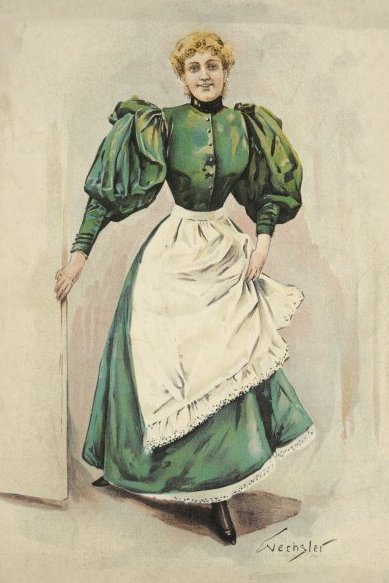
Illustration of a young woman from about 1895, wearing a green dress with large puffed sleeves. The skirt is floor length and over the skirt she wears a white apron tied around her waise.

“Now, let us look for a moment at one of the exceptions:

“She is an American girl with a partial high school education. She planned to be a teacher, but something happened. Illness, or sudden reverses, or unexpected demands, have made it necessary for her to become an immediate wage-earner. Times are hard and openings few; as a last resort she resolves upon trying domestic service, with every nerve in her body shrinking from the ordeal, because of what she has heard and seen and fancied.

Illustration of a young woman bending over the railing of a staircase. In one hand she holds a bar of soap. In the other hand she holds a cloth she uses to clean the spindles and post of the staircase.

“The woman who employs her (knowing she lacks previous training or recommendations) does so because she is in straits and must have somebody right away. All she knows about the applicant is that she looks “uppish” and as though she would feel above her work; which is precisely what the girl does feel. She is all ready to have her worst fears confirmed, and they are confirmed. She finds a thousand things to flush her cheeks with indignation.

“She resents the “orders” given out by the hurried and worried mistress who yet is not mistress of herself. She resents the poorly furnished room, the solitary meals at the section table, the eternal use of her given name. These and a dozen other grievances keep her in a constant state of irritation and resentment. She cannot do even her best—and none know better than she that, because of the lack of training, her best is not very good, for she is too much tried to give real heart to her work.

Illustration of woman holding a bottle of furniture polish in one hand. In her other hand she uses a cloth to polish the top of a dining table.

“What wonder that, after a short trial, the exasperated mistress and the equally exasperated maid separate, the one to be more convinced than ever that the word “help” as applied to the kitchen is a misnomer, and the other to write letters to someone to prove the impossibility of self-respecting girls earning their living in domestic service?

“For the sake of my correspondent who thinks I am theorizing and do not understand the situation, I want to explain that I have been a housekeeper for forty-five years; that I have been studying this problem carefully in my own home and the homes of certain of my friends for more than a quarter century; that I have known intimately all sorts of “hired girls,” and have helped a few of them to experiment in all sorts of homes.

“I have had the would-be fine lady who was an intolerable nuisance; I was glad when I saw her depart, and endured with what patience I could the unkind and untrue things she said about me; though I really believe they were true from her standpoint; she had so warped a view of the whole situation that she was incapable of even listening correctly.

Illustration of young woman wearing a white apron over an orange dress, and a white dusting cap with an orange bow over her hair. She holds a large feather duster.

“I have had all grades between, and I have had the real lady who came into my kitchen in appropriate dress and with quiet voice and quiet ways, and submitted to the regulation that obtained—many of which must have been new and trying to her—without the raising of an eyebrow to hint that she had all her life been used to different things.

“She came to me without flourish of trumpets, as an ordinary domestic servant at common wages; and when she left me after a year of invaluable helpfulness, it was as a tried and trusted friend, whom every member of my family not only respected, but enjoyed; and whom, as the years pass, we are glad to count as one held close in the bonds of friendship.

Illustration of smiling young woman wearing an apron and carrying a tray on which are glasses of juice and three plates of desserts.

“Nor was she the only “lady” help I have personally enjoyed. Glancing back over the almost half century, I find that five of them stand out in bold relief; strong friends, faithful friends, my “servants” still, in the same sense that I am theirs; and all of us trying to pattern after Him who said, “I am among you as he that serveth.”

“My correspondent asks if I “could live as a hireling in other people’s houses?” To which I reply, I do not know; I have never had the opportunity of trying myself in this way. It would all depend upon whether I was strong souled and resolute and sweet-spirited enough to brave present conditions and help to make them better.

“Yours for service,
Pansy.”

What do you think of Isabella’s idea?

Do you think you could ever “live as a hireling in other people’s houses?”

You can read Isabella’s short story “Their Providence” for free by clicking here.

Read Isabella’s novel, Ester Ried’s Namesake by clicking here.

Pansy’s Best Advice Giveaway

In past blog posts we’ve share some of Isabella’s advice columns that appeared in Christian magazines in the early 1900s. Sometimes humorous, sometimes serious, but always straightforward, Isabella answered reader questions on a variety of topics, from unwanted marriage proposals to a fear of praying in public.

Cathy and Elaine—two longtime readers of this blog—mentioned they would love to be able to have a booklet that contained all of Isabella’s advice columns.

What a great idea!

Thanks to Cathy and Elaine, today’s giveaway is an e-book collection of Isabella’s most popular bits of advice.

Book cover for Pansy's Advice to Readers. Image of a blue teacup and saucer filled with purple and yellow pansies and butterflies against a pink polka-dot background.

You can read Pansy’s Advice to Readers for free!

Choose the reading option you like best:

You can read the e-book on your computer, phone, tablet, Kindle, or other electronic device. Just click here to download your preferred format from BookFunnel.com.

Or you can select BookFunnel’s “My Computer” option to receive an email with a version you can read, print, and share with friends.


This post is part of our 10-Year Blogiversary Celebration! Join us every weekday in September for a fun drawing, giveaway, or Free Read!

We're 10! It's our Blogiversary Celebration! IsabellaAlden.com. September 2023. Join Us!

A Scolding Mood

Do you have a pet peeve?

Is there some irritating little thing others do that seems to steadily accumulate until you can’t help but be angry?

Isabella found herself in just such a situation regarding the many letters she received each month from readers of her magazine and books. Here’s what she had to say about it (as published in a Christian magazine):

A Scolding Mood

Photograph of Isabella Alden from about 1898. She is seated at a table. In her lap she holds a piece of paper. Her right hand holds a pen poised above a piece of  paper on the table.
Isabella Alden at her writing desk.

Perhaps it would be well for me to own at the outset that I am in a scolding mood this morning. On my desk lie three letters written with as much care and thought as I could give them. Out of my busy life I took time to do my best for the three earnest girls who wrote me on important subjects, all of them of such a character that it was either not wise to bring them into print or so important as regards time that it seemed not well to wait for the printed page. Yet what was the result? Within ten days of their writing, all three letters were returned to me with the words, “Person not found,” written on the envelope.

Now whose fault is that? Not the postmasters’ or postmen’s certainly; for, judging from the appearance of the returned letters, much care has been taken to find their owners. In one instance the information has been volunteered, “Address incomplete.” As if the writer did not know that! But how was I to help it? A name, and the name of a certain city in a certain State; this was all. No street, nor number, nor post-office box—nothing to indicate where in the great city the person was to be found.

If this had been my experience but three times in my life, I should indeed be a happy woman; but oh, dear, the innumerable times I have exhausted my knowledge on a given theme for the attempted benefit of another, only to have to consign my work two weeks afterwards to the waste-basket, and to go about with the injured feeling that someone who had opened her heart to me was smarting under the sense of having been rudely treated!

Dear friends, is not the moral plain? Why will you not give a carefully detailed address? If you are visiting in a strange city, expecting to be there but a short time, by all means give the full address of the person whose guest you are, or of the hotel or boarding-house where you are stopping. If it is possible that you may leave the town before the reply to your letter reaches there, consider how it would expedite matters if you would instruct your correspondent to write on the envelope, “If not there, please forward to —,” etc.

While we are on this subject and I am in the mood, suffer me a few more growls.

How many letters do you suppose I get, asking for immediate replies, with not so much as a postage-stamp enclosed? In most cases this is pure forgetfulness; but if one receives—let us say—one hundred letters a week, requiring private replies, and fifty of the writers have forgotten the return stamp, in the course of a year this amounts to quite a sum.

Let me tell you something. Instead of the stamp (which every well-informed person now encloses when he does not forget it), if those who desire a prompt reply would enclose an envelope properly addressed, with the stamp securely stuck on its own proper corner, their chances for very prompt response would be largely increased. One who has not a large list of correspondents can hardly be made to understand what a relief it is to find letters so prepared, nor what an amount of work it saves in the course of months. So small an item for the writer, such a load lifted from the shoulders of the burdened!


What do you think? Did Isabella have a good reason to scold her readers a little bit?

What’s your pet peeve?

A Hard Text about Gifts

Isabella’s brother-in-law Reverend Charles M. Livingston wrote several articles for The Pansy magazine in which he explained Bible verses that might seem confusing to children. Here’s one he wrote in 1892:


Matthew 13:12:

For whosoever hath, to him shall be given, and he shall have more abundance; but whosoever hath not, from him shall be taken away even that he hath.

No, it does not seem fair at all to give to him that has something, and to refuse it to one that hasn’t anything scarcely, and even to take away what little that one has! Just think of giving a rich Pansy five hundred dollars more, and then snatching away the last penny from a poor Pansy!

Surely you don’t suppose the loving, gentle, merciful Lord Jesus meant any such thing? Of course he didn’t.

What did He mean?

Why, simply this, my dear: that one who makes good use of his gifts will have more gifts. He will grow wiser and better, and go up higher all the time, just like a tree that uses well the good ground and good air and good dew around it.

And the tree that, for some reason, won’t send its roots down this way and that, and set every one of its leaves to breathing—such a lazy tree will lose all its life and die, the first wide-awake tree sucking up that very life.

It may be just so with two Pansies. One is good, true, active; the other one isn’t—how one will go up and the other down; how one will increase and the other decrease until one seems to have all the good, even the little the other started out with.

Think on it in this way:

You borrow from a bank one hundred dollars and pay it back with interest when your note is due, and quite likely the bank will loan you two hundred dollars then, if you want it, and so on, increasing it just as you are faithful.

But if you don’t pay as you promised, your one hundred dollars will be taken from you and loaned to one who may have ten thousand dollars, because he makes good use of it.

We are all on trial. How happy we should be to be trusted by the Lord! It’s a fearful thing when he will not loan us any more.

What do you think of Rev. Livingston’s explanation?

You can click on the links below to read more of Rev. Livingston’s “Hard Text” articles:

A Hard Text about Burdens

A Hard Text about Swearing

A Hard Text in Matthew

A Hard Text: Matthew, Mark and Luke

A Hard Text

Getting Ready to Travel

As a minister’s wife, Isabella knew a thing or two about thrift. She knew how to prepare nutritious and economical meals, how to decorate a home on a barely-there budget, and how to create useful household items from everyday materials.

She also admired those traits in others, and shared this anecdote in an 1897 magazine article she wrote:

I will tell you a little incident connected with the lives of two girl acquaintances of mine.

They belonged decidedly to the work-a-day world, and something unusual had come into their lives in the form of an opportunity for a short journey.

They met one evening to talk the matter over.

“Each pleasure hath its poison,” quoted one. “Mine comes in the shape of having nothing in which to pack my voluminous wardrobe. There is not a valise owned in our family, except an old carpetbag affair that looks as if Noah’s wife used it. And even that isn’t available. Tom must needs take it.”

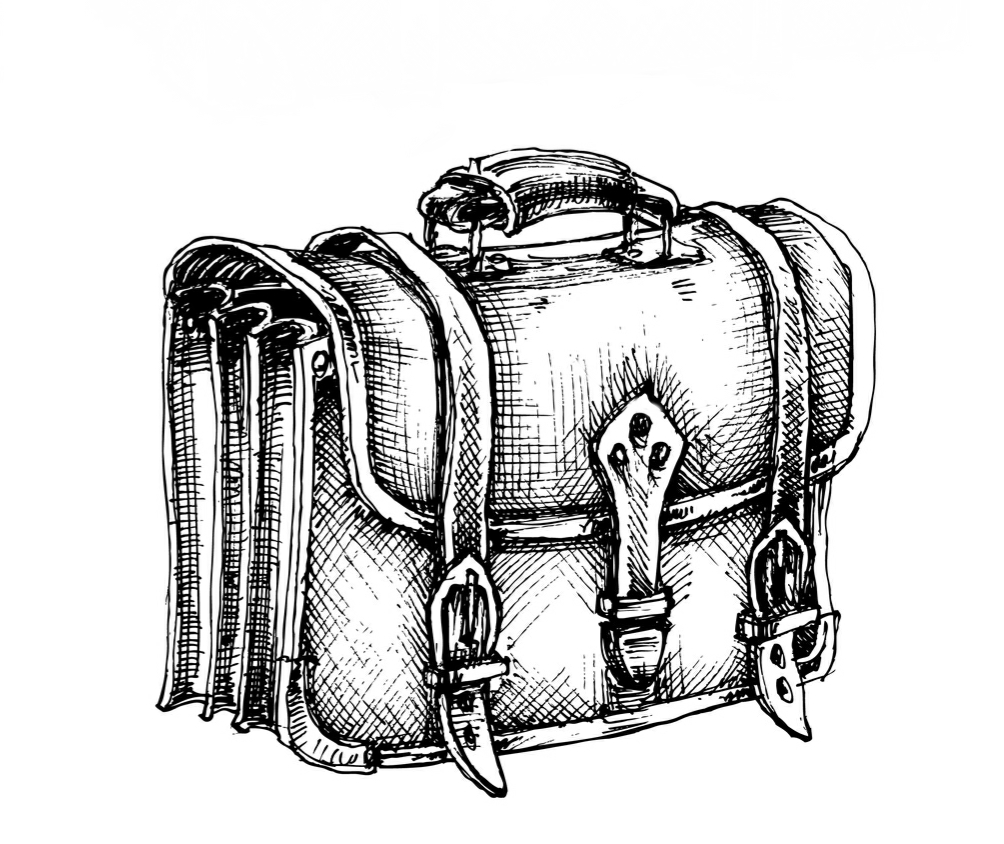
Drawing of an old-fashioned satchel with brass buckles and straps to keep it closed.

Mary, who was to be her companion in travel, regarded her thoughtfully.

“It is queer that our perplexities should be the same,” she said. “Only there is no satchel of any sort in our family. I brought away my belongings in an old family trunk so large that it was a question, for a time, whether I had not better set up housekeeping in it, if I could have afforded ground-rent.”

drawing of an old-fashioned steamer wardrobe standing open. On the left side of the wardrobe is a space to hang clothes. On the right is a series of drawers in difference sizes to hold clothing and accesspries.

Then the girl who had complained of the satchel looked remorseful and sympathetic. What were old-fashioned satchels, when one had father and mother and Tom?

“Never mind!” she said cheerily. “We can do our things up in newspapers. It won’t take a very large one to hold mine.”

We did not see them again until two days afterwards, when we met at the train. She of the “carpetbag” came first. Her bundle was characteristic of her, and awkwardly wound about with cord unnecessarily heavy. It was not wrapped in newspaper, it is true; but the brown paper was too stiff. It refused to listen to coaxing fingers, and crackled a good deal.

“I don’t know how to tie up bundles,” its owner said merrily, “and I did this in an awful hurry. I thought I was late. Hasn’t Mary come yet? Oh, here she is. Why, Mary Sheldon!”

The exclamation evidently belonged to Mary’s dress-suit case. That was what it looked like. A neat, trim valise, holding evidently quite a wardrobe, yet so compact and of such shape that it was easy to carry.

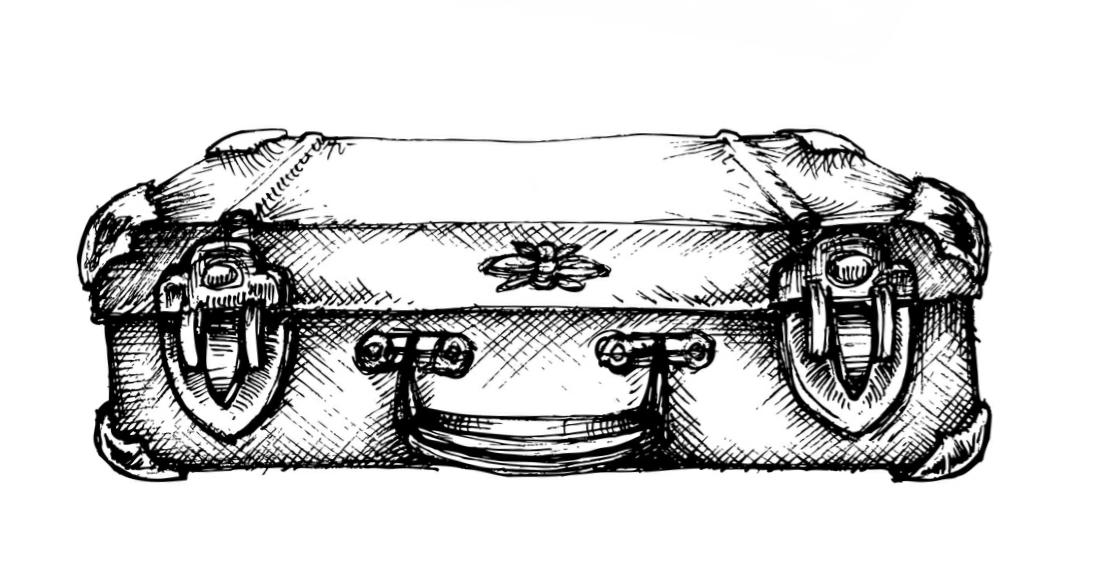
Drawing of an old suitcase with brass closures and corner guards.

“Where in the world did you borrow that? How nice it is! It will be ashamed to have my old bundle for a travelling companion.”

“It isn’t borrowed,” said Mary with dignity. “It belongs to me. It cost fifty cents.”

We gathered around her with exclamations and inquiries, and evolved this:

One of the boarders in the act of moving threw out as rubbish a pasteboard box in which a suit of clothes had been sent home from the tailor’s. It was about two feet long, one foot wide, and six inches deep, with a cover exactly the depth of the box.

Drawing of an old box-style suitcase with straps to hold it closed.

Mary, taking possession of it, covered it with dark-green cambric, at seven cents a yard. It took two yards. This was for strength. Then she re-covered it with plain wall-paper of a tint that suggested leather. Nine cents furnished enough for box and cover.

Drawing of various sewing tools: a needle with thread, a paper package of needles, a needle threader, a pin cushion with pins, a cloth tape measure and bolts of fabric.

By that time she thought that she had a very good travelling-case; but, having grown ambitious, she determined to make it still more useful. Twenty-five cents bought a yard of strong gray denim. This she cut and fitted at sides and ends, and, having bound it with dark-green braid, and sewed strings on it at intervals, she had a neat protective cover for her travelling-case, and one that added materially to its strength, as well as to its capacity, should occasion require. A shawl-strap to carry it by (which she already owned) completed the neat outfit.

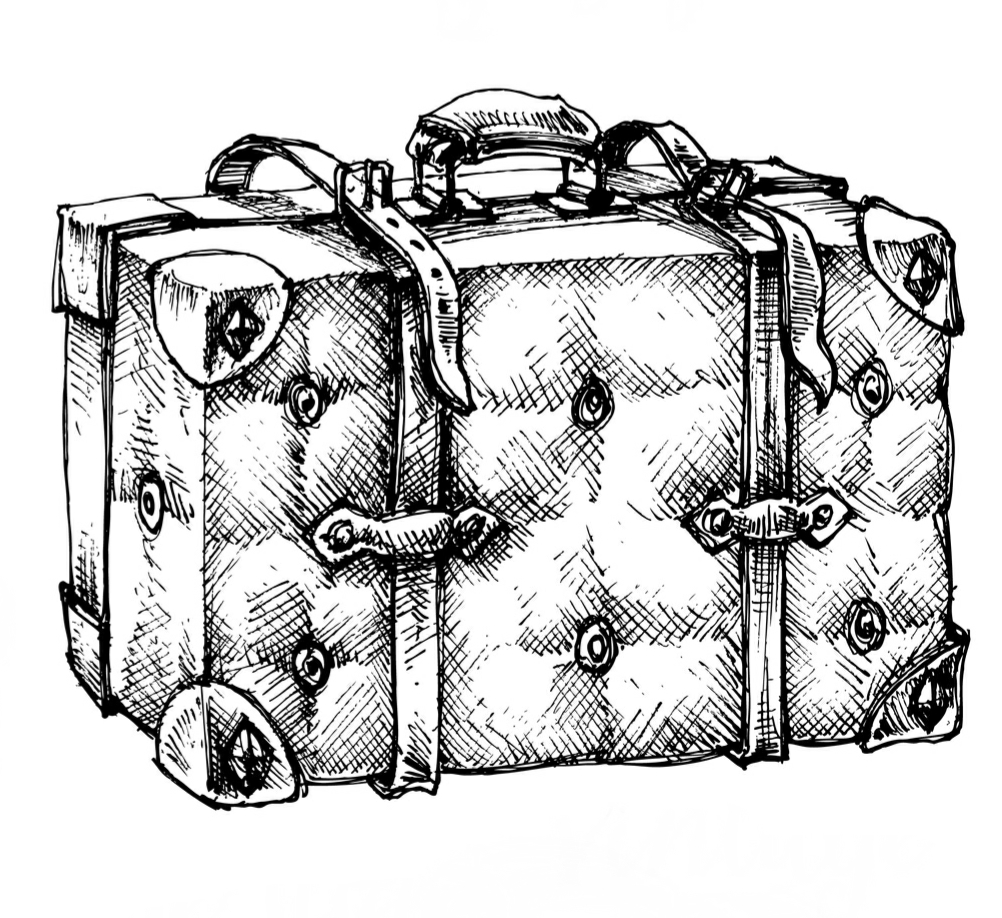
Drawing of a large suitcase and satchel. Both have brass closures and leather straps.

“You are a regular genius,” said the girl with the bundle, admiringly. “I might have invested fifty cents myself. But then, it was an awful bother to make it.”

Which, let me explain, was the marked difference between the two girls. It was not so much the inventive talent that the one possessed above the other. It was the habit that the other had of considering little common-place efforts of that character “an awful bother.”

I wonder how many girls who are sighing for “Boston bags,” or leather hand-satchels, or even neat, trim two-dollar “telescope bags” as beyond their means, will get a hint from my friend Mary’s management? I see ways of improving on her work. Do any of you?

Drawing of a stack of four old suitcases.

A Wee Booklet

Readers often wrote to Isabella asking how they could study the Bible on their own, and Isabella was always happy to suggest a method that seemed to fit their individual circumstance.

Here’s what she wrote to one reader, a harried housewife who had very little time each day to call her own:

As to methods of Bible study, there are numberless ways, and they are all good. The main point is to choose one of them and study. There are books that help wonderfully in the understanding of the Bible. Some of the very little ones contain a great deal of instruction.

This is notably the case with a wee booklet of not more than fifty small pages. It is called “Rightly Dividing the Word of Truth,” and contains ten outline studies on the divisions of the Bible. It is prepared by C. I. Scofield and published by the Asher Publishing Co., St. Paul, Minn.

Black and White photo of Cyrus Ingerson Scofield in his later years. His hair is white and he is dressed in a three-piece suit. He is seated at a table.  In one hand he holds a pair of glasses. His other hand points to a passage of text in a Bible open on the table before him. Behind him are bookcases lined with books.
Dr. C. I. Scofield at work in the library at Princeton University.

You can read the “wee booklet” Isabella recommended.

“Rightly Dividing the Word of Truth” by C. I. Scofield is available online.

You can read an electronic version for free on one of these websites:

BibleCentre.org

BibleBelievers.com

Or you can purchase a paperback copy from Amazon by clicking here.

Have you read Scofield’s booklet?

Do you think it’s a helpful guide for someone who is new to studying the Bible?

Advice to Readers about Dissatisfied Lives

For many years Isabella wrote a popular advice column for a Christian magazine. She used the column to answer readers’ questions on a wide variety of topics.

This question came to Isabella in a letter from a woman named Jessie:

What is the meaning of the Bible verse: “He satisfieth the longing soul, and filleth the hungry soul with goodness”?

I am not satisfied and I don't know what I want. I have asked God to help me find out, but I don't get help. I try to do what I think is right, but I seem to be as badly off today as I was yesterday. The soul hunger is still there, and I don't know where to look in the Bible, or out of it. How can I satisfy this hunger, or this longing for something that I haven't got? Can you help me? 
          Jessie

Here is Isabella’s advice:

I think the Bible verse you quoted means exactly what it says; it is the out-pouring of a glad heart in thankful song because God has made good his promise.

“Blessed are they that hunger and thirst after righteousness, for they shall be filled.”

That is the promise, and there are multitudes who can testify to its truth. The first step in securing its fulfillment to the individual soul is to believe it unquestioningly.

As to the reasons why some Christians (who think they are hungry for righteousness) continue from day to day to be “as bad off today as they were yesterday,” they are various. There is a state of longing, of unrest, of desire for something—one hardly knows what—that has very little to do with God. It merely represents a dissatisfied heart that thinks itself willing to take God, or anything else, in order to find happiness; but that is not hunger for righteousness.

The Bible verses quoted have to do, I think, with those who have already had an actual Christian experience that abides. They have settled it once and for all that they belong to the Lord Jesus Christ in covenant relations. That is, they have seen themselves as sinners, and Christ as the only Savior, and have definitely accepted him as their substitute. They recognize that they are not their own, that they have been “bought, with a price,” and have ratified the transaction; that henceforth their time, their talents, their possessions are his—lent to them for use, but absolutely under his control. Such an experience leaves no room for dissatisfaction and vague unrest.

Their days begin with prayer, real prayer—a definite commitment of each hour and each bit of work, each responsibility, each “thorn in the flesh,” each trifle to God, asking and expecting his minute and continuous attention.

Old photo of a woman kneeling in her bedroom in front of her dressing table, her hands are clasped together in prayer.

.

Sometime during the progress of their day there is definite Bible study. Not simply the reading of a few verses in succession, or scattered here and there, without giving careful attention to their meaning, but a real feeding of the mind:

“Whose word is this that I am reading? Is it my Lord’s?”

“Just what does he say here, and how?”

“What part of this is assuredly for me? Is it a promise? Can I claim it? Have I done so, definitely?

“Is there a direction here? Am I obeying it?”

“Is the meaning obscure?

“Am I using my best endeavors to find out just what he meant me to get from this portion?

“Has he explained it somewhere else in my Bible?”

Remember that he will work no miracles for you except those of which you stand in need. He has given you the book and a capacity for studying it; he will no more do the studying for you than he will make the bread in your kitchen while you fold your hands and wait for it.

I speak intentionally of daily Bible study, remembering, as I use the phrase, that there are some lives so crowded with what are known to be duties, that not even a small portion of their day can be claimed for what they call actual study.

Old photo of a Bible on a table. Beside it is an old oil wick lamp made of etched glass.

.

In those situations there is a delightful and helpful “study,” which one dear saint calls “feeding upon a Bible verse.” Take a little verse, or a piece of a verse, into the duties and perplexities and pin-pricks of the busiest day, and it will often prove a veritable armor.

Think of going into the thick of a Monday morning with a cantankerous parent to appease, with a wide-awake and deeply interested baby at the mischievous age to watch, with two or three heedless and belated children to be buttoned and brushed and smoothed and sent happily off to school; with door bells and telephone bells to answer, with luncheon to manage for seven or eight persons, with a tardy announcement that a friend is coming for luncheon and to spend the afternoon with the neighbor next door running in to borrow, and chat and hinder, with the thousand and one besetments of a wife, and mother, and housekeeper. Think of her as taking hold of all these duties, freshly armored with the verse:

There hath no temptation taken you but such as man can bear; God is faithful who will not suffer you to be tempted above what ye are able: but will, with the temptation, make also the way of escape that ye may be able to endure it.

You can imagine one’s temptations to the hasty word, to undue fault-finding, to feeling sure that she simply cannot endure any more of this.

“No,” says the Word upon which she is feeding, “you must not say that. God will not suffer you to be tempted above what you are able. He says so. He knows the temptations; he will make the way of escape. He says so.”

Did he mean her? Oh, yes, indeed! He had her in mind. “Neither pray I for these alone,” said Jesus, “but for them also which shall believe on me.” That includes her, and she knows that “he ever liveth to make intercession for her.”

Who is going to estimate the effect on the world of that day’s soul-food, as the busy daughter, wife and mother, with quiet face and sweet, low voice, meets and endures her multiform temptations with the armor that her Lord has supplied!

Such Bible reading is Bible study reduced to living. Such a life will grow; will feel more intimate acquaintance with the Lord today than it had yesterday, more joy in his service.

Such a soul will learn to long after fellowship with Jesus Christ, and will daily be given more and more of his felt presence.

Such a soul will “hunger and thirst after righteousness,” not in a sickly, sentimental, dissatisfied way, but with an eagerness and a hopefulness born of experience, and an experience that will refuse to be satisfied with anything less.

I believe real soul-hunger to be a pleasant experience: as when one with a healthy, normal appetite sits down to a well-filled table, knowing that he is very hungry, and knowing, also, that his hunger will be satisfied.

What do you think of Isabella’s advice?

Have you ever tried her method of memorizing a single Bible verse to carry with you throughout the day?

Isabella based some of her novels on the advice she gave here about “feeding upon a Bible verse.”

In Frank Hudson’s Hedge Fence, for example, Frank learns that memorizing one Bible verse a day, and keeping it top of mind all day long, can make a big difference in his outlook and his walk with God. You can get your copy of the book by clicking here.

She used a variation of the method in A Dozen of Them, where a boy named Joseph promised his sister he would choose one Bible verse a month and make it a rule to live by. You can read the book for free by clicking here.

Quotable

“Bloom where you are planted” is a popular phrase that Isabella Alden took to heart. Many of her books—such as The King’s Daughter and Interrupted—feature characters who use small acts of kindness as a way to witness for Christ under trying circumstances.

A New Graft on the Family Tree is another example. In the book Louise Morgan and her new husband move in with his difficult parents, who do not hide their disappointment in their new daughter-in-law.

If you’ve read the book, you know how Louise responds. No matter how much her mother-in-law complains or gives her menial tasks to do, Louise does everything asked of her with a cheerful spirit, because she believes that in serving her mother-in-law, she is also serving the Lord.

Illustration of an open book and blue vase with pink flowers on a table near an open window. Below are the words: "I bless Him that I may constantly serve, whether I am wiping the dust from my table, or whether I am on my knees." -From A New Graft on the Family Tree, by Isabella Alden.

.

What do you think of Louise’s method for dealing with her in-laws?

Have you ever had to deal with a difficult person? What method did you use?

Advice to Readers on Church v. Nature

Isabella wrote a popular advice column for a Christian magazine. Some topics she addressed may sound very familiar to today’s readers, like this one from 1897:

“What can be said to someone who says he can get as much good from reading sermons at home, or communing with nature, as in going to church to hear, perhaps, a poor sermon?”

Here is Isabella’s answer:

I infer from your letter that the person who takes this position is a professing Christian. To that person should come, first, a reminder of this direct command: The church we believe to be a divine institution, and careful study of the Bible shows that the Lord has promised to be in a special sense “in the midst” with those who gather in His name. To argue, then, that as much good can be secured in other ways is to set one’s self in opposition to the Lord’s wisdom, and to thwart His plans of grace for us.

Photo of man sitting on a large rock as he looks out over a pastoral scene.

.

Moreover, the first object in attending church is not to hear a sermon—good or poor—but to worship God in united prayer and song. He has planned that we shall gather in companies to do this, in order to be helpful to one another, as well as to ourselves. There is always that question of influence over others to be remembered. The habit of church-going is an unquestioned safeguard to thousands of people who have no deep-seated Christian principle in regard to it; and whatever I can do to confirm and increase this habit I am bound—by the rules that govern good society—to do. So that (leaving myself out of consideration altogether) for the sake of others I should be regular at church; but God has planned so wisely for us that in helping others we are, as it were, compelled to help ourselves.

Illustration of a man and his dog sitting at the base of a tree, looking out over a open field with a grove of trees in the background.

.

These are some of the reasons for habitual church-going that appear on the surface. But the best remedy for one not inclined to regularity in this matter is to ask the Master who “went into the synagogue on the Sabbath day,” “as his custom was,” what He thinks.

Have you ever heard someone say they believe reading their bible or communing with nature is just as good as attending church?

What do you think of Isabella’s advice?

A Hard Text about Burdens

Isabella’s brother-in-law Reverend Charles M. Livingston wrote several articles for The Pansy magazine in which he explained Bible verses that might seem confusing at first. Here’s one he wrote in 1888:


Bear ye one another’s burdens. (Galatians 6:2)
Every one shall bear his own burden. (Galatians 6:5)
Cast thy burden upon the Lord. (Psalms 4:22)
Old illustration of a hand holding up a Bible surrounded by rays of light.

How do we reconcile these verses that conflict one with another? Think in this way:

One day Martha went over the way to the pump with a four-quart pail for some water, and soon returned to her mother with it.

An hour later she went with an eight-quart pail and, filling it, tried to carry it back, but could not. Her neighbor, Mark, happened to be there with his three-quart pail. He offered to carry hers and let her carry his, and so they did and got on nicely.

Some time after they were both at the pump again, each with an extra pail. They were soon filled, but when they tried to lift them all and go forward they could not. Just then their good friend Moses came along and, seeing their trouble and their pleading looks, came to them, and with his two strong arms took up the extra heavy pails of water and easily and cheerfully carried them to their homes, while they followed with their other pails.

Maybe this will aid you to see that those three texts are not so hard, after all; that they do not go against each other, but go rather hand in hand.

What do you think of Rev. Livingston’s explanation?