The Domestic Problem

Isabella Alden believed that young Christian women who must earn a living would—for the most part—be better off doing so by hiring themselves out as domestic helpers in Christian homes, rather than taking jobs in factories or stores.

Illustration of a young woman about 1910 wearing a long-sleeved, floor-length dress over which is an apron. In one hand she holds a canned grocery item. With her other hand she gestures toward a large, ornately-decorated cast-iron stove. Beside her is a kitchen work table holding a jar, a bowl, a bucket, a spoon and glass.

She used that idea as the premise for her short story “Their Providence” (which you can read for free by clicking here).

Isabella believed a Christian home offered a safer living environment for a single young woman; and that she would be protected from the coarse worldly influences she would find if she lived in a boarding house.

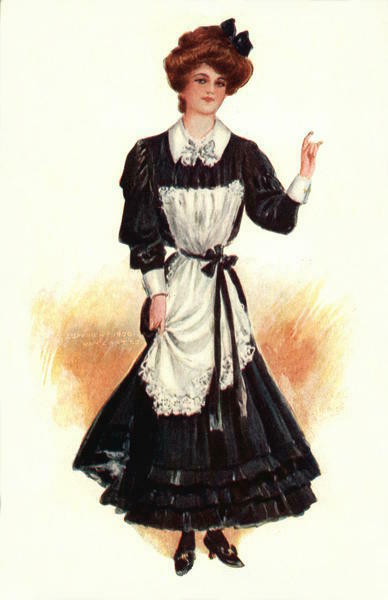
Illustration of a young girl from about 1910. She wears her brown hair up in a loose bun with a large black bow. Her floor-length dress is black with a white collar, cuffs, and a white lace-trimmed apron.

She also believed that living with a Christian family would reinforce the beliefs and principles Christian girls grew up with, such as keeping the Sabbath holy, regularly attending church, having daily Bible readings, and engaging in mission work.

Isabella knew the arrangement could be problematic. In her novel Ester Ried’s Namesake she wrote about a head-strong, quick-tempered young heroine who was hired as a live-in domestic helper for a Christian family that often treated her very poorly. But in true “Pansy” fashion, the characters in her novel eventually recognized their shortcomings and, with God’s help, learned to forgive and influence each other for good.

Illustration of a woman about 1900 wearing a high-necked, long-sleeved shirt and a brown skirt, over which is a white apron. In one hand she holds a recipe book; in the other she holds a pan of backed bread. Behind her another woman wearing a servant's cap pours a liquid from a saucepan into bowls placed on a table. Behind them is a large cast-iron stove. On top of the stove is a kettle with steam coming from its spout.

She also shared her idea of young women working as domestic help in some of her speaking engagements and in magazine articles she wrote.

But the concept was not always a welcome one. In 1911 Isabella received a letter from a young woman in Ohio who disagreed with Isabella’s advice.

I have recently read, in a paper or yours, a remark about “lovely Christian homes” where self-respecting girls could earn their living as helpers. I wonder if you really have any idea how these “lovely” people treat their hirelings? I think you had in mind the comfort of your well-to-do friends, rather than the girls whom you advised.

When you talk about girls finding good “homes” I don’t think you stop to consider both sides. What does “home” mean, if not a place where one has entire freedom to come and go, to plan one’s work, and work one’s plans?

I cannot see how any self-respecting person who has always had her own home could live as a hireling in other people’s homes. Could you? My observation has shown me that a condescending manner is the very best that even “lovely Christian people” have for their domestic helpers.

—Ohio.

Isabella had heard such criticisms before, some of which were “kind and sensible” and others “supercilious and snappy.” Here’s how she responded to the letter writer from Ohio:

“Notwithstanding the letter writer’s opinion, I believe I had in mind the comfort of both employer and employed when I urged self-respecting girls who had their living to earn to choose an average Christian home in which to earn it, in preference to factories, shops, and other public places. You, my dear girls, who have written to me, are starting this argument from the wrong platform.

“The foundation question is not, “How shall I secure me a home where I can have entire freedom to come and go, to plan my own work, etc.” but, “Is doing housework in other people’s homes a good and respectable way for a young woman to earn her living, and can she in this way hope to secure the reasonable conveniences and comforts of a home?”

“To this question I reply with an unhesitating Yes.

Illustration of a young woman about 1895. She wears a black dress with a high collar and puffed sleeves, and a white apron. She is pouring liquid from a copper pan into a soup tureen that rests on a kitchen table beside a variety of vegetables.

“The only—or almost the only—work open to women in which careful previous training is not demanded, nor even expected, is domestic service. Here the demand has been so much greater than the supply that absolutely untrained and ignorant help has rushed in and created the conditions that now exist.

“The attitude of the average employer toward her servant is endurance: she is unable to commend her work, she can only tolerate it. She has learned to conduct herself accordingly; and the multitude of decently educated, reasonably well brought up American girls who cannot be artists nor teachers nor stenographers, but must, nevertheless, earn their living, have, because of the above state of things, given this form of work a wide berth and rushed into shops and offices and factories, instead.

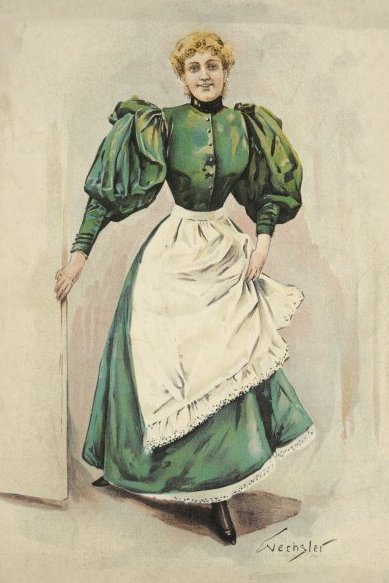
Illustration of a young woman from about 1895, wearing a green dress with large puffed sleeves. The skirt is floor length and over the skirt she wears a white apron tied around her waise.

“Now, let us look for a moment at one of the exceptions:

“She is an American girl with a partial high school education. She planned to be a teacher, but something happened. Illness, or sudden reverses, or unexpected demands, have made it necessary for her to become an immediate wage-earner. Times are hard and openings few; as a last resort she resolves upon trying domestic service, with every nerve in her body shrinking from the ordeal, because of what she has heard and seen and fancied.

Illustration of a young woman bending over the railing of a staircase. In one hand she holds a bar of soap. In the other hand she holds a cloth she uses to clean the spindles and post of the staircase.

“The woman who employs her (knowing she lacks previous training or recommendations) does so because she is in straits and must have somebody right away. All she knows about the applicant is that she looks “uppish” and as though she would feel above her work; which is precisely what the girl does feel. She is all ready to have her worst fears confirmed, and they are confirmed. She finds a thousand things to flush her cheeks with indignation.

“She resents the “orders” given out by the hurried and worried mistress who yet is not mistress of herself. She resents the poorly furnished room, the solitary meals at the section table, the eternal use of her given name. These and a dozen other grievances keep her in a constant state of irritation and resentment. She cannot do even her best—and none know better than she that, because of the lack of training, her best is not very good, for she is too much tried to give real heart to her work.

Illustration of woman holding a bottle of furniture polish in one hand. In her other hand she uses a cloth to polish the top of a dining table.

“What wonder that, after a short trial, the exasperated mistress and the equally exasperated maid separate, the one to be more convinced than ever that the word “help” as applied to the kitchen is a misnomer, and the other to write letters to someone to prove the impossibility of self-respecting girls earning their living in domestic service?

“For the sake of my correspondent who thinks I am theorizing and do not understand the situation, I want to explain that I have been a housekeeper for forty-five years; that I have been studying this problem carefully in my own home and the homes of certain of my friends for more than a quarter century; that I have known intimately all sorts of “hired girls,” and have helped a few of them to experiment in all sorts of homes.

“I have had the would-be fine lady who was an intolerable nuisance; I was glad when I saw her depart, and endured with what patience I could the unkind and untrue things she said about me; though I really believe they were true from her standpoint; she had so warped a view of the whole situation that she was incapable of even listening correctly.

Illustration of young woman wearing a white apron over an orange dress, and a white dusting cap with an orange bow over her hair. She holds a large feather duster.

“I have had all grades between, and I have had the real lady who came into my kitchen in appropriate dress and with quiet voice and quiet ways, and submitted to the regulation that obtained—many of which must have been new and trying to her—without the raising of an eyebrow to hint that she had all her life been used to different things.

“She came to me without flourish of trumpets, as an ordinary domestic servant at common wages; and when she left me after a year of invaluable helpfulness, it was as a tried and trusted friend, whom every member of my family not only respected, but enjoyed; and whom, as the years pass, we are glad to count as one held close in the bonds of friendship.

Illustration of smiling young woman wearing an apron and carrying a tray on which are glasses of juice and three plates of desserts.

“Nor was she the only “lady” help I have personally enjoyed. Glancing back over the almost half century, I find that five of them stand out in bold relief; strong friends, faithful friends, my “servants” still, in the same sense that I am theirs; and all of us trying to pattern after Him who said, “I am among you as he that serveth.”

“My correspondent asks if I “could live as a hireling in other people’s houses?” To which I reply, I do not know; I have never had the opportunity of trying myself in this way. It would all depend upon whether I was strong souled and resolute and sweet-spirited enough to brave present conditions and help to make them better.

“Yours for service,
Pansy.”

What do you think of Isabella’s idea?

Do you think you could ever “live as a hireling in other people’s houses?”

You can read Isabella’s short story “Their Providence” for free by clicking here.

Read Isabella’s novel, Ester Ried’s Namesake by clicking here.

Christmas For Jesus’ Sake

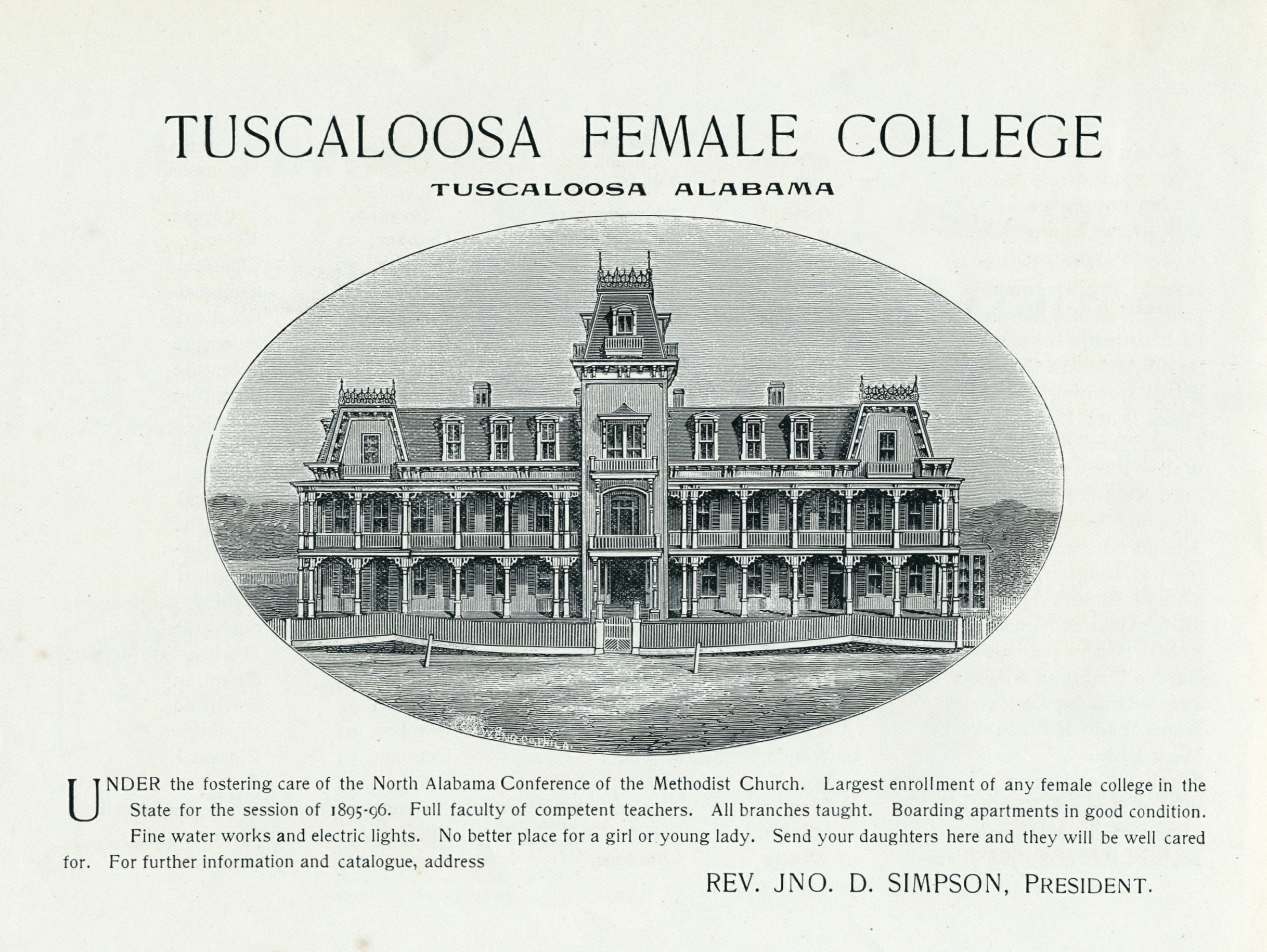
In Alabama the Tuscaloosa Female College was a successful and popular boarding school for girls aged six through sixteen.

Black and white illustration of a large building, three stories tall built in an ornate Gothic style. The first and second stories have verandas that stretch across the entire front of the building.
Tuscaloosa Female College, from an 1895 brochure.

In addition to classroom studies, the school offered students a variety of different clubs they could join; one club that was available to the youngest students was a chapter of The Pansy Society.

Isabella created The Pansy Society of Christian Endeavor as a children’s version of the Christian Endeavor program that had taken teens and young adults by storm in the 1880s.

Black and white drawing of the Pansy Society logo. In large letters are the initials P.S.C.E. behind and surrounding them are drawings of pansy flowers, ribbon, and letter-size mailing envelopes with scribbled addresses and hand-drawn postage stamps.
Logo for The Pansy Society of Christian Endeavor

She wrote about The Pansy Society in stories and articles she published The Pansy magazine. Children who joined the society pledged to do good works and live their daily lives “For Jesus’ sake.”

That motto—For Jesus’ Sake—was a motto the students at the Tuscaloosa Female College took to heart. Under the mentorship of teacher Eloise Hemphill, the school’s Pansy Society chapter took a special interest in some newspaper articles written by a local reporter about an orphanage in Tuskegee that was in need of help.

Excerpt from a newspaper. Headline: Tuskaloosa Female College. Faculty for Session 1888-89. The article lists several names of teachers in the "Collegiate Department" and the "Academic Department." Under the heading "Primary Department" is only one name: Miss C. Eloise Hemphill, Principal.
From The Tuskaloosa Gazette, September 20, 1888.

So when it came time for the school’s Pansy Society to perform their annual Christmas cantata, they invited the same reporter who wrote the articles to attend so he could write about their performance for the newspaper.

Unfortunately, the reporter arrived late, after much of the performance was over, and after Santa Claus had distributed all of the presents under the Christmas tree. So he was very surprised when, as soon as he arrived, the students immediately halted the program and called him up on the stage.

Wary, he did as he was asked, expecting to “receive a ten-cent comic toy placed on the tree by some little girl, to have a good laugh at his expense.”

“Imagine, therefore, his surprise and gratification when old Santa Claus handed him an envelope, tied with a piece of pink floss, with the following inscription:

“A Christmas offering of five dollars to the orphans of Tuskegee; presented by the Pansy Society in the Primary Department of the Tuskaloosa [sic] Female College, December 25, 1887.”

Newspaper Excerpt. Heading: The Pansy Society. On Saturday evening the Pansy Society of the Tuskaloosa Female College gave a Cantata and Christmas Tree. The Gazette reporter arrived too late to witness the first part of the evening's performance, and when he got a few feet inside the door the little girls commenced to call him to the stage. Mustering up all of his courage he walked straight up to the rostrum, blinded as he was by the bright light from the chandeliers. He expected to receive a ten cent comic toy, placed on the tree by some little girl, to have a good laugh at the expense of "ye reporter." Imagine, therefore, his surprise and gratification when Old Santa Claus handed him an envelope, tied with a piece of pink floss, with the following inscription: "A Christmas offering of $5 to the orphans of Tuskegee; presented by the "Pansy Society" in the Primary Department of the Tuskaloosa Female College, Dec. 25th, 1887."
From The Tuskaloosa Gazette, Thursday, January 5, 1888.

In 1887, five dollars was a lot of money for little girls to raise; it was the equivalent of about $160 in today’s economy.

The reporter was so surprised and gratified, the gesture caused him “to lose his head and eyesight at the same time” as he stammered out his thanks.

Of course the editor of The Tuskaloosa Gazette printed the story of the evening’s events, and added:

“Miss Eloise Hemphill and the sweet little Pansy Society have acted nobly. Out of their own little savings, in the midst of the festivities of Christmas, these little girls have contributed the handsome sum of five dollars for the little orphans whom God hath bereft of father and mother. It was one of the most delicate little acts of kindness it has ever been our pleasure to witness.”

Black and white head-and-shoulders photo of young woman in her twenties from about 1890. She is wearing a white dress with a high neckline where a small  brooch is pinned. Her hair is dark; bangs curl around her forehead. The rest of her hair is loosely pinned up at the back of her head.
Miss Eloise Hemphill (from Ancestry.com)

The editor added:

“The seeds of charity that have this Christmas been planted in their hearts by their noble teacher, Miss Eloise Hemphill, will take root and grow and bloom as they develop into lovely womanhood, until, like angels of mercy, they will go about doing good as long as they live.”

Isabella encouraged every member of The Pansy Society to plant similar “seeds of charity.” Each Christmas she asked them to pause amid the merry bustle of the season to “make some little gift as a loving reminder to one who otherwise would have none,” and to do it “For Jesus’ Sake.”

Do you have a similar Christmas tradition of giving a christmas gift to someone who otherwise wouldn’t have one?

What’s your favorite way to share a small act of kindness “For Jesus’ Sake”?

You can read more about The Pansy Society of Christian Endeavor in these posts:

New Free Read: A Five-Cent Investment

In 1893, when Isabella’s books were at the height of their popularity, a newspaper article about her mentioned that if forced to choose one word to describe Isabella’s work, that word would be “Help.”

The writer of the article made a very insightful observation. Typically, the main characters in Isabella’s books were, indeed, helpers. No doubt Isabella made them so as a reflection of her own belief that every effort counts. In her stories, no contribution was too small, and no effort was too little, as long as her characters did their best and made the most of what God had given them.

Today’s free read reflects that theme, when Mrs. Burns (one of the story’s main characters) asks the question, “How can I turn a small donation to help missions into a large and meaningful contribution?”

When Mrs. Burns is given a five-cent budget with which to help the cause of church missions, she can’t believe her ears. Five cents! What could she possibly accomplish with a small, insignificant nickel?

But with God’s help and a little imagination, Mrs. Burns soon discovers that her five-cent investment can accomplish great things.

You can read “A Five-Cent Investment” for free!

Choose the reading option you like best:

You can read this short story on your computer, phone, tablet, Kindle, or other electronic device. Just click here to download your preferred format from BookFunnel.com.

Or you can select BookFunnel’s “My Computer” option to receive an email with a version you can read, print, and share with friends.

Reader Tip: As you read the story, be on the look-out for one of Isabella’s most beloved characters from The Chautauqua Girls series to make a brief “cameo” appearance!


This post is part of our 10-Year Blogiversary Celebration! Join us every weekday in September for another fun drawing, giveaway or free read!

The Power of Prayer Giveaway

Isabella was a strong believer in the power of prayer. She once wrote:

Prayer is the pulse of the renewed soul; and the constancy of its beat is the test and measure of the spiritual life.

One of Isabella Alden’s talents was creating characters who discovered for themselves the power of prayer in their lives. Some of her characters turned to prayer in times of trouble or to heal a loved one of illness; other characters spoke to God as naturally and as often as they would speak to a close friend or family member.

As wealthy Miss Mary Brown discovered in The Browns at Mount Hermon:

“I would give—oh, what would I not give!—to be able to talk to God as those girls did this afternoon, with the assurance which they evidently had that he heard and cared!”

Book cover for The Brown at Mount Hermon by Isabella Alden showing a young woman holding a letter to her chest with one hand and a hand-addressed envelope with her other hand, while wearing a thoughtful expression.

In her own life Isabella knew the power of prayer. It was through the prayers of her sister Marcia that Isabella chose Christ as her Saviour (read more about that here).

As a busy author and public speaker, Isabella began each day with prayer “to ask God’s help and blessing on the work to be done.” (You can read about that here.)

And in her journal she regularly wrote down prayer requests, notes about sermons, favorite Bible verses, and lessons learned.

The Giveaway:

We’re giving away three “Power of Prayer” journal packages to readers of Isabella’s blog!

Photo of Journal and sticker pack.

Each package includes a lovely prayer journal with . . .

Journal cover. "Good Morning God Prayer Journal" is printed in white against a green background, surrounded by a border of white and yellow flowers.

. . . a daily two-page spread that includes a verse of Scripture, space to record your meditations and prayers, and a generous area to reflect on God’s goodness.

Open journal. Page on left has a text box heading: Remember your Father knows exactly what you need even before you ask Him! Matthew 6:8. Below the text box is the word Prayer and several lines for writing. The right page has the heading "God is good because ..." with several lines for writing.

The set also includes a coordinating sticker pack to help inspire your quiet moments of reflection.

Image of package showing sample stickers that say "It is well with my soul," "Grace," "Have Faith," and "Salt & Light."

To enter the drawing, just leave a comment below or on Isabella’s Facebook page no later than midnight (EDT) on Thursday, September 28.

The three winners will be announced on Friday, September 29. Good luck!


This post is part of our 10-Year Blogiversary Celebration! Join us every weekday in September for a fun drawing, giveaway, or Free Read!

New Free Read: Honor Bound

Isabella Alden and Theodosia Foster were not just best friends—they were writing partners, too.

Like Isabella, Theodosia was a prolific writer, and published her work under the pen name “Faye Huntington.”

When they got together to write a story, their styles were so similar, and they were so in tune with each other’s talents, it’s impossible for us to tell which of them wrote what chapter or scene.

Today’s free read is a novel they wrote together about the love of money and how it can change (or reveal) someone’s true colors.

Book cover showing the exterior front of a large mansion with tall columns supporting a balcony on the second floor and a wide veranda on the first floor.

Lawrence Brenholz always knew he would inherit his grandfather’s millions once he satisfied the provisions of the will. But on the eve of that momentous day, when all the Brenholz millions would be his, Lawrence’s ornery old Uncle Amos—long thought to have died in the wilds of Colorado—makes a shocking appearance that threatens Lawrence’s inheritance.

With Uncle Amos’ unreasonable demands disrupting every area of his life, how can Lawrence ever again find peace for himself and those he loves?

You can read Honor Bound for free!

Choose the reading option you like best:

You can read the story on your computer, phone, tablet, Kindle, or other electronic device. Just click here to download your preferred format from BookFunnel.com.

Or you can select BookFunnel’s “My Computer” option to receive an email with a version you can read, print, and share with friends.


This post is part of our 10-Year Blogiversary Celebration! Join us every weekday in September for a fun drawing, giveaway, or Free Read!

Poems of Faith from The Pansy

When Isabella edited The Pansy magazine, she made sure each issue included (in addition to her own stories) a wide variety of content, such as essays on science, history, life in foreign countries, and biographies of famous people.

Her family members regularly contributed articles, anecdotes, stories, and poems.

Isabella’s husband, her son, her sister, and even her niece Grace Livingston (who, as Grace Livingston Hill, later became a best-selling author just like her aunt Isabella) all wrote poems for The Pansy.

The Giveaway

Today’s giveaway is an e-book of some of the best-loved poems from the pages of The Pansy magazine.

Book cover of Poems of Faith from The Pansy has image of an old-fashioned lady's high-heeled shoe with a bouquet of purple, yellow, and blue pansies coming out of the top of the shoe.

Sometimes soulful, sometimes charming or funny, Poems of Faith from The Pansy is the perfect read when you’re in the mood for a bit of whimsy or a quiet moment of reflection.

You can read Poems of Faith from The Pansy for Free!

Choose the reading option you like best:

You can read the book on your computer, phone, tablet, Kindle, or other electronic device. Just click here to download your preferred format from BookFunnel.com.

Or you can select BookFunnel’s “My Computer” option to receive an email with a version you can read, print, and share with friends.


This post is part of our 10-Year Blogiversary Celebration! Join us tomorrow as we announce the winners of this week’s drawing!

Pansy’s Best Advice Giveaway

In past blog posts we’ve share some of Isabella’s advice columns that appeared in Christian magazines in the early 1900s. Sometimes humorous, sometimes serious, but always straightforward, Isabella answered reader questions on a variety of topics, from unwanted marriage proposals to a fear of praying in public.

Cathy and Elaine—two longtime readers of this blog—mentioned they would love to be able to have a booklet that contained all of Isabella’s advice columns.

What a great idea!

Thanks to Cathy and Elaine, today’s giveaway is an e-book collection of Isabella’s most popular bits of advice.

Book cover for Pansy's Advice to Readers. Image of a blue teacup and saucer filled with purple and yellow pansies and butterflies against a pink polka-dot background.

You can read Pansy’s Advice to Readers for free!

Choose the reading option you like best:

You can read the e-book on your computer, phone, tablet, Kindle, or other electronic device. Just click here to download your preferred format from BookFunnel.com.

Or you can select BookFunnel’s “My Computer” option to receive an email with a version you can read, print, and share with friends.


This post is part of our 10-Year Blogiversary Celebration! Join us every weekday in September for a fun drawing, giveaway, or Free Read!

We're 10! It's our Blogiversary Celebration! IsabellaAlden.com. September 2023. Join Us!

September

Isabella’s husband, the Rev. G. R. Alden, was a prolific poet, and many of his works were published in The Pansy magazine. He was adept at sharing humorous stories, childhood memories, and Biblical truths through rhyme. In the following poem he writes about anticipating the change of seasons in a long-ago, and much simpler time.

The fields and meadows paling 
Lie ’neath the hazy sky;
The thistle-down is sailing
By zepyrs slowly by.
The stalks of stubble, bleaching
Beneath September’s sun,
Seem silently now teaching
Of rest when labor’s done.
Image of two yellow birds sitting in a bush of white and pink thistles. One bird plucks the tuft from one of the white thistles.
The goldenrod, bright gleaming 
Above the parched sod, 
Is surely sent, the seeming 
Of the golden things of God. 
The katy-dids are calling, 
In a social sort of way,  
To learn what is befalling 
The neighbor ’cross the way.
Communist like, the blackbirds 
Hold meetings every night, 
As though the world went backwards, 
And they must set it right. 
The apples fast are falling 
From heavy-laden boughs; 
The milkmaid’s faintly calling 
’Cross the meadows for the cows.
Image of a large apple tree with branches full of apples bent down to the ground.
The milking-stool is ready
Astride the barnyard gate;
The cows come slow and steady,
Like messengers of Fate.
And soon, in silence sleeping,
Master and maid and herd
Beneath God’s kindly keeping
Will rest—as on his word.
Image of some cows grazing in a flowering field while other cows stand in the shallow waters of a lake or pond.
So may this mild September,
With its pictures passing fair,
Make each of us remember
God’s mercies, rich and rare.

A Scolding Mood

Do you have a pet peeve?

Is there some irritating little thing others do that seems to steadily accumulate until you can’t help but be angry?

Isabella found herself in just such a situation regarding the many letters she received each month from readers of her magazine and books. Here’s what she had to say about it (as published in a Christian magazine):

A Scolding Mood

Photograph of Isabella Alden from about 1898. She is seated at a table. In her lap she holds a piece of paper. Her right hand holds a pen poised above a piece of  paper on the table.
Isabella Alden at her writing desk.

Perhaps it would be well for me to own at the outset that I am in a scolding mood this morning. On my desk lie three letters written with as much care and thought as I could give them. Out of my busy life I took time to do my best for the three earnest girls who wrote me on important subjects, all of them of such a character that it was either not wise to bring them into print or so important as regards time that it seemed not well to wait for the printed page. Yet what was the result? Within ten days of their writing, all three letters were returned to me with the words, “Person not found,” written on the envelope.

Now whose fault is that? Not the postmasters’ or postmen’s certainly; for, judging from the appearance of the returned letters, much care has been taken to find their owners. In one instance the information has been volunteered, “Address incomplete.” As if the writer did not know that! But how was I to help it? A name, and the name of a certain city in a certain State; this was all. No street, nor number, nor post-office box—nothing to indicate where in the great city the person was to be found.

If this had been my experience but three times in my life, I should indeed be a happy woman; but oh, dear, the innumerable times I have exhausted my knowledge on a given theme for the attempted benefit of another, only to have to consign my work two weeks afterwards to the waste-basket, and to go about with the injured feeling that someone who had opened her heart to me was smarting under the sense of having been rudely treated!

Dear friends, is not the moral plain? Why will you not give a carefully detailed address? If you are visiting in a strange city, expecting to be there but a short time, by all means give the full address of the person whose guest you are, or of the hotel or boarding-house where you are stopping. If it is possible that you may leave the town before the reply to your letter reaches there, consider how it would expedite matters if you would instruct your correspondent to write on the envelope, “If not there, please forward to —,” etc.

While we are on this subject and I am in the mood, suffer me a few more growls.

How many letters do you suppose I get, asking for immediate replies, with not so much as a postage-stamp enclosed? In most cases this is pure forgetfulness; but if one receives—let us say—one hundred letters a week, requiring private replies, and fifty of the writers have forgotten the return stamp, in the course of a year this amounts to quite a sum.

Let me tell you something. Instead of the stamp (which every well-informed person now encloses when he does not forget it), if those who desire a prompt reply would enclose an envelope properly addressed, with the stamp securely stuck on its own proper corner, their chances for very prompt response would be largely increased. One who has not a large list of correspondents can hardly be made to understand what a relief it is to find letters so prepared, nor what an amount of work it saves in the course of months. So small an item for the writer, such a load lifted from the shoulders of the burdened!


What do you think? Did Isabella have a good reason to scold her readers a little bit?

What’s your pet peeve?

A Character Sketch of “Mrs. V”

Isabella Alden was an esteemed teacher, a successful author, and a beloved minister’s wife. During her life she was widely admired by those who knew her, and she was an inspiration to women across the country. But who inspired Isabella?

She gave us a hint to the answer in 1894 when she wrote an essay about a beloved friend she greatly admired. Here’s how she described “Mrs. V”: 


Something—a chance sentence of one who lingered for a moment in my room—has sent my mind back over the past, and recalled a vivid picture of one friend for whom the gates opened heavenward years ago; yet she lives so distinctly in my memory that it seems but yesterday that I saw her quiet, pleasant face, and heard her low, kind voice.

Today I have set myself to earnestly studying why she influenced me so steadily, and why her memory lives so plainly, not only with me, but with many others who were not bound to her by any closer tie than that of friendship.

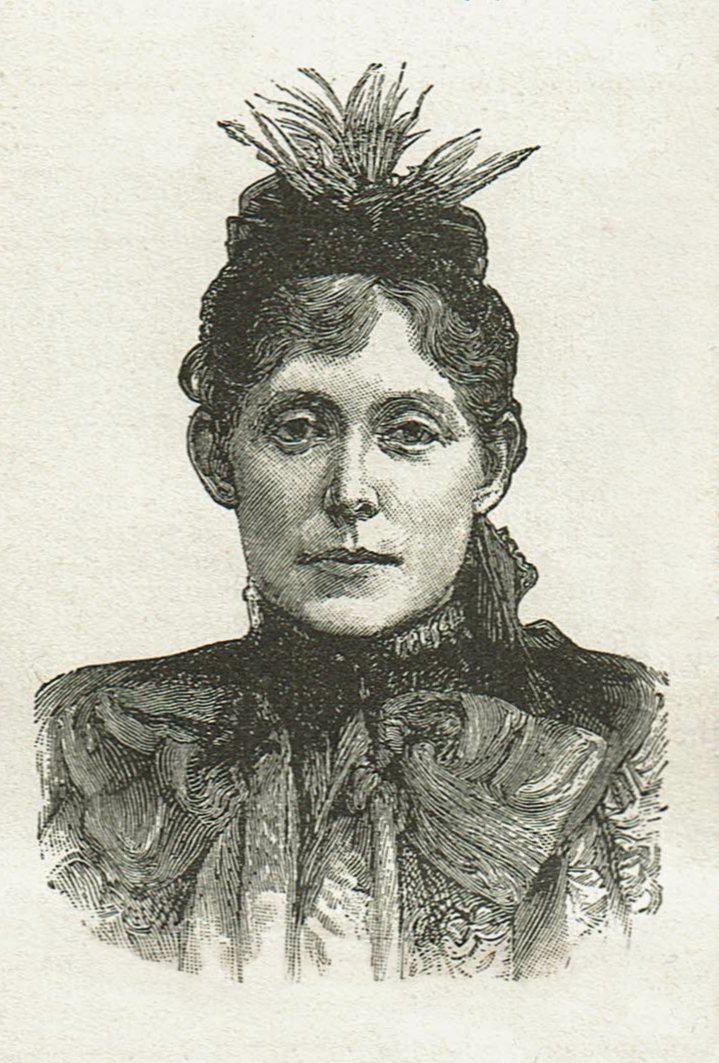
Illustration of a woman's shoulders and heads. She is dressed in a high-neck gown that was in stile about 1895. Her hair is pinned up and on top of her head is a modest pill-box style hat with short feathers stick out from the top.

I remember her as one who was always at our women’s prayer-meeting. There were a dozen or twenty of us who were more or less regular in attendance. Several women we could count upon if the day was reasonably pleasant; others would be there if there had not been something exhaustive the day before, like a church sociable, or festival; but Mrs. V established such a reputation for regularity, that in the few times she was absent during the years of my intimate acquaintance I distinctly remember seeing anxious faces and hearing questionings like this:

“Did any of you know that Mrs. V was ill?”

“Oh, no; I haven’t heard from her, but she isn’t here.”

She was not a woman gifted with a great command of language. She had no startlingly original ideas of any sort to offer. A superficial listener might have called her commonplace. Perhaps she was. When one stops to think of it, many things which we prize the most are really commonplace. I suppose love is. And mothers are very common, and homes.

Mrs. V was a low-voiced, quiet woman. She shrank from notoriety; she was not made president of any of the church societies.

“Oh, no,” she would say, when someone mentioned her name; “choose Mrs. Jones, or Mrs. Smith; either of those will fill the office better; they know how; and I will work just the same in any way that I can.” She meant these negatives, and pressed them until she was taken at her word.

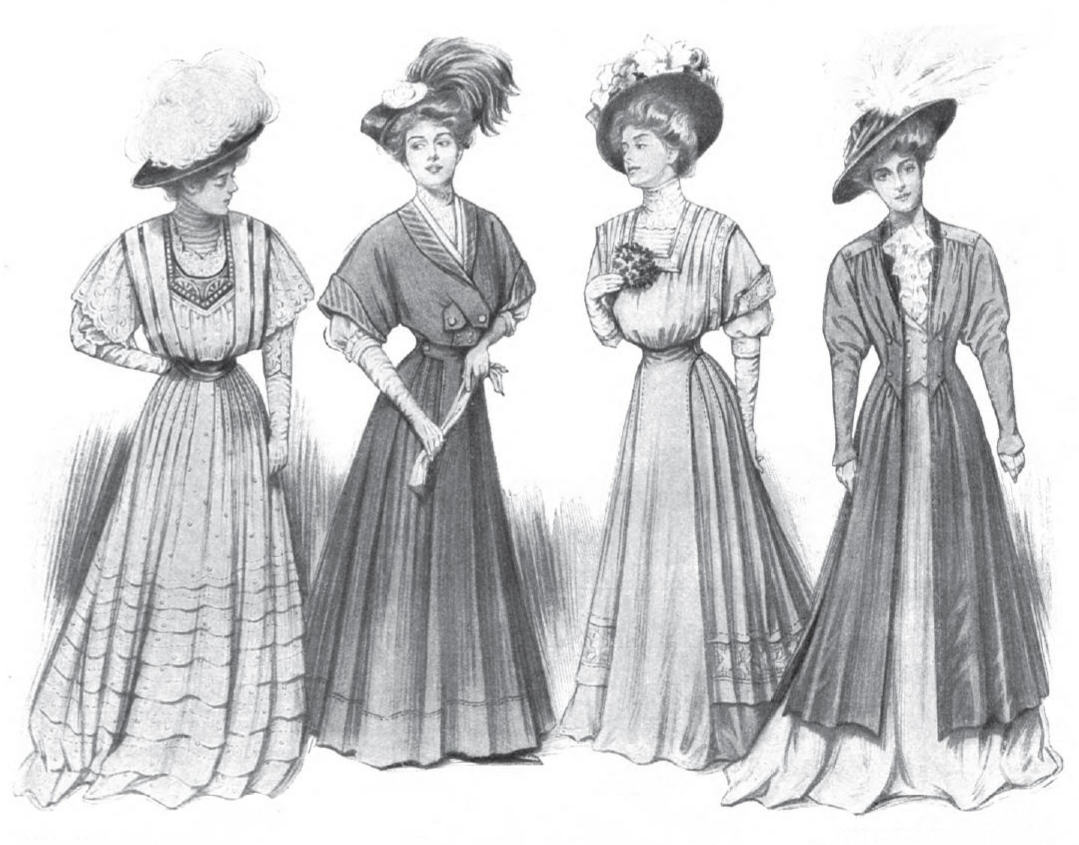
Illustration of four women standing in a line dressed in clothing from about 1905. Each is dressed for going out; one in a long coat, one in a short, waist-length jacket; and two in long-sleeved dresses with high collars. Each wears a wide-brimmed bonnet adorned with different kinds of featheers.

“Mrs. V shrinks from office,” we said. “She is timid.” But she did not shrink from work. No matter what the scheme—whether it included baking, or frying, or broiling, or one’s self and one’s nice things—Mrs. V could be counted on.

“I will try to do my share,” she would say, cheerfully, and we were always anxious to let her decide for herself what her share was. No one thought of apportioning to her all the things which she quietly took upon herself. Neither did we ever say to her, “Mrs. V, will you do this or that?” singling out the pleasant places or the pretty part of the work. It was not hopeless selfishness upon our part which made us never select these places for her, but because she would be too quick for us.

“I will see that the dishes are in order, and attend to spoons and forks and all that sort of thing,” she would say when we were planning a campaign; or “I will get the church parlors ready for evening.” This would be long before we had reached dishes or parlors. In the course of time we learned to depend on her for all such things.

Illustration of a woman dressed in a blouse and long skirt from about 1905. She stands at a table she is setting for dinner and arranges flowers in a small bowl.

“Mrs. V will look after that,” was a sentence often upon our lips, and I do not think it was until afterwards that some of us realized how often the sentence referred to drudgery; though one of our ladies had said once, significantly:

“Mrs. V will dust and arrange the parlors, and put everything in perfect homelike order, and Mrs. W will entertain the guests; we believe in division of labor.”

Illustration of two women dressed in clothing from about 1905. One is polishing a small vase. One is wearing a dust cap and uses a feather duster to dust off the back of a wooden chair.

But while Mrs. V. shrank from office, and was always proposing the names of others, there was one duty from which she never drew back. Always, even at very short notice indeed, we could depend on her to lead the woman’s prayer-meeting.

“I am not gifted in that direction,” she would say, meekly, “but I will do the best I can.” And the meetings which she led proved the truth of her pledge; moreover, her “best” was something to remember.

Illustration of a group of five women praying and singing in a church. They are dressed in gowns and bonnets that were in style around 1890.

She may not have been “gifted”; I do not think we ever talked about her as one who was, nor said to one another: “Wasn’t that a beautiful talk she gave today?”

One good woman voiced the thought of our hearts when she said as we went quietly out from a meeting which Mrs. V had managed:

“We ought to be better women all the week after such a meeting as that. The Lord led it, didn’t he?’ Perhaps that is the feeling which Mrs. V’s work gave us as much as words can express it: she was taught of God.”

I recall so many quiet, pleasant things about her; things which were not much thought of at the time, but which have left their impression.

She had a little grandson, a sweet, shy boy, who shrank painfully from any contact with strangers, and was long in making acquaintances. She was very anxious to have him become a member of our primary department in the Sabbath-school, and tried in various ways to win him to go with some of the children, without success. Finally she said to me:

“I think if I may come with him a few times, he will overcome his timidity.”

Illustration of a little boy standing on tiptoe on a footstool in order to reach up to wrap his arms around a woman's neck as she bends over him.

Of course she was invited to do so; we gave her a seat in the visitors’ corner, and used all our skill to win the timid little fellow by her side into our youngest class. All in vain. He was contented and happy beside grandmother, but his fair, pale face would grow red, and his lip quiver pitifully, at the mention of a separation.

After weeks had passed, and he made no progress, the dear grandmother said, “I think I will have to become one of your teachers with my boy for a pupil. May I not come every Sunday and keep him beside me, and teach him what you teach the others as far as I can, until he learns to come without me? I want him to form the habit of coming here, and to be happy in coming.”

We joyfully welcomed her and her one lambkin, and all summer, not only, but through the long, cold, stormy winter, not a Sabbath afternoon passed but grandmother and little one were in their corner, and, so far as I could judge, a more interested pupil did we have than the fair-faced little fellow, who bent earnest eyes on card, or picture, or whatever his teacher used to hold his thoughts.

Drawing of a woman and 8 children sitting on wooden chairs in a circle. All are dressed in clothing from about 1900; the woman and girls wear bonnets and dresses; the boys wear little suits. The woman is holding an open book and point to a place on a page.

In the course of time he learned to rise and join with the children in reciting the golden text, or in singing their motion songs, his grandmother always rising with him, and going gravely through the motions, as if she were a child. I remember nothing sweeter, in its way, than the gravity with which she would repeat with the children the verse:

"I've two eyes to look to God,
I've two ears to hear his word;
I've two feet to walk his ways
Two hands to work for him all my days."

She would touch her fingers to her eyes and ears, and bow her head to look at her feet, and spread out her hands, exactly as the hundred or more children were doing all about her; and seemed able to forget that she was not five, instead of quite past fifty. Also, it was a curious thing that the children seemed to forget it; they accepted her as one with them. I do not recall so much as a smile on the faces of the little ones, growing out of the fact that dear Grandmother V said the verses just as they did.

“My little fellow is a mixture,” said the grandmother to me. “He is too shy to do many of the things which others do, but he is also too large. He confides to me the fact that he is only going to do what fathers and mothers and grandmothers do, and not be like little specks of children! And I want him to understand that eyes are never too old to ‘look to God,’ nor hands too old to work for Him. And as example seems to do so much more for little people than precept, I join in all the exercises to prove to him that Grandmother is not too old for any of them; then I try to explain to him afterwards in what ways he and I can use our eyes and ears and hands and feet for God; the ways are different, I tell him, but the heart is the same.”

Sweet, wise grandmother! Happy little grandson to live in the daily atmosphere of such careful, tender precept and example.

When I heard that she had left them and gone to heaven, I think my tears fell first for the grandson bereft of so much, even before he was old enough to fully realize its worth.

In the woman’s prayer-meeting of which I have already spoken, and which was an altogether social gathering where topics of general interest were discussed in as informal a manner as we would have discussed them had we met in one another’s parlor by accident for a social call, Mrs. V used often to let drop quiet little words, generally in answer to some question, which would illuminate the topic before us as nothing else had done.

At one time we were talking about women taking part in the general prayer meeting of our church; a matter in which the pastor was deeply interested, and which he urged persistently.

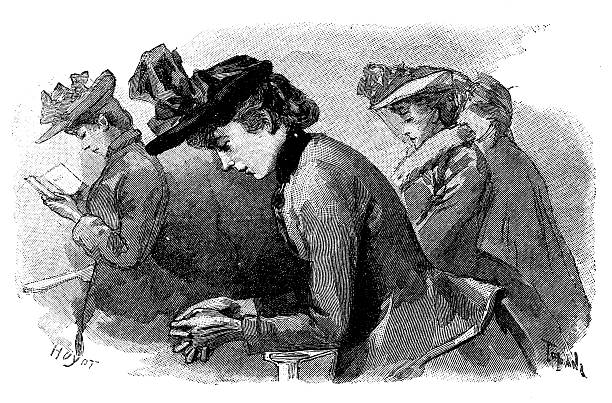
Illustration of four women kneeling in prayer in church. All wear coats and bonnets. One holds an open prayer book.

One lady said she had not the slightest objection to it; indeed, she liked to hear other ladies. She thought it made the meeting seem more social; but for herself she could never do it; she might think over a sentence at home, even commit it to memory, but the moment she tried to give it in prayer meeting it would stick in her throat, and choke her, she knew it would!

Then she turned to Mrs. V and said, “I am always surprised to see how quietly you recite a verse, or say a few words, exactly as though you were in your own home with your intimate friends. Your voice does not tremble, and you never look confused. Why, I believe I should faint if I should attempt it! And you are a very timid woman; how do you manage?

“I don’t believe I manage,” said Mrs. V, with a quiet smile. “I have nothing of any particular consequence to say, so it never takes any managing. I just remember that we are all brothers and sisters gathered for an hour to talk about things which have to do with our journey Home, and I think it would be very strange if I, who am in the midst of the journey, farther along than many of the others, could not have a friendly word of cheer for them, or a promise to remind them of. It is just a family gathering for conversation with one another, and with the Elder Brother, you know. I always take my part in our family gatherings at home; not a very large part, perhaps—I am not much of a talker, you know, anywhere—but still I always have a word to say; and I try to make the prayer meeting feel just like that, and not think about what words I am using, or anything of that kind.”

Her questioner stared, as one bewildered. I do not know that to this day she realizes anything of the sweetness and fullness of her answer, nor dreams how much of spiritual fellowship was embodied in it; but some of us felt its power.

“It is just a family gathering for conversation with one another and the Elder Brother,” repeated a dear friend to me, as we passed out. “I shall always think of that after this, when I am in a prayer meeting. What she says in the meetings fits that thought, doesn’t it?”

Yes, it was true that while some of those who could manage an oyster supper or a carnival, from its first inception through to the distracting and oftentimes bitter end, could not open their lips in the general prayer meeting, would have “fainted at the thought,” she, the timid woman of our number, always responded to the pastor’s invitation; often among the first. Never saying much; rarely saying anything which could have been quoted and commented on, yet forever leaving her impress on the gathering, so that on one of the rare occasions when she was absent from her accustomed seat, I recall the fact that the pastor said, “I feel as though we have lost a benediction tonight; Mrs. V is not here.”

At another time, in the woman’s meeting, we were talking about regularity in attending the Sabbath services, and some were bemoaning the fact that they had a great deal of company during the summer, and were often detained at home.

One lady said, “It does seem to me that I have more company, who have a habit of staying home from church on the slightest pretext, than any other people do. If it is a trifle warmer than usual, or cloudy, and looks as though there might possibly be a shower some time or other, it is seized upon as a pretext for lounging at home. I always dread to ask the question, when my house is full of company, lest I may be doomed to stay with some indolent guest who simply does not want to take the trouble to get ready. Mrs. V, you always seem to have company, and I notice that they are always in church with you; how do you manage? When you ask if they are going out that morning, and they say they believe they won’t go until evening, they have a little headache, do you say they must?” The question closed with a half laugh, for so informal were our meetings that even a laugh did not frighten anybody; but we listened with interest for Mrs. V’s answer.

She considered the lady thoughtfully for a moment, with retrospective air, as though she might be looking back over her past for illustration, then said, “I do not believe I ever ask that question. I cannot recall an instance when I did. I am in the habit of saying at the breakfast table that our church services commence at half-past ten, and that we try to start from the house promptly at twenty minutes past ten, which will give us ample time to walk leisurely; and that we are in the habit of meeting in the parlor and all going together. I think I take it for granted that everybody is going, children and all, and they never disappoint me. I have always found that there was so much gained in taking some things for granted. You know we have to do that way with children. I had a little fellow once to whom it would have been fatal to have said, ‘Are you going to church this morning?’ When I saw the spirit of insubordination creeping over him I had to say, ‘You may wear your new collar to church today,’ or something like that, forestalling any objections to going. Perhaps I have fallen into that habit with company.”

“I’m sure it is a very good habit to fall into,” said one. “I’m afraid I should not have the courage to carry it out.”

For certain reasons I wanted to draw her out more fully, and I said, “Suppose, for purposes of illustration, Mrs. V, that you have a friend who, although not ill, is yet not inclined for church, and she says to you that she thinks she will not go this morning, do you remain with her?”

“By no means,” said Mrs. V, quickly. “I furnish her with as comfortable surroundings and as good a book to read as I can and excuse myself.”

“That will do for Sunday,” said one, “but suppose it is prayer meeting evening; I have a great many callers on Thursday evenings, just at church-time. Do you ever, Mrs. V? And if so, what do you do with them?”

“Plead an engagement and invite them to join me,” said Mrs. V, smiling.

“No! Do you really?”

“Why, certainly,” said Mrs. V, looking almost bewildered. “What else could I do? I am under covenant obligations to be at prayer meeting when I can; and I should not consider callers a sufficient excuse for my pastor’s absence; why should it be for mine?”

There is a bit of personal experience which comes to me so tenderly that, even after the lapse of years, I can scarce keep back the tears at the thought of it. Just one of those little things—commonplace, so called—a thing which one had to receive simply as a matter of course, and yet it was far from being that.

The occasion was an evening wedding in our church—a wedding where everything was expected to be arranged according to approved ideas. In some way I had gotten the impression that no bonnets were to be worn by the guests, and I therefore appeared late, in the vestibule, with no other covering for my head than an old veil which I had hastily snatched to protect my hair, to discover that I was the only bonnet-less one of that large company. There was no time to return home and make the necessary changes, and I certainly would be unpleasantly conspicuous as I was.

While I stood there in doubt and annoyance, Mrs. V and her party entered. She was faultlessly dressed, and wore a handsome new bonnet which exactly fitted her. In a moment I had told her my trouble, because she was one to whom people naturally told troubles, great and small, not because there was supposed to be anything that she could do.

Illustration of two women talking. Both wear clothing from about 1910. One woman is sitting on a bench, without a hat. The other woman is standing, wearing gloves, a short jacket and a hat.

I looked to hear her say, “I’m sorry you did not understand; they ought to have told you,” or “I wouldn’t mind; just go in as you are; there is such a large company people will not notice you much,” or some other equally comforting commonplace which people say in the face of the annoyances of others. She did differently.

“Oh, we can arrange that.” she said. “The immediate family are to be bonnet-less, and they will be here in a moment. I am an immediate friend, and you are the pastor’s wife; nothing could be more appropriate than that we should be exceptions to the others. I’ll whisk off my bonnet in a twinkling; my hair isn’t exactly arranged to appear without it, but that’s no matter, and we’ll go in together and pose as guests of honor.”

It had all been done so quickly, there was no time for protest. The handsome new bonnet was hastily consigned to the care of an attendant, and in a moment we were moving down the aisle, being recognized by the usher as special guests, and being shown into the be-ribboned pew which, it seemed, had been set apart for the wife of the pastor. Nobody stared; the quick-witted woman had made everything look reasonable and in order, and the family party followed almost immediately.

A very trifle? Yes, I told you so, but not one woman in twenty would have done it. Half of them would not have thought of it at all, and the other half would not have sacrificed their new bonnet, and worn their hair in an unbecoming fashion, merely to save another from a moment’s annoyance.

“Don’t speak of it,” she said, laughing, when I tried to murmur my thanks. “I am the one to be grateful; don’t you see, I secured a place of honor by the means, and a little of the reflex glory fell on me, I am sure.”

It is ten years since that time, yet I have never forgotten the little kindly, unselfish act, but laid it away with dozens of others connected with this sweet, inconspicuous, quiet woman who never for a moment imagined that she was doing or saying anything worth mentioning or remembering. Yet so many remember her. They crowded about her quiet grave and paid their tribute of tears. People whom her family did not know at all; people to whom she had given some kindly word or look, that had lived and borne fruit in their hearts.

Heaven must be full of sweet surprises to Mrs. V. Sometimes I try to fancy what it is to hear one and another, as they gather up there, tell her of the flowers she planted unawares. Someday I mean to tell her myself certain things which I know will surprise her to hear.

Why am I paying this tardy tribute to a friend who has been so long gone from us? Because, as I grow older, I realize more and more how rare she was, and recognize more fully that it was her Christ-like self-forgetfulness and her Christ-like interest in others which made much of the charm of her life. Long ago, the Master must have spoken to her—her face full of surprise and wonder the while—his blessed “inasmuch.”

What do you think of Isabella’s essay?

Have you ever known someone like “Mrs. V”?