Isabella Alden and her best friend Theodosia Toll Foster shared many things: a strong Christian faith; a belief in the values of honesty, kindness, and honor; and a true desire to make the world a better place for everyone. They also shared a talent for writing.
Theodosia Toll Foster (about 1865)
Under the pen-name “Faye Huntington,” Theodosia published over forty books, as well as pamphlets, short stories, histories, and other articles for magazines and newspapers.
But perhaps her most beloved short stories appeared in The Pansy magazine, which Isabella edited. For over a decade they collaborated on the magazine’s contents.
You can meet Theodosia’s Great-granddaughter!
Susan Snow Wadley, Theodosia’s great-granddaughter, will be giving an on-line Zoom lecture on Theodosia’s life and writings.
Hosted by the Erie Canal Museum of New York, the lecture is scheduled for:
In 1891 a Christian weekly magazine mailed letters to America’s most prominent Christian authors and ministers asking one question:
What is it to be a Christian?
Many of the replies from ministers and church elders spoke about adhering to New Testament doctrines. Some replied that being a Christian meant following the example set by the Divine Master.
A famous Unitarian pastor answered that to be a Christian was “to do the will of my father who is in heaven.”
Of course, Isabella was one of the Christian authors who received the letter.
Isabella Alden, about 1900.
Here is her answer, which was printed in newspapers across the country on Sunday, March 20, 1892:
“To be a Christian is to love the Lord Jesus Christ so much that I shall desire to have him reign supreme in my heart.”
When Isabella wrote her short story “Their Day at the Beach” in 1909, she based her story on personal experience.
It was common practice at the time for physicians to prescribe a change of climate for certain medical conditions, particularly ailments of the skin and respiratory system.
Isabella’s son Raymond suffered his entire life from a chronic condition that caused Isabella and her husband to consult numerous doctors in search of a cure. Ultimately their search took them to Florida, where they hoped the sunshine and moderate climate would benefit their son.
An 1897 map of Florida.
There’s a special reason they chose Florida over any other southern state: in 1885 a new Chautauqua Assembly opened on Florida’s gulf coast. Located in what is now Defuniak Springs, the Assembly was built around Lake De Funiak (as it was then called), a naturally circular-shaped lake about a mile in circumference.
A travel brochure advertising the new Florida Chautauqua.
The Aldens found the location very much to their liking. The climate was delightful; the temperature rarely rose above ninety degrees, fruit trees and forests grew in abundance, and a gentle gulf breeze meant the dry air always felt fresh and pure.
The Florida Chautauqua officially opened on February 18, 1885, and the Aldens were there!
An announcement in The Chautauquan, May 1885.
As they did in New York, the Aldens built a small house on the Florida Chautauqua grounds and promptly named it Pansy Cottage.
A rendering of Pansy Cottage at Lake Defuniak in 1885.
Their cottage faced the lake and gave the Aldens a lovely view of the lake shore and the promenade.
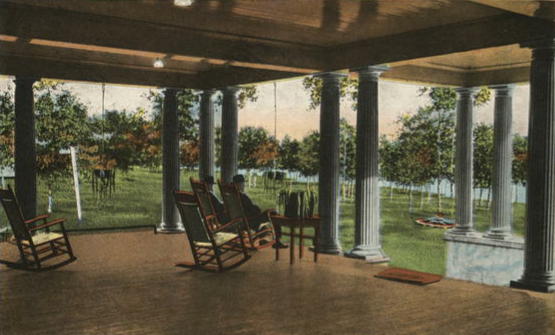
This view of the lake from the porch of Hotel Walton is similar to the view Isabella would have had from her cottage.
With her usual energy, Isabella dove into the Florida Chautauqua experience. Many of the Chautauqua New York programs were duplicated here: A school of Greek, a kindergarten, a school of cookery, an art school, and the C. L.S.C. all took root in the new Florida location. There was even an amphitheater and a Hall of Philosophy.
Hotel Chautauqua on Lake de Funiak, 1907.
The most marked difference between the two Chautauquas was duration. While the New York assembly remained open for three months every summer, the Florida Chautauqua packed as many speeches, studies and classes as possible into a thirty-day assembly.
When the first Florida assembly came to an end in March 1885, The Aldens began to entertain the idea of staying in Florida for the remainder of the winter months. Eventually, they decided to settle in Winter Park, not far from Orlando, where they built a large home they also named Pansy Cottage. (You can read more about her Winter Park home by clicking the link at the end of this post.)
Isabella’s charming cottage in Defuniak Springs still stands today!
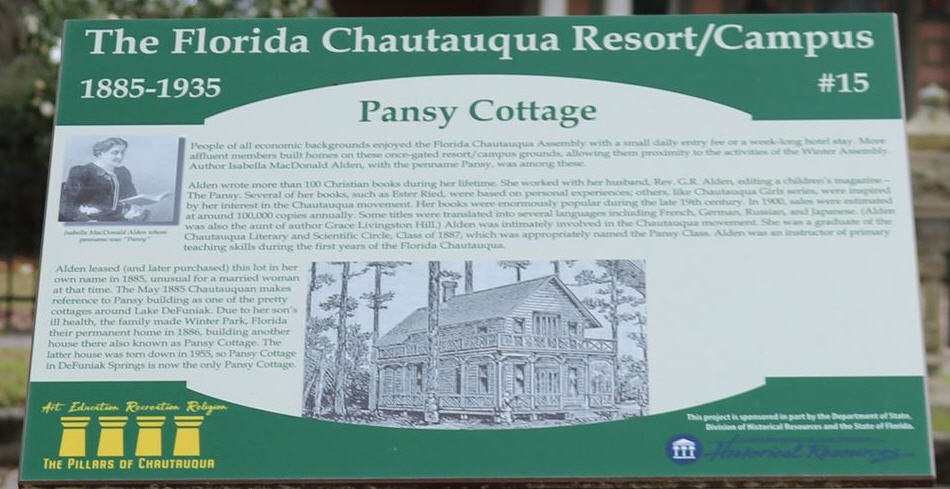
The city of Defuniak Springs has erected a plaque to commemorate its history. The plaque reads:
Pansy Cottage
People of all economic backgrounds enjoyed the Florida Chautauqua Assembly with a small daily entry fee or a week-long hotel stay. More affluent members built homes o n these once-gated resort/campus grounds, allowing them proximity to the activities of the Winter Assembly. Author Isabella MacDonald [sic] Alden, with the penname [sic] Pansy, was among these.
Alden wrote more than 100 Christian books during her lifetime. She worked with her husband, Rev. G.R. Alden, editing a children’s magazine—The Pansy. Several of her books, such as Ester Ried, were based on personal experiences; others, like Chautauqua Girls series were inspired by her interest in the Chautauqua movement. Her books were enormously popular during the late 19th century. In 1900, sales were estimated at around 100,000 copies annually. Some titles were translated into several languages, including French, German, Russian, and Japanese. (Alden was also the aunt of author Grace Livingston Hill.) Alden was intimately involved in the Chautauqua movement. She was a graduate of the Chautauqua Literary and Scientific Circle, Class of 1887, which was appropriately named the Pansy Class. Alden was an instructor of primary teaching skills during the first years of the Florida Chautauqua.
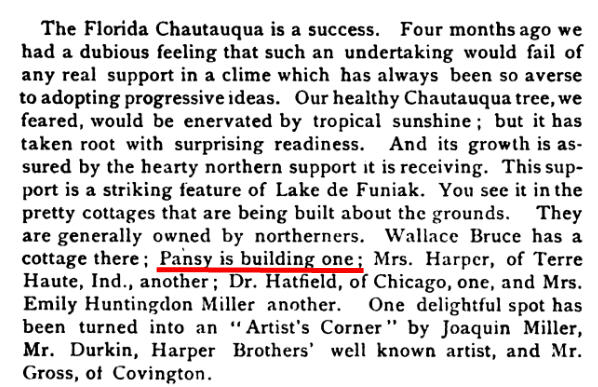
Alden leased (and later purchased) this lot in her own name in 1885, unusual for a married woman at that time. The May 1885 Chautauquan makes reference to Pansy building as one of the pretty cottages around Lake DeFuniak. Due to her son’s ill health, the family made Winter Park, Florida their permanent home in 1886, building another house there also known as Pansy Cottage. The latter house was torn down in 1955, so Pansy Cottage in DeFuniak Springs is now the only Pansy Cottage.
The plaque that marks Isabella’s cottage at the Florida Chautauqua.
You can read Isabella’s Story “Their Day at the Beach” for free! Click here for details.
Click on the links below to read more about Isabella’s home in Winter Park Florida:
For over twenty years Isabella Alden and her husband edited a children’s magazine called The Pansy. While their names were credited on the magazine’s cover, the entire endeavor was a family affair.
Isabella’s son Raymond regularly contributed poems, short stories, and science-related articles.
Her sister Marcia wrote “Baby’s Corner,” a monthly column for the magazine’s youngest readers.
Marcia’s husband, the Reverend Charles M. Livingston, contributed stories, anecdotes, and news items.
Charles Livingston (from the Livingston Family Album, courtesy GraceLivingstonHill.com)
Rev. Livingston had a talent for explaining the Bible’s most challenging verses in terms young people could understand. He told young readers:
When one thing in one part of the Bible seems to conflict with another part or say something which seems to be wrong, you are to conclude that a little better understanding will set it all to rights in your mind.
In 1888 Rev. Livingston wrote a brief article for The Pansy magazine about a certain Bible verse that young people—and adults—often found very confusing!
Here’s what he wrote:
A Hard Text?
If any man come to me, and hate not his father, and mother, and wife, and children, and brethren, and sisters, yea, and his own life also, he cannot be my disciple. (Luke 14:26)
A hard text? Some readers think it is. But suppose it read this way:
“If any man come to me and love not his family less than me … he cannot be my disciple.”
The other way is simply a strong way of saying this idea, that Christ must always be FIRST to His child. He must have our supreme love, and nothing must stand in the way. Do you get the idea?
Of course it does not teach one to hate anybody, much less a dear father, mother, brother, sister.
You know this same Jesus who spoke Luke 14:26 also said:
“Love,” even one’s enemies, and “Honor thy father and mother.”
Jesus cannot contradict Himself.
Readers of The Pansy enjoyed Rev. Livingston’s lesson so much, he wrote several more installments, and “The Hard Text” became a regular recurring column in ThePansy magazine!
Would you like to see more “The Hard Text” columns by Rev. Livingston?
What do you think? Did Rev. Livingston do a good job of explaining the meaning of this particular Bible verse?
Isabella was born and raised in upstate New York, so she was very familiar with east coast winters.
After she and Reverend Alden married, they served congregations in Pennsylvania, Ohio, New Jersey, and Washington D.C. where winter storms often brought snow, wind, and dangerous ice.
Fortunately, Isabella’s book sales allowed the Alden family to sometimes spend a portion of their winter months in sunny Florida; still, there were times Reverend Alden’s duties kept them in the cold and snowy north instead.
When the good reverend retired in 1910 the Aldens moved to California, where they built their dream house in Palo Alto (click here to read more about their house).
Never again did they have to deal with harsh winters, extreme cold, or deep drifts of snow that had to be cleared from walkways and roads.
A postcard Isabella might have sent from California.
The Aldens found California winters delightful. Januarys were warm and mild; Februarys boasted average temperatures around 60 degrees. For them, snow banks and ice dams were things of the past.
A 1918 postcard.
In her letters to old friends and relatives in the east, Isabella might have mentioned the perfect weather she enjoyed, free of “fierce storms and slushy spring thaws.”
And when she hadn’t time to write letters, she could send off a quick postcard that made her point for her about California winters.
Sunshine, Fruits, Flowers, and Snow.
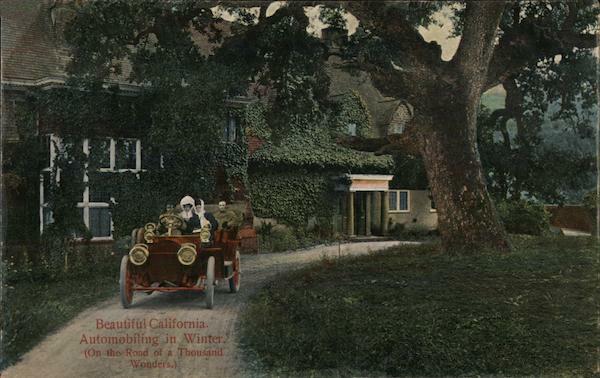
Picture postcards made up a large portion of the California printing industry. They featured color photographs that depicted what it was like to spend a winter in that state.
Beautiful California. Automobiling in Winter, about 1909.
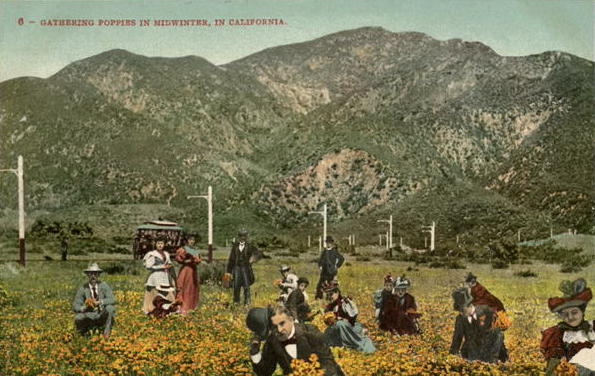
Some postcards featured images of flowers that bloomed in the winter months, like poppies and bougainvillea.
Gathering poppies in midwinter in California.
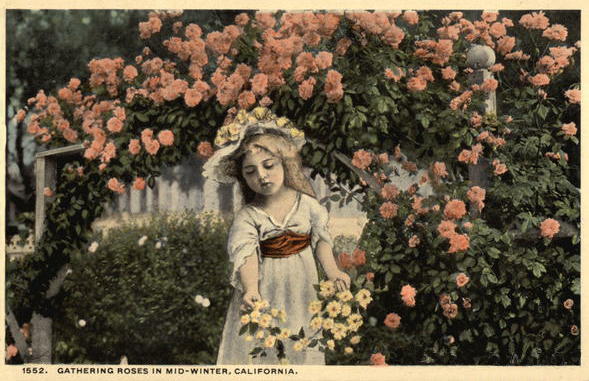
Isabella loved flowers and often marveled over the varieties of roses that bloomed beside her porch in California:
“Red, cream, salmon, pure white, and every shade of pink. Hundreds and hundreds and hundreds of them! The world seems made of roses!”
Gathering Roses in Mid-Winter, California
Other postcards showed people boating on lakes or swimming in the ocean in the middle of winter.
A winter’s day in Westlake Park about 1909.
Each postcard was like a little advertisement for the state of California, teasing and enticing people to come live the good life among the orange groves and poppy fields of the west coast.
Isabella was an ambassador for the state, as well, because California life certainly seemed to agree with her. One day in November she wrote to her niece, Grace Livingston Hill:
“Today is glorious sunshine, and the grass and trees glow in their freshly painted garments of green after the rain of yesterday.”
It sounds like Isabella was very happy in her California home!
Isabella Alden knew all about the Christmas shopping season. She had a large extended family, and she either bought or made gifts for each family member.
Her niece, author Grace Livingston Hill, recalled what it was like when the Aldens, Livingstons, and Macdonalds got together:
Our Christmases were happy, thrilling times. There were many presents, nearly all of them quite inexpensive, most of them home-made, occupying spare time for weeks beforehand; occasionally a luxury, but more often a necessity; not any of the expensive nothings that spell Christmas for most people today.
Isabella—being a clever and creative person—made many of the gifts she gave.
Sometimes she got gift-making ideas from magazines. She subscribed to The Ladies’ Home Journal and Harper’s Bazar, both of which regularly printed directions for making items to use or give as gifts. Sometimes she passed those ideas and directions on to her own readers.
For example, an 1898 issue of The Ladies’ Home Journal published instructions for making this pretty wall pocket:
Isabella liked the idea so much, she wrote simplified instructions that children could follow and printed them in an issue of The Pansy magazine. She told her readers how to make the wall pocket from pine board, calico, buttons, and felt, and hinted it would make a lovely gift “for mamma.” She wrote:
I get the idea and most of the details from Harper’s Bazar. The article from which they are taken says the contrivance is for an invalid, but let me assure you that mamma will like it very much, or, for the matter of that, papa also.
At Christmas she encouraged boys and girls to make gifts not only for family members and friends, but for strangers, too. She wrote this to readers of The Pansy magazine:
How many Pansies are planning the Christmas gifts they will make? In all the merry bustle and happy, loving thoughts, don’t forget to throw a bit of kindly cheer into those poor little lives darkened by distress and want.
If every member of The Pansy Society would make some little gift as a loving reminder to one who otherwise would have none, how many children, think you, would be made happy?
Remember, you do it “For Jesus’ sake.”
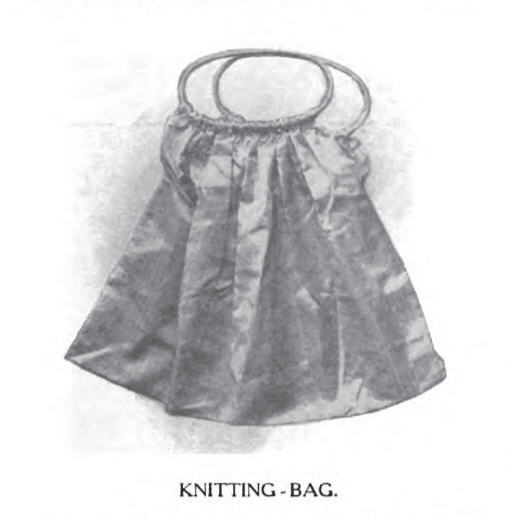
There were instructions for making this simple knitting bag, made of fabric, ribbon, and embroidery hoops:
And this case, made from pieces of cardboard and colored ribbons, to hold photos, greeting cards, or pictures cut from magazines.
She wrote:
What a delightful present that will be when you get it done! I can imagine an ingenious girl and boy putting their heads together, and making many variations which would be a comfort to the fortunate owner.
Isabella always knew how to give those gentle reminders that children (and adults!) sometimes need about the true spirit of Christmas.
What is your favorite way to share the message of Christmas with people in need?
Have you ever made a Christmas gift for someone? How was it received?
For many years Isabella wrote a popular advice column for a Christian magazine. She used the column to answer readers’ questions on a variety of topics.
In 1916 a Sunday-school teacher wrote to Isabella about a unique problem.
Here is her letter:
I want to know if you think there is any use in a woman past thirty—who has never been in the habit of committing to memory—trying to learn Bible verses by heart? Our pastor wants the Sabbath-school children trained to commit their lessons to memory, or at least to commit a verse a day, and he wants the teachers to set them an example; but I find it very hard to do, never having been accustomed to it. Would you say you couldn’t?
Here is the advice Isabella gave her:
Indeed, I would not. There is every use in it, and there is no good reason why you should not conquer and be far richer in your own life, as well as being able to set a good example.
Nearly all Bible verses are capable of careful analysis, and the finding out exactly what they say goes a long way toward fixing the word on the memory. Let me illustrate by the verse I am memorizing this morning, Romans 1:5:
“Through whom we received grace and apostleship, unto obedience of faith among all the nations, for his name’s sake.”
Notice those four short words: “Through,” “unto,” “among,” “for.” They are pegs on which the thoughts hang. My attention once called to them, my mind naturally asks questions:
Through what? Unto what? Among whom? For what?
Getting those four statements fastened to their connecting word gave me the verse. And what an amazing verse it is! Well worth memorizing, and living by. Already this morning I have several times been reminded that my tardy and faulty obedience is due to my lack of faith in God’s assured word. I need to pray for the “obedience of faith.”
I must not take time to talk about my verses. This is only to illustrate how readily they can be picked to pieces in a way to aid the memory.
One thought I must add: Don’t fail to memorize chapter and verse. I have spent precious hours in looking for the whereabouts of verses with which I was perfectly familiar.
Pansy.
What do you think of the advice Pansy gave?
What tips or advice would you give someone who is just beginning to memorize Bible verses?
Did you know Chautauqua Institution had its own commercial printing office? It produced brochures, maps of the grounds, programmes, daily schedules, and a newspaper called The Chautauqua Assembly Herald.
Published six days a week, The Chautauqua Assembly Herald filled eight to ten pages of every issue with news about Chautauqua, including the comings and goings of some of its residents and visitors.
On July 24, 1895 one of the newspaper’s reporters spotted Isabella’s familiar face at a concert in Chautauqua’s amphitheater:
Pansy’s placid, pleasant face was seen in the veritable sea of faces at the concert in Chautauqua’s amphitheater Wednesday. From her very looks one would judge Mrs. Alden as a woman who loves little people, even if one had never heard of the famous Pansy books.
Naturally, the reporter sought Isabella out as soon as the concert was over, and asked about her summer plans and whether she was writing anything special. Isabella confirmed she was indeed working on a story, and added:
“All of my stories, you know, are published in serial form in my magazine before they are put out in book form. My magazine work occupies most of my time.”
“For the past 19 years we have spent every summer at Chautauqua. We have our summer home here, but for many years past I have had to give up my Assembly work. I am much interested, however, in the Woman’s Club here.”
Knowing the Woman’s Club was to meet the next day, the reporter asked Isabella if she was going to read a new, unpublished story to club members.
“It is a story which not only has not been published, but which is not yet all written,” replied Pansy smiling.
Their conversation drifted into other topics, including an observation about the new phenomenon of women using bicycles as a means of getting around Chautauqua.
Progressive-thinking Isabella had no problem with the new “wheelwomen” (as lady cyclists were called in 1895):
“I think the bicycle must offer a pleasant, healthful form of recreation to women, but I do like to see them dress inconspicuously and neatly when riding, and I do not like to see them wear bloomers.”
Any guesses which story Isabella was writing and publishing as a serial in The Pansy magazine during the summer of 1895?
It was Reuben’s Hindrances! Chapter eight of Reuben’s Hindrances appeared in the July 1895 issue of The Pansy; monthly installments continued into 1896 until all twenty-four chapters appeared in the magazine.
For many years Isabella served as an editor and contributor to a Christian magazine in which she had a very popular advice column. She used the column to answer readers’ concerns—from a Christian perspective—on a variety of topics.
One letter came from a woman who was having trouble overcoming a very common problem: She was terrified of praying aloud in front of other people.
The writer described herself as a grown woman, “not very young” of age. She believed it was her duty to pray before others in Sunday-school class or at prayer meetings, but she found it “almost impossible” to do so. Even when she planned out what to say ahead of time, she would forget, and stammer and stutter; and she often ended her prayer feeling embarrassed and pledging never to pray before others again.
Here is the advice Isabella gave her:
First, let me assure you that your “name is Legion.” As a worker among those that are moving toward middle age, I have found this feeling a constant hindrance.
My friend, by all means persevere, no matter how much you stumble, nor how many carefully-thought-out sentences you “forget.” Stammering lips often carry a message straight to the throne of God, and it is to God that we speak when we pray.
Do not let Satan blind you with that specious argument of his that you cannot pray to “edification.” That is not the first object of prayer. Moreover, God often uses the stammering tongue for his glory. I remember and am helped to this day by the thought of the hesitating, sometimes broken, sentences of a dear father who thought that he could not pray aloud.
Now for a few hints that I have found helpful:
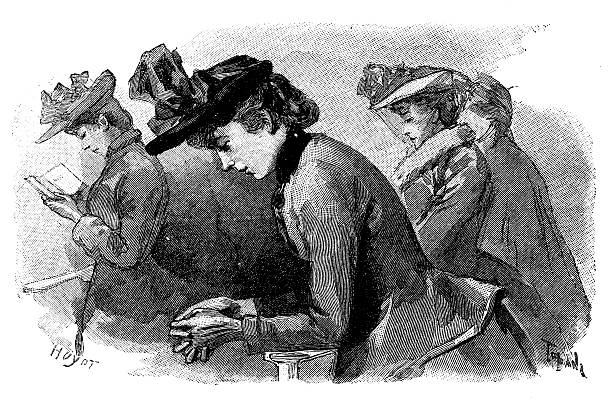
First: Cultivate the habit of praying in an audible voice when alone in your room. Perhaps no one thing will give you self-control more speedily than this. We are creatures of habit, and when we have grown accustomed to the daily sound of our own voices when on our knees, habit, after a little, asserts itself when we kneel before others. Because of habit, the kneeling posture is, I think, the most helpful one to assume, even in public prayer, wherever this is feasible.
Next,grow very familiar with Bible prayers, those terse sentences pregnant with meaning:
“Create in me a clean heart, O Lord.”
“In thee, O Lord, do I put my trust.”
“Be thou to me a strong rock.”
“Send out thy light and thy truth.”
The Bible is very rich as a prayer-book. If we linger much among such petitions, habit will again come to our aid, and the Bible words will rush in upon us when we pray before others. When I was a beginner in public prayer, I used to write out certain of these Bible prayers that voiced my desires, and spread them before me, lest my memory should prove treacherous. I found this a good crutch for a time.
For a like reason I used sometimes to write out my own form of prayer, carefully avoiding set phrases and sentences that I should never think of using if alone, going over and over the form to make it simple and direct, and to be sure that it expressed only what I really felt. This I would read aloud, with bowed head; and it helped me in overcoming timidity.
Let me close as I commenced, with an urgent appeal to you to overcome the temptation to shirk this duty; and to resolve to conquer in His name.
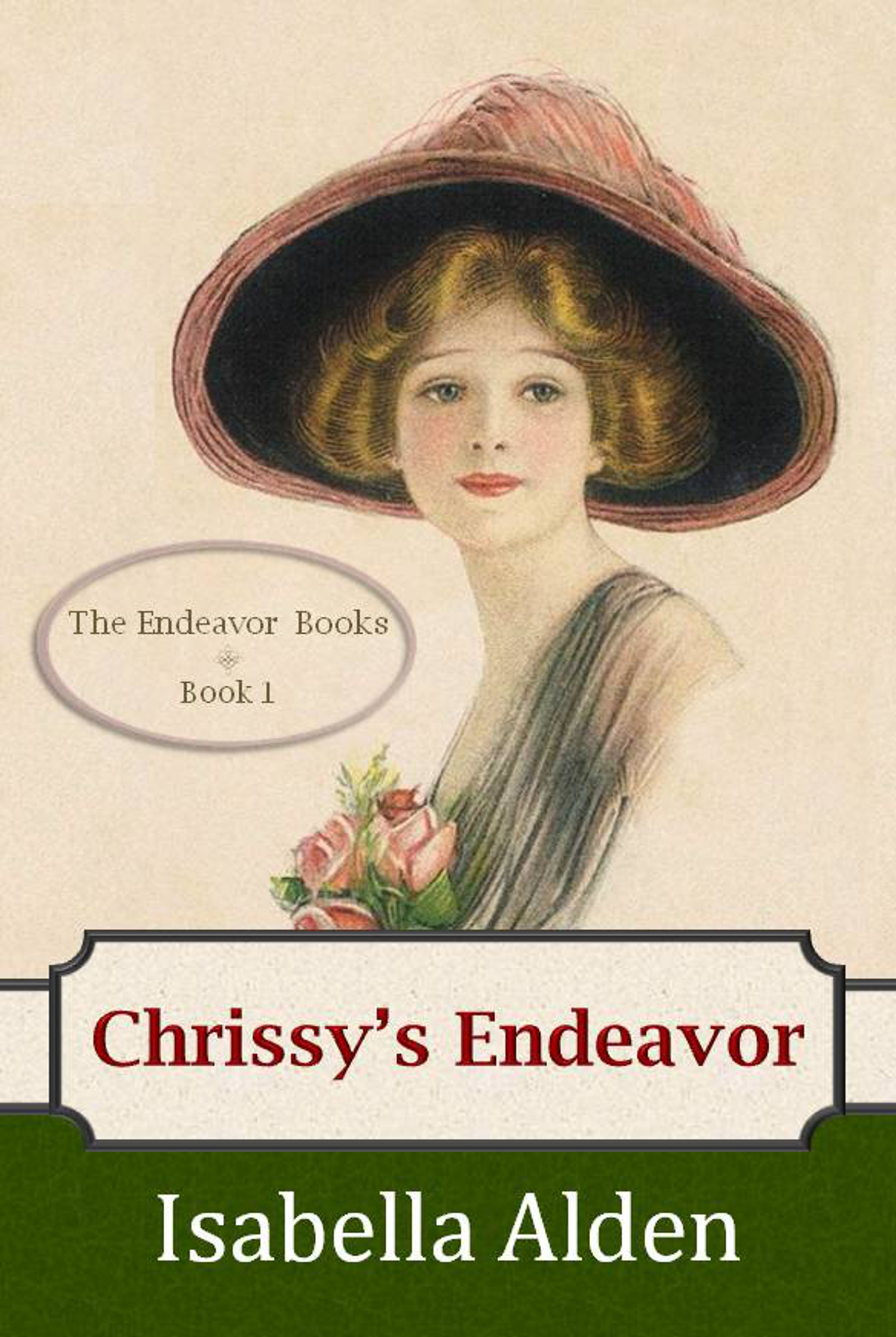
Isabella Alden was deeply involved in the Christian Endeavor movement that took root in America and swept around the world in the late 1800s. She regularly contributed to the Christian Endeavor newspaper; and she wrote about Christian Endeavor in of her novels Chrissy’s Endeavor, Her AssociateMembers, and others.
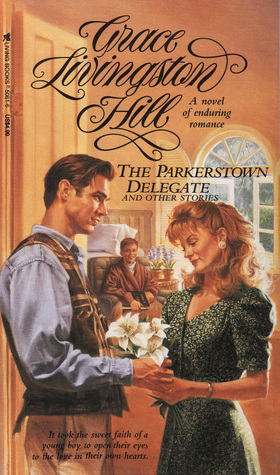
Isabella’s family was involved in Christian Endeavor, as well. Her niece, Grace Livingston Hill, served as president of a Christian Endeavor chapter. One of Grace’s early novellas was a Christian Endeavor story called “The Parkerstown Delegate;” and with her husband Grace published a guide for Christian Endeavor leaders that was widely used by C. E. chapters.
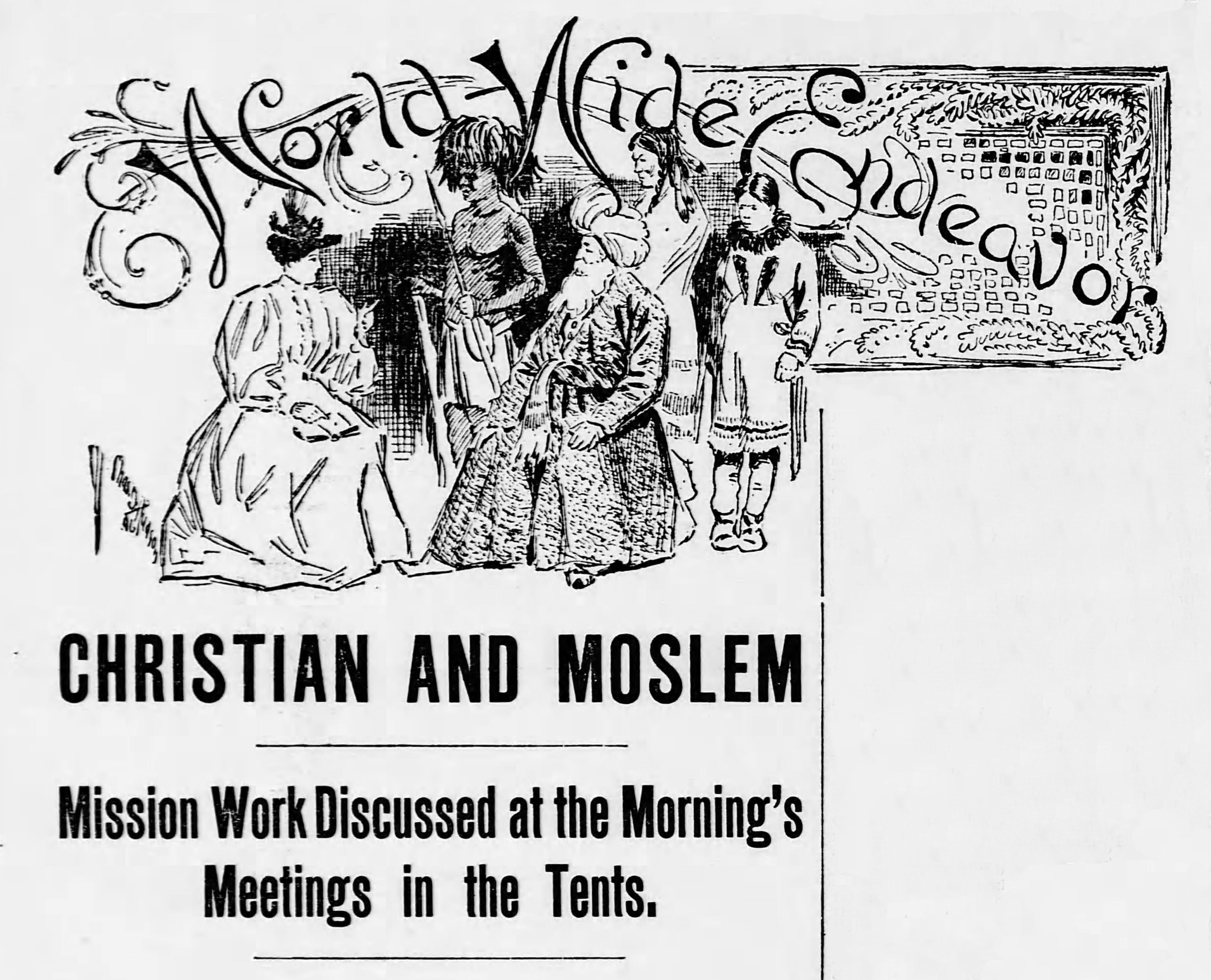
The Christian Endeavor Society held regular annual conventions in the U.S. that were very well attended by people from all over the country; but in 1896 the society held an international convention in Washington D.C. Thousands of Christians of all ages, nationalities, and denominations, descended upon the U.S. Capitol for five days of non-stop meetings, worship services, training classes, and Bible studies.
Newspaper headline about the convention, from the Evening Star, Monday, July 13, 1896.
Isabella knew Washington, D.C. very well. She and her family lived there for three years when her husband served as assistant pastor of The Eastern Presbyterian Church, located just blocks from the Capitol building (read about her D.C. home here). In early 1896 the Aldens moved to New Jersey, just a short train ride away from Washington; so it’s entirely possible the Aldens attended all or part of the international convention that year.
The convention opened on Thursday, July 9 and ended the following Monday. Convention attendees were given a schedule of events and a map to help them travel from venue to venue, most commonly by foot.
The Christian Endeavor Society distributed this map of Washington, D.C. to conventioneers in 1896.
Attendees braved the heat, the humidity, and the stifling crowds of fellow Endeavorers that thronged the mall from the Lincoln Memorial to the Capitol building.
“The Army of the King.” Christian Endeavorers crowd Washington, D.C. in 1896. From the New York Public Library Digital Collection.
On The Ellipse, located between The White House and the Washington Monument, enormous tents were erected where meetings and lectures were held.
A newspaper photo of the meeting tents, with the Washington Memorial in the background.
Each tent was designed to hold hundreds of people, but some evening gatherings drew enormous crowds. At times there were so many people, and the interiors of the tents became so hot, the tent sides had to be raised to allow fresh air to circulate.
A tent interior layout, printed in the Evening Star on Wednesday, July 8, 1896.
But of all the activities that took place over the five-day convention, there was one event that stood out and was talked about for months afterward.
On Saturday evening, July 9, a patriotic service was planned to take place on the east front of the Capitol Building.
The east front of the United States Capitol building, photographed in 1904.
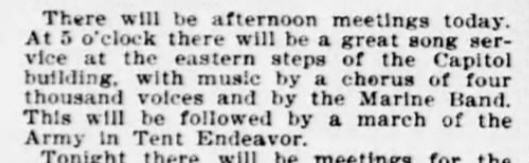
The service was described as “a great song service” of patriotic songs and hymns led by a chorus of four thousand voices.
An announcement of the service in the Evening Star on July 11, 1986.
A photographer captured this image of the chorus assembling on the steps of the Capitol:
One newspaper enthusiastically wrote that the patriotic service was “grand music to listen to, and something to remember.”
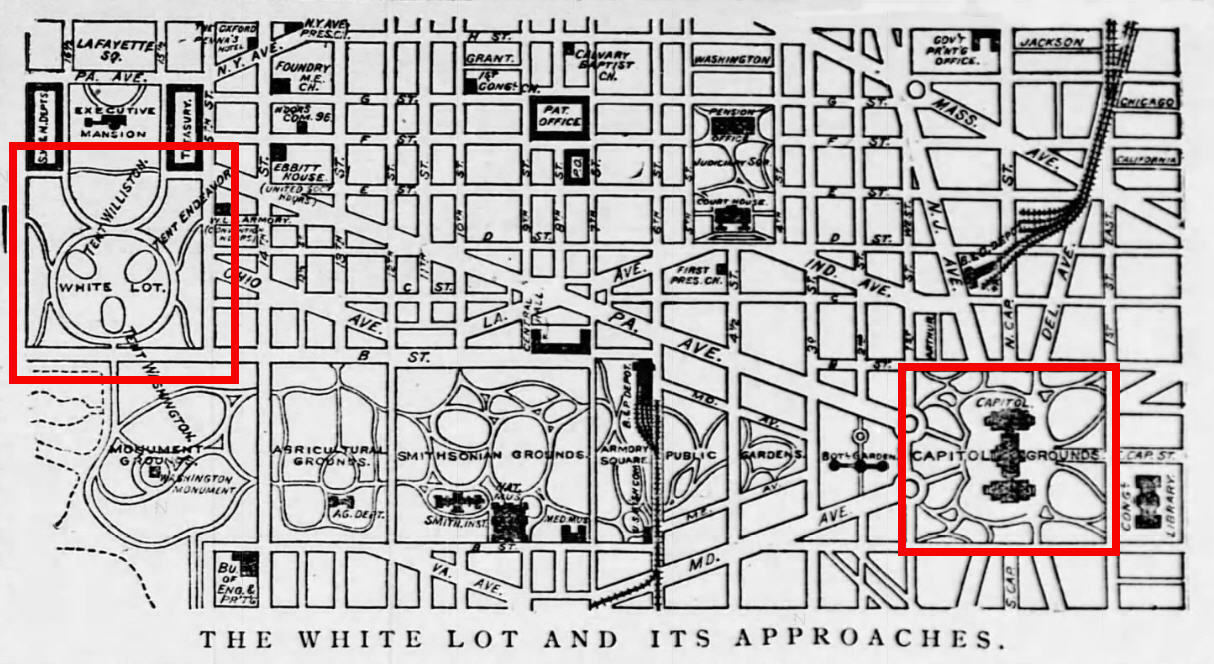
At the conclusion of the service, the chorus, the Marine band, and the audience left the Capitol steps to march down the National Mall to the Ellipse, where they gathered at Tent Endeavor.
The Ellipse and the Capitol Grounds shown on a map published in the Evening Star.
The song service was a tremendous success! While there was no official count, attendees believed there were just as many singers among the audience as there were on the Capitol steps.
If that’s true, there were over eight thousand people at the service, all raising their voices together in songs of praise!
What do you think it was like to sing hymns with thousands of other people?
Have you ever participated in an outdoor sing-a-long where your voices could be heard for blocks?
Reviews and giveaways for Christian fiction and sweet, clean fiction. Bringing readers information on great stories and connecting authors with their readers.






















 Isabella Alden