Long before last year’s mannequin challenge went viral on social media, Isabella Alden and her contemporaries struck poses like statues. Tableaux vivant (which means, literally, “living pictures”) was a very popular form of entertainment in late 19th century America.
The premise was simple. People donned costumes and recreated famous scenes from literature, art, and historic events.
A 1903 photo of a woman posing as Margaret in Faust.
.
On a small scale, people performed tableaux in parlors. They selected a famous scene from history or literature, donned make-shift costumes, and struck poses while other guests observed.
Isabella Alden was very familiar with tableaux. In Julia Ried Isabella described how guests at a party …
made very free use of the wraps in the dressing-room for our impromptu charades and tableaux, and shawls, cloaks, hoods and rubbers were in inextricable confusion.
Woman in Elizabethan costume, 1903.
.
On a large scale, churches, women’s clubs and fraternal organizations staged more elaborate tableaux on stages with scenery and props.
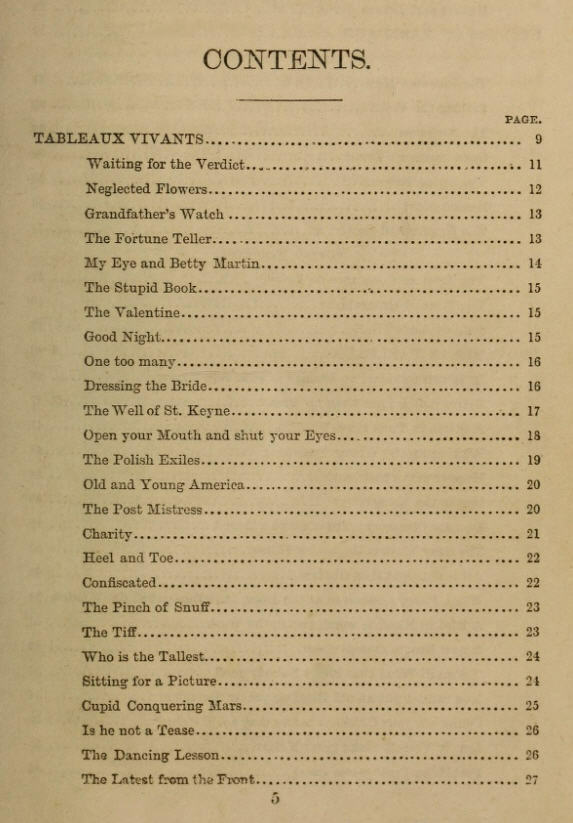
There were many books available to help performers turn out their best statue-like performances.
Part of the table of contents for The Book of Tableaux and Pantomimes, with detailed instructions for enacting each tableau
.
In his book, Parlor Tableaux and Amateur Theatricals, William Gill promoted tableaux as “a simple and elegant amusement,” and “a favorite entertainment of persons with taste.” He recommended that music—vocal or instrumental—be played between representations so the audience would not grow restless and to help heighten the suspense as the audience waited for the curtain to rise on the next scene.
Isabella wrote often enough about tableaux to indicate she was very familiar with the pastime. In her novel A Dozen of Them, young Joseph participated in a simple New Year’s Eve tableau party where he …
… dressed in an extraordinary manner—like a youthful musician of the olden time. Mrs. Calland had managed—nobody but she knew how—to arrange for him a most remarkable wig of soft curling hair. The mustache part was easy; a little burnt cork settled that.
On a larger scale, Julia Ried (heroine in the book of the same name) helped put together a grand tableau of several re-enactments that required weeks of preparation:
I remember an animated discussion that ensued concerning the getting up of tableaux for a certain festival, which was to be held about Christmas time. Mrs. Tyndall gave minute descriptions of the style of dress needed to personate certain characters, and I suddenly became an object of importance, because I had not only seen, but participated in one of the tableaux mentioned, and could give accurate information as to whether the young lady who personated religion should dress in white or black.
Hand-painted 1905 photo of a woman in Old Testament costume for a religious tableau.
.
Rehearsals and sewing costumes consumed Julia’s days. She helped make costumes for characters portraying Religion, Queen Vashti, Quakers, and a Turkish sultan. Some of the elaborate scenes challenged Julia, because she was convinced they weren’t suitable for Christian women to enact.
Society ladies and a gentleman perform as Bacchantes, 1909.
.
Some of the most common themes for tableaux were religious and patriotic scenes. The scenes below, performed by a church in 1920, depict the story of Jesus’s life, from the angel Gabriel’s visit to Mary through his early childhood:
.
.
.
.
.
Tableaux featuring Greek aesthetics were also popular, because the draped costumes and classical poses were considered to be the epitome of grace and beauty.
A woman in a classic Greek pose, 1903.
.
If you’ve ever seen The Music Man you’ll remember that the mayor’s wife was devoted to performing Greek tableaux.
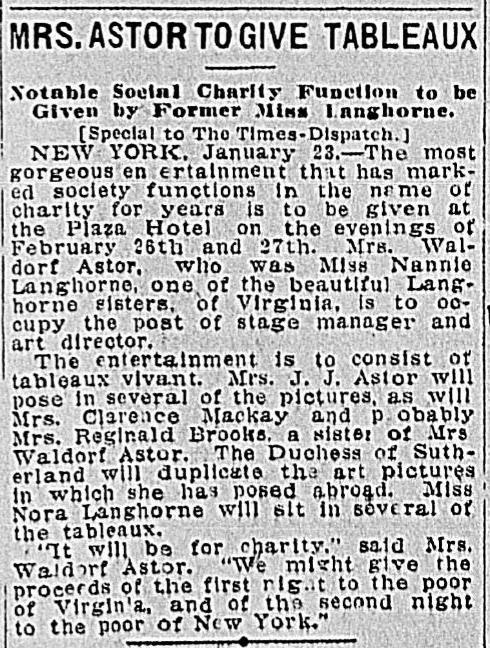
Even the famous Mrs. Astor, leader of New York Society, staged an evening of tableaux for charity in 1909.
.
Women attending Mrs. Astor’s society tableau in 1908.
.
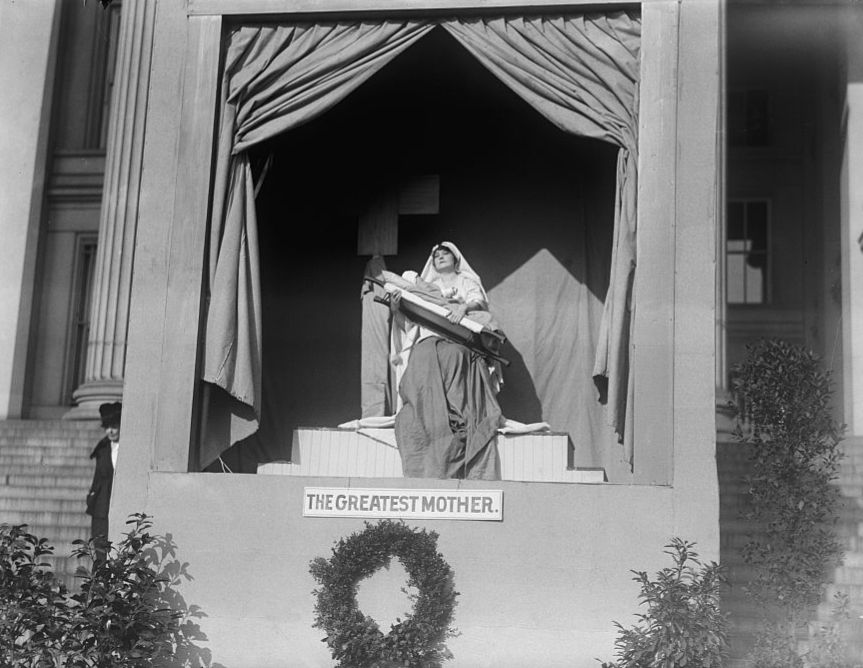
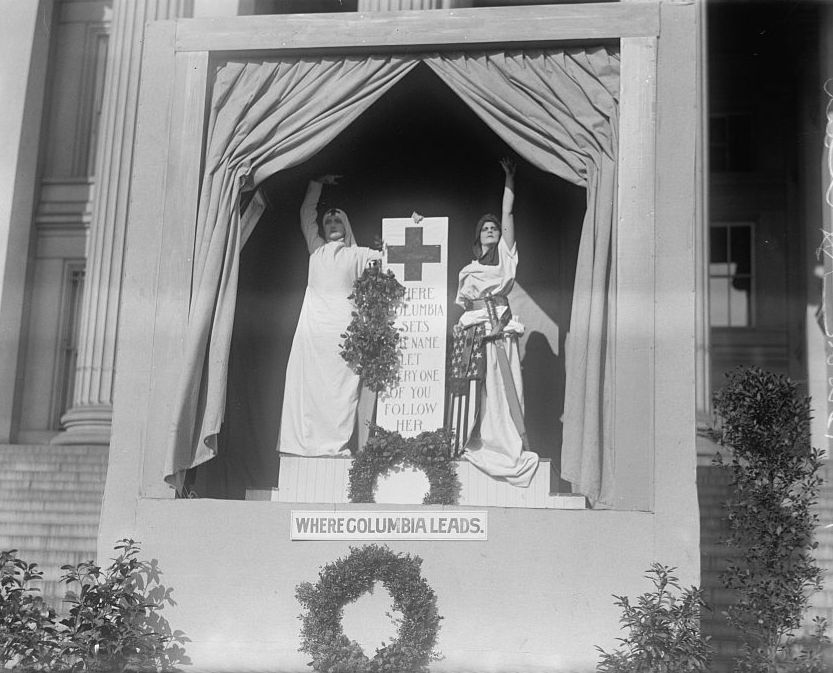
National organizations also dove into the tableau craze. To publicize their organization, the Red Cross staged tableaux on the south front of the Treasury Building in Washington DC in 1917:
.
.
.
It’s possible that Isabella participated in a few tableaux herself. She was certainly able to describe the entertainment with some affection and a good deal of detail in several of her books and stories.
A tableau for women’s suffrage on the front steps of the Treasury Building in Washington DC, 1913.
.
Did you know there are still organizations practicing the art of tableaux vivant today? One such organization is the New Orleans Tableaux Vivant Society. Click here to visit their site, where you’ll find news of upcoming performances and photos of past events.
If you know of any other tableau events coming up, please share by posting a comment below.
The idea for this post was suggested by Karen, a regular reader of this blog. If you have any questions about Isabella Alden or would like to learn more about something you read in one of her books, please leave a comment below.
When you read Isabella’s books, you might notice that the women in her stories were often ruled by “days.”
There was laundry day, and baking day. There was gardening day and canning day, when all the fruits and vegetables gathered from the garden were preserved.
Every week, women devoted entire days to certain tasks because they were time consuming and involved a great deal of physical labor.
Shopping in the dry goods district of New York City, 1886; from the Library of Congress
.
Marketing day took women out of the house from early morning to late afternoon. Unlike shoppers today who simply visit their local grocery store, Isabella’s contemporaries went from one specialty shop to another.
An 1872 trade card for a butcher’s shop
.
They visited the green grocer and the baker.
A Boston bakery, 1917; from the Library of Congress
.
They stood in line at the confectionery and dry goods store.
Customers shopping for canned goods at a grocery in the early 1920s; from the Library of Congress
.
And then there were the specialty stores to visit, like the cobbler’s shop, where they purchased new shoes or repaired older shoes; and the drugstore where they shopped for lotions, salves, beauty and grooming products, and medicinal cures.
A cobbler with a customer, 1896, from Library of Congress
.
At each location they had to wait their turn for a store clerk to assist them in picking out the item they desired. With all the waiting and traveling from store to store, women spent hours shopping, even if their shopping list contained only a few items.
Kellogg’s magazine ad, 1915
.
But by 1900 a shift in shopping habits occurred, brought on by new products that gained a foothold in women’s buying habits. As the new century dawned, women began to buy more products designed to make their lives easier.
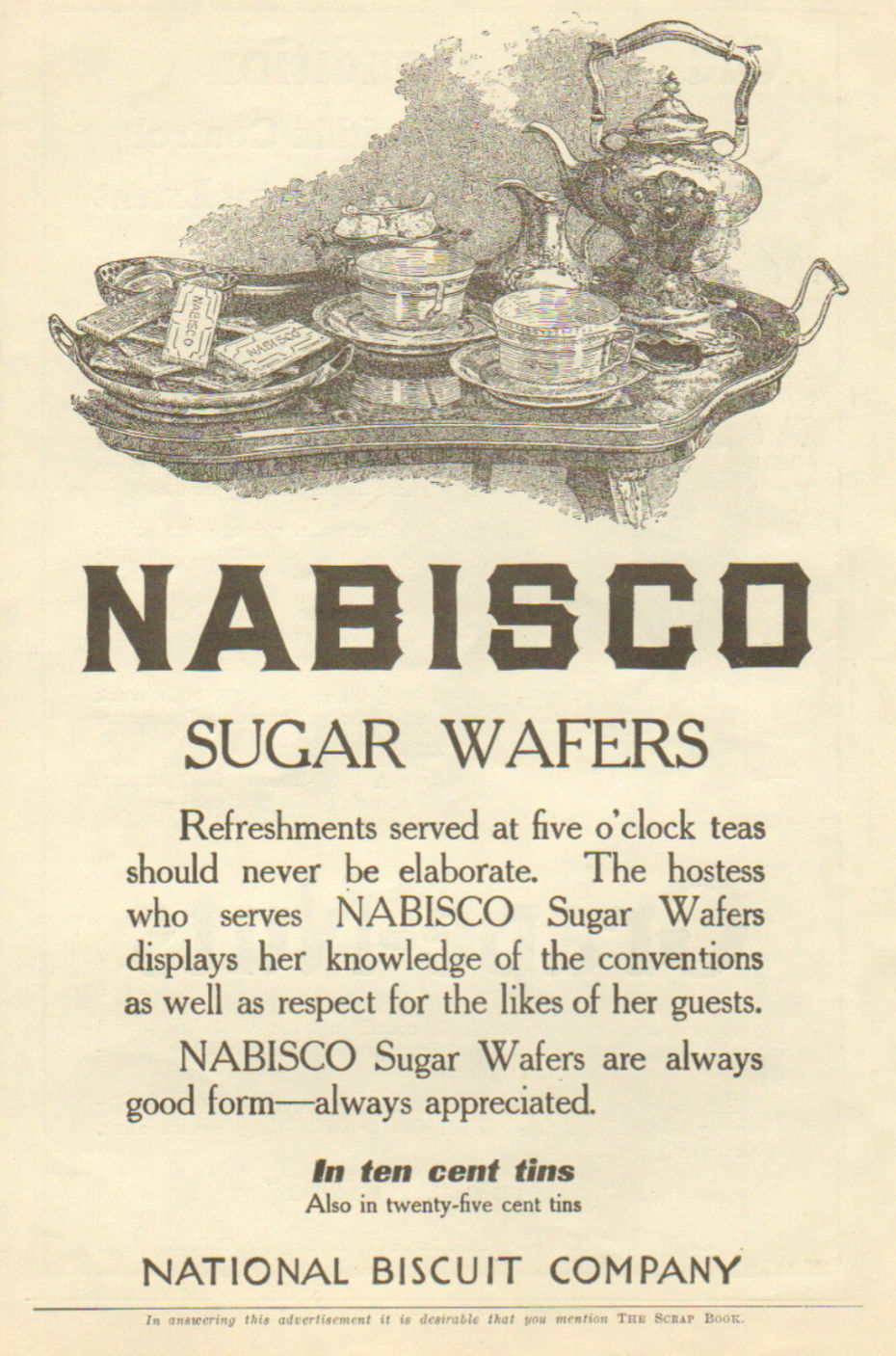
For example, women still visited the confectioners for fancy baked goods to serve their guests, but they were more willing to buy pre-made cookies and breads for their every-day table.
Magazine ad for Nabisco Wafers, about 1910
.
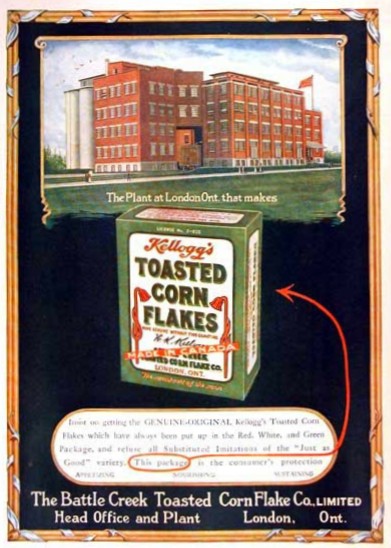
And though they still cooked a good breakfast for their families most mornings, they also knew serving cold cereal to their children once or twice a week was a time saver.
A 1919 magazine ad for Toasted Corn Flakes
.
Another time saver: serving canned soup to their families instead of spending hours preparing soup in their own kitchens.
Campbell’s soup print ad from about 1920; from the Library of Congress
.
In the early years of the century, many products hit the market that proved to be convenient time-savers for women, and women began to trust the quality of pre-made products.
Trade Card for J. A. Dahn and Son Baking Company, from about 1900; from the Library of Congress
.
The more women employed pre-made products, the more time they saved for pursuits they enjoyed.
Some products that were introduced around the turn of the last century proved so popular, they are still on the market today.
Trade card for Arm and Hammer Baking Soda, 1900; from the Library of Congress
.
Print ad for Ivory Soap, 1898; from the Library of Congress
.
Over the years, some products were re-purposed, such as Listerine, which was initially marketed as a topical antiseptic.
Magazine ad for Listerine, 1917.
.
Other products, like Wesson Oil and Jell-O are still popular and might even be in your kitchen cabinet today.
Print ad for Wesson Oil from the Ladies Home Journal, 1919
.
Print ad for Jell-O, early 1920s
.
But the biggest change to women’s shopping habits occurred in 1916, when Piggly Wiggly opened its first grocery store in Memphis Tennessee. The store introduced a revolutionary concept: self-service.
The entrance to the first Piggly Wiggly store in Memphis, Tennessee, with baskets on the left and cashier on the right; from the Library of Congress
.
Women no longer had to stand at a counter and wait for a clerk to assist them; they simply picked up a carrying basket on their way into the store, and browsed the aisles for goods to purchase.
Neat, well-stocked shelves in the Memphis Piggly Wiggly, 1917; from the Library of Congress
.
The store’s concept proved to be an immense time-saver for women. With the success of their Memphis store, Piggly Wiggly expanded to hundreds of locations and became the model for today’s modern grocery store.
Sunkist oranges on display in the window of a Piggly Wiggly, 1917; from the Library of Congress
.
Piggly Wiggly stores led the way in many modern innovations. You can click here to see the various ways Piggly Wiggly revolutionized the grocery industry.
As A Dozen of Them draws to a close, Joseph confronts a fearful situation, and confesses a secret to his sister Jean. If you missed any of the previous chapters, you can read the entire book here.
.
A Dozen of Them
.
CASTING ALL YOUR CARE UPON HIM, FOR HE CARETH FOR YOU.
THEREFORE ALL THINGS WHATSOEVER YE WOULD THAT MEN SHOULD DO TO YOU, DO YE EVEN SO TO THEM.
EVERY TREE THAT BRINGETH NOT FORTH GOOD FRUIT IS HEWN DOWN AND CAST INTO THE FIRE.
.
“I want a nice still verse,” said Joseph, with his head in Jean’s lap. “Things have been in such a bustle for so long, it seems as though all the verses were hot, and had stirred up a fire somehow—no, I don’t mean that, either; they have helped put out the fire, every time, but I want something nice and still.”
Jean smiled; Joseph must be almost tired out if he wanted still things. “I’m sure you can be easily gratified,” she said. “Look at the very first verse for the month.”
“Say it to me,” said lazy Joseph, “I don’t want to stir.”
So Jean said it: “Casting all your care upon Him, for He careth for you.”
“But I haven’t any care,” he said, after a moment’s thought.
“Never mind; some care may come, before you expect it; and you may find it good to be prepared. It is a nice still verse, and unless you take the next one to it, I don’t know that you can do better.”
“What is the next?”
“It is the Golden Rule.”
“Then I don’t want it. I don’t want a bit of doing; there will be enough of that when school begins. I’ll take the still one.”
From Pinterest
.
Exactly two days from that talk, this, which I am going to tell you, happened. Miss Emerson was visiting her sister, who was a pupil in the Fowler School, and did not go home for vacation, for the reason that a large part of her home had gone to Europe. Miss Emerson was an elocutionist, and volunteered to give a little entertainment during her visit, for the benefit of the library in the Fowler School.
On the evening in question she was in her room giving the finishing touches to her toilet, and the audience was already assembled in the large parlors waiting for her.
“Let me see,” she said, speaking to her dog Trust, I suppose, as he was the only one present beside herself, “no, I believe I won’t wear diamonds; it would not be in good taste for so small a gathering. They will think I am too much dressed as it is, I presume. I haven’t time to lock these up again. Trust, you may stay here and take care of them; remember, old fellow, you are not to let anybody touch anything of mine until I come back.” She held up her finger at Trust for emphasis, and he gave an intelligent bark in reply; then she smiled on him and swept away.
From Pinterest
.
Five minutes afterwards she was saying in the hall, “Are they waiting? Well, I am quite ready—oh dear! I have left my fan in my room.”
“Joseph will bring it,” said Mrs. Calland who liked things to begin promptly. “Joseph, bring it to me in the parlor. Miss Emerson, will you come now?” And Joseph scampered for the fan.
It lay on the table behind the jewel case. Joseph sprang in breathless, his hand ready to grasp it, when a low growl arrested him, and the fiery eyes of Trust were upon him. He took in the situation at once; Trust was in charge, and he would not be allowed to touch the fan.
.
“All right,” he said good-naturedly; “I won’t, old fellow. Your mistress wants it, but you cannot be expected to understand that, and I’ll report you as doing your duty.”
Not so fast, my boy; Trust not only distrusts you too much to allow you to touch the fan, but he does not mean that you shall escape him. At the first step toward the door, he grasped Joseph’s trousers with his fierce teeth, almost grazing the skin, and held on. It was by no means a pleasant position. Joseph did not understand dogs very well, was a good deal afraid of this one, as was everybody in the house, and had been glad to think of getting away as quickly as possible from his fiery eye, and here he was a prisoner! For how long? The entertainment was not yet opened. Two hours at least before he could hope that Miss Emerson would reach her room. If her fan was not forthcoming, some other fan would be handed her, and no one would remember that he had been sent for it. What was to be done? Clearly nothing but to stand still and endure Trust’s stern gaze.
.
Shall you be surprised if I tell you that Joseph’s heart beat fast? He did not know how soon Trust might weary of holding on to cloth only, and conclude to try a bit of the flesh underneath it. In point of fact, Trust soon let go with his teeth; but held on with his eyes. Joseph did not dare to move a muscle, lest it might be taken for resistance, and receive punishment. Was ever a worse dilemma for a good-intentioned boy?
It seemed strange to him long afterwards, the sudden sense of courage which came with the words which memory brought him just then: “Casting all your care upon Him, for He careth for you.”
Wasn’t this care? Had he ever a worse anxiety? Did not God know all about it? Could He not protect from this danger, as well as from others?
The loud thuds which Joseph’s heart were giving, began to quiet. It was a trying place, one full of care, certainly, but he began to have a strange sense of security; a sort of assurance that Trust would do no more than guard his mistress’ property, and that he, Joseph, so long as he stood still, would escape injury. Two hours of standing perfectly still! Never mind, he could bear it; and he was beginning not to be afraid.
Which of you can tell why Jean, just a moment before this, should whisper to Mrs. Calland, daring the voluntary, “Do you know where Joseph is?”
“He is with the scholars, I suppose,” answered Mrs. Calland, a little surprised at the question. Where should Joseph be but in his place? She had already forgotten that she sent him for a fan.
What made Jean anxious? She couldn’t have told you. Joseph was never in mischief, was almost certain to be where he ought to be, yet his sister fidgeted, stretched her neck up to get a glimpse of her brother, and finally slipped quietly away to investigate. The boys did not know where he was; the girls had not seen him since supper. Oh, yes, Laura Akers saw him just before the entertainment commenced; she heard Mrs. Calland send him to Miss Emerson’s room for her fan; she was passing the hall, and heard her give the direction; he was to bring it to the parlor; she presumed he had done so, but she had not seen him come in.
Neither had Jean, and in two minutes more she knocked at Miss Emerson’s door and said, “Joseph!”
.
Trust looked toward the door, and gave an ominous growl.
Joseph spoke in low, quiet tones, “I’m all right, Jean. Trust is on guard and won’t let the fan go, nor me either. Don’t make a fuss; just run and ask little Fanny Emerson to come here a minute; Trust will obey her.”
This sensible idea was at once carried out. Fanny Emerson, the young sister of the elocutionist, came in haste, exclaimed over the situation, scolded Trust, and carried off both Joseph and the fan in triumph.
When the owner of the fan heard the story a few hours later, she exclaimed over it, too; looked a trifle pale; told Joseph it was well he had sense enough not to try to move, for Trust would have torn him in pieces.
“I quite forgot that I left him on guard,” she said. “I don’t know how you escaped so easily. Mercy! If he had bitten you I would never have forgiven myself.”
.
“I should think not,” said Jean, her, face flushing. She could not help feeling a little indignant.
But Joseph smiled.
“It is all right,” he said, “I wasn’t hurt a bit.” It was only to Jean that he added, afterwards, this bit of information:
“I was scared, Jean, most as much as I ever was in my life; but it came to me all of a sudden that it was big enough to be called a ‘care,’ and I just tried, you know, to give it to Him; and somehow, I don’t know how, He took it. It does beat all how those verses fit in!”
I HAVE NOT FOUND SO GREAT FAITH, NO, NOT IN ISRAEL.
WHY ARE YE FEARFUL, O YE OF LITTLE FAITH.
THE SON OF MAN HATH POWER ON EARTH TO FORGIVE SINS.
ACCORDING TO YOUR FAITH, BE IT UNTO YOU.
FREELY YE HAVE RECEIVED, FREELY GIVE.
.
“But I have nothing to give,” said Joseph. He was, as usual, talking with Jean about the verse he would take for the month.
“I’ve received enough, I’ll own that; a fellow never received a nicer year in his life than I have spent here; but I haven’t a thing to give, as you know yourself.”
Jean sewed in silence for a few minutes, then said, “It seems strange to me that a bright boy like you, with strong hands and feet and a good sensible tongue and a pair of eyes of his own, should make a speech like that.”
.
Joseph laughed a little. “Well, I have those things, of course,” he said at last. “Everybody has; but I can’t very well give them away.”
“I don’t see why not. I’m sure of one thing: it makes very little difference what else you give, so long as you hold on to those. Why don’t you give your heart, out and out, Josey, and be done with it?”
“How do you know but I have?” said Joseph, after resting his chin on his hand and looking thoughtfully out of the window for awhile.
Jean looked at him eagerly, a bright light in her eyes. “Sometimes I think you have, Joseph, but you never said so in words.”
“A fellow doesn’t say everything he thinks; but I always meant to tell you I did it, Jean, quite a while ago; and I mean that my hands and tongue and all that, shall be His forever; but I was thinking of money and such things when I said I had nothing to give.”
“Oh, Joseph! Never mind the money. Don’t you suppose He can get it for you whenever He wants you to give any? I’m so glad!”
She looked it, out of her eyes; and she did what was not usual with her—drew his brown head close to her lips and kissed him two or three times; tender, slow kisses such as his mother might have given him.
Joseph said nothing, only winked hard, and told himself that his sister was the best sister a boy ever had, and he chose the verse she suggested for the month.
That was the reason it came to him, while he stood talking with merry little Nellie Ayers, as she sat on a bench in the workshop, her great green-eyed cat in her arms. Nellie Ayers was a character in the school; a homeless orphan to whom Mrs. Fowler was almost a mother, just because her heart was large and she could not help being. Nellie was bright, and warm-hearted, and thoughtless, and in a hundred thoughtless ways gave more trouble than all the other scholars put together. Mrs. Calland even reached the point of sometimes saying, “I really don’t believe we can keep Nellie another year unless she is changed in some way.”
.
Just now, Nellie was putting as much mourning into her words as her merry heart could furnish, as she explained to Joseph, “Why, I haven’t the first thing to put in the special collection for next week. I wish I had; I’m the only girl, I guess, who won’t have anything. I wish they’d let me give my shoes and stockings; I hate to wear them; but Mrs. Calland won’t allow that; I wouldn’t like her to see me this minute sitting here without them. Or I might give Muffy; she is all I have of my very own; but she wouldn’t look well in a collection-box; besides, she would be sure to say ‘Meow’ right in the midst of the prayer, maybe,” and then Nellie laughed.
It was then that Joseph thought of the verse. Surely none had received more freely than Nellie; yet what had she to give in return? This set him to studying.
“What do you want to give anything for?”
“Why, just because I do. All the girls are going to; why shouldn’t I want to? You don’t think I haven’t any heart, do you?”
“Oh, no! But I was wondering what the motive of it all was, you know.”
“The motive? Why, you ought to know; one would think you had never heard Mrs. Calland talk. Doesn’t she say a hundred times a week that we must give always for Jesus’ sake?”
“That’s just it. Is that what you want to give for?”
“Why, I suppose so, of course.”
“Then why don’t you give yourself?”
“Myself?”
“Yes,” said Joseph steadily, though there was a flush on his face which deepened as he went on. “Out and out; settle this whole business forever. Give your hands, and your feet, and your tongue, and —well, your heart, you know, and that covers all the rest. If folks really want to give for Jesus’ sake, I say, why don’t they give the only thing He wants, instead of hunting around for something that they haven’t got, and he doesn’t want them to give?”
Said Nellie, “You are a queer boy! Why, that means— do you mean being a Christian?”
“Yes; I said so, out and out. Why not? That is giving the thing He has asked for; and He doesn’t care for all the money in the country unless we do as He wants us to.”
“Have you done it?”
“Yes, I have.” The whole face was rosy red now, but Joseph’s clear eyes looked steadily into the face of the little girl. “I belong to Him; I’ve given to Him all I’ve got; strength and voice and everything. I’m going to serve Him the best way I know how.”
He said not another word at -that time, but turned away, leaving Nellie to her kitten and her thoughts. He had not the least idea how large a harvest would grow from that little seed. It was only a few days afterwards that Nellie came to Mrs. Calland with something hid under her little work apron. “I don’t know whether it will do to put in the collection basket,” she explained, her cheeks rosy, “but I haven’t any money, you know, and I truly mean this.”
It was a carefully-shaped heart cut from pure white paper, and on it were printed these words:
.
“I have given them all to Him,” said Nellie, “and He will understand that if I had any money for the basket that would belong, too.”
There were tears in Mrs. Calland’s eyes when she kissed Nellie. “He will certainly understand,” she said. “Give the heart to me; it is very precious. I will put a silver dollar in the basket in its place, and keep the heart in memory of my little scholar. You have given the only offering which He cares for, Nellie.”
“That was what Joseph said,” was Nellie’s answer, and it set Mrs. Calland to questioning, to learn that the consecration of this young, and heretofore almost wasted life, was the first fruit of Joseph’s seed-sowing.
But not the last; during the fall term a new spirit seemed to pervade the school. The change in Nellie was decided and marked, and being a little girl of energy, she worked with all her heart in this new way which she had entered; awakening a new courage in Joseph’s heart; helping him to see a dozen ways of “giving” which had never occurred to him before.
.
While the golden days of October were still smiling on them, one and another, and yet another of the scholars came quietly to Mrs. Calland with the story of their new-born life, hid in Christ; and each time she traced the seed-sowing to Joseph and Nellie.
“He is helpful in every way, and our troublesome, mischievous Nellie is going to develop into a real comfort, thanks to his leading.” This was the sentence with which Mrs. Calland closed a long talk with Father and Mother Fowler.
“Well, mother,” said Farmer Fowler, “you and I think about the same, I believe; and I don’t know as we need wait any longer. Mrs. Calland will be carrying him off before our eyes, if we don’t make haste;” and he smiled on his daughter as he spoke.
“Harry would carry him off in a minute,” said Mrs. Calland, “and make a merchant of him.” Harry was Mrs. Calland’s city brother-in-law, with whom her husband had been in business during his lifetime.
“I don’t doubt it; and Joseph would make a good one; but your mother and I have about decided to make a son of him, that is, if you will have him for a brother. I was for waiting a year or two longer, but she wants it done out and out; and I don’t know but she is right.”
“I’m sure she is,” Mrs. Calland said, with radiant face. “He is just the boy to be a son to you always, and, as for me, I’ll adopt Jean; I don’t believe I could get along without her.”
But Joseph does not know a word of all this yet. He will soon be told, but I determined that you should know it first.
Thanks for reading A Dozen of Them by Isabella Alden. Later this week a complete version of the book will be added under the Free Reads tab on this site, so you can re-read the book or share it with others.
Isabella’s novel Twenty Minutes Late was first published as a serial in The Pansy Magazine in 1892. Isabella originally named the story “Way Stations,” referring to the unexpected train trip one of the characters—Caroline Bryant—takes in the story.
Twenty Minutes Late is the sequel to Miss Dee Dunmore Bryant (which also began life as a serial in The Pansy), and follows the fortunes of the Bryant children as they learn to trust Jesus as their savior and friend.
Isabella often test-drove her novels by publishing them as serials in her magazine; then she made final edits and adjustments to her stories before they were published in book form.
You can find out more about Twenty Minutes Late and read sample chapters from the book by clicking on the cover image.
This week, Joseph deals with peer pressure and finds himself accused of another boy’s crime. If you missed any of the previous chapters, you can read them here.
A Dozen of Them
.
THOU SHALT CALL HIS NAME JESUS, FOR HE SHALL SAVE HIS PEOPLE FROM THEIR SINS.
HE DELIVERED ME BECAUSE HE DELIGHTED IN ME.
BRING FORTH THEREFORE FRUITS MEET FOR REPENTANCE.
THIS IS MY BELOVED SON IN WHOM I AM WELL PLEASED.
HE IS ABLE TO SUCCOR THEM THAT ARE TEMPTED.
It was Jean who helped him choose his verse. She had a private notion that the Fourth of July was a rather dangerous time for a boy, so she hinted that of all the July verses the one which she thought the most helpful was the very last. It made some talk; Jean was sewing a button on his shirt and he was waiting for it, so there was time for a few pleasant words. Joseph said he remembered the lesson for next Sunday; he looked it over last Sunday afternoon, and that if a fellow knew as much about the Bible as Jesus did, of course it would help him, but that he, Joseph, would never expect to think of the right verse.
“But that,” said Jean, “is Jesus’ part; if you learn the verses, he has promised that the Holy Spirit shall remind you of them at the right time, if you depend on his help.”
This thought seemed new to Joseph, and held him dumb with wonder that the great God could actually take time to remind a boy of his Bible verses!
He chose the last verse, with a dim notion of putting the thought to the test of experience. There was never a day more full of temptation than that same Fourth of July. Turn which way he would, it seemed to Joseph that the tempter was waiting for him.
It began the day before; the boys coaxed him to join them in a midnight frolic, when the bells of the village should be made to ring, and a wheezy cannon should bang, and various other noises should help to make night hideous.
It was really very tempting. Joseph had not much patience with people who wanted to sleep the night before the “glorious Fourth;” and it seemed to him that boys ought to have free license once a year to make all the noise they could.
But then, Mrs. Calland did not approve of such doings, and had expressly hoped that none of their family would be guilty of helping along the village uproar. Still, the boys argued that she need never know anything about their share in it; she would be in bed and asleep when they slipped away; and they would slip back, long before she was up in the morning; and there would be a noise, anyhow, whether they helped make it or not, and they might as well have the fun.
“Not with eye service as men pleasers.”
Where did that verse come from? Joseph did not know it was stored away in his memory, until someone brought it suddenly before him at that moment. He could not help speaking the words aloud, they fitted so perfectly, and he added, “No, you don’t! if you fellows want to do behind her back what you would be ashamed to do when her eyes were on you, why, I suppose you will, for all me, but I don’t propose to train in any such company.”
The boys “poohed” and “pshawed” a little, but the conclusion of it was that they gave up the plan. He had no trouble the next morning in convincing the boys that it would be mean to put a torpedo under Rettie’s crib and scare her awake. Because she was such a little thing, and was very much afraid, and the old verse “Thou shalt love thy neighbor as thyself,” came in to do good service. It is true that Will Jenkins said Rettie wasn’t his “neighbor; “ that she roomed two flights of stairs below him; but he laughed, while he said it, and looked a little ashamed of himself, and no torpedoes were placed under Rettie’s crib.
But the next scheme held out strong temptations for a fun-loving boy. It was all very well for little Rettie to be afraid; but it did seem ridiculous for Sarah, the tall, pretty-faced, good-natured chambermaid to have such a horror of firecrackers that she would run and scream whenever she heard one snap. Joseph did not understand this in the least, and felt disposed to ridicule it. So when the boys hurriedly planned their next bit of mischief, he was on the very verge of joining them. It was such an excellent opportunity: Sarah was out under the gnarled old tree, with Rettie on one side of her, and the little daughter from the next neighbor’s, on the other, and they were having a grand frolic. What unutterable fun it would be to fasten the strings of her long apron to the tree, and then set fire to a bunch of crackers at her feet; and when she squealed and tried to run, she would find herself tied fast, and would have to stay and see what innocent things firecrackers really were. The boys rolled on the grass and laughed over the thought of how her eyes would look, and how she would squeal! Yes, Joseph was almost ready to help in this; because no one could possibly be harmed, and what sense was there in a grown woman being scared with firecrackers?
“Yes, sir, we’ll do it,” said Will Jenkins. “We’ll have one bit of fun this morning, anyhow. Luckily for us there isn’t a Bible verse that will fit it. There’s the Golden Rule, even, encourages us: ‘Do to others whatever they do to you.’ Didn’t Sarah sprinkle us with a dipper of water, this very morning? Tell me it was an accident! I saw by the twinkle in her eyes that she meant it.”
If he hadn’t misquoted that verse I am not sure that Joseph would have stopped to do any thinking; but the thought which struck him was that Satan had done that very thing at the temptation of Jesus! Was this a temptation? Ought he to want help to get out of it?
“Consider them that are bound as bound with them.” Was that Bible? Yes, he was sure of it; though when learned, or where found, he did not know. It was absurd for Sarah to be “bound” by such silly fears; but then she was; and if the words meant anything, they meant that we must try to put ourselves in other people’s places and see if we should like done to us what we were about to do to them, provided we felt about things just as they did.
“S’posin’ I was most dreadful scared at firecrackers,” said Joseph to himself, and that “s’posin’” cleared the air wonderfully. He told the boys decidedly that he couldn’t join them, and there was a rather heated argument, in which the Bible verse took a prominent part; and before it was concluded, Sarah’s frolic was over, and the opportunity for mischief had passed.
I have not time to follow my boy through the day, but he was really amazed at night over its history; almost it seemed to him that the Fourth of July ought to be named “slave” day, instead of “independence,” so many of the boys were slaves to fun.
About their latest scheme he knew nothing. It was no more nor less than to take a pitch-pine stick, dress it in white garments saturated in benzine, set it up in a pine-knot seat on the stone floor of the dairy, and fire it at just the moment that Hannah the cook would visit the dairy for butter for tea. How royally scared she would be to see a woman in white all ablaze! This precious piece of mischief was planned most carefully, and finally abandoned, for the simple reason that Joseph was the only one of the scholars who could gain access to the dairy.
“And there’s no kind of use in applying to him,” said Will Jenkins. “He’s so chock full of Bible that all he will do will be to pitch a verse at a fellow. We’ve just got to give it up.” Which, fortunately for them, they did.
THE PEOPLE WHICH SAT IN DARKNESS SAW GREAT LIGHT.
GRACE AND TRUTH CAME BY JESUS CHRIST.
THINK NOT THAT I AM COME TO DESTROY THE LAW OR THE PROPHETS, I AM NOT COME TO DESTROY, BUT TO FULFIL.
MAN LOOKETH ON THE OUTWARD APPEARANCE, BUT THE LORD LOOKETH ON THE HEART.
.
It was little Dick who helped our Joseph into trouble. The fact is, little Dick was skillful in getting up trouble for other people. He liked apples; most boys do; but little Dick liked them so much that he could not help taking them from the tree by the garden wall, before they were ready to pick; and before the injunction had been taken off that not one of the scholars must so much as touch them. It is quite a long story, how little Dick reached the point where he felt as though he must have just one apple, whatever happened; and how he stationed his friend and constant companion in mischief, Rufus Miller, to watch that nothing special did happen, while he climbed the wall for just a taste.
Something happened. Hannah came to the back door and called John, the coachman. That was all; but it was enough to frighten little Dick so much that he lost his balance and pitched over the wall with a loud cry, carrying a branch from the apple-tree with him.
Rufus, much alarmed, ran away, leaving the sobbing little boy with scratched face and torn trousers to get along the best way he could. You will understand that he was not very badly hurt when I tell you that after he had gotten a little over his fright, he waited to pick every apple from that broken limb and stuff them into his pockets, as many as would go in, and tug the rest home in his hands. He meant to get to his own little corner closet before anybody saw him; and if he didn’t, it wouldn’t matter; folks were always giving him apples.
So reasoned little Dick; but the scratched face smarted, and he could not help crying, which made it smart worse. In this plight Joseph found him, pitied him, comforted him, offered to carry some of his burdens, stuffed his own pockets with the, fruit, saying as he did so, “What pretty apples! Did Farmer Brooks give you these?” and did not think it at all strange that Dick cried on, without answering.
The scratches were soothed at last, the torn trousers, together with little Dick’s bump, reported to Mrs. Calland and properly cared for, and peace was restored; that is, to all outward appearances. Greedy little Dick ate every apple from the broken limb during the day, except a little red-cheeked one which lay in the bottom of Joseph’s pocket, unknown to anybody.
By six o’clock in the evening, trouble came. Farmer Fowler found the broken limb, guessed that some of the boys knew more about it than he did, told Mrs. Calland, and a search was the result. No trace of that peculiar kind of apple anywhere, except—Oh, dear me!—in the pocket of our Joseph’s school trousers, which he had changed when he went to drive Mrs. Fowler to town.
Can you imagine what anxiety there was in the home after that? Mrs. Calland declared that it could not be possible Joseph broke the limb, and Farmer Fowler admitted that he would almost as soon have thought of the minister doing it, but, after all, there was the broken limb, and there was the tell-tale apple. When Joseph-returned from town, and Mrs. Calland sent for him and told him the whole story, his face was redder than the little red apple.
“Mrs. Calland, you don’t think—” he burst forth excitedly, but she quietly interrupted him.
“I don’t think anything about it, Joseph; I am going to think just what you tell me. I know it will be the truth, even if you did, by accident, break a limb of the choice tree.”
“I didn’t,” he said, speaking more quietly. “I didn’t, Mrs. Calland, and I did not know one was broken, and I did not know that apple was in my pocket; but I can guess now, how it got there, and I’ll tell you, if you say so; but it isn’t about me; and Mrs. Calland, don’t you think folks would be a great deal better off if they would tell about their own scrapes?”
Mrs. Calland admitted that she thought they would; told him he need say no more at present, and the next morning took the apple with her into the schoolroom, told part of its story, then called on any boy or girl who could tell any more, to rise and do so. This did not mean Joseph, as she had explained to him, that when she called for information, he was not to speak.
No one rose; Joseph tried not to look at little Dick, but stole a glance at him, and saw that although his cheeks were redder than usual, he was busy with his spelling-book and did not mean to speak.
“Joseph,” said Mrs. Calland, that afternoon, “I will not ask you yet, to tell me what you can guess about this sad business; but you may answer my questions: were the persons who, you guess, know about it, in the school-room this morning?”
“Yes’m,” said Joseph.
“That will do,” said Mrs. Calland. The days passed, and no word was heard about the apple.
Joseph’s heart was very sore. Mrs. Calland treated him just as usual, but Farmer Fowler occasionally cross-questioned him—as much as his promise to Mrs. Calland not to make Joseph tell what he suspected would admit—and Joseph felt that when he shook his head, and said: “It is very strange,” Farmer Fowler thought he was in some way to blame. It was hard.
Jean sympathized with him, but said very little; the fact is, she longed to have him tell the whole story and bring the right person to justice.
There was one evil result of all this, which none but Joseph knew. He could not feel right toward little Dick. As the days passed and the little boy seemed much as usual, but kept his lips tightly closed, Joseph glowered at him often when no one was looking, and could not help feeling that something dreadful ought to happen to him; and that he certainly could never forgive him. There were times when he wished that Mrs. Calland would command him to tell the whole story, so that he might see Dick brought to shame. But Mrs. Calland seemed to have forgotten about it. She asked no questions, and Farmer Fowler continued to say occasionally that it was very strange.
Matters were in this state when, one evening at the quiet hour when all the home scholars were gathered in the school-room and Mrs. Calland read to them from the Bible, she read slowly and carefully the verse which Joseph had, some time before, chosen for his own.
“Man looketh upon the outward appearance, but the Lord looketh on the heart.”
She closed her reading with that verse and began to talk—a few earnest simple words, to help the scholars to think of that solemn truth; then she asked them to bow their heads, and in utter silence look for a moment at their hearts, and try to think what God saw there at that moment.
Now, the verse had for some time been Joseph’s greatest comfort; he had repeated it perhaps oftener than any other verse of his during the year; as often as Farmer Fowler had sighed and spoken of his injured apple-tree with its choice graft, Joseph had thrilled with satisfaction over this thought:
“Oh, yes! You sigh, and look at me; and I know you think I am to blame; and God can see right into my heart; and he knows I have nothing to be ashamed of.”
And as often as he thought of something which would displease God’s all-seeing eye, it was found in little Dick’s heart, not his own. But on this evening as he bowed his head with the rest, under pledge to look into his own heart, he started as though a thorn had pierced him. What did he see? Why, an ugly weed named “Hate.” Yes, actually, he almost hated little Dick! What a dreadful thing this was; almost as bad, perhaps to God’s sight just as bad as poor little silly Dick’s unspoken falsehood! Yet how could he help it? He could not feel right toward little Dick!
The silent minute was passed, and heads were upraised. I do not know but Joseph in his distress would have begged to be excused and have gotten to his room, if little Dick had not at that moment taken all the attention. He came with a sudden rush to Mrs. Calland’s side, bowed his head in her lap and sobbed:
“I don’t want Him to see it in my heart; I did eat the apples! The branch broke; I didn’t mean to break it; and Joseph didn’t take one, and he didn’t know where the apples came from; and I don’t want to be a naughty boy.”
You can imagine what a time there was after that.
It was late when Joseph went to bed; he stayed a good while with Jean, talking things over, after all the other scholars were quiet for the night.
“I oughtn’t to have any trouble in forgiving him,” he said, in answer to a question of Jean’s. “I don’t suppose weeds of hate look much better than weeds made out of lies. When it comes to hearts, I guess maybe little Dick’s looked most as well as mine.”
We’re nearing the end of A Dozen of Them. Join us next Tuesday for the final installment!
Reviews and giveaways for Christian fiction and sweet, clean fiction. Bringing readers information on great stories and connecting authors with their readers.



 On a larger scale, Julia Ried (heroine in the book of the same name) helped put together a grand tableau of several re-enactments that required weeks of preparation:




 .
.




















 Isabella Alden