Isabella was the youngest of six siblings. She had one brother, James, and four sisters. With her sisters she enjoyed a close bond, even though there was a wide range of ages between them. Her eldest sister Elizabeth was a married woman with a home of her own by the time Isabella was fourteen months old.
Her sister Mary married George Heaton when Isabella was a girl of 17. Mary and George moved into a house of their own—one that was so close to Isabella’s family home, that the two properties shared a garden gate.
Mary’s husband George was editor of the town’s newspaper; and it was he who was so impressed by the first story Isabella wrote, that he begged Isabella’s parents to allow him to publish the story in the newspaper. Reluctant at first, they eventually gave their permission, but only if Isabella’s name was not used. Instead, the story was published with the author’s name listed as “Pansy,” thus beginning Isabella’s writing career that would span the next eighty years. (You can read more about Isabella’s first published story here.)
Isabella was in her early thirties when she began editing and writing for The Pansy magazine. The enterprise quickly became a family affair when her sisters, brothers-in-law and friends also began to write articles and stories for the magazine.
Sisters Marcia, Julia and Mary were among those writers, and Mary often chose pets as the focus of her stories. In one story Mary explained to her young readers how she came to adopt a sweet little kitten:
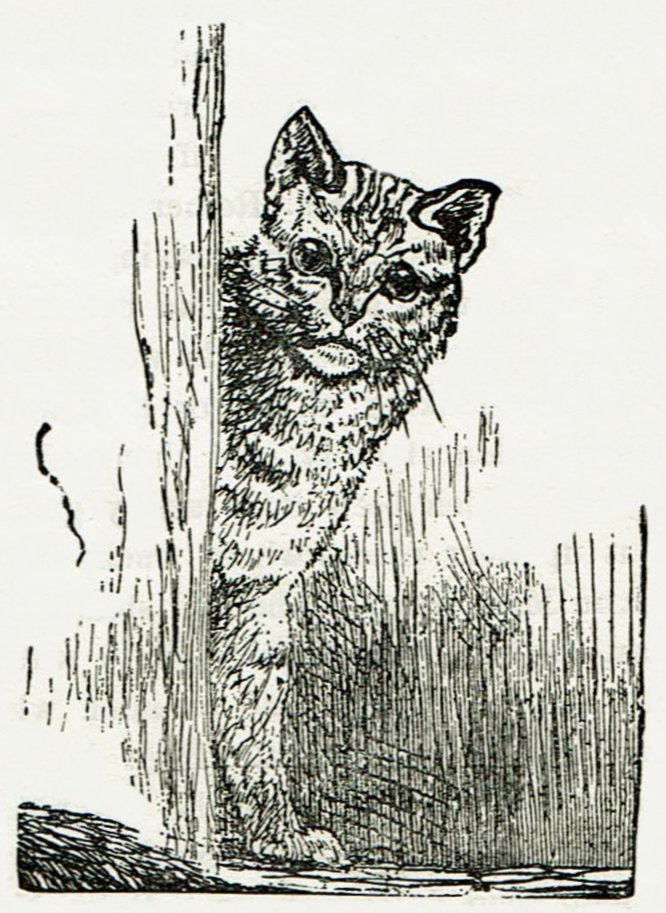
“I live in a part of the country that is blessed with cats. I never saw so many gathered in one place before in my life — gray cats and yellow cats, cats with tails and cats without tails, and kittens without number. One day I took pity on a poor little hungry kitty, and set her out a basin of milk. In less than five minutes there were nine kittens, all with their heads in that basin. One late comer could not get into the ring, so she climbed on the backs of the others, and reaching down got her little red tongue into the dish. I said last week that I would adopt one of the orphans, so I kept her in the house all day, and fed and played with her; but at night I let her out. When we came downstairs in the morning there she was waiting at the door for admittance, but she had brought four others with her! She has seemed, however, to settle down, and decide that she belongs; she stays in the house with me all the time, and the others scamper in when they can get a chance, and out again.”
Illustration from Mary’s story in an 1893 issue of The Pansy magazine.
In another issue of the magazine, she wrote about her new parrots:
“I have named the large one Billy, and the small one Polly. They are very happy together. Every afternoon Billy will spend an hour in petting and dressing Polly. He will oil her feathers, and scratch her head; then he will hold his head down, and try to make her fix him, but she can’t take time. She will just give him two or three little pecks, and then be intent on eating her supper, or playing with a stick, or bit of paper. Whenever she screams, Billy will say, ‘Shut up, Polly; shut up!'”
Illustration from Mary’s story in an 1888 issue of The Pansy magazine.
Mary gauged her reading audience to a nicety—don’t all children love to read about friendly kittens and talking birds?
Over the years Mary occasionally wrote more stories for The Pansy under the pen name “Auntie May.”
When Isabella retired from editing the magazine, and her husband retired from the ministry, they moved to Palo Alto, California to be close to their son Raymond and his family. Isabella’s sister Julia, who had never married, also lived with them; so when Mary’s second husband died unexpectedly, Isabella invited her to join them in their spacious California home.
So at the age of 76, Mary packed her belongings and set off across the country to live with Julia, Isabella, and the rest of the Aldens in sunny California. (You can click here to read about the house they all lived in together). She soon found herself happily sharing a home with Isabella’s young grandchildren.
Mary, age 88 in 1914, with two of Isabella’s grandchildren.
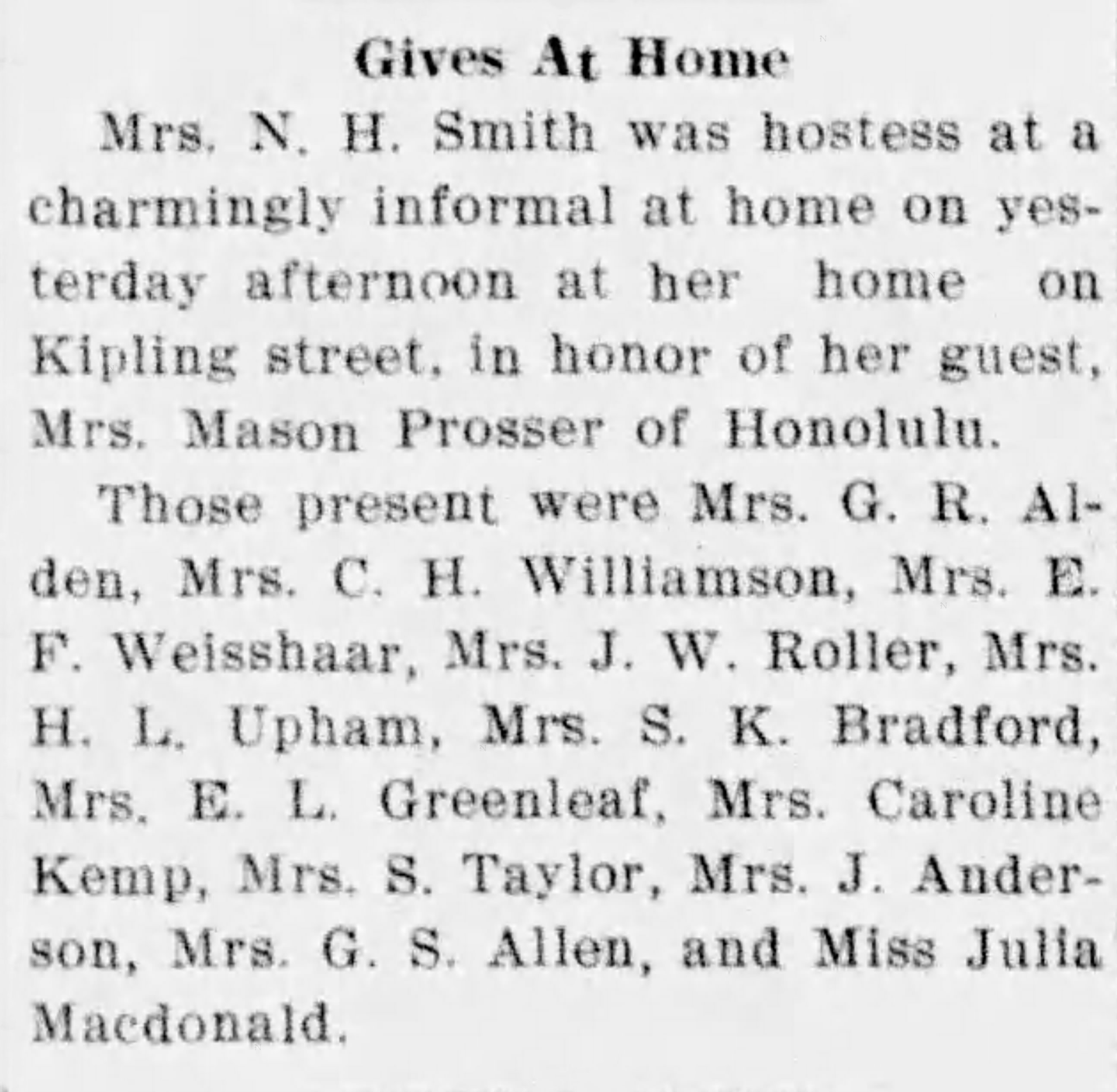
And she quickly joined the Alden’s church and began attending social events with Isabella and Julia. The local newspaper gave this brief account of their attendance at a ladies’ “at home.” (Isabella is listed as Mrs. Alden, Mary as Mrs. Williamson, and Julia as Miss Macdonald.)
No matter their age difference, there seemed to be a close camaraderie and tightly-knit bond between the Macdonald sisters, and Isabella was grateful for the time she had with her sisters in their later years. She wrote:
“I took the very best care I could of my sister Mary for eleven years, and was close beside her when she ceased to breathe. I had the comfort and companionship of my sister Julia for fifty years and knelt beside her bedside when she was called Home.”
It was probably difficult at times for Isabella when she recalled that she was the last member of the family—that her husband and son, brother and sisters, mother and father had all gone on before her to their heavenly home. But as she neared the end of her own life, Isabella wrote to her niece Grace:
“But isn’t it blessed to realize that one by one we shall all gather Home at last to go no more out forever! The hours between me and my call to come Home grow daily less.”
The bond between the Macdonald sisters—Elizabeth, Mary, Julia, Marcia, and Isabella—helped shape Isabella’s entire life. From childhood through old age, through marriages and widowhood, through writing careers and quiet domesticity, the sisters were loving constants in each other’s lives. Their shared faith and genuine affection for one another provided Isabella with both comfort and inspiration. Perhaps the sister relationships that fill Isabella’s novels—tender, loyal, challenging, but always enduring—reflected the very real treasure she found in her own family bonds.
Reviews and giveaways for Christian fiction and sweet, clean fiction. Bringing readers information on great stories and connecting authors with their readers.




 Isabella Alden