Grace Livingston Hill and the Authors’ Carnival

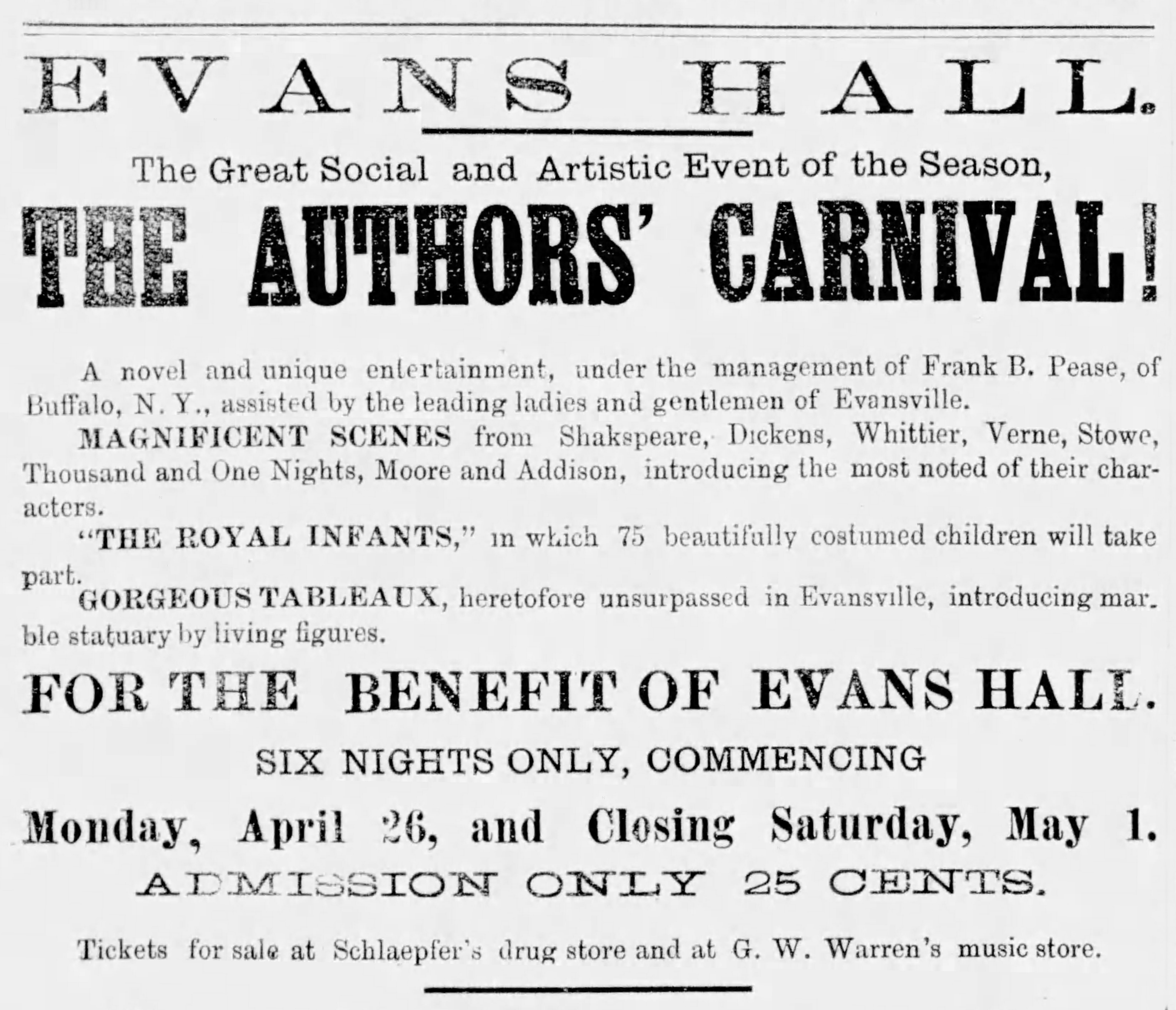
Newspaper Headline: The Great Social and Artistic Event of the Season, THE AUTHORS' CARNIVAL! A novel and unique entertainment, under the management of Frank B. Pease, of Buffalo, N.Y., assisted by the leading ladies and gentlemen of Evansville. MAGNIFICENT SCENES from Shakespeare, Dickens, Whittier, Verne, Stowe, Thousand and One Nights, Moore and Addison, introducing the most noted of their characters. "THE ROYAL INFANTS," in which 75 beautifully costumed children will take part. GORGEOUS TABLEAUX, heretofore unsurpassed in Evansville, introducing marble statuary by living figures. FOR THE BENEFIT OF EVANS HALL. SIX NIGHTS ONLY, COMMENCING Monday, April 26, and Closing Saturday, May 1. ADMISSION ONLY 25 CENTS.
From the Evansville, Indiana Daily Courier, April 18, 1880

In the late 1800s a new and exciting form of entertainment swept across America. It was called the Authors’ Carnival. It had all the fun of a community fair, as well as dazzling theatrics on a magnificent scale.

Old photo of ten women standing on the steps of a building. Each woman is dressed in a different costume, such as Native American, Arabian, Western, etc.
Women in costume for an Authors’ Carnival in Washington DC

The Authors’ Carnival drew great crowds in every city in which it was staged, so it had to be set up in a large space, such as a town hall or tabernacle. The concept, though, was simple: the Carnival was comprised of a number of booths, each of which depicted a scene from a famous author’s works.

For example, there was a booth devoted to Twenty Thousand Leagues Under the Sea by Jules Verne. Costumed actors portrayed scenes from the book in an elaborately decorated submarine compartment behind a gauze curtain that simulated water.
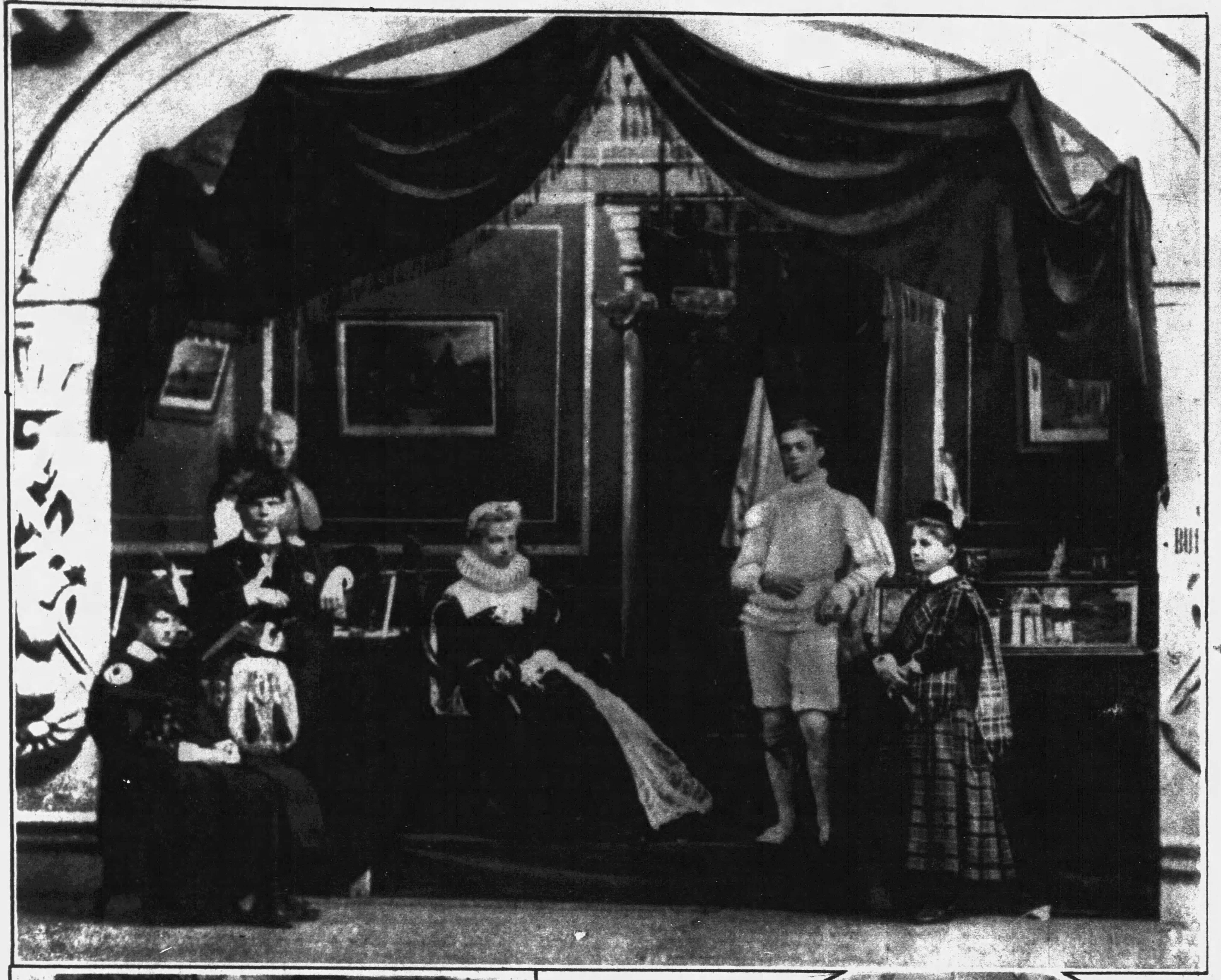
Black and white photo of a woman, a man, and three children dressed in costumes of Sixteenth Century Scotland. The woman wears a headpiece and neck ruff from the Elizabethan period. Then man and one child wear kilts. They are in a well-decorated parlour with art on the walls and paneled moulding.
A booth devoted to Sir Walter Scott’s Baronial Hall, from The Buffalo Times

Another booth was devoted to John Greenleaf Whittier’s poem, “Snow-Bound: A Winter Idyll.”
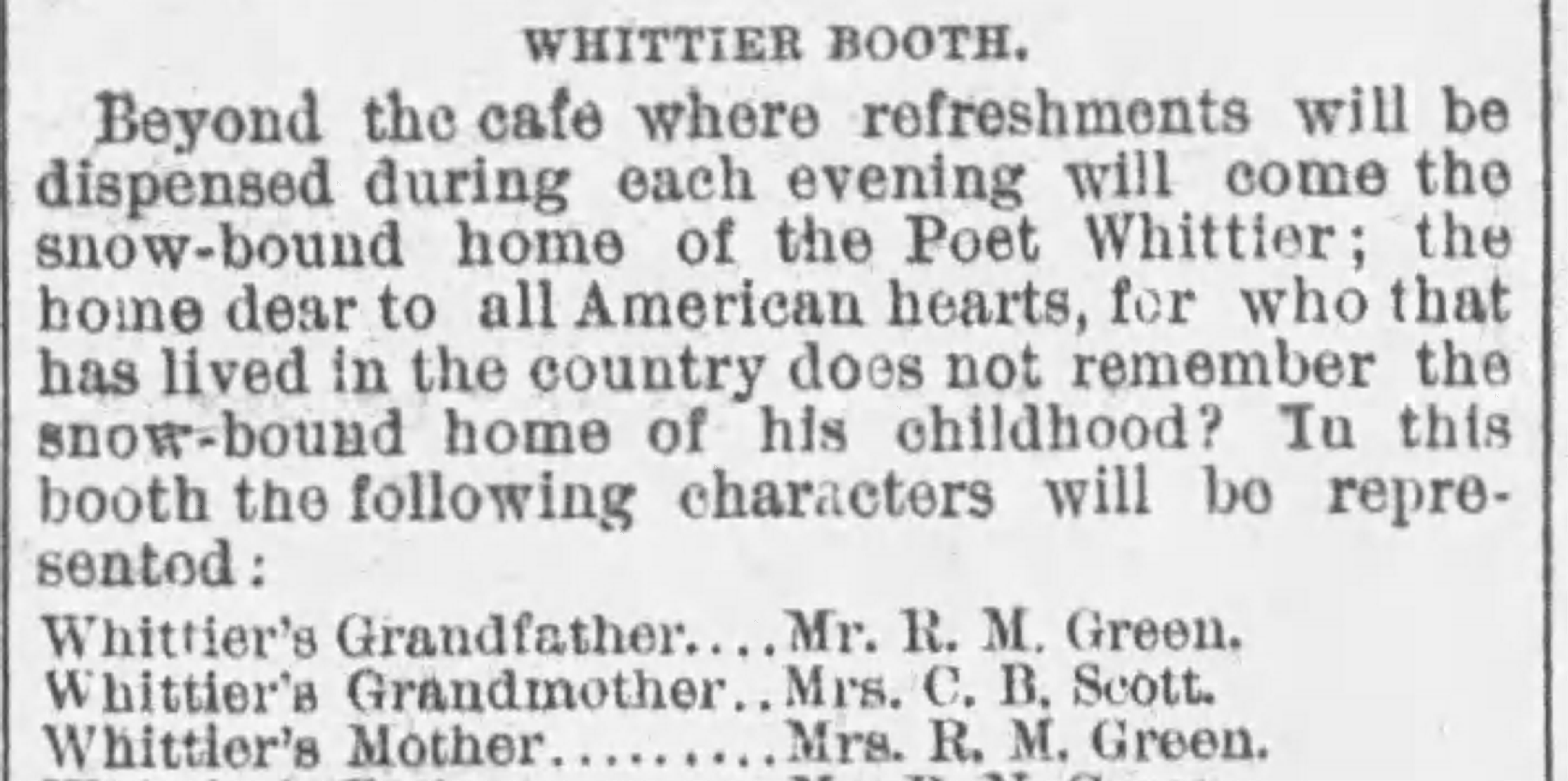
Newspaper excerpt that reads: WHITTIER BOOTH. Beyond the cafe where refreshments will be dispensed during each evening will come the snow-bound home of the Poet Whittier; the home dear to all American hearts, for who that has lived in the country does not remember the snow-bound home of his childhood? In this booth the following characters will be represented: Whittier's Grandfather, Whittier's Grandmother, Whittier's Mother.
A description of the Whittier booth, from The Scranton Republican, April 23, 1886

There were booths dedicated to Shakespeare, Longfellow, and Washington Irving, and many more literary figures, including Mother Goose. One of the most popular booths was lavishly decorated as Aladdin’s Cave.

In many cases, booths were set up so the costumed actors could interact with the people passing by.

Old black and white photo showing a group of people dressed in costumes from the 1770s. Some men are standing; others are seated beside women. There is a statuary urn with a plant between the chairs. Behind them is a background painting of a garden scene with more statues.
Victor Hugo’s Paris Garden booth, from The Buffalo Times

The highlight of the Authors’ Carnival occurred on a center stage where tableaux vivant were enacted at intervals throughout the day and evening. The most popular tableau was the colorful, well-choreographed “The Fan Brigade.” It illustrated an essay by British satirist Joseph Addison on how ladies in the eighteenth century used their fans as weapons in flirtation and romance.

Old photo of eight women dressed in gowns from the late eighteenth century. Some of them have powdered hair; all wear tall headdresses and carry fans. Two of the women stand between a large open fan mounted on top of a pole that is about seven to eight feet tall. Behind them is a painted backdrop of the stone columns and balustrade of terrace, with a landscape beyond.
Fan Brigade, from Authors’ Carnival Album, 1880, Library of Congress

In 1881 the Authors’ Carnival arrived in Cleveland, Ohio, where sixteen-year-old Grace Livingston lived with her father Charles and mother Marcia (who was Isabella Alden’s older sister). Already an aspiring author, Grace visited the Authors’ Carnival one afternoon and wrote the following account of her experience:

The Author’s Carnival in Cleveland

By Grace

It was impossible for me to attend the evening entertainment of the Author’s Carnival, but when a matinee was announced for the next afternoon, I thought I would go.

It was held in the tabernacle. As you entered the door, directly opposite you was the stage, where the most beautiful tableaux were exhibited every twenty minutes, the performers never having rehearsed before, but being picked out and arranged on the spot, from the different booths.

The booths were ranged around the sides, and the center left for the audience to promenade. We took a look at the booths before the first tableaux.

The “Alhambra,” which, having a piano, and a few good players, managed to keep such a crowd around it all the time, that one could hardly get a peep at it.

Whittier’s “Snow Bound,” with its soft gray costumes, which harmonize wonderfully with the neat room, and fire-place, and cupboard, with its rows of bright, shining dishes, and the strings of dried apples hanging from the ceiling. Whittier’s “grandmother” happened to be a friend of mine, so I stepped up to her, and she said, “How does thee do, friend Grace?”

There was the “Arabian Nights” booth, where they sold miniature “Aladdin Lamps,” said to be exact copies from the original.

“Lalla Rookh” and the “Jules Verne” booths were beautiful and picturesque, with their mermaids, and flowers, and sea-weeds.

Longfellow’s “Hiawatha,” where the Indians flourished their tomahawks, and gave war-whoops, attracted a great deal of attention, and really was one of the most fascinating.

The “Egyptian” booth had beautiful, rich costumes.

The “Addison” booth had, perhaps, the most beautiful costumes, but the characters were all ladies.

The “Dickens” booth, with all its comical characters, was just refreshing.

As I walked up to the “Shakespeare’s” booth, the “Duke of York,” an old schoolfellow, stepped forward and shook hands with me.

The tableaux-bell rang, and we all rushed to the center of the floor, each one trying to get the best position for seeing. The most beautiful and quaint pictures succeeded each other; lastly, the beautiful “Fan Drill.” If you have never seen it, seen the perfect time and graceful motions, you cannot imagine how beautiful it was.

But there was one blight on all this beauty. At the “Spanish” booth they sold cigars and cigarettes, and some ungentlemanly persons even smoked among all that company of ladies. It was Satan’s way of joining in the Author’s Carnival.

Tableaux and theatricals were common forms of entertainment during Isabella Alden’s lifetime, and she wrote about them in several of her novels. You can read more about tableaux in these previous posts:

Tableaux: Bringing Pictures to Life

A Nice Oyster Supper

A New Grace Livingston Hill Free Read!

When she first started out in her writing career Grace Livingston (as she was then known) wrote short stories for several different Christian newspapers and magazines.

In 1891 her story “How One Fanatic was Made” was published in one of those newspapers, and it included two charming wood-cut-style illustrations, one of which you can see here:

It also included one of Grace’s timeless lessons on what it means to live a Christian life:

A devout Christian, Miss Delia Stebbins attends church regularly and reads her Bible every day. She is righteous and strong in her faith, or so she thinks. But when a less-than-desirable family moves in next door Miss Stebbins realizes God’s words are actually God’s instructions for daily life. Is it possible she can make up for the years she’s wasted?

You can read “How One Fanatic was Made” for free!

Just follow this link to go to BookFunnel.com. Then, choose whether you want to read the story on your computer, phone, ipad, Kindle, or other electronic device.

Or choose the “My Computer” option to print the story as a PDF document to read and share with friends.

New Free Read by Grace Livingston Hill

Isabella Alden was very close to her sister Marcia Livingston. Like Isabella, Marcia was a writer and they often co-wrote stories together.

Isabella Alden and her sister, Marcia Livingston in an undated photo
Isabella Alden (left) and her sister, Marcia Livingston (right) in an undated photo

After the sisters married, the Alden and the Livingston families remained close. They spent much of their time together, and Marcia’s daughter Grace grew up in the creative atmosphere of writers and books.

Grace learned her ABCs on her “Aunt Belle’s” typewriter. At the age of ten she wrote a story of her own called, “The Esselsltynes; or, Marguerite and Alphonse,” which the family published for her as a surprise. That gift, along with the encouragement and work example set by her family, inspired Grace to continue writing.

She followed the adage of “write what you know.” When Grace became involved in the Young People’s Society of Christian Endeavor, she wrote stories about that experience; many of those stories were published in Christian Endeavor World magazine.

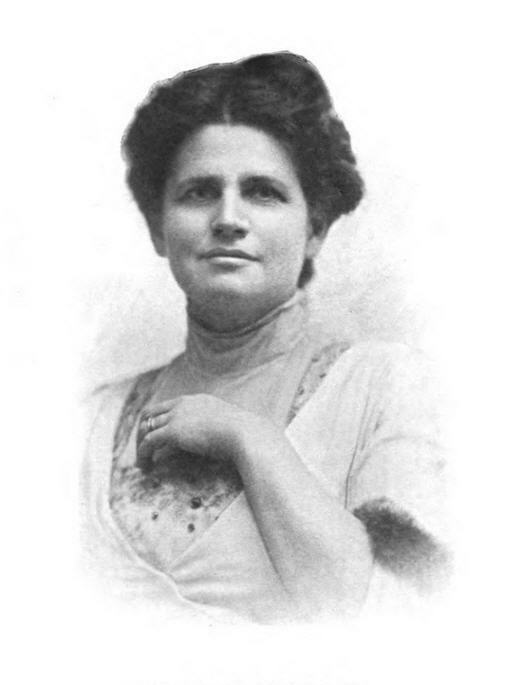
Grace Livingston Hill-Lutz, about 1912

The Epworth Herald also published Grace’s stories that illustrated simple truths about the Christian life. One such story was “Hazel Cunningham’s Denial,” which described a young woman’s dilemma while vacationing at a summer resort

“Hazel Cunningham’s Denial” first appeared in The Epworth Herald on August 9, 1902, and it’s available for you to read for free.

Click on the cover below to begin reading “Hazel Cunningham’s Denial” by Grace Livingston Hill.

Cover_Hazel Cunninghams Denial by GLH scaled