Frank Beard’s Chalk Talk

Chalk Talk

Frank Beard was one of the most popular lecturers at Chautauqua Institution. His Chalk Talk lectures drew standing-room-only crowds because of their pitch-perfect blend of humor, art and Biblical truths.
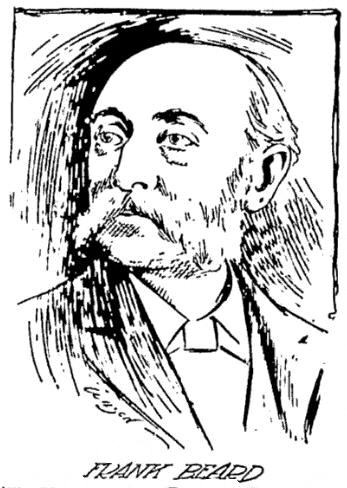
Black and white sketch of the artist Frank Beard.In an 1895 interview, Frank recalled how his Chalk Talks came to be:

“I was a young artist in New York, and had just been married. My wife was an enthusiastic churchgoer; and a great deal of our courtship was carried on in going to and from the Methodist church. The result was that I struck a revival and became converted. This occurred shortly after I was married, and like other enthusiastic young Christians, I wanted to do all I could for the church.”

Soon after he joined the church, the congregation put together an evening of entertainment. The ladies, knowing of his talent, suggested that Frank draw some pictures as part of the program. Frank agreed, but he felt that just standing in front of an audience and sketching without saying anything about the pictures “would be a very silly thing.”

He decided instead to make a short talk and draw sketches to illustrate his points. The talk was to be given as part of a Thanksgiving celebration, and Frank later joked that he rehearsed in front of his wife, his mother-in-law, and the turkey. “Well, my wife survived, my mother-in-law did not die while I was talking, and the turkey was not spoiled.”

Black and white sketch of Frank Beard drawing at an easel. Seated in chairs watching are a young woman, an older woman and a plucked, headless turkey strapped in the third chair.

When he gave his talk in front of the congregation, it was a great success. Soon, other churches asked him to repeat his talk, and in very short order he had more invitations to speak than he could ever hope to accept. His wife suggested charging a fee for each lecture, hoping that the cost would deter organizations from inviting him to talk at their functions. So Frank dutifully began charging $30 per talk. The requests continued to pour in. He increased his fee to $40, then $50, but his talks continued to be in great demand.

Newspaper announcement of a Freank Beard lecture from the 10 Mar 1890 edition of the Rock Island Argus
Announcement in the March 10, 1890 edition of the Illinois newspaper, The Rock Island Argus

That was the birth of the Chalk Talk, and Frank soon hit the lecture circuit. He was one of the first speakers at Chautauqua Institution in New York; and he lectured at many of the daughter Chautauquas. This 1899 clipping from the Los Angeles Herald recounts Frank’s Chalk Talk at the Long Beach Chautauqua (which named July 19, 1899 Frank Beard Day):

Announcement of Frank Beard Day at the Long Beach Chautauqua; from The Los Angeles Herald, 20 Jul 1899

The topics of his Chalk Talks ranged from morality tales to stories from the Bible, each told in a casual, funny, but reverent, way. He knew that people who wouldn’t listen to a “sermon” would listen to his Chalk-Talk if the truths were presented in an entertaining fashion.

In Four Girls at Chautauqua, Eurie Mitchell proved that very point. Eurie was so opposed to listening to “sermons” at Chautauqua, she refused to go to any of the lectures; but when she heard about Frank Beard’s caricatures, she decided to go see him for herself.

If you have never seen Frank Beard make pictures, you know nothing about what a good time she had. They were such funny pictures! Just a few strokes of the magic crayon and the character described would seem to start into life before you, and you would feel that you could almost know what thoughts were passing in the heart of the creature made of chalk. Eurie looked and listened and laughed.

In Isabella’s book, Frank’s Chalk Talk was able to do what no other lecture at Chautauqua could: reach Eurie’s heart and lead her, ultimately, to salvation through Christ.

“Pictures can often tell stories quicker and better than words,” Frank once said, “and I believe that cartoons can be used in the service of religion, righteousness, truth, and justice.”

Black and white drawing of a man standing at a blackboard drawing a circle by moving his arm in a wide round motion

To prove his point, he once asked, “If you were commissioned to teach a child the nature of a circle, would you begin by stating that a circle is an area, having for its center a point, and bounded by a circumference in the nature of an endless imaginary line, which at all points is at an equal distance from the center? No! You would do nothing of the sort, but you would [show] its nature and properties [by drawing a circle] in black and white.”

Sometimes the subjects of his Chalk Talks were very simple. He told a story, for example, of how a blackboard and chalk could be used to teach a Sunday-school class of young children who had never before seen the Christian symbol of a cross inside the shape of a heart. He started by drawing the simple outline of a heart on the blackboard.

A simple sketch of a heart-shape in white chalk against a black background“What is this?”

“A heart!”

“Yes, a heart. Now, I mean this to represent a particular heart—I mean it for my heart. What is it now?”

“Your heart!”

“Don’t forget that. Now, see what else I will draw.” And he drew a child’s face within the heart.

“Now what have I made?”

Drawing in white chalk of a child's face inside the shape of a heart“A little boy!” “A little girl!” “A little child!” Variously cried the children.

“Yes, a little child; but where is the child?”

“In the heart.”

“In the heart?”

“In your heart.”

“That’s right. Now, what does it represent? When I tell you that I have a little child in my heart, what does it mean?”

A chalk sketch of a cross inside the shape of a heart against a black background“You mean you love the child.”

“Exactly. Now I will rub out the child and put a cross in the heart. What does that mean?”

“You love the cross.”

Then he went on to explain in a simple way what loving the cross meant.

He also shared an example of one of his lessons for older children and adolescents. He used this lesson to illustrate the concept of the narrow Christian path described in Matthew 7:13-14:

A young man is attracted by the appearance of beauty and the pleasure along the broad way. Timidly at first, for he is not bad and rather fears evil—but he loves play and pleasure—so he steps into it. He knows it is not the right way to take but he thinks to himself:

Chalk drawing of the head of a nicely-dressed young man wearing a hat.

“After a while, after I have had a good time, I will go over to the right path and come out all right after all.”

Chalk Drawing of the head of a frowning young man wearing a hat and smoking a cigarette

Frank went on to explain how the young man fell in with evil companions and was drawn further away from the good path.

Chalk drawing of the head of an old man with disheveled clothes and hat, smoking rumbled cigarette.

The young man learned to smoke and chew tobacco and read books “which mislead and give us wrong notions in life, that make heroes of scamps, thieves and liars.”
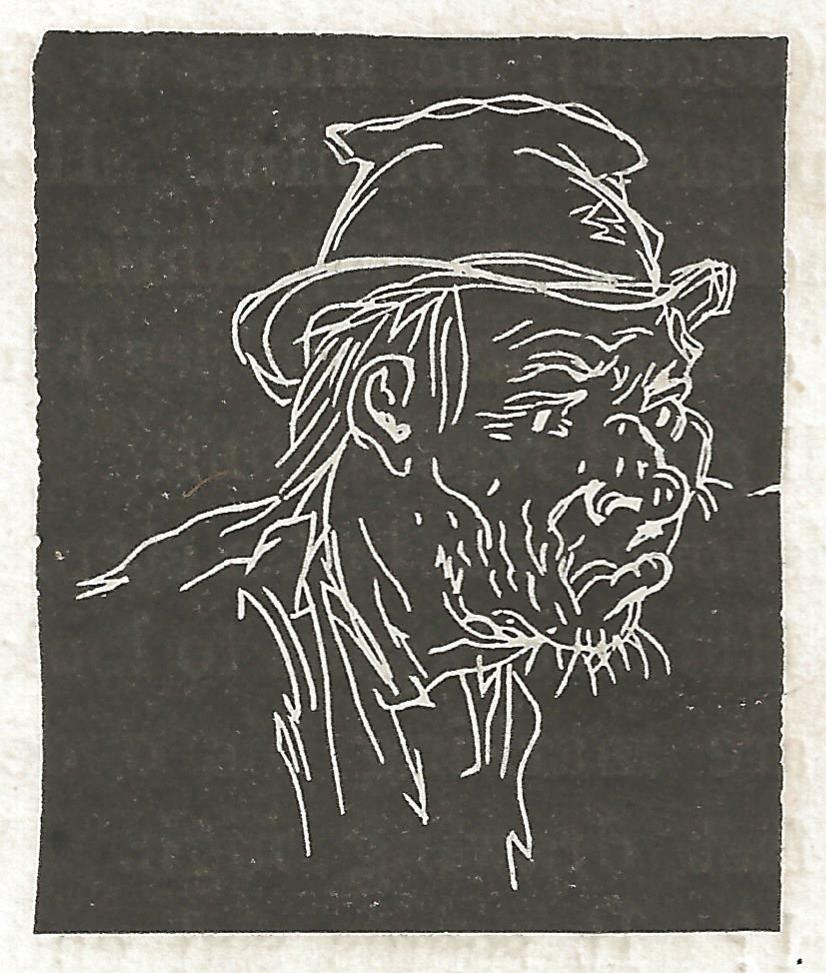
Chalk Ddawing of the head of an old man, hunched over, wearing disheveled clothes and hat.

As Frank continued the lesson, he amended and enhanced his original drawing to show the progressive results of the choices the young man made in his life.

Wherever he gave his Chalk Talks, he was well received, and his reputation grew. But not everyone was a fan of using a blackboard and chalk as teaching tools in the Sunday-school. Frank shared a story about one church that decided to use a man in their congregation—they assumed he had talent because he was a sign painter by profession—to illustrate Sunday-school lessons. The man decided to illustrate the story of Samuel as a child, entering the apartment of the high priest Eli in answer to his summons. His efforts were not well received.

Chalk drawing of Samuel running towards Eli who is in bed.

“Some objected to the bed-posts,” Frank said. “Some didn’t exactly know why, but the drawing didn’t conform to their idea of Samuel at all, and, more over, Eli’s nose was out of proportion.”
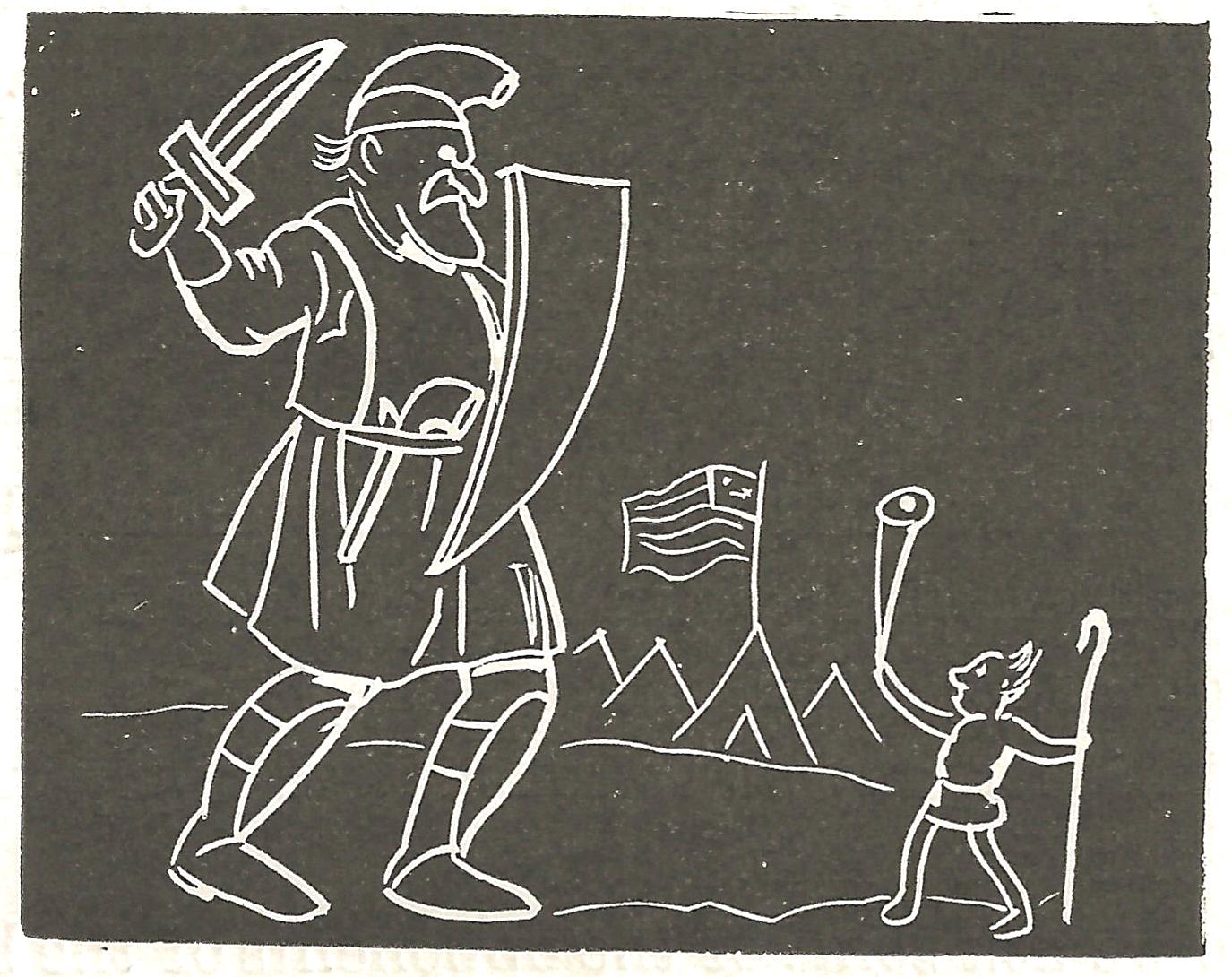
Chalk drawing of the Bible story of David and Goliath

The man’s next attempt didn’t fare any better, when he drew Goliath about thirty-five feet high in proportion to David. In fact, the congregation didn’t like anything at all about the poor sign-painter’s efforts at the blackboard.

Isabella Alden’s book Links in Rebecca’s Life featured a character who also disliked Chalk-Talk style lectures. She was a Sunday-school teacher who hated chalk and blackboards.

“They are such horrid dusty things. You get yourself all covered with chalk, and just ruin your clothes. I can hardly wear anything decent here as it is. If I had a blackboard, I should give up in despair.”

“I should think it would be a great help in teaching children,” Rebecca said.

“Well, I don’t know. What could I do with it? I don’t know how to draw, and as for making lines and marks and dots, I am not going to make an idiot of myself. What’s the use?”

But Frank Beard believed no special talent was required for a teacher to incorporate chalkboard drawings into Sunday-school lessons.

“Many are apt to think some extraordinary genius is necessary to fit a teacher to use the blackboard,” he said. “It is a mistake. You can teach better with a pencil than without. You can learn to draw far better than you ever imagined possible.”
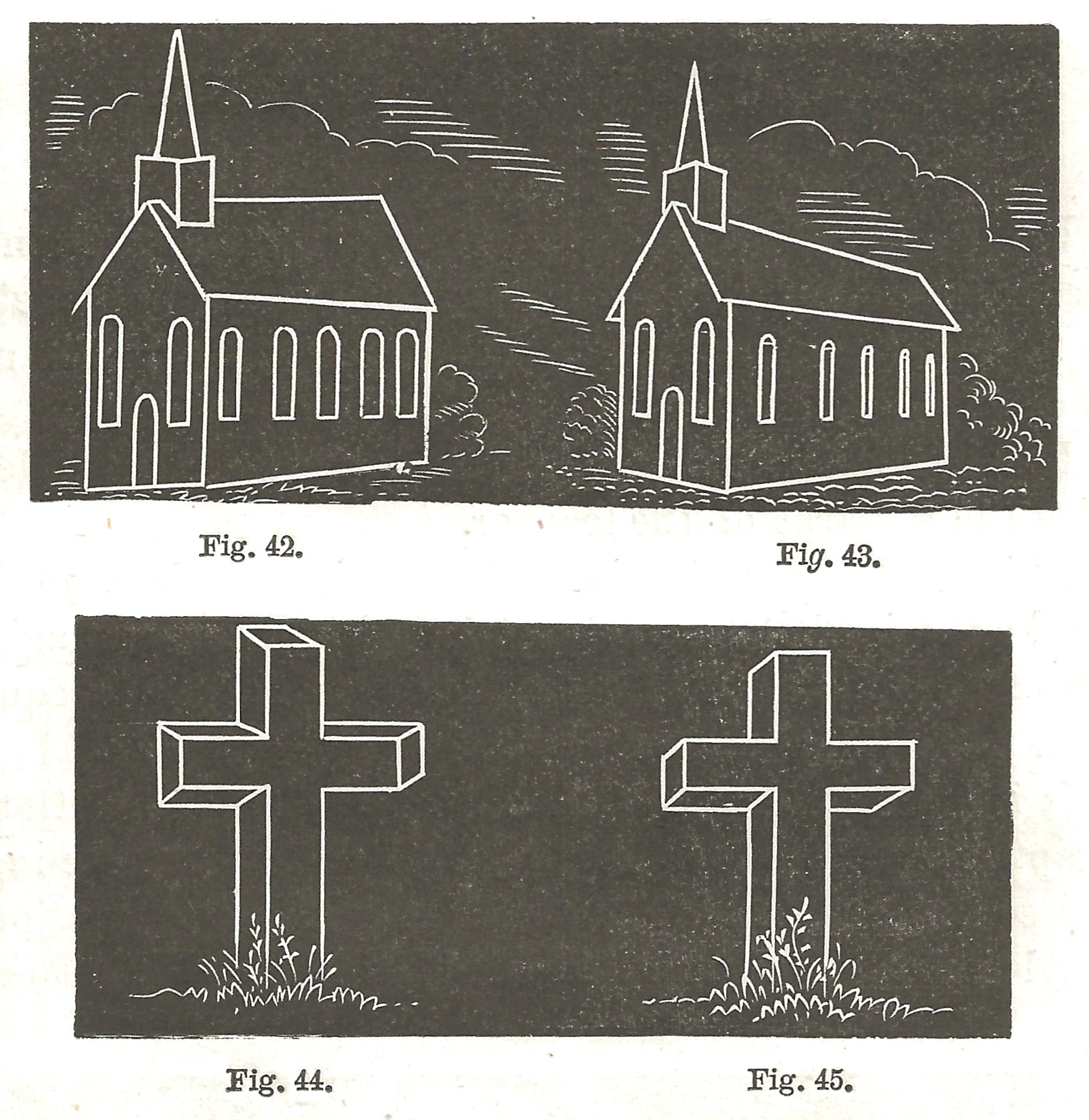
Drawings of two different versions of a church and a cross; one version showing the wrong perspective and one version showing the correct perspective.
Illustrations from Frank’s book showing the right (Figures 43, 45) and wrong (Figures 42, 44) way to draw an image in perspective.

In 1896 Frank published a book for Sunday-school workers; in it he gave simple instructions for using the blackboard to illustrate Bible lessons.

Example of a simple but artistic way to write "The Lord is my shepherd" in chalk on the blackboard

Two examples of chalk talk methods for writing "what a friend we have in Jesus" on the chalkboard.

His book included how-to’s on perspective, lettering, and using easy-to-draw symbols as illustrations. Here are some of the symbols he illustrated:
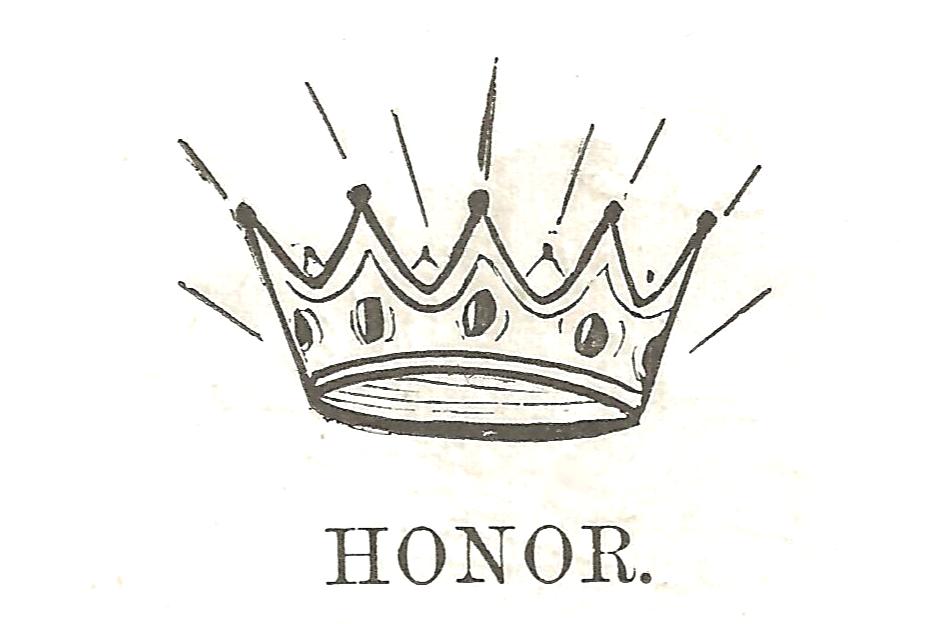
Drawing of a crown with the word "Honor" written below. Drawing of a key with the word "Knowledge" written below. Drawing of a star with the word "Promise" written below. Drawing of a cross with the word "Salvation" written below. Drawing of an ancient oil lamp with the word "Wisdom" written below.

The purpose of writing the book, he said, “is to show how the blackboard can be used in the Sunday-school, and to furnish such instruction in drawing upon it” so it can be done in the most effective way.

drawing of a Victorian-era woman darwing with chalk on a blackboard in front of children seated on chairs in front of her
Illustration from Frank Beard’s book, Chalk Lessons

He was quick to say that he didn’t want the blackboard to monopolize the Sunday-school or supplant other useful forms of instruction. But, if used correctly, Frank Beard proved that the blackboard—and Chalk Talks—could be the “instrument which proves effective as a means of winning souls to Christ.”


"Taught by Pictures." "Frank Beard believes in the cartoon in religion." A Chat with the Artist." "How He Came to Invent the Chal Talk." "War-Time Caricatures"In 1895 Frank Beard gave an interview to the Washington D.C. newspaper The Evening Star. Click on this image to read the interview in which Frank tells how he invented the Chalk Talk:

.

.

Cover_Links in Rebecca's LifeClick on the book cover to learn more about Links in Rebecca’s Life.

.

.

Cover Box Set books 1-3 Click on the book cover to learn more about Four Girls at Chautauqua.


A Tour of Chautauqua: Palestine Park

At Chautauqua, opportunities for learning weren’t confined to classrooms and lecture halls. Dr. John Vincent, a Methodist minister and co-founder of the Chautauqua Institute, was a great proponent of learning in the out-of-doors. He embraced the forest setting and set out to make Chautauqua the standard for open air summer schools throughout the country and the world.

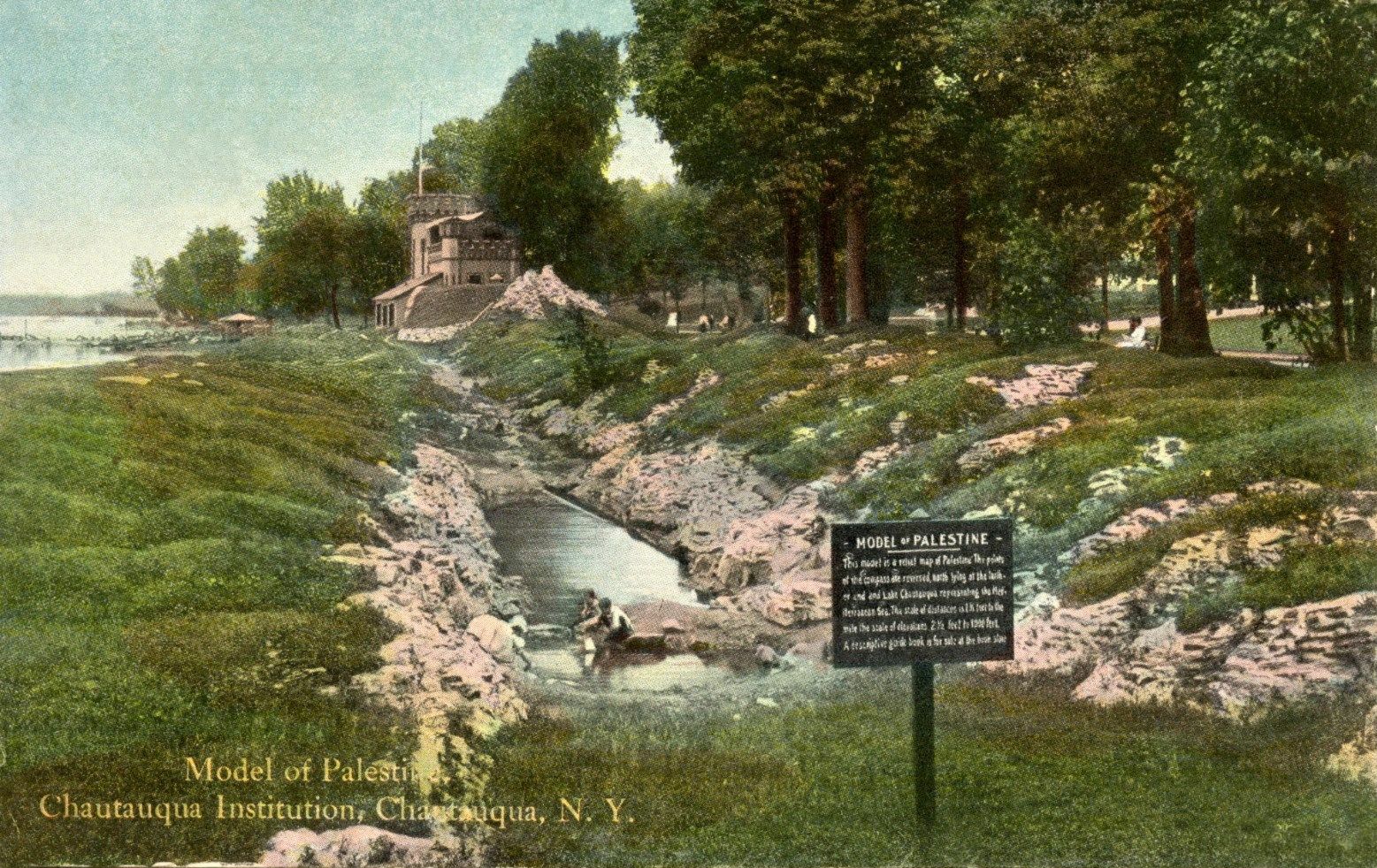
Chautauqua Model of Palestine One notable example of Dr. Vincent’s vision of a fresh-air classroom was Palestine Park. He came up with the concept of making a miniature model of the Holy Land so students could get a visual sense of the settings they learned about in their Bible classes.

Sign describing Palestine Park
Text of the sign posted at the entrance to Palestine Park. Click on the image to see a larger version.

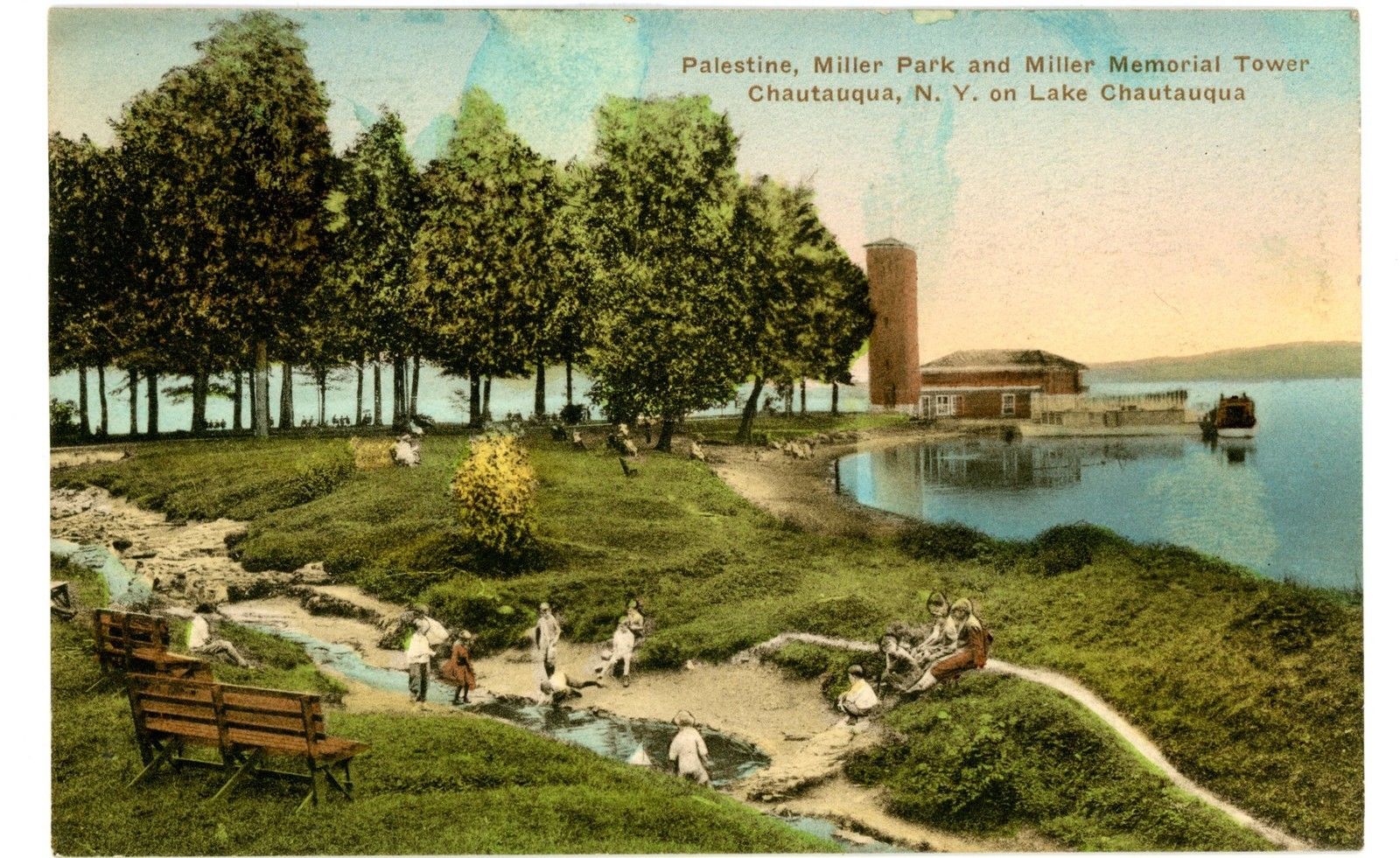
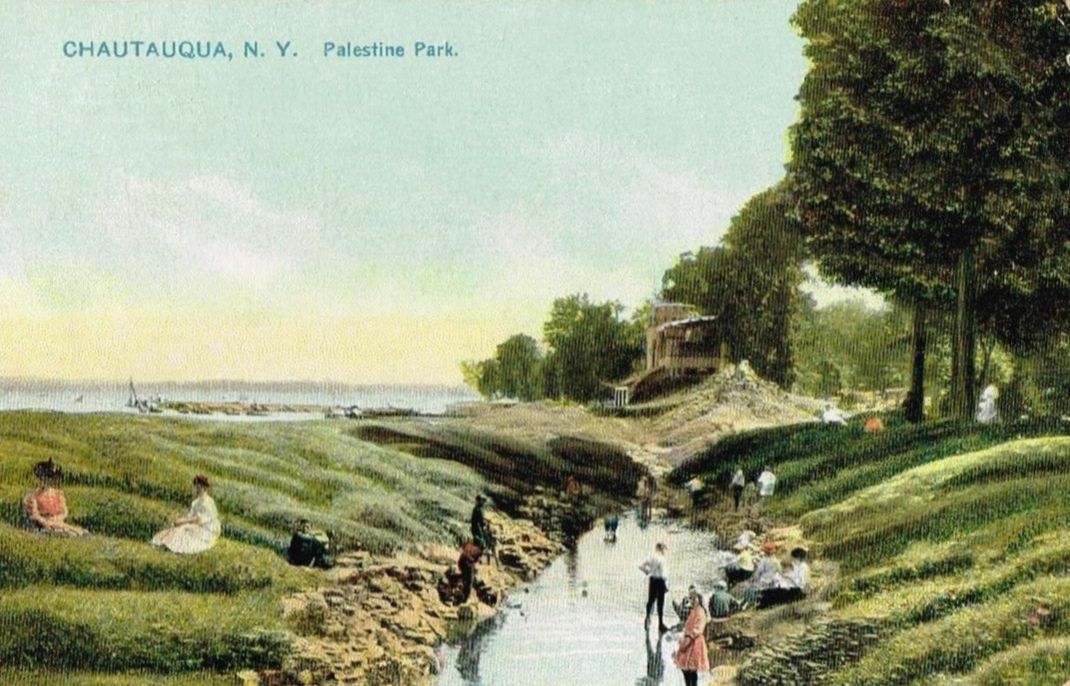
Palestine Park was constructed near the pier on the shore of Lake Chautauqua. The lake itself represented the Mediterranean Sea. Nearby were representations of the cities of the Philistines, Joppa and Caesarea, Tyre and Sidon.

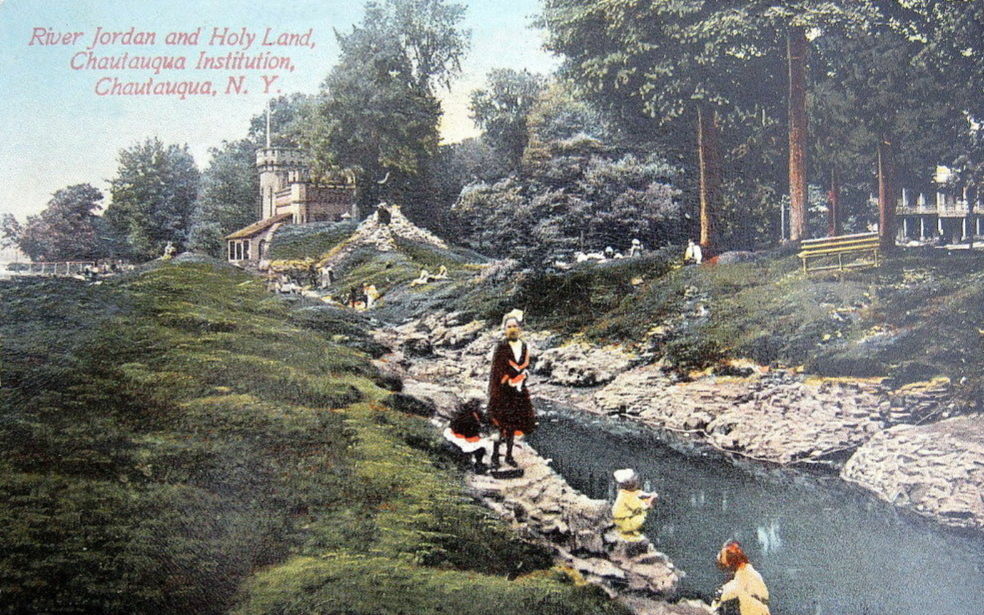
The Mountain Region showed the famous places of Israelite history from Beersheba to Dan. The sacred mountains Olivet and Zion, Ebal and Gerizem were built. And there were also the River Jordan, the Sea of Galilee, and the Dead Sea.

Guide Book to Palestine ParkSmall plaques identified each place of interest and included Bible verses that mentioned the site. In 1920 Dr. Jesse Lyman Hurlbut published a guide to Chautauqua’s Palestine Park. Click on this cover image to read Dr. Hurlbut’s guide.


Old postcard of Chautauquans enjoying Palestine Park.

The model of Palestine was one of the most popular sites at Chautauqua. Theology students regularly walked the area of Palestine Park, notebooks in hands. And Sunday school teachers held classes there, sometimes on the hills around Nazareth to illustrate a lesson on the boyhood of Jesus.

A Lecture on the Model of Palestine 1895
A Lecture on the Model of Palestine, 1895

Isabella Alden was very familiar with Palestine Park, and described it in Four Girls at Chautauqua. In the book, Eurie Mitchell and Flossy Shipley decide to walk to Palestine together one evening:

“Come,” Eurie said, “you have been to meetings enough, and you haven’t taken a single walk with me since we have been here, and think of the promises we made to entertain each other.”

Flossy laughed cheerfully.

“We have been entertained, without any effort on our part,” she said. Nevertheless she suffered herself to be persuaded to go for a walk, provided Eurie would go to Palestine.

“What nonsense!” Eurie said, disdainfully, when Flossy had explained to her that she had a consuming desire to wander along the banks of the Jordan, and view those ancient cities, historic now. “However, I would just as soon walk in that direction as any other.”

There was one other person who, it transpired, would as soon take a walk as do anything else just then. He joined the girls as they turned toward the Palestine road. That was Mr. Evan Roberts.

“Are you going to visit the Holy Land this morning, and may I be of your party?” he asked.

“Yes,” Flossy answered, whether to the first question, or to both in one, she did not say. Then she introduced Eurie, and the three walked on together, discussing the morning and the meetings with zest.

“Here we are, on ‘Jordan’s stormy banks,’” Mr. Roberts said, at last, halting beside the grassy bank. “I suppose there was never a more perfect geographical representation than this.”

“Do you really think it has any practical value?” Eurie asked, skeptically. Mr. Roberts looked at her curiously.

“Hasn’t it to you?” he said. “Now, to me, it is just brimful of interest and value; that is, as much value as geographical knowledge ever is. I take two views of it. If I never have an actual sight of the sacred land, by studying this miniature of it, I have as full a knowledge as it is possible to get without the actual view, and if I at some future day am permitted to travel there, why—well, you know, of course, how pleasant it is to be thoroughly posted in regard to the places of interest that you are about to visit; every European traveler understands that.”

“But do you suppose it is really an accurate outline?” Eurie said, again, quoting opinions that she had read until she fancied they were her own.

Again Mr. Roberts favored her with that peculiar look from under heavy eyebrows—a look half satirical, half amused.

“Some of the most skilled surveyors and traveled scholars have so reported,” he said, carelessly. “And when you add to that the fact that they are Christian men, who have no special reason for getting up a wholesale deception for us, and are supposed to be tolerably reliable on all other subjects, I see no reason to doubt the statement.”

On the whole, Eurie had the satisfaction of realizing that she had appeared like a simpleton.

Flossy, meantime, was wandering delightedly along the banks, stopping here and there to read the words on the little white tablets that marked the places of special interest.

“Do you see,” she said, turning eagerly, “that these are Bible references on each tablet? Wouldn’t it be interesting to know what they selected as the scene to especially mark this place?”

Mr. Roberta swung a camp-chair from his arm, planted it firmly in the ground, and drew a Bible from his pocket.

“Miss Mitchell,” he said, “suppose you sit down here in this road, leading from Jerusalem to Bethany, and tell us what is going on just now in Bethany, while Miss Shipley and I supply you with chapter and verse.”

“I am not very familiar with the text-book,” Eurie said. “If you are really in the village yourselves you might possibly inquire of the inhabitants before I could find the account.” But she took the chair and the Bible.

“Look at Matthew xxi. 17, Eurie,” Flossy said, stooping over the tablet, and Eurie read:

“‘And he left them, and went out of the city into Bethany; and he lodged there.’”

“That was Jesus, wasn’t it? Then he went this way, this very road, Eurie, where you are sitting!” It was certainly very fascinating.

“And stopped at the house on which you have your hand, perhaps,” Mr. Roberts said, smiling at her eager face.

“That might have been Simon’s house, for instance.”

“Did he live in Bethany? I don’t know anything about these things.”

“Eurie, look if you can find anything about him. The next reference is Matthew xxvi.”

And again Eurie read:

“‘Now when Jesus was in Bethany, in the house of Simon the leper.’”

“The very place!” Flossy said, again. “Oh, I want so much to know what happened then!”

Eurie, Flossy, and Mr. Roberts spent the better part of the day at Palestine Park, following the plaques from one location to the next and reading verses out of Mr. Roberts’s Bible.

Model of Palestine with Miller Park and Bell Tower in the background

Palestine Park was among the great attractions at Chautauqua and, as Isabella mentioned in her book, it received accolades from Biblical scholars of the time because of its accuracy and geographical precision.

But Palestine Park did have one major flaw, which was alluded to in the sign that marked the entrance to the model. In order to use Chautauqua Lake to represent the Mediterranean Sea, the geography of the Holy Land had to be flipped; north had to be south, and east was made the west.

Jesse Lyman Hurlbut, D.D.

Jesse Lyman Hurlbut, who regularly used the park as part of his theology lectures and children’s Sunday school classes, explained:

“Chautauqua has always been under a despotic though paternal government and its visitors easily accommodate themselves to its decrees. But the sun persists in its independence, rises over Chautauqua’s Mediterranean Sea where it should set, and continues its sunset over the mountains of Gilean, where it should rise. Dr. Vincent and Lewis Miller [the founders of the Chautauqua Institute] could bring to pass some remarkable, even seemingly impossible achievements, but they were not able to outdo Joshua and not only make the sun stand still, but set it moving in a direction opposite to its natural course.”

Over the years, Palestine Park was repaired, rebuilt and expanded to add a model of Jerusalem and its surrounding hills, as well as Bethlehem, Jericho, and other places of interest until, ultimately, it almost doubled in size.


Palestine Park as it looked in 1908


Palestine Park in 1914

Click on the map below to see where Palestine Park was located on the Chautauqua Institution grounds. You’ll find it on the shore of Lake Chautauqua near the steamboat landing at The Point.

Map of Chautauqua 1874

Next on our Tour of Chautauqua: A Healthy Body

A Tour of Chautauqua: Lectures and Classes

(Note: You can click on any of the images in this post to view a larger version.)

The Chautauqua Assembly had a modest beginning in 1874. It was originally conceived as a summer training program for Bible teachers; but from the start, the Chautauqua Assembly differed greatly from accepted Bible training of the time. At Chautauqua, Sunday school teachers gathered not in convention halls to hear reports and listen to speeches. Instead, they spent two or more weeks in the out-of-doors studying the Bible, attending classes, and collaborating together to create Sunday school lesson plans for use in churches across the country. From that modest beginning, the Chautauqua Institution grew and its mission expanded, as did its fame.

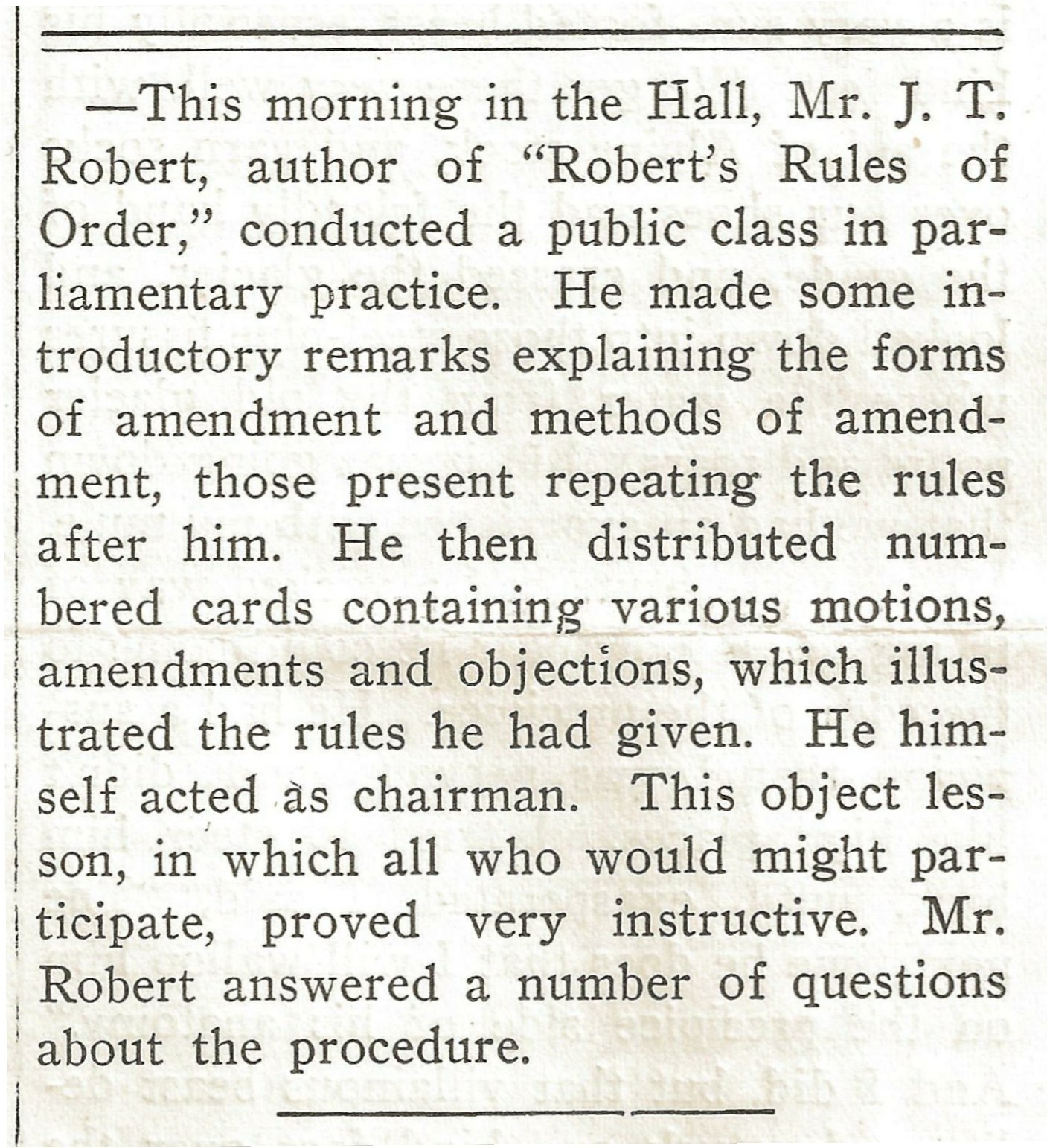
Report of a summer class on Robert’s Rules of Order, 1901

By 1885, when the twelfth annual Chautauqua Assembly was held, over seventy-five thousand people gathered—some for a day, some for a week and several thousand for the entire eight-week term of the Summer Assembly. While many still came to be trained and inspired as Sunday school teachers, others came to hear lectures and attend classes on the Bible, ancient history, science, and philosophy. They participated in experiments in chemistry, and studied the stars through telescopes. They learned languages of the world, including Hebrew, Latin or Greek; and received instruction in music and vocals.

Report of a Harvard Professor’s Lecture; 1901.

A remarkable element of the Chautauqua Summer Assembly was the level of course instruction. The best lecturers and teachers in the world came to Chautauqua. Renowned clergymen, famous statesmen, and college presidents lectured at the Assembly, as did Nobel Peace Prize winners and military heroes. Students with grade-school educations sat beside college graduates at lectures given by professors from Yale, Harvard, Cornell, Wellesley, Johns Hopkins and other prominent universities from the U.S. and Canada.

Chautauqua’s democratic culture extended beyond the classroom. The Reverend Jessie Lyman Hurlbut told of a woman who once said:

“Chautauqua cured me of being a snob, for I found that my waitress was a senior in a college, the chambermaid had specialized in Greek, the porter taught languages in a high school, and the bell-boy, to whom I had been giving nickel tips, was the son of a wealthy family in my own State who wanted a job to prove his prowess.”

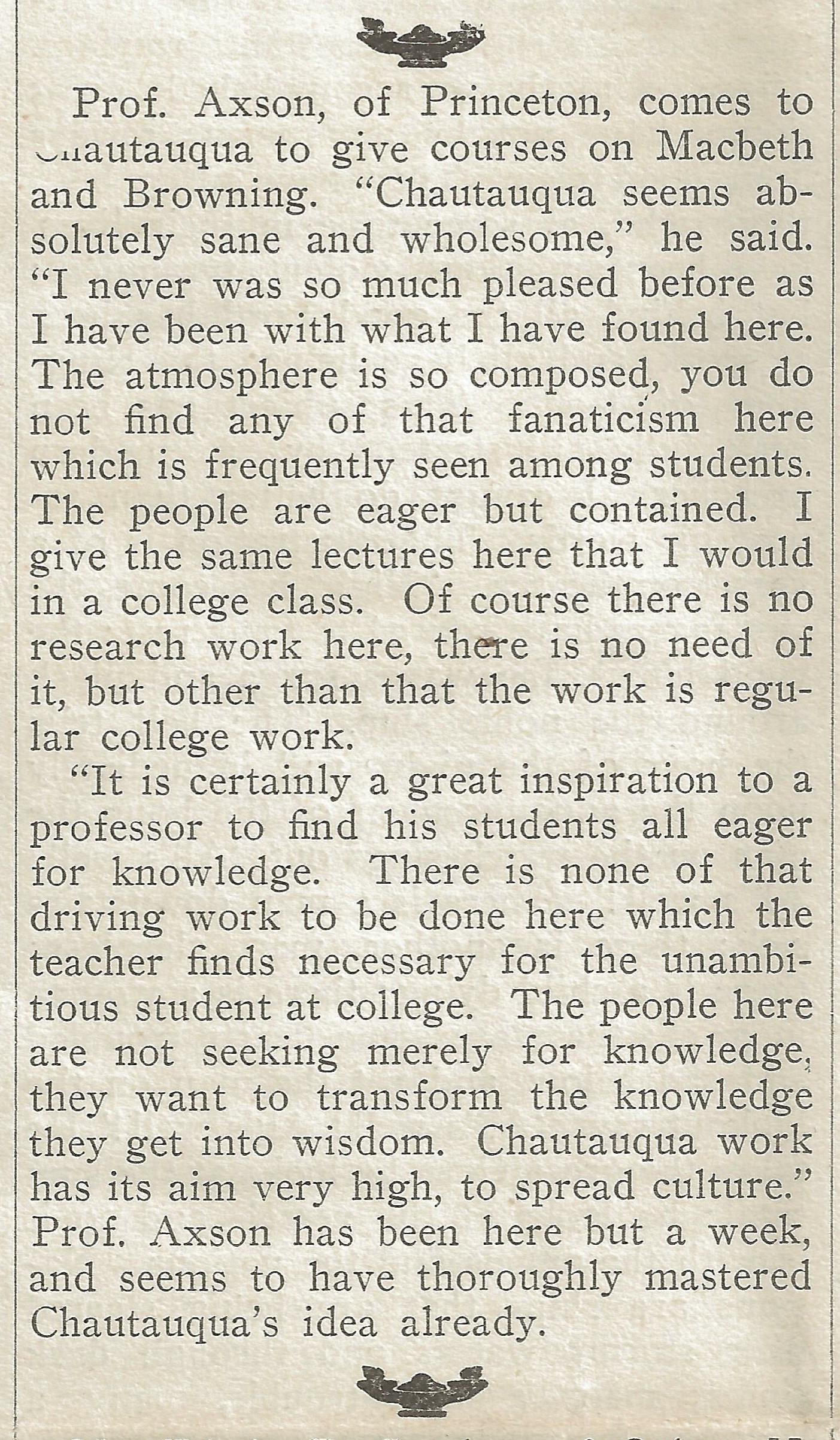
1901 announcement of classes offered by a Princeton professor.

But not everyone was as open minded. Reverend Hurlbut also recalled chatting with a highly respected clergyman from England as they sat together at a hotel table. When he explained to the clergyman that their waiter was a college-student, working to earn money to continue his college coursework, the clergyman was offended. “I don’t like it, and it would not be allowed in my country. I don’t enjoy being waited on by a man who considers himself my social equal!”

Theodore Roosevelt
Theodore Roosevelt


The names of guest lecturers read like a Who’s Who of the time: G. K. Chesterton, H. G. Wells and George Bernard Shaw. Theodore Roosevelt attended four different years and when William Jennings Bryan took the podium, Chautauquans packed the Amphitheater to its utmost corners to hear him speak.

Lectures and classes were designed to educate and stimulate, to encourage Chautauquans to think globally and broaden their views. Students were urged to discuss lecture contents and ask questions so they had a full understanding of the issue or topic at hand.

06Chautauqua College
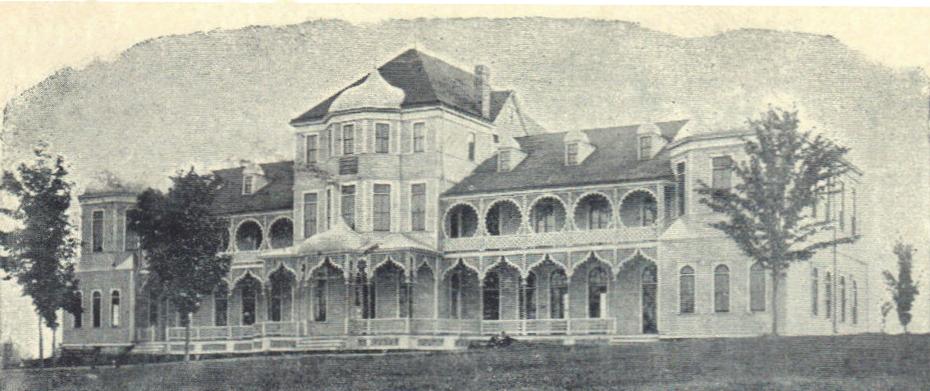
The Chautauqua College building.

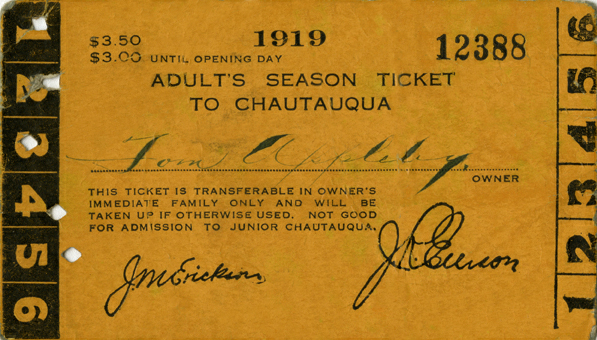
The Chautauqua Summer Assembly was part of a wider Chautauqua system of education that included as many as eight different departments. Each department offered classes and lectures throughout the summer months of July and August.In July 1884 an individual could purchase a one-day admission to the Summer Assembly for 25¢. That admission cost gave them access to all lectures, classes and meetings except those conducted by the School of Languages and the Teachers Retreat. In August the cost of a one-day admission rose to 40¢.

Chautauqua Ticket, 1919

If you planned to stay longer, you could purchase admission for a week in July for $1.00, or $2.00 for a week in August. Or you could stay the entire summer term for $4.00.

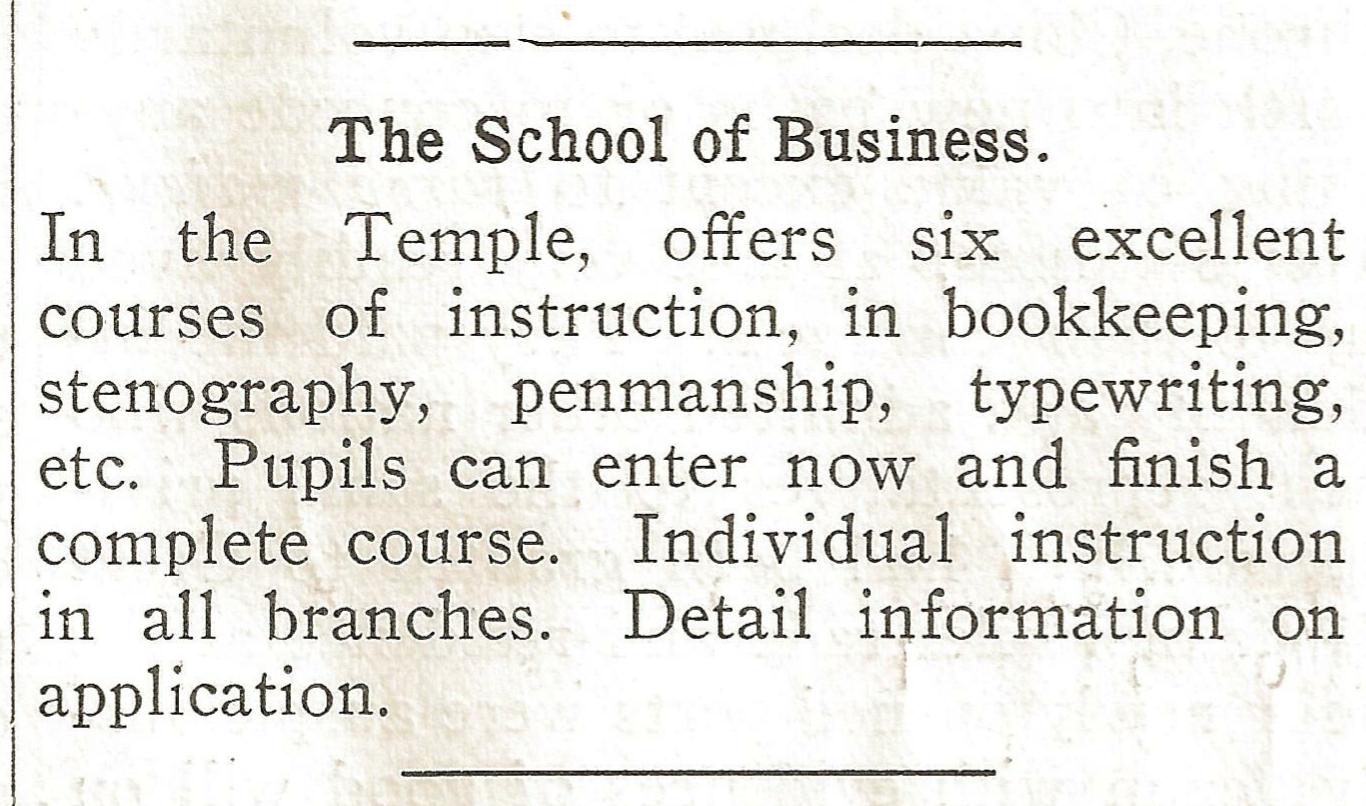
Courses offered by the School of Business, 1901

Some special classes required a separate ticket. For example, 15 lessons in penmanship (including stationery) cost $2.50; a course in bookkeeping cost $3.00; 10 lessons in elocution cost $4.00; and 4 weeks of instruction in Hebrew cost $10.00.

Newsboys of the Chautauqua Assembly Herald

With so many available classes and so many activities to attend, Chautauquans had to schedule their days with precision. They mapped out their daily classes, lectures and activities by reading The Chautauqua Assembly Herald. This newspaper, published on-site every day but Sunday, listed the weeks’s offerings. It also gave an account of the speakers, meetings, and activities from the previous day. Eager Chautauquans took advantage of as many offerings as they could, often running from one event to another from 8:00 a.m. until 10:00 p.m.

Click on this link to view the July 29 and July 30, 1901 editions of  The Chautauqua Assembly Herald. On page 4 of each edition you’ll find a list of the week’s programs, meetings, lectures and classes.

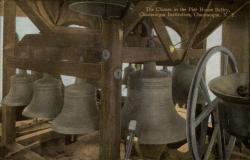
11 Chautauqua Chimes 1924The Chautauqua Institution kept things running in a timely manner. Five minutes before the hour a bell rang, giving notice that the next event or class would begin promptly at the top of the hour. The sound of the bell usually resulted in a throng of people streaming out the door of one class in order to get to the next class on time. Bells marked the hour until 10:00 p.m. when the last night bell rang signaling quiet.

In Four Girls at Chautauqua, Flossy Shipley overheard a man say, as he ran past her, “Confound it all! Talk about getting away from these meetings! It’s no use; it can’t be done. A fellow might just as well stay here and run every time the bell rings. I heard more preaching today on this excursion than I did yesterday; and a good deal more astonishing preaching, too.”

An afternoon class in German, circa 1895.

With each passing year, the number of people attending the Summer Assembly increased, as did the number of schools and courses offered. For instance, in 1901 the School of Languages added Arabic and Assyrian to their offerings of French, German, Spanish, Latin, Hebrew and Greek. Students took classes in mathematics, oratory and expression, mineralogy and geology.

Art Lessons

There were classes in clay modeling and china painting, as well as classes in music and singing. Small cottages were erected in a far-away corner of the grounds where music students could practice their scales and exercises without disturbing their neighbors. One instructor wrote, “I am told that forty-eight pianos may be heard there all sending out music at once, and each a different tune.”

Cooking Class.

The School of Domestic Science attracted great attention. One instructor, Mrs. Emma Ewing, erected a model kitchen and taught ladies from all walks of life to make bread, prepare meals, and serve tables with refinement.

A class in Library Science, 1904

The Summer Assembly offered career training, as well. Students learned shorthand and typing, grammar and composition, library sciences and bookkeeping.

15 School for Library Training
Announcement of the School of Library Training, 1901.


Standing room only at an open air lecture. About 1896.

In the early years of the summer Assemblies, classes were held in tents but as Chautauqua grew, buildings were erected to accommodate students.

The majority of the lectures were held in the Amphitheater. Erected in 1897, it could hold 5,500 to 5,600 people; but some lectures proved so popular that the Amphitheater overflowed.

Chautauqua crowds listen to a speaker in an open area.

Other lectures were held in the park, or anywhere else that could accommodate large numbers of attendees. The subjects were widely diverse, covering a broad array of topics:

  • The Last Days of the Confederacy
  • Going Fishing with Peter
  • The Women of Turkey
  • The Physiological Effects of Alcohol
  • Ideals of Modern Education
  • Christian Life in the Modern World
  • Shakespeare as a Moral Teacher
  • America’s Leadership in World Politics
  • The Knights of King Arthur
  • Does Death End All?
  • A Study of the Lynch Law
  • The Juvenile Court
  • The Drama and the Present Day Theater
  • Beyond the Grave
  • The Artisan and the Artist
  • The Ideal of Culture
  • French Literary Celebrities
  • The One-Hundred Worst Books
  • A Dozen Masterpieces of Painting
  • Mountain Peaks in Russian History
  • Growth and Influence of Labor Organizations

 Click on this link to read the text of a lecture presented July 26, 1901 by Dr. P. S. Henson of Chicago on the topic of grumbling. (Yes, grumbling!) You’ll find it on page 3 of The Chautauqua Assembly Herald.

Isabella Alden was arguably the best chronicler of the Chautauqua Summer Assembly experience. The characters she created in her books represented the diverse people who attended the Assembly and their different social and economic walks of life. She also captured the varied topics and inspirational nature of the many classes and lectures the Summer Assembly offered.

Next Stop of our Tour of Chautauqua: Palestine Park


A Tour of Chautauqua – Where to Stay

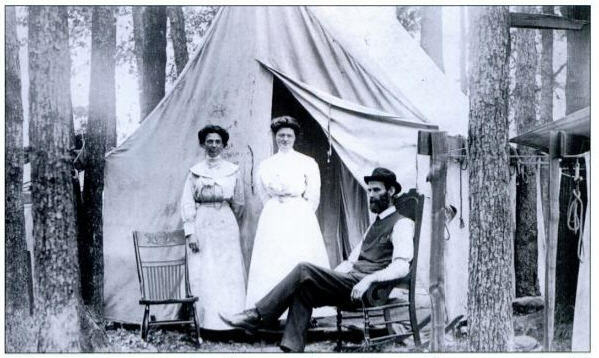
Chautauqua tent life in 1910

In the early days of Chautauqua, there were no hotels or boarding houses where visitors could stay. Instead, visitors rented tents or small cottages erected on the grounds. Some cottagers with room to spare rented out rooms to paying guests, but Chautauqua rules prohibited anyone from providing meals for pay.

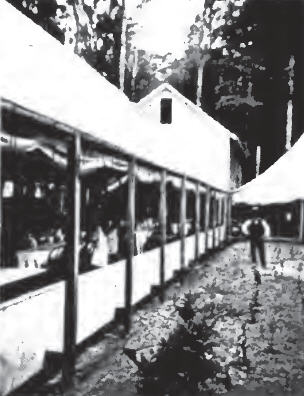
If you were not lucky enough to have a kitchen of your own in which to prepare your meals, you had to eat in the dining-hall, which was a long, open-air building furnished with rough, unpainted tables and benches.

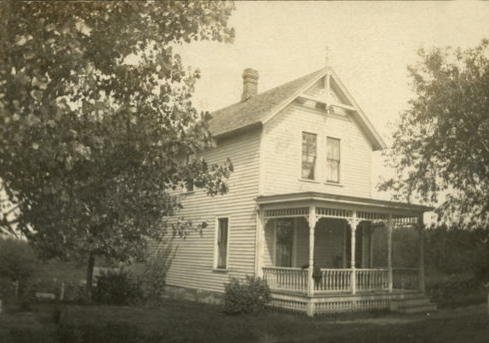
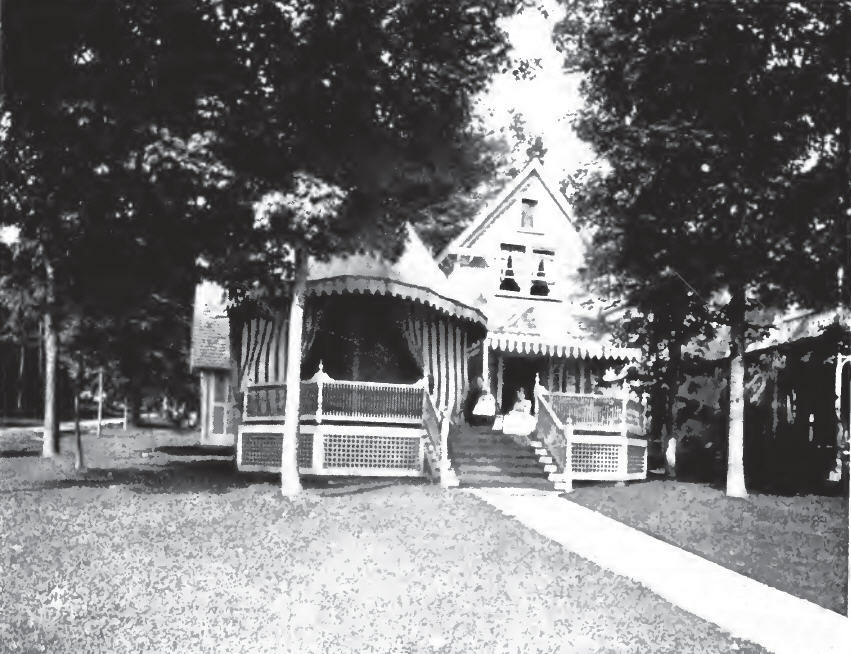
A Chautauqua cottage in 1908

Visitors often complained that the roof leaked and the backless benches were uncomfortable, but the dining hall was the only place visitors could have meals unless they prepared food themselves.

In Four Girls at Chautauqua, Isabella Alden used the no-board-for-profit rule to show the difference in personalities between practical Marion and wealthy Ruth as they ate in the dining hall:

Chautauqua Old Dining Hall
The old dining hall.

It was a merry dinner, after all, eaten with steel forks and without napkins, and with plated spoons—if you were so fortunate as to secure one. The rush of people was very great, and, with their inconvenient accommodations, the process of serving was slow.

Marion, her eyes being opened, went to studying the people about her. She found that courteous good-humor was the rule, and selfishness and ungraciousness the exception. Inconveniences were put up with and merrily laughed over by people who, from their dress and manners, could be accustomed to only the best.

Ruth did not recover her equanimity. She was rasped on every side. Those two-tined steel forks were a positive sting to her. She shuddered as the steel touched her lips. She had no spoon at all, and she looked on in utter disgust while Eurie merrily stirred her tea with her fork. When the waiter came at last, with hearty apologies for keeping them waiting for their spoons, and the old gentleman said cordially, “All in good time. We shall not starve even if we get no spoons,” she curled her lip disdainfully, and murmured that she had always been accustomed to the conveniences of life, and found it somewhat difficult to do without them.

In 1876, the meal restriction was removed and anyone could provide rooms and meals for a fee, as long as a specified percentage of the amount charged was given to the Institution. Within a year, boarding houses had sprung up as if by magic, while a vast number of individual cottages sported signs offering “Rooms and Board.”

Chautauqua cottages along Miller Park in early 1920s. To the right, just out of view, is Chautauqua Lake.

In Four Mothers at Chautauqua, Mrs. Bradford and her daughters rented a cottage for the summer, despite the fact they could ill afford it. Mrs. Bradford was always on the look-out for ways to economize and found one way to make her pennies go further at Chautauqua:

.

Before Mrs. Bradford’s table economies reached what Josephine called the “starvation point” a method of relief was discovered. It was learned that among the numerous boarding houses scattered over the grounds, certain of them furnished fairly good meals for twenty-five cents. They were named lunches, to be sure, but on occasion they would serve excellently well for dinners. Pencil and paper together with a vigorous exercise of Josephine’s computation powers proved that seventy-five cents would afford three of them better dinners than that sum would produce in the kitchenette.

The Longfellow in 1907

The Longfellow Cottage was a large boarding house. Centrally located on Roberts Avenue, it was only one block away from The Amphitheatre, the C.L.S.C. Building, the Children’s Temple,the Administration Building, The Colonnade and the Post Office (which will be featured in the next leg of our tour).

The Palace Hotel was the first hotel on the Chautauqua grounds, but it was far from luxurious. It was little more than a three-story, wood-framed tent, with canvas partitions to divide the guest “rooms.”

The Palace Hotel

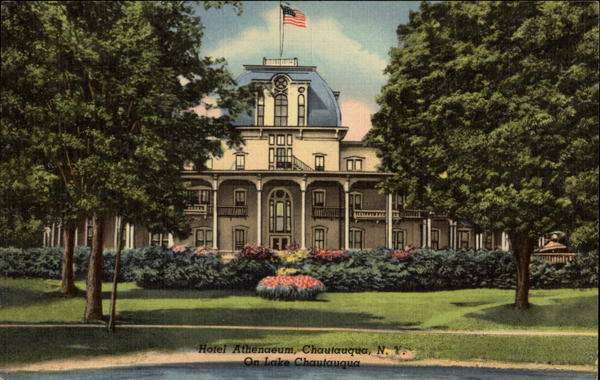
In 1881 the Palace Hotel was replaced by The Athenaeum, a proper hotel that featured elegant accommodations and beautiful views of the lake.

Chautauqua Athenaeum Hotel edited
An undated postcard from The Hotel Athenaeum

As the Athenaeum attracted more guests, the cottages and boarding houses grew in number, size and comfort in order to compete for their share of paying boarders.

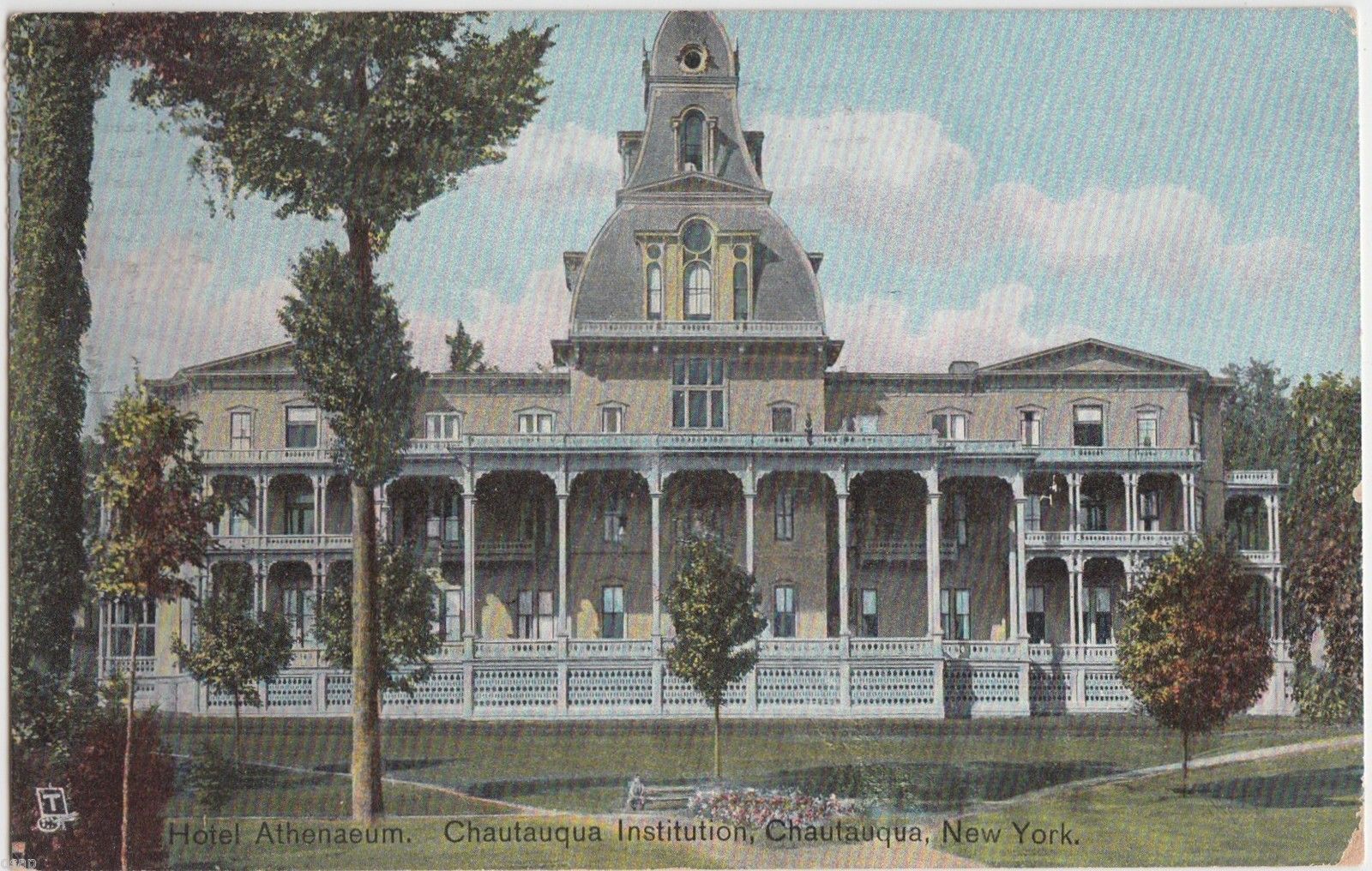
The Hotel Athenaeum as it looked in 1908. The hotel is still in use today.
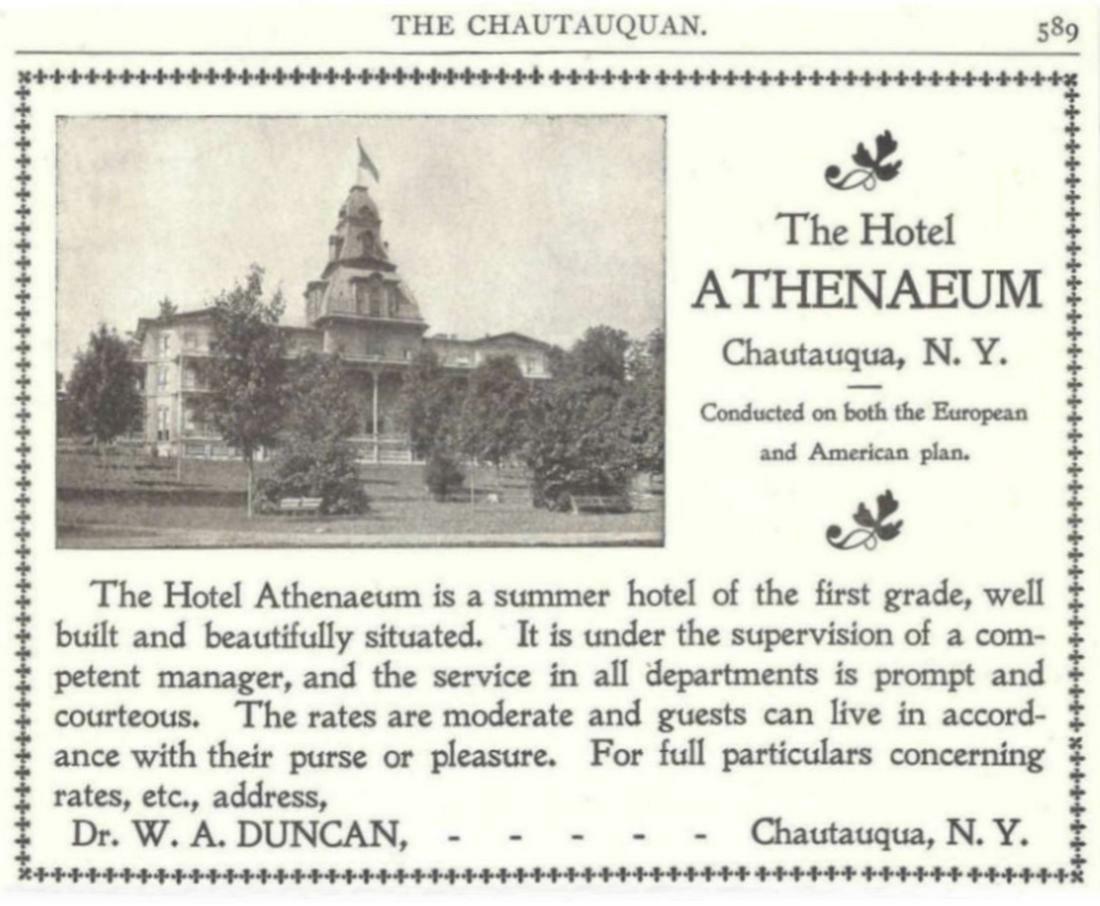
An 1897 magazine advertisement for The Hotel Athenaeum

When the Four Mothers returned to Chautauqua with their children and grandchildren, they stayed at a hotel that sounded very much like The Athenaeum. Isabella Alden set many scenes on the hotel’s upper and lower verandas and her characters made great use of the lush lawns that led from the hotel down to the lake.

.

This image of The Hotel Athenaeum and its verandas is dated 1911, just two years before Four Mothers at Chautauqua was published.

Chautauqua Athenaeum Hotel 1911

Visitors to Chautauqua used a Handbook of Information to locate places to stay. These sample pages from the 1908 Handbook list hotels and boarding houses on the grounds, their addresses, and the owners of the establishments. The Longfellow boarding house (pictured earlier in this post) is listed on the top of the second page.

1908 handbook appendix d highlighted

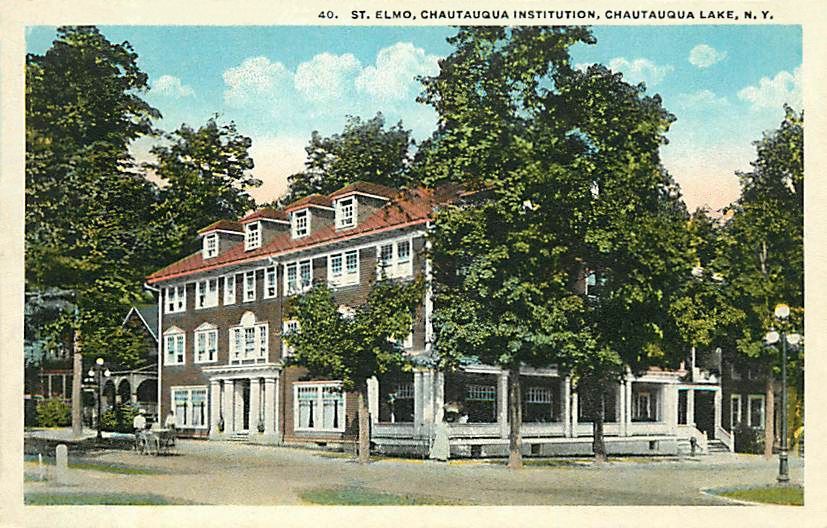
The St. Elmo was another hotel on the Chautauqua Institution grounds that was listed in the 1908 Handbook. Here’s how The St. Elmo looked in 1920, as it stood at the corner of Ames and Pratt Avenues.

Chautauqua Hotel St Elmo edited
St. Elmo Hotel in the 1920s

With all the boarding and hotel options, tent living still thrived. Chautauqua’s founders, John Heyl Vincent and Lewis Miller, maintained residences that were hybrids of cottage and tent.

Bishop Vincent’s Tent Cottage


Lewis Miller’s cottage. He accommodated overnight guests in a tent he erected on the lawn.

As Chautauqua grew and offered more and more styles of accommodations, many visitors still chose a simple summer of tent life in God’s great outdoors.

Chautauqua Institution by William Flanders edited

Next  on our Tour of Chautauqua:  Touring the Grounds


A Tour of Chautauqua – Getting There

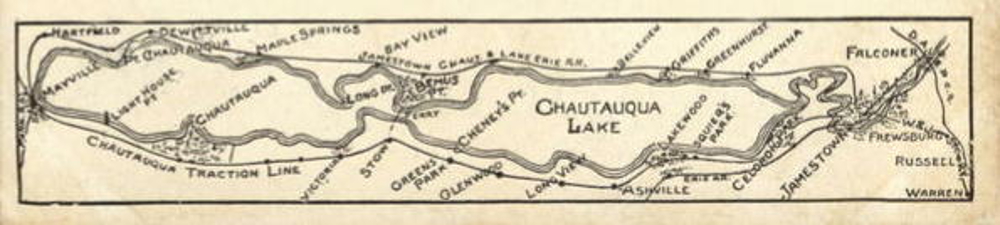
When Eurie, Marion, Ruth and Flossy embarked on their journey to Chautauqua in August, 1875 they traveled by railroad to Mayville. From there they took a steamer to Chautauqua. The map below shows the towns that lined Chautauqua Lake in 1906 (several years after the girls first journeyed there). You can see Mayville on the far left side of the map (click on the map to see a larger version).

Chautauqua Lake Map 1906 edited large

In Mayville, the girls boarded a steamer named, The Colonel Phillips, and boated along the southern shore of the lake to Chautauqua. As luck would have it, they arrived at Chautauqua under less than perfect conditions: it was raining and well past dark when they reached their destination.

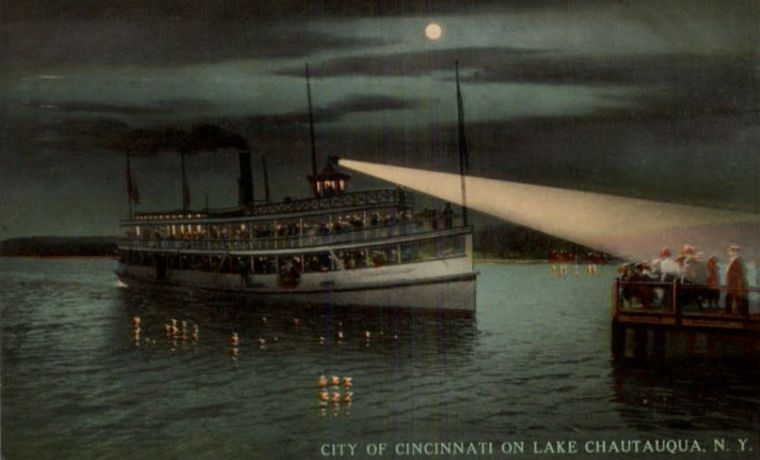
From the deck of The Colonel Philips, their first glimpse of the institute was probably the Chautauqua Institution dock, which stood at the tip of a point that jutted out into the lake. Incoming steamboats used the dock to  let passengers on and off. The vintage postcard below shows the steamer, City of Cincinnati, docking at Chautauqua after dark, in much the same way as The Colonel Phillips would have docked (click on any of the images below to see a larger version).

Chautauqua Lake Dock at night edited

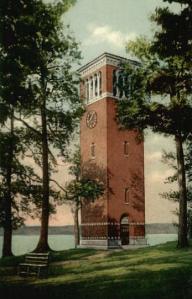
In 191Chautauqua Miller Bell Tower v2 edited1 the Miller Bell Tower was erected alongside the dock. It was built to commemorate the life and contributions of Chautauqua co-founder Lewis Miller. When the girls returned in 1913 (as described in Isabella Alden’s book, Four Mothers at Chautauqua), they would have seen the beautiful new bell tower as they approached the dock; and they would pass it as they stepped off the boat and entered the Institute grounds.

The hand-colored postcard below shows the tower and dock looking northeast toward the direction from which the girls’ steamer would have arrived from Mayville. The postcard also shows South Lake Drive, which ran along the shore from the bell tower to the south end of the Institute grounds. From the vantage point presented in this picture, the Chautauqua Auditorium was just out of view to the left.

Chautauqua Lake 1943 edited

During the girls’ first visit to Chautauqua, The Auditorium was an open-air arena with “rows and rows and rows of heads, men and women, and even children. A tent larger than they had imagined could be built and packed with people.”  Here’s how Isabella Alden described it in Four Girls at Chautauqua:

Lake Chautauqua outdoor auditorium. Photo courtesy of http://chautauqua.palmerdividehistory.org

For the benefit of such poor benighted beings as have never seen Chautauqua, let me explain that the auditorium was the great temple where the congregation assembled for united service. Such a grand temple as it was! The pillars thereof were great solemn trees, with their green leaves arching overhead in festoons of beauty. I don’t know how many seats there were, nor how many could be accommodated at the auditorium. Eurie set out to walk up and down the long aisles one day and count the seats, but she found that which so arrested her attention before she was half-way down the central aisle that she forgot all about it, and there was never any time afterward for that work. I mean to tell you about that day when I get to it. The grandstand was down here in front of all these seats, spacious and convenient, the pillars thereof festooned with flags from many nations. The large piano occupied a central point; the speaker’s desk at its feet, in the central of the stand; the reporters’ tables and chairs just below.

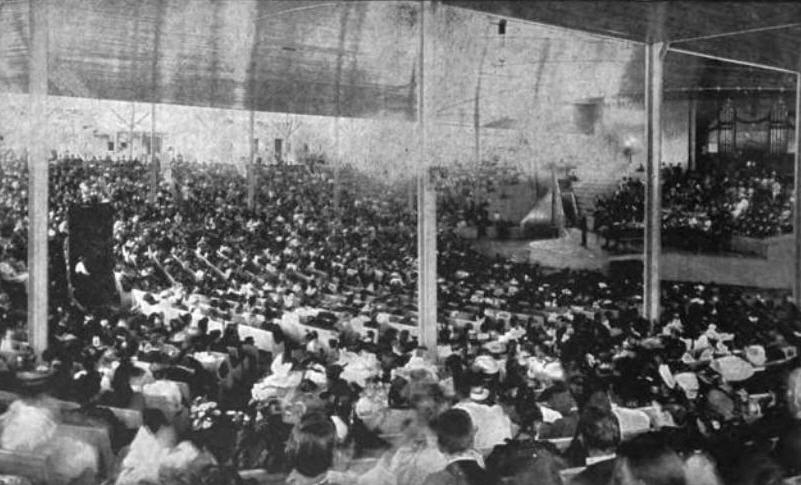
The Auditorium was used for the first four years, then the Amphitheatre—a more permanent, open-air structure—was erected that could hold many more people. The Amphitheatre’s crowning glory was its magnificent pipe organ. The seats behind the Amphitheatre stage were typically occupied by speakers, performers, choirs and orchestras.

Chautauqua Amphitheater edited

The photo below from about 1895 shows The Amphitheatre in service, with every possible seat taken. The view looks across The Amphitheatre, with the stage and speakers on the right. You can just make out the shape of the huge organ pipes.

Chautauqua Amphitheater full house 1895

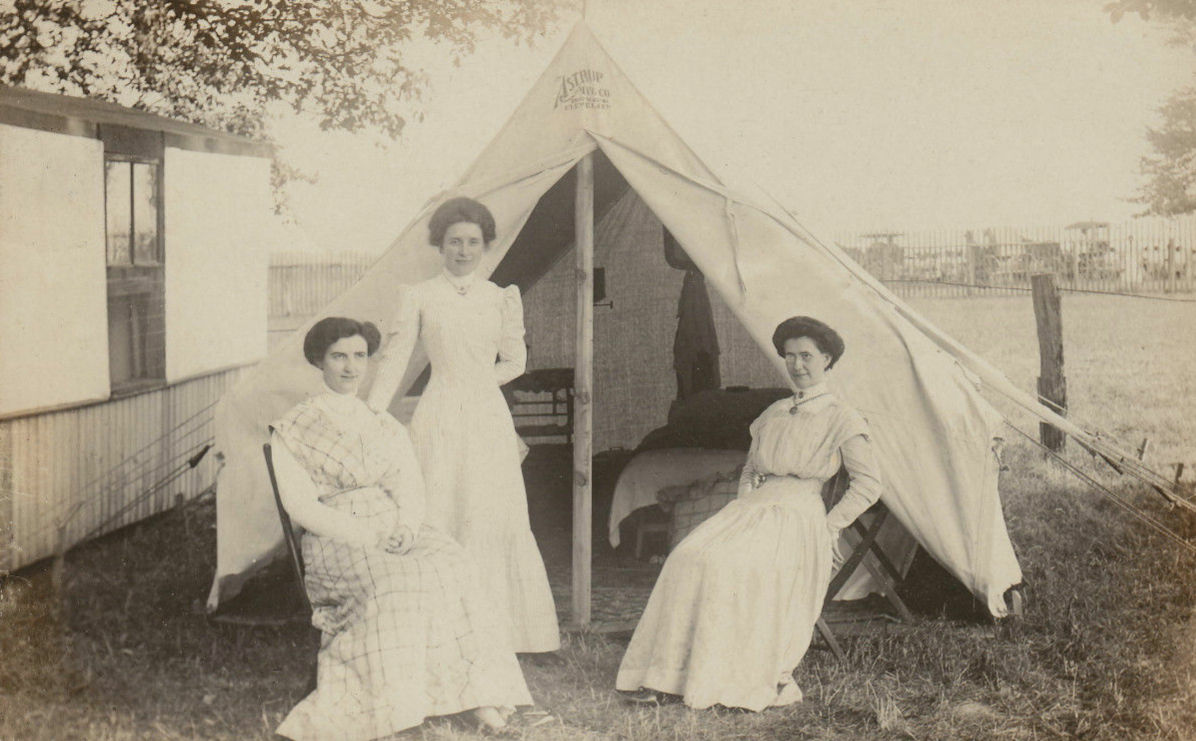
After the girls attended their first lecture in the Chautauqua Auditorium, they decided to stay on the grounds, rather than at a nearby hotel. They appealed to the Institute President to help them find a suitable place to stay. As he showed them the available tents to rent, Ruth couldn’t hide her dismay.

Chautauqua camping 1908_Ladies
Ladies camping in a typical Chautauqua tent in 1908.

“Why, the bed isn’t made up! Pray, are we to sleep on the slats?”

“Oh, no. But you have to hire all those things, you know. Have you seen our bulletin? There are parties on the ground prepared to fit up everything that you need, and to do it very reasonably. Of course, we cannot know what degree of expense those requiring tents care to incur, so we leave that matter for them to decide for themselves. You can have as many or as few comforts as you choose, and pay accordingly.”

“And are all four of us expected to occupy this one room?” There was an expression of decided disgust on Miss Erskine’s face.

Tent Life 1875 Hurlburt Beard and Worden
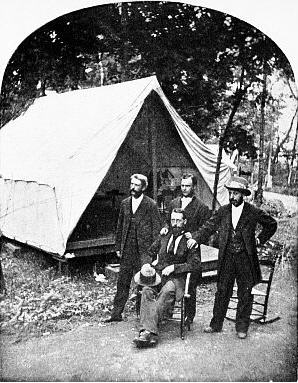
Chautauqua Speakers in front of their tent in 1875. J. L. Hurlbut, J. A. Worden, Frank Beard (famous for his “chalk talk”), and J. L. Hughes.

“Why, you see,” explained the amused President, “this tent is designed for four; two good-sized bedsteads set up in it; and the necessity seems to be upon us to crowd as much as we can conveniently. There will be no danger of impure air, you know, for you have all out-doors to breathe.”

“And you really don’t have toilette stands or toilette accommodations! What a way to live!”

Another voice chimed in now, which was the very embodiment of refined horror. “And you don’t have pianos nor sofas, and the room isn’t lighted with gas! I’m sure I don’t see how we can live! It is not what we have been accustomed to.” This was Marion, with the most dancing eyes in the world, and the President completed the scene by laughing outright. Suddenly Ruth discovered that she was acting the part of a simpleton, and with flushed face she turned from them, and walked to a vacant seat, in the opposite direction from where they were standing.

Chautauqua Tents and Cottages, 1910

“We will take this one,” she said, haughtily, without vouchsafing it a look. “I presume it is as good as any of them, and, since we are fairly into this absurd scrape we must make the best of it.”

“Or the worst of it,” Marion said, still laughing. “You are bent on doing that, I think, Ruthie.”

By a violent effort and rare good sense Ruth controlled herself sufficiently to laugh, and the embarrassment vanished. There were splendid points about this girl’s character, not the least among them being the ability to laugh at a joke that had been turned toward herself.

The girls survived their first night in the tent. The next day, they split up, each going in different directions; and Flossy soon found herself lost and alone on the grounds.

Meantime Flossy was being educated. The morning work had touched her from a different standpoint. She had not heard Dr. Walden; instead she had wandered into a bit of holy ground. She began by losing her way. It is one of the easiest things to do at Chautauqua. The avenues cross and recross in an altogether bewildering manner to one not accustomed to newly laid-out cities; and just when one imagines himself at the goal for which he started, lo! There is woods, and nothing else anywhere. Another attempt patiently followed for an hour has the exasperating effect of bringing him to the very point from which he started. Such an experience had Flossy, when by reason of her loitering propensities she became detached from her party, and tried to find her own way to the stand. A whole hour of wandering, then a turn into perfect chaos. She had no more idea where she was than if she had been in the by-ways of London. Clearly she must inquire the way.

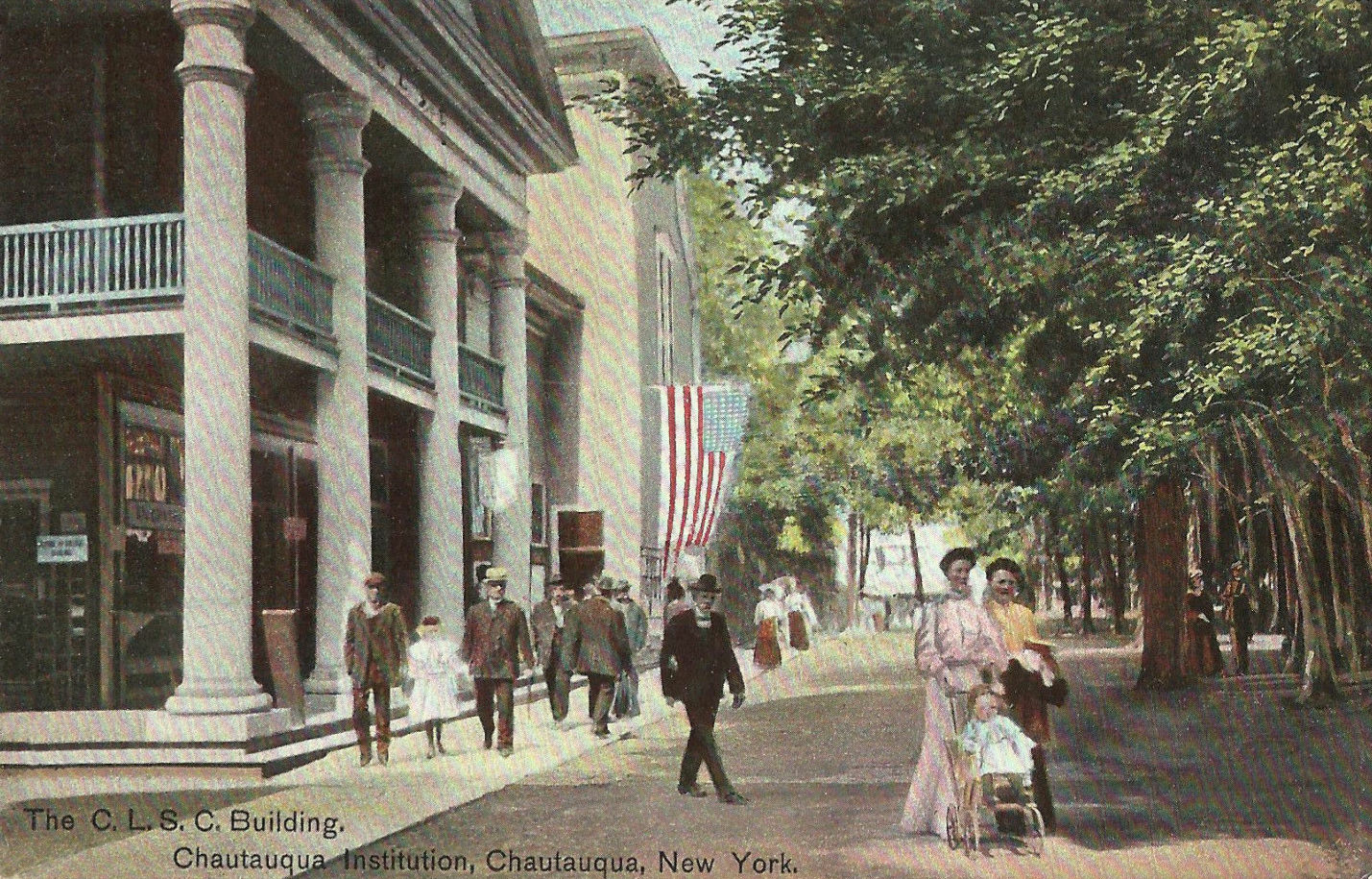
While trying to find her way, Flossy may have walked down Clark Street, which is pictured below in 1907, looking south from Miller Avenue (named after Lewis Miller). The Chautauqua Literary and Scientific Circle (C.L.S.C.) building is on the left.

Chautauqua Clark Street 1907 edited

Here’s a closer view of the C.L.S.C. building, as it looked in 1908:

Chautauqua CLSC Building 1908 edited

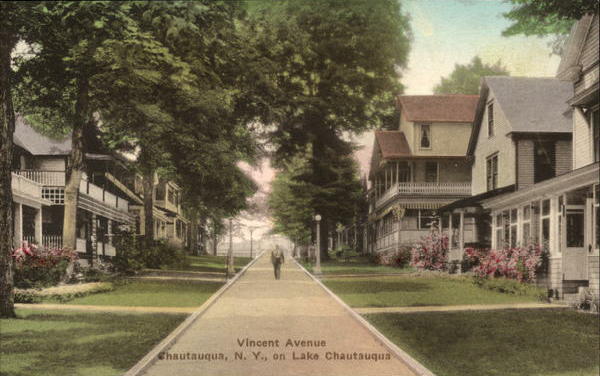
And below is a photo of Vincent Avenue, named for Methodist Bishop John Heyl Vincent, one of the founders of the Chautauqua Institute. The photo was taken in 1930, long after the girls’ first visit.

Chautauqua Vincent Avenue 1930

Little did Flossy, Ruth, Eurie and Marion know that those first days in Chautauqua were the prelude to life changing experiences for each of them!

Next  on our Tour of Chautauqua:  Where to Stay