Blog

When I was a Girl on New Year’s Day

In 1889 Isabella wrote this charming recollection from her childhood of a very special New Year’s Day:


I close my eyes and go back in fancy to that morning long, long ago. New Year’s morning when I was eight years old.

Cold! Oh, how cold it was! Great icicles hanging from the eaves, frost covering the window-panes, snow festooning the trees and hiding the ground, and the whole air a-tingle with the music of sleigh bells. How beautiful it all was.
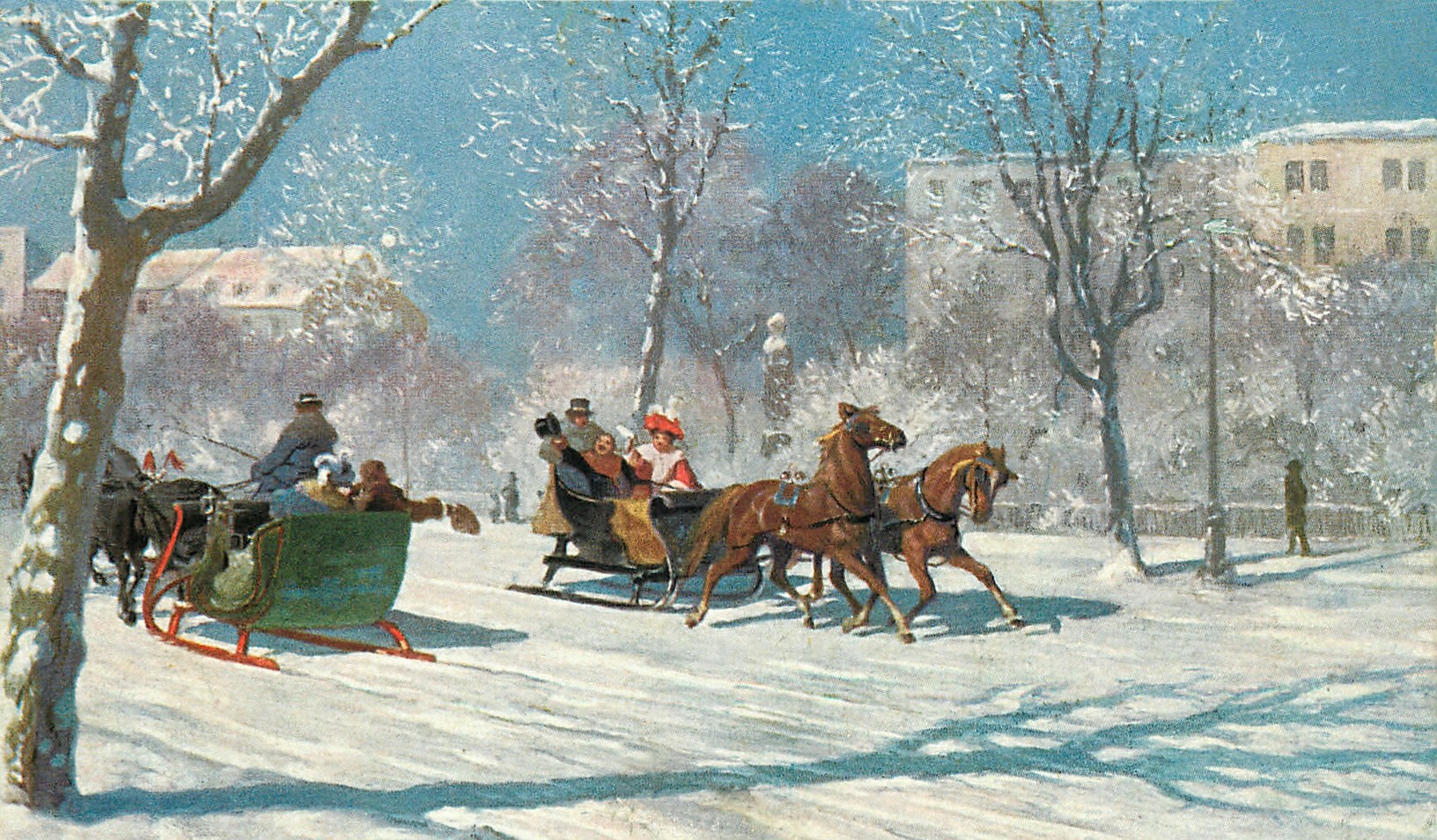
Illustration of a winter day with bright sunshine and a wide avenue covered in snow. two horse-drawn sleighs full of people pass each other going opposite directions and the occupants ave at each other. Behind them are the outlines of multi-story buildings, trees without leaves, and a vivid blue sky.

.

Those frosted window panes, by the way, were a source of never-ending temptation to me. I wouldn’t like to have to try to recall the number of times my fingers had to be “snapped” for forgetting that I was on no account to indulge in my favorite amusement of making “thimble chains.” I don’t quite understand what the fascination was, or is, but to this day I find it almost impossible to pass a frosted window pane, with a thimble anywhere in sight, and not stop to make just a few of those magic chains in which my childhood delighted.

Illustration of the outside of a home's open window. Snow and frost cling to the panes and the wooden trim around the window. Sprigs of holly adorn the top of the window and the bottom corners. A red robin sits on the window ledge and peeks inside.

.

What a pity it seemed that the contact of my chubby fingers with the clear glass should soil it, and that my mother, whose artistic taste was not so highly cultivated as mine, would not permit the amusement.

On this particular New Year’s morning the frost was unusually thick, and my sister Mary’s thimble stood on the window-seat. It was father’s warning voice that saved me, just as I was about to make a marvelous chain, which should connect two lovely frost castles.

“Take care,” he said. “Think what a pity it would be if a certain stocking which I saw hanging in the chimney corner should have to hang there all day just because a little girl forgot.”
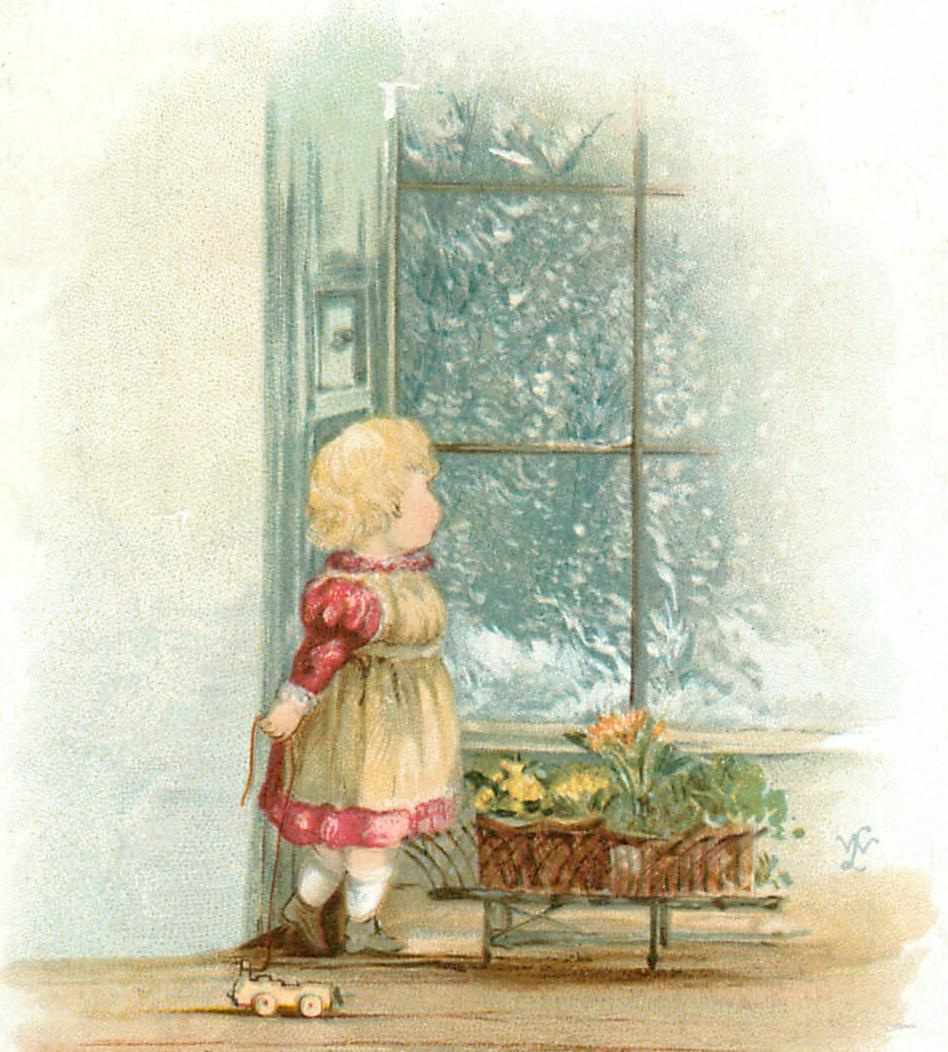
Illustration of a little girl wearing a red dress and brown pinafore, stockings and boots. In her hand she holds the pull string for a toy wooden toy cart on wheels. She stands beside a basket of plants at a window, where frost and snow flakes have covered the outside of the window.

.

I set the thimble down with an exclamation of dismay. What if I had forgotten again? Mother had decreed that the stocking, which I longed to examine, should remain untouched until after breakfast, because at Christmas time I had been so “crazy” over my presents as to be unable to eat any breakfast. For a small moment I had forgotten the stocking, though it had been on my mind all the morning, and but for father the mischief would have been done.

I went over to him to express my joy in his having saved me, and to ask him privately whether he really believed that breakfast would ever be ready and eaten and prayers be over, so I could have my stocking.

He laughed, and asked me if I supposed I would ever learn patience. “I suppose,” he said gravely, “that time will travel fast enough for you one of these days. I can remember when a week used to seem longer to me than a whole year does now.”

I exclaimed over that. I said I thought a year was a very long time indeed; that I was really almost discouraged with time, it went so slowly. I said it seemed to me that I had been waiting half a lifetime for this day to come.

He laughed again, said I was at the impatient age; then, looking serious, he repeated these lines:

“Eighteen hundred and forty-eight is now forever past: Eighteen hundred and forty-nine will fly away as fast.”

“Oh, dear me!” I said. “If it doesn’t fly faster than this has, I don’t know what I shall do. It does seem too long to wait for Christmases and New Year’s; I wish we could have two of them in a year.”

Instead of laughing at my folly, father evidently decided to give me something else to think about. He was sitting near the door of the kitchen, where my mother was at work. The kitchen walls were painted. “Mother,” he said, “may we write on the walls, since we mustn’t on the windows?”

“I should not think that would be a very great improvement on window-writing,” my mother said, but she smiled as she spoke. It was evident that it made a great difference with my mother whose plan was to be carried out; she never interfered with anything that my father chose to do. He selected from the box nearby a lovely pine board as smooth as a slate, and handed it to me.

“You may use that, and I’ll use the wall,” he said, “and we’ll see which can write our verse the quickest.”

I had been writing for two years, and prided myself on the speed and neatness of my work, but long before I had finished the lines they appeared on the wall.

“Eighteen hundred and forty-eight is now forever past: Eighteen hundred and forty-nine will fly away as fast.”

“Yes,” said my mother, pausing in her swift movements to glance at the couplet, “that it will. It has begun already; the first morning is flying too fast for me. Come to breakfast.”

I am a long while in reaching that waiting stocking, but that is to correspond with the length of time I had to wait. It seemed longer to me then than it does to look back upon it. At last the treasure was in my arms. What do you think it contained? A lovely dollie about as long as my hand, beautifully dressed, not like a fashionable lady ready for a party, but like a dear little home baby, in a long white slip frilled at the neck, precisely as my own baby slips used to be—indeed I learned after­wards that it was made from a piece of one of them. I cannot possibly make you understand, I presume, how precious that little creature was to me.

Illustration of little girl in red polka dot dress and red hair bow looking up at a stocking hanging from above. The stocking holds a sprig of holly, a long peppermint stick and a doll with short blonde hair and a red tunic over a white blouse.

.

I suppose you are imagining a wax doll with “real” hair, and lovely blue eyes and rosy cheeks? No, she was not made of anything so cold and hard as wax. She was a rag baby—limbs and face and all—made by my mother’s own dear hand, cut from a pattern which she herself had fashioned. What a work it must have been! I never realized it until a few years ago, when I tried to cut a pattern for a dollie for my little son.

This work was beautifully done. Black eyes, my baby had, and black hair, both made care­fully with pen and ink! Red checks, she had, too, and lovely rosy lips. Will you love her the less, I wonder, when I confess to you that these were made with beet juice?

Illustration of a little girl in 1910 attire of dress, pinafore, stockings and boots. She is holding a doll dressed in white cap and long white dress and wrapped in a blue blanket.

.

Oh, but she was a darling! Much the most carefully made dollie I had ever owned. Here­tofore I had been content with mother’s little shawl, or her long clean apron rolled up and pinned; now I had a dollie for which clothes had been made not only, but arms and feet; and actually her dress was not sewed on her, but unbuttoned and came off, and a neat little night-gown went on.

Never was I happier in my life than when I made this last crowning discovery.

I named her—you could not guess what, so I’ll tell you at once—Arathusa Angeline, and I thought the name was lovely.

“Take good care of her,” said my father, looking on with a smile of infinite sympathy, “there’s no telling what may happen to her, you know, before ‘eighteen hundred and forty-nine’ has flown away.”

Illustration of a little girl holding a doll looking out a frosty window.

.
A Hard Text about Burdens

Isabella’s brother-in-law Reverend Charles M. Livingston wrote several articles for The Pansy magazine in which he explained Bible verses that might seem confusing at first. Here’s one he wrote in 1888:


Bear ye one another’s burdens. (Galatians 6:2)
Every one shall bear his own burden. (Galatians 6:5)
Cast thy burden upon the Lord. (Psalms 4:22)
Old illustration of a hand holding up a Bible surrounded by rays of light.

How do we reconcile these verses that conflict one with another? Think in this way:

One day Martha went over the way to the pump with a four-quart pail for some water, and soon returned to her mother with it.

An hour later she went with an eight-quart pail and, filling it, tried to carry it back, but could not. Her neighbor, Mark, happened to be there with his three-quart pail. He offered to carry hers and let her carry his, and so they did and got on nicely.

Some time after they were both at the pump again, each with an extra pail. They were soon filled, but when they tried to lift them all and go forward they could not. Just then their good friend Moses came along and, seeing their trouble and their pleading looks, came to them, and with his two strong arms took up the extra heavy pails of water and easily and cheerfully carried them to their homes, while they followed with their other pails.

Maybe this will aid you to see that those three texts are not so hard, after all; that they do not go against each other, but go rather hand in hand.

What do you think of Rev. Livingston’s explanation?

Free Read: A Ten-Dollar Christmas

This month’s free read is a short story Isabella wrote in 1891 about the joy of giving at Christmas time:

Book cover for A Ten-Dollar Christmas. A woman stands with two children, dressed inc oats and hats, stand on the street looking into a shop window. The window display shows dolls, toys, a Santa Clause coming out of a chimney, a vase of flowers on a table, and a framed print in front of a Christmas tree decorated with toys.

It’s the worst Christmas ever for wealthy Adele Chester. Her mother and father are in Europe, and Adele has been left behind to stay with her Aunt Martha … on a farm! Her parents sent her money to spend, but where would she spend it? And on what? Then a little girl named Janey enters her life, and suddenly Adele’s Christmas takes on a whole new meaning.

You can read “A Ten-Dollar Christmas” for free!

Choose the reading option you like best:

You can read the story on your computer, phone, tablet, kindle or other electronic device. Just click here to download your preferred format from BookFunnel.com.

Or you can select BookFunnel’s “My Computer” option to receive an email with a version you can read, print, and share with friends.

Pansy’s NaNoWriMo

If you’re a writer—or know someone who is—you’re probably aware that the month of November is all about novel writing.

Every November writers from around the world join on-line writing communities (like NaNoWriMo and The King’s Daughters’ Writing Camp) where they record their efforts to write a novel in thirty days. Participants encourage each other, write together, share lessons learned, and talk about the challenges they face.

The most common challenge writers share in their on-line posts is how hard it is to find time to write every day. Many writers have full-time jobs, or small children, or other pressures that make it difficult to write a few paragraphs in thirty days, to say nothing of writing a full-length novel.

Old black and white photo of a young woman about 1910 seated at a desk, her hands on the keys of a typewriter. Behind her a giant clock on the wall shows three o'clock.

Yet, that problem isn’t a new one for twenty-first century writers. In the nineteenth century Isabella Alden faced the very same difficulty as she juggled her writing career with speaking engagements, household tasks, church duties, editing deadlines, and demands from fans and acquaintances.

In 1906, when Isabella was writing Ruth Erskine’s Son, she described a typical writing day that will probably sound very familiar to writers everywhere:

She began her day at seven o’clock by dressing and performing her daily household chores; but even before she finished making beds and doing laundry, she was interrupted by a summons to morning prayers and breakfast.

Old black and white photo of a woman circa 1915, dressed in long-sleeved, high collar blouse and long skirt, seated at a table, typing on a typewriter. Beside her is an large wooden roll-top desk. Behind her is a tufted leather bench.

After that she cleared the breakfast table, put the dining room in order, and went back to bed-making, dusting, laundry, and other tasks.

Then the postman made his delivery, which included a long-awaited letter, so the entire family was summoned to hear Isabella read the letter aloud.

Other delivered letters included:

  • A request from a woman who wanted Isabella to read her manuscript,
  • A man asking permission to read one of Isabella’s stories in his church,
  • Another woman requesting Isabella speak at a temperance meeting,
  • A little girl wanting Isabella to spend an evening with her Sunday-school class,
  • And one from her editor asking her to please write her magazine columns a little faster!

By 11:00 Isabella was finally seated at her typewriter, “struggling with an unusually hard problem in the life of that much enduring woman, Ruth Erskine Burnham,” when she was interrupted yet again.

Her sister Julia (who was living with the Aldens at the time) was busy in the kitchen making a ginger cake and she wanted Isabella to taste it. Of course Isabella did not complain about such a delicious interruption!

Color illustration of a woman about 1915 seated at a wooden desk, typing on an old-style typewriter.

Back at her work once again, she heard the door bell ring with a delivery.

A few minutes later came a vendor at the door selling “choice spinach, some delicious cauliflower, some fine oranges, and some splendid green peas.”

After dealing with the vendor, she wrote: “I am seated again with Ruth Erskine only to hear, ‘Belle!’ from the front stairway.”

It was her sister Mary volunteering to “fix my scrap basket for me, if I will find the materials for her.”

Old hand-colored photograph of a woman about 1915 wearing a blue dress with long-sleeves, high neckline, and floor-length skirt. she is seated at a small table on which is a red tablecloth and a typewriter.

By the time Isabella returned to her typewriter, she realized the entire morning was gone and it was time for lunch.

After lunch it was time to clear the table, and on entering the kitchen, Isabella discovered Julia had made much more than a ginger cake. She had busily baked “mince pies and apple pies, and a million little ginger cakes in patty tins” as well as five loaves of “splendid bread.”

All of those delicious items resulted in a great number of dishes to wash. Isabella wrote:

“I wash, and wash, and WASH; and scour the sink and clear off shelves and refrigerator and empty more dishes, and sweep the floors, and wash seven dish towels.”

And just as she was hanging her dish towels to dry, “the clock strikes four!”

Determined to write, Isabella went back to her desk, only to be interrupted by the doorbell, then by her husband asking “What do I want from downtown?”

At five o’clock she had a long conversation with a college student who was “consumed with fear that she has not passed” a class of which Isabella’s son Dr. Raymond Alden was the professor. The student made a special request of Isabella:

“Will I, his mother—for whom, they say he will do anything in the world [according to the student]—intercede for her and explain to him how it was? And then for the eleventh time she proceeds to tell me how things were.”

By the time that conversation ended, it was six o’clock and time for dinner. At eight o’clock Isabella wrote:

“I am seated again, not with Ruth Erskine, but giving heart and brain to that explanatory letter which is to move the hard heart of Professor Alden.”

“That being done, Satan enters into me, and instead of working, I write a letter to my beloved sister Marcia three thousand miles away—and then, good night, I’m gone to bed!”

These were—as Isabella called them—“the snares which lie across my path” when she was supposed to be writing.

Does Isabella’s account sound familiar to you?

Have you ever pledged to write—or read, or craft, or exercise—only to be interrupted or have competing priorities intrude on your time?

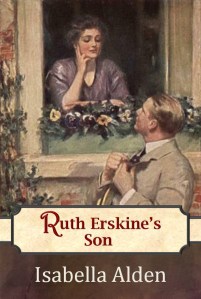
By the way, Isabella did finish writing Ruth Erskine’s Son, and it was published the following year. You can get your copy of Ruth Erskine’s Son by clicking on the book cover below:

At Home Friday Evening

Busy Isabella! Even after her husband retired from the ministry and Isabella retired from teaching, they both remained active in the Presbyterian church.

They moved to Palo Alto, California (you can read more about their new home here) and quickly joined their local congregation.

And since Isabella was a long-time member of the Woman’s Christian Temperance Union, she also joined that organization’s local chapter.

Black and white photograph from 1910 of women, men , and one little girl posing outdoors for photograph. Five women are seated; two of whom hold a banner that reads "W. C. T. U." Behind them stand eight men and women. The little girl sits on the ground in front and also holds a small banner that reads "WCTU."
Woman’s Christian Temperance Union chapter members about 1910

On Friday, November 20, 1908 Isabella hosted an “At Home” for her fellow W.C.T.U. members.

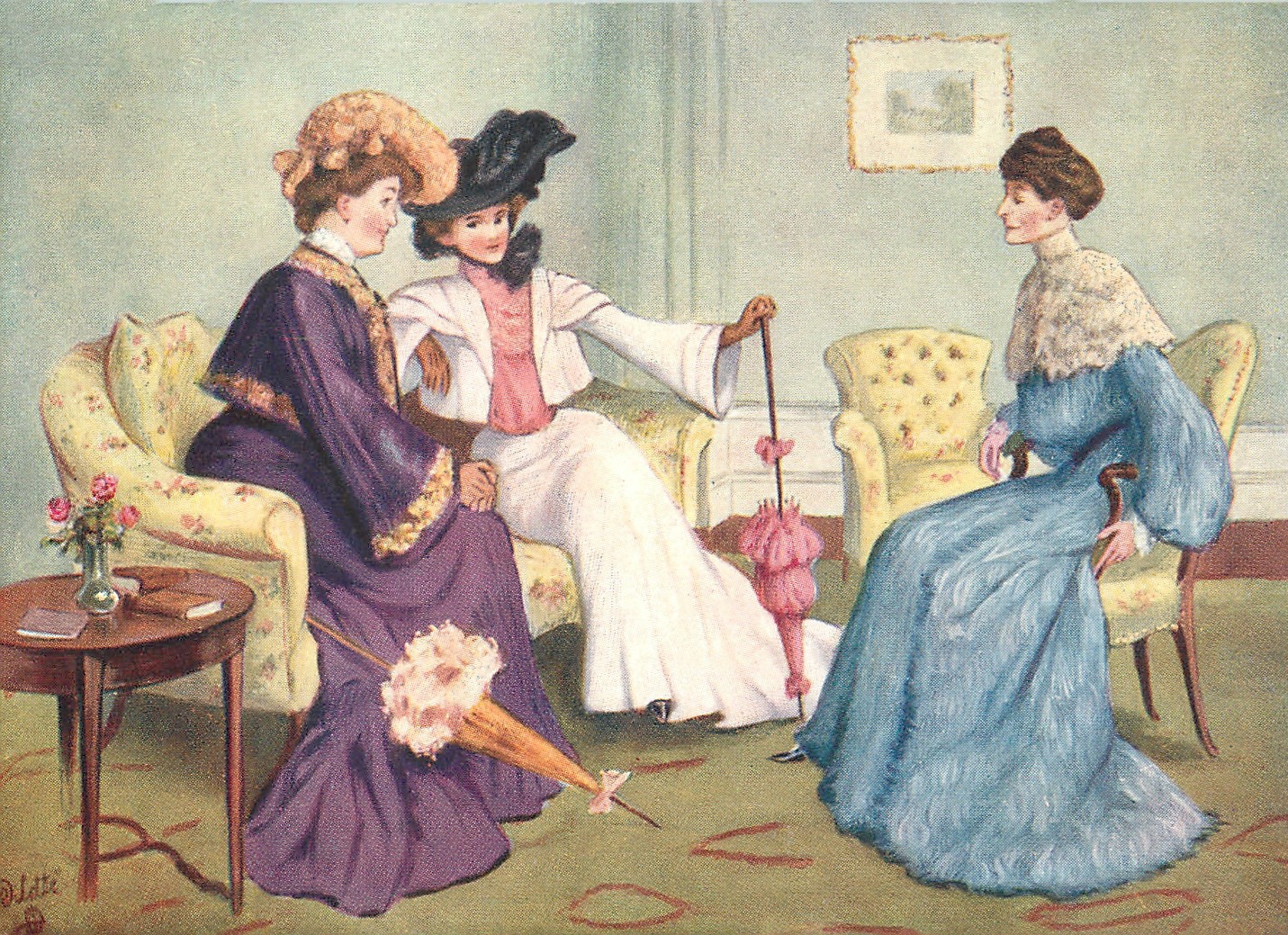
The event was a new spin on an old point of etiquette. For generations society ladies typically designated one afternoon a week where they were “at home” to receive callers.

Illustration from about 1908 of two ladies dressed in bonnets and gloves with parasols seated in a parlor, conversing with a third woman in a gown from the same period.
Paying Calls.

Some ladies even had cards printed up which they handed out to acquaintances or left at the homes of other women to let them know what day they were invited to call.

A printed card (about the size of a modern business card) that reads: At Home Thursdays, May eleventh and eighteenth, from three until six and from eight until ten, 38 Sumner Street, Dorchester.
An undated “At Home” card. Credit: Boston Public Library.

For this event Isabella did the same thing, but instead of inviting people to drop by for an hour or so of conversation, she devised an entire program of meaningful entertainment that lasted well into the evening hours.

There were vocal solos and talks by ministers on the subject of temperance. Isabella’s son Raymond read a selection of popular poems by William Henry Drummond.

Side by side black and white photographs of Raymond Alden and William Henry Drummond

.

Isabella gave a talk, and several of the San Francisco Bay area’s leading citizens and ministers also provided entertainment and food for thought.

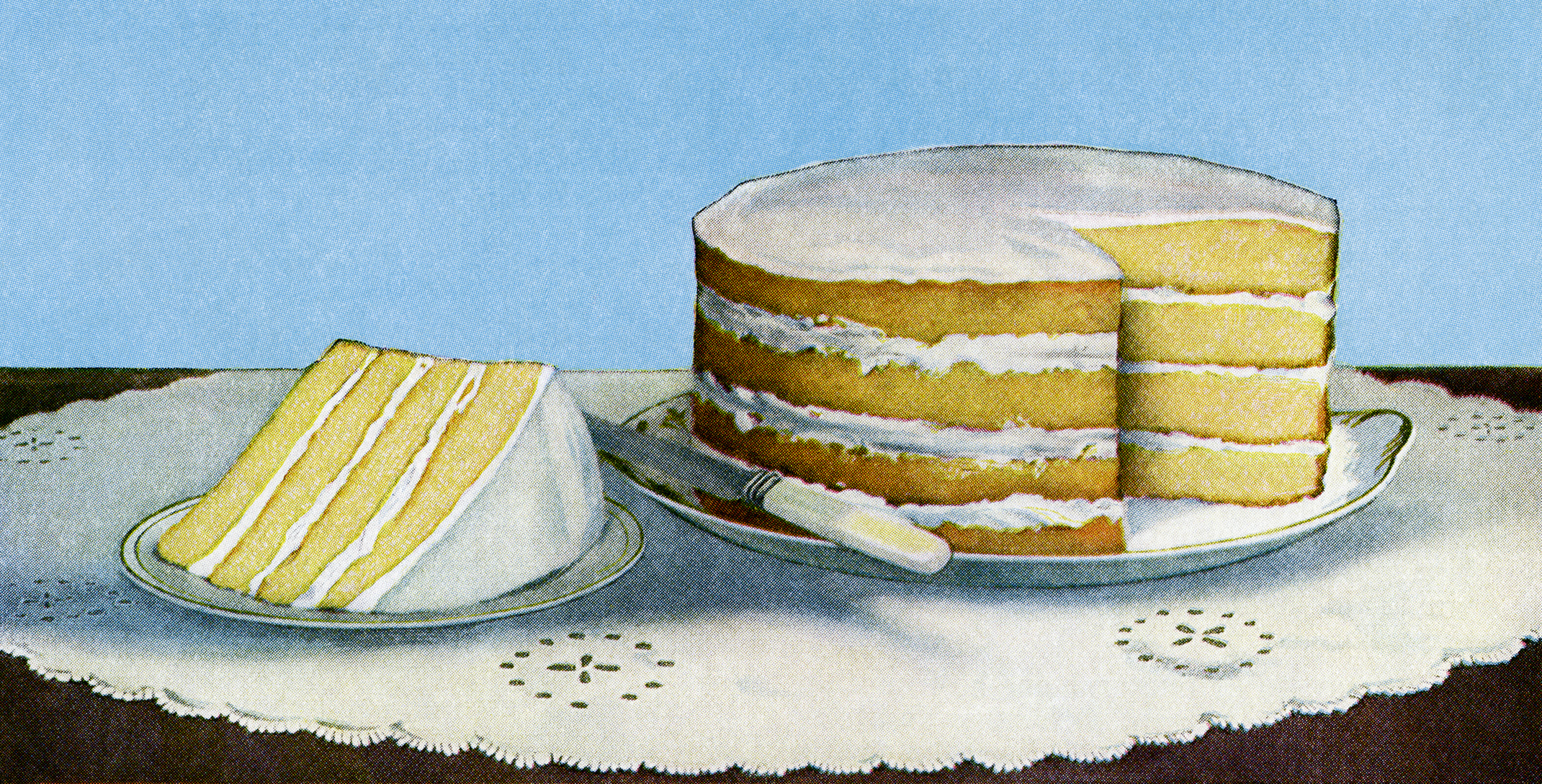
Illustration of a white, four-layer cake with white icing on a plate with one slice removed. On a smaller plate is the slice. Both plates rest on a white embroidered doily on a dark-colored table top.

.

After the program, Isabella served “dainty refreshments.”

Illustration of various desserts on plates on a table, including a slice of cake with strawberries on top, a square piece of cake with whipped cream and fruit, and a molded gelatin with slices of pineapple and cherries arranged on the surface.

.

And it was all reported the following week in one of the local newspapers:

Newspaper article: The Woman's Christian Temperance Union of Palo Alto gave an At Home Friday evening at the residence of Mrs. R. G. Alden, 425 Embarcadero road, the guests of honor being the pastors of the city, the School Trustees and teachers. An interesting program was given as follows: Irish selections, Miss Ruth Lakin; vocal solo, Miss Adele Gilbert; Drummond's poems, Professor R. M. Alden; poem of Robert Burns, Rev. Mr. Moody; and talks by Mrs. Alden, J. C. Templeton, Mrs. E. G. Greene, W. E. Vail, and Rev. H. W. Davis. Mrs. J. C. Templeton presided. Dainty refreshments were served late in the evening.
San Jose Mercury News, November 23, 1908.

Busy Isabella certainly knew how to throw a party, didn’t she?

Does Isabella’s “At Home” sound like something you’d like to attend?

Which part of the evening entertainment do you think you would enjoy the most?

A New Luxury

Isabella was always interested in new inventions that came her way. When typewriters first came on the market, she began using one to write her stores. She even featured a typewriter in one of her novels (you can read more about that here).

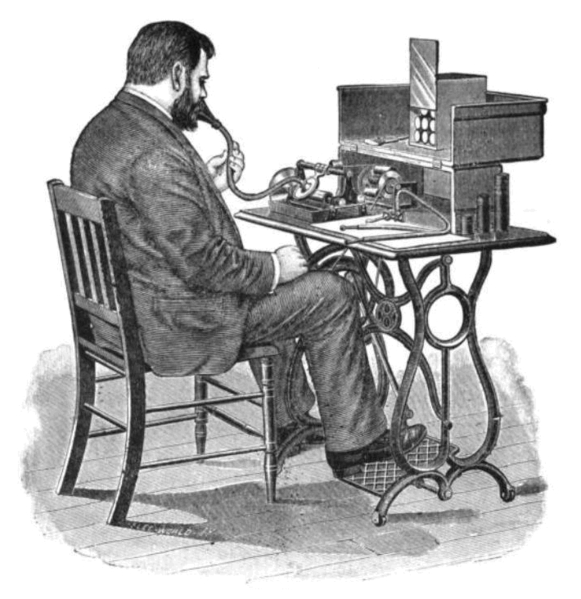
And when her fingers tired from typing, she used dictation equipment and hired a stenographer to transcribe her spoken words into typed pages.

Black and white illustration of a man wearing a business suit seated in a chair in front of a small table. On the table is a dictation machine, which has a speaking tube the man is holding up to his mouth. Near the feet of the table is a treadle, which the man operates with one foot.
An early wax cylinder phonograph for dictation, 1897 (from Wikicommons).

Add to her love of innovation the fact that she was also very social-minded and had a keen interest in bettering people’s lives, and you can understand her interest in a new trend in health and hygiene that began in the late 1890s.

During the majority of Isabella’s life, indoor plumbing was a luxury for most Americans. Only the wealthy could afford to install bathrooms in their homes.

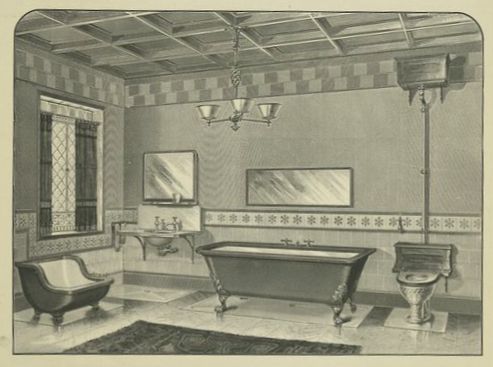
Design for an 1888 bathroom. Credit: New York Public Library Digital Collections.

By contrast, poor residents in large cities lived in tenement buildings that often had only a single source of water; that meant residents had to carry water (sometimes up several flights of stairs) to their apartments in order to bathe or even wash their hands.

Color illustration of a woman seated in a wicker chair and wearing the dress and hairstyle of about 1910. Across her lap is a large towel and she is holding a baby over a wash tub on the floor in front of her. The baby kicks water onto a little girl seated on the floor near the wash tub. Another little girl standing behind the tub holds the baby's hand. A small dog scurries away from the water being splashed in his direction.
“Baby’s Bath” by Arthur J. Elsely

But in the 1890s that began to change. By that time most great cities of the world had implemented public baths. London, Paris, Vienna, and Rome had spacious and magnificent buildings devoted to the purpose of bathing. Isabella’s home state of New York took notice, and began devoting attention to the matter of making bathing facilities available to all citizens, especially the poor.

The New York Board of Health worked with New York City officials to develop plans for a public bath house to be opened in Manhattan. The design included waiting rooms for men and boys, and a separate waiting room for women.

An 1897 design illustration for a New York public bath house. The stone building is two stories tall with a colonnade on the first floor and a balcony on the second. Both floors have several floor-to-ceiling windows.

.

More importantly, the design featured an entirely new concept: Rain-baths.

Isabella like this new idea so much, she wrote about it in her magazine, The Pansy, and described the concept to her readers:

One who wishes a bath can set the machinery in motion, and stand under a warm rain, rubbing himself as much as he pleases; using plenty of soap, at first, and then showering off without it.

The water thus used flows away through pipes prepared for it, and without having any bath tub to clean, or water to empty, the bather can dress himself and step out into the world fresh and clean, leaving the room in order for the next one. This has all been planned for the benefit of those who have not homes of their own, with bath rooms and all conveniences.

Black and white photograph of rows of shower stalls with doors.
Shower stalls in a Boston Public Bath House 1898.

Having seen for herself the tenements and slums in major American cities such as New York, Isabella was well aware that there were few opportunities, if any, for city residents to bathe on a regular basis.

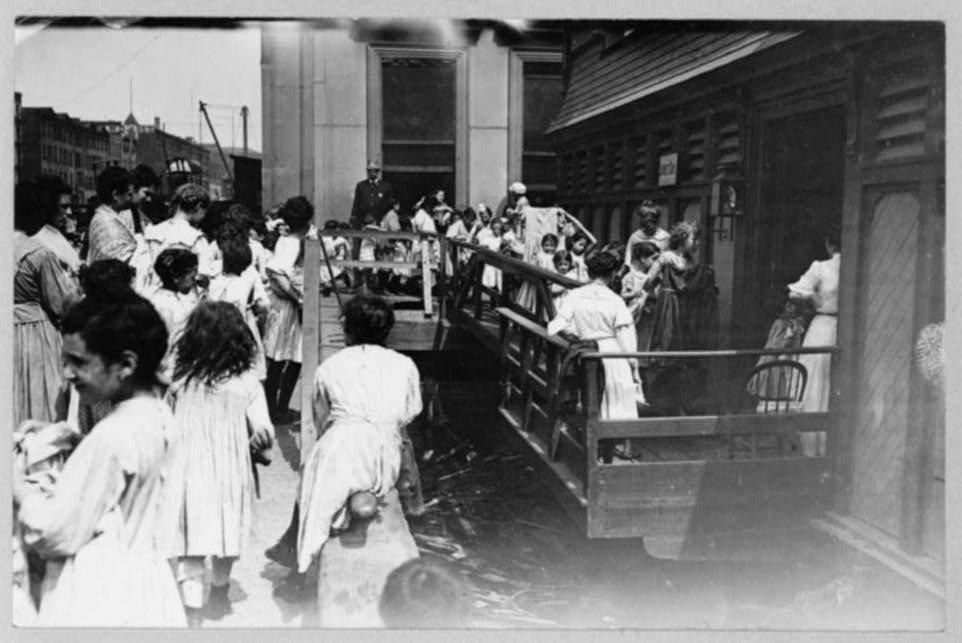
1908 black and white photo of about thirty women and girls standing in line to enter a New York City bath house.
Women and girls in line at a New York City bath house, 1908.

She also knew—having taught homemaking classes at Chautauqua—the health benefits of maintaining a clean body and a clean home. It was natural, then, for her to embrace this new plan for showers in public baths, especially since the facilities would be offered for free to anyone who wanted to use them.

Old photograph of about thirty young boys waiting in a room. Some are seated on benches along the wall, while others are standing in a line taking direction from a porter who is pointing at them, while five boys leaving the waiting room climb a staircase to the the baths.

.

She ended her article in The Pansy by reminding her readers about the blessing the new bath houses would be:

I wonder if any Pansy knows what a luxury a warm bath is, when one is tired and soiled with the wear of the day? I am actually acquainted with some Pansies who weep when they are called upon to come in and have their baths! I venture to say that [the children of New York] are more than willing to wait for their turn in the bath room.

[Credit for the two photos of Boston’s Public Baths: Harvard Art Museums/Fogg Museum, Transfer from the Carpenter Center for the Visual Arts, Social Museum Collection.]

Sweet Travels with Pansy

In the late 1880s a woman named Martha Wood attended a women’s missionary convention and later wrote a newspaper article about her experience. The highlight of her trip was a chance encounter with Isabella Alden.

By that time Isabella was a best-selling author and her pen name “Pansy” was a household word. You can imagine Martha’s surprise to discover Isabella was not only attending the same convention, but was among the ladies traveling on the very same train!

Black and white photo about 1910 of a group of women in traveling clothes and bonnets standing together on the observation deck of a railroad car.

.

Martha’s account does not mention who made the first overture, but at some point Martha and Isabella fell into conversation. When they arrived at their destination they were greeted by a member of the convention’s entertainment committee, who had been sent to escort Isabella to her hotel. Of course, the committee member was only too happy to include Martha in their party. But when it came time for them to take a cab from the train station to the hotel, they encountered a slight problem:

Amid the bustle of the station we were greeted by the Entertainment Committee, and, as we were assigned to places adjacent, were to occupy the same cab, when, lo! The cab had but one seat, and there were three of us! Quickly the happy thought found expression: Who would not think it an honor to ride in the same cab with Pansy? How much more, then, to ride with her on one’s knee, as she is so petite? Thus we rode to our destination.

Isabella was scheduled to address the convention, and Martha described her performance:

She was on the program, of course, and read one of her exquisitely appropriate stories to an interested audience; but the acoustic properties of the church were so bad that, with straining ears, we failed to hear it well, though it was a real pleasure even to see her, and to hear the silvery voice of one whom we had learned to love already, from her writings.

Later, Martha noticed some devoted Pansy fans were among the convention attendees:

She was constantly surrounded by a bevy of bright young girls, and it seemed quite the fitting thing, too, for had she not devoted herself to them and to their uplifting?

One of them gave her a lovely plaque of wild-wood violets marked as her “country cousins,” to which she laughingly referred as we journeyed homeward together. She was quite as entertaining as her stories, we found, full of a nameless gentle grace, betokening a lady.

On the journey home after the convention, Martha and Isabella traveled with a third woman. Martha never identified the woman by name, but described her as a “leading educator in the state.” The woman had also been a speaker at the convention on the topic of “All I Am, and All I Have, for the Lord.” Martha wrote:

Pansy was even then revolving in her mind a new story and she asked my friend if she could use her name as one of the characters.

Now, this friend was just a trifle old-fashioned in her ideas about story writing, and especially about young people spending their time in reading novels, so she hesitated.

Then Pansy told us how she had been oftentimes solicited to enter the arena of popular fiction, for mere fiction’s sake and pecuniary gain, but that she had always refused. Her solemn purpose was to devote herself entirely to the development of higher Christian character and life, and she had never yet yielded, had never been swerved, from her high resolves.

I wish I could paint the beautiful glow of her cheek, and the clear shining of her dark, glowing eyes, as she talked to us from her heart.

Deeply impressed, I turned to our friend and said, “Remember your subject, ‘All I Am, and All I Have, for Christ,’ and she only asks to use your name. He taught in parables most effectively, and she is only following His example by writing stories to develop true, higher Christian life.”

Of course, she then consented and the story was written, but I do not think I am quite at liberty to reveal all here.

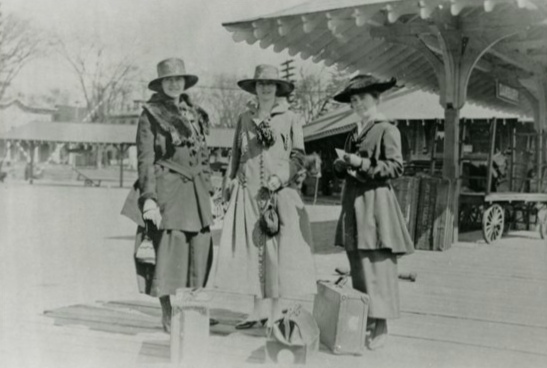
Black and white photo of three women in coats and hats, standing on a train platform with their suitcases on the ground beside them.

.

Martha’s story—as charming as it is—is full of tantalizing mysteries!

When and where was the missionary convention held? And who was the woman whose name Isabella wanted to use as a character in a story? What was the name of the story Isabella ultimately wrote?

We may never know the answers to these questions, but Martha’s encounter with Isabella sounds delightful!

Did Martha’s recollection give you any new insights into Isabella’s personality? Please share your thoughts in the comments box below.

Free Read: An Eventful Thanksgiving

This month’s free read is a short story Isabella wrote about a very unusual Thanksgiving dinner.

Cover of An Eventful Thanksgiving

.

When Mrs. Wykoff learns her vagabond son has died in a tragic accident, her grief knows no bounds. She plans to honor his memory by hosting a Thanksgiving dinner with his closest friends, but her lovingly-made plans may be disrupted by a stunning revelation.

You can read “And Eventful Thanksgiving” for free!

Choose the reading option you like best:

You can read the story on your computer, phone, tablet, Kindle, or other electronic device. Just click here to download your preferred format from BookFunnel.com.

Or you can select BookFunnel’s “My Computer” option to receive an email with a version you can read, print, and share with friends.

Advice to Readers about Selfishness

Isabella wrote a popular advice column for a Christian magazine. In 1897 she mentioned in her column that she had received “at least a dozen letters lately about selfishness.”

Here is Isabella’s Advice:

It is a curious illustration of human nature that in nearly every instance the writers are sufferers because of this trait in others, and are not themselves guilty of the sin. Of all sins to which the human being is heir, that of selfishness seems to me sometimes the most insidious.

Let me tell you about two lovely young friends of mine, sisters, beautiful girls, who have been carefully trained in a choice Christian home. It was summer, and in their hospitable home were gathered several guests. The mother, who had been an invalid during the winter, and like most mothers was tempted to overtax her strength, was being watched over tenderly, not only by her husband, but by grown-up sons and daughters. The morning which I am especially recalling was that one trying to the nerves of housekeepers generally—wash-day.

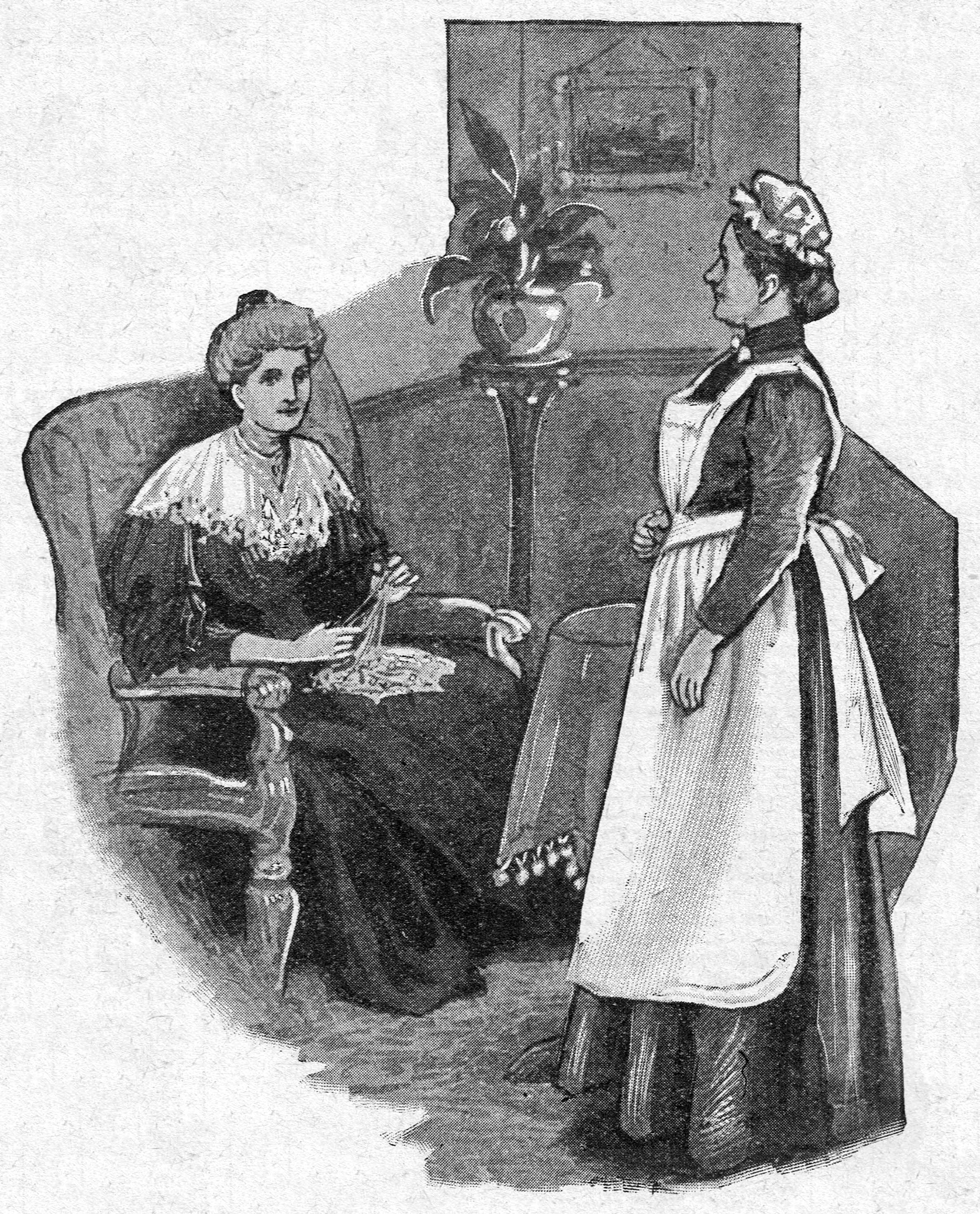
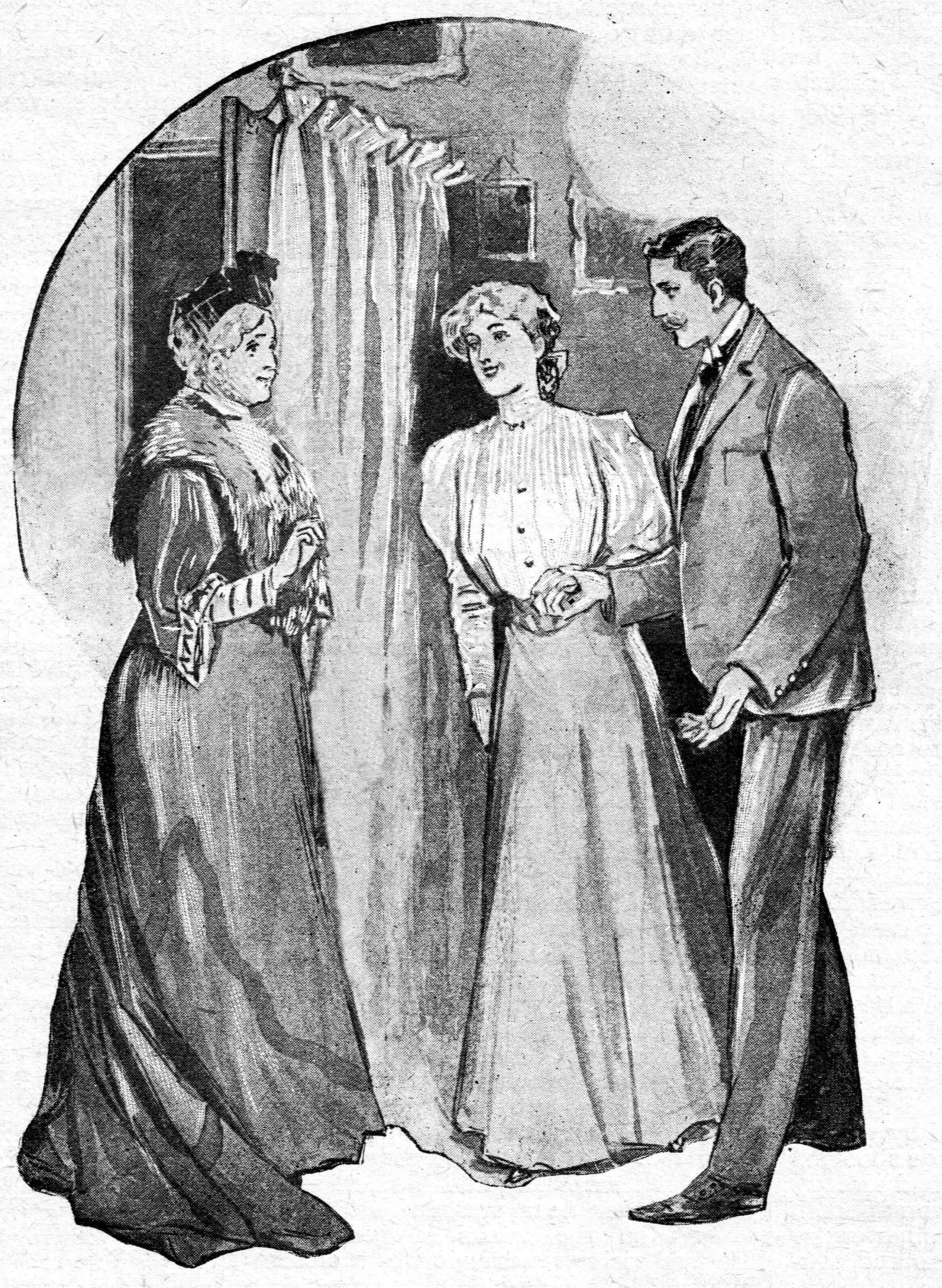
Illustration of two women. An elderly woman sits in a chair. Before her stands a woman dressed in the apron and mob cap of a maid.

It was a country home, and the cook, Jane, was also the maid of all work. There was a second girl, Norah, who served during the influx of company; but on this particular morning, when she was most needed, her aunt’s brother’s cousin had arrived from Ireland, and she must needs go home to welcome her. I came down to the piazza in time to hear and see a bit of family life, after this fashion:

“I’ve kidnapped her,” said Marian, the eldest daughter, gleefully, as she held with gentle force the little mother in the large rocker where she had placed her. “Now, dear mamma, do be persuaded not to go upstairs again. Don’t you know that it is warmer this morning than it has been for several days? And don’t you remember what the doctor said about exerting yourself on warm days?”

Illustration of elderly woman sitting in a chair. A younger woman sits upon the arm of the chair, with one of her arms wrapped around the elderly woman's shoulders.

“But, my dear,” protested the mother, trying to withdraw her arms from the loving clasp, “I was not doing anything to injure myself; and Norah is away, you know.”

“I cannot help it if she is. Your strength is more important than the work of fifty Norahs. Come and help me, Norm. She ought not to bustle around in the heat, ought she?”

“Certainly not,” said the tall brother. He strolled toward them, and drew a chair beside his mother.

Illustration of a young man and young woman speaking to an elderly woman.

As the morning waned, she made ineffectual appeals to both son and daughter to let her “step out for a few minutes” and see how things were going.

“No, indeed!” said Marian with emphasis. “As if we should let you into that hot kitchen for a minute! We might better go without luncheon than to have it at any such price. Don’t worry, mamma dear; things will come out all right; they always do.”

Yet the mother undoubtedly worried, although the guests were as polite as possible, and protested that it was too warm to think of anybody’s doing anything. People did not need to eat in warm weather. Yet they knew, and the hostess knew, that people do eat in warm weather, and that, moreover, the average man and woman like cool, dainty edibles that do not make themselves.

 After a time the two self-constituted policemen became absorbed, the one in a new embroidery stitch which a guest was teaching her, the other in a volume of Browning. As the other guests were by this time engaged in writing or reading, the hostess slipped away. My thoughts followed her regretfully. If I were only well enough acquainted to beg to be allowed to help, how gladly would I have done so! Later, two or three of us took a stroll about the grounds, and discussed the several members of the family.

“What a lovely girl Marian is!” said one. “So unselfish, and so thoughtful of her mother! It was really charming this morning to see her solicitude. And the eldest son seems very much like her.”

“They are so different from Kate,” chimed in another voice. “One never sees her hovering around her mother, anxious lest she should overtax her strength. I wonder where she is, by the way. I have not seen her since breakfast.”

“Kate is sufficient to herself, I fancy,” said a third. “She seems to have her own pursuits, regardless of family life. But I do not wonder, I am sure, that Marian and her brother are anxious about the mother; she looks miserable this summer. I think they will not have her with them long.”

The mother returned, sooner than I had expected, and her face was serene. Something had happened to lift the burden of care.

“Your children are very solicitous for you,” I said in an aside to her a few minutes afterwards. “It is pleasant to see them.”

“Yes,” she said with a motherly smile, “I am blessed in my children. Marian’s anxiety is sometimes almost burdensome; but the dear girl means it well. This morning, for instance, I felt as if it would have been a real comfort to be able to slip away and attend to a few things. But I need not have worried; I might have known that my dear Kate would manage.”

“That is your second daughter, is it not?”

“Yes, the dear child! You do not know her very well; she gives herself little time for our friends, she is so busy assuming the cares of others. I wanted to arrange the lunch today, for Jane does not like to be interrupted; but I found Kate had planned everything, and executed it, for that matter. She had even been to my room, and made the bed, and put everything in exquisite order. I don’t know how she found time to accomplish so much. It is not any of it her regular work, you understand—just extras that she is doing to save me.”

Illustration of a young woman arranging flowers on a dining table.

I moralized, afterwards, over this bit of revelation. Did any of us think that the daughter Marian was selfish? Did she herself for a moment imagine such a thing? And yet . . .  

Oh, it is the little bits of things that catch us. Why, bless your heart! I know a boy who most cheerfully gave up a cherished plan to make a three days’ visit to a friend, because there were reasons why his mother did not wish him to be absent at the time. There were reasons why it was more than an ordinary sacrifice for the young man, and I admired him for making it. But that very fellow came to breakfast, dinner, and supper a few minutes late every time but one during the five days that I was his mother’s guest, although he knew perfectly well that both his mother and his father were annoyed by it. He did not do it intentionally, mind; but his ease-loving nature found it to his convenience to dawdle just at those moments. I think he would have been surprised and pained had one accused him of selfishness. Yet what was the name of the difficulty?

I am glad I used that word “cheerfully” in speaking of him. It hints at another way of giving up. I have a friend who sacrificed her quarter’s salary to relieve her father of a temporary embarrassment; yet she did it so ungraciously, and he heard about it so continually for the next six months, that I doubt whether he would accept such an offering again no matter how great the stress. That girl considers herself a monument of unselfishness.

What do you think of Isabella’s advice?