
Isabella Alden believed that young Christian women who must earn a living would—for the most part—be better off doing so by hiring themselves out as domestic helpers in Christian homes, rather than taking jobs in factories or stores.

She used that idea as the premise for her short story “Their Providence” (which you can read for free by clicking here).
Isabella believed a Christian home offered a safer living environment for a single young woman; and that she would be protected from the coarse worldly influences she would find if she lived in a boarding house.
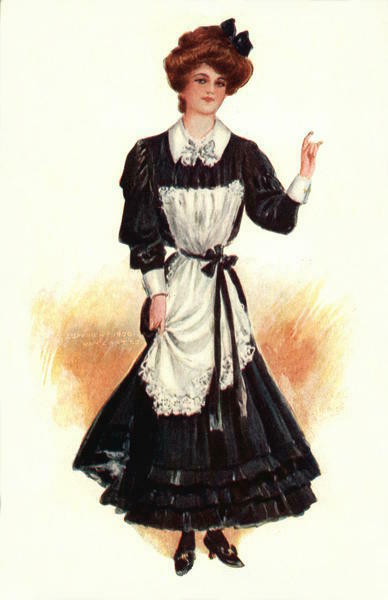
She also believed that living with a Christian family would reinforce the beliefs and principles Christian girls grew up with, such as keeping the Sabbath holy, regularly attending church, having daily Bible readings, and engaging in mission work.
Isabella knew the arrangement could be problematic. In her novel Ester Ried’s Namesake she wrote about a head-strong, quick-tempered young heroine who was hired as a live-in domestic helper for a Christian family that often treated her very poorly. But in true “Pansy” fashion, the characters in her novel eventually recognized their shortcomings and, with God’s help, learned to forgive and influence each other for good.
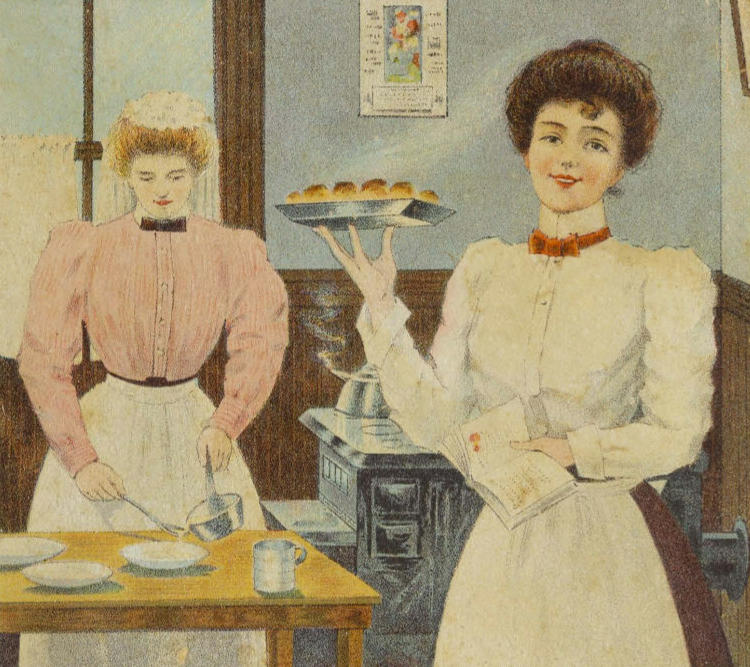
She also shared her idea of young women working as domestic help in some of her speaking engagements and in magazine articles she wrote.
But the concept was not always a welcome one. In 1911 Isabella received a letter from a young woman in Ohio who disagreed with Isabella’s advice.
I have recently read, in a paper or yours, a remark about “lovely Christian homes” where self-respecting girls could earn their living as helpers. I wonder if you really have any idea how these “lovely” people treat their hirelings? I think you had in mind the comfort of your well-to-do friends, rather than the girls whom you advised.
When you talk about girls finding good “homes” I don’t think you stop to consider both sides. What does “home” mean, if not a place where one has entire freedom to come and go, to plan one’s work, and work one’s plans?
I cannot see how any self-respecting person who has always had her own home could live as a hireling in other people’s homes. Could you? My observation has shown me that a condescending manner is the very best that even “lovely Christian people” have for their domestic helpers.
—Ohio.
Isabella had heard such criticisms before, some of which were “kind and sensible” and others “supercilious and snappy.” Here’s how she responded to the letter writer from Ohio:

“Notwithstanding the letter writer’s opinion, I believe I had in mind the comfort of both employer and employed when I urged self-respecting girls who had their living to earn to choose an average Christian home in which to earn it, in preference to factories, shops, and other public places. You, my dear girls, who have written to me, are starting this argument from the wrong platform.
“The foundation question is not, “How shall I secure me a home where I can have entire freedom to come and go, to plan my own work, etc.” but, “Is doing housework in other people’s homes a good and respectable way for a young woman to earn her living, and can she in this way hope to secure the reasonable conveniences and comforts of a home?”
“To this question I reply with an unhesitating Yes.

“The only—or almost the only—work open to women in which careful previous training is not demanded, nor even expected, is domestic service. Here the demand has been so much greater than the supply that absolutely untrained and ignorant help has rushed in and created the conditions that now exist.
“The attitude of the average employer toward her servant is endurance: she is unable to commend her work, she can only tolerate it. She has learned to conduct herself accordingly; and the multitude of decently educated, reasonably well brought up American girls who cannot be artists nor teachers nor stenographers, but must, nevertheless, earn their living, have, because of the above state of things, given this form of work a wide berth and rushed into shops and offices and factories, instead.
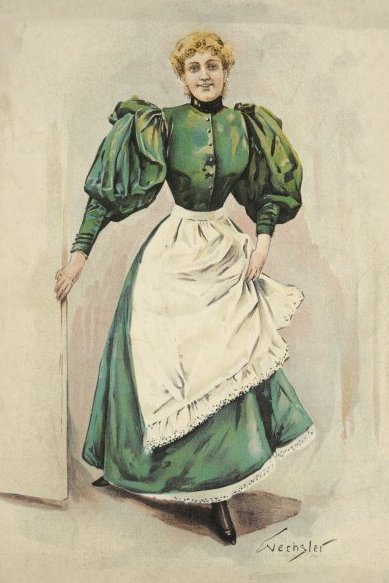
“Now, let us look for a moment at one of the exceptions:
“She is an American girl with a partial high school education. She planned to be a teacher, but something happened. Illness, or sudden reverses, or unexpected demands, have made it necessary for her to become an immediate wage-earner. Times are hard and openings few; as a last resort she resolves upon trying domestic service, with every nerve in her body shrinking from the ordeal, because of what she has heard and seen and fancied.

“The woman who employs her (knowing she lacks previous training or recommendations) does so because she is in straits and must have somebody right away. All she knows about the applicant is that she looks “uppish” and as though she would feel above her work; which is precisely what the girl does feel. She is all ready to have her worst fears confirmed, and they are confirmed. She finds a thousand things to flush her cheeks with indignation.
“She resents the “orders” given out by the hurried and worried mistress who yet is not mistress of herself. She resents the poorly furnished room, the solitary meals at the section table, the eternal use of her given name. These and a dozen other grievances keep her in a constant state of irritation and resentment. She cannot do even her best—and none know better than she that, because of the lack of training, her best is not very good, for she is too much tried to give real heart to her work.

“What wonder that, after a short trial, the exasperated mistress and the equally exasperated maid separate, the one to be more convinced than ever that the word “help” as applied to the kitchen is a misnomer, and the other to write letters to someone to prove the impossibility of self-respecting girls earning their living in domestic service?
“For the sake of my correspondent who thinks I am theorizing and do not understand the situation, I want to explain that I have been a housekeeper for forty-five years; that I have been studying this problem carefully in my own home and the homes of certain of my friends for more than a quarter century; that I have known intimately all sorts of “hired girls,” and have helped a few of them to experiment in all sorts of homes.
“I have had the would-be fine lady who was an intolerable nuisance; I was glad when I saw her depart, and endured with what patience I could the unkind and untrue things she said about me; though I really believe they were true from her standpoint; she had so warped a view of the whole situation that she was incapable of even listening correctly.

“I have had all grades between, and I have had the real lady who came into my kitchen in appropriate dress and with quiet voice and quiet ways, and submitted to the regulation that obtained—many of which must have been new and trying to her—without the raising of an eyebrow to hint that she had all her life been used to different things.
“She came to me without flourish of trumpets, as an ordinary domestic servant at common wages; and when she left me after a year of invaluable helpfulness, it was as a tried and trusted friend, whom every member of my family not only respected, but enjoyed; and whom, as the years pass, we are glad to count as one held close in the bonds of friendship.

“Nor was she the only “lady” help I have personally enjoyed. Glancing back over the almost half century, I find that five of them stand out in bold relief; strong friends, faithful friends, my “servants” still, in the same sense that I am theirs; and all of us trying to pattern after Him who said, “I am among you as he that serveth.”
“My correspondent asks if I “could live as a hireling in other people’s houses?” To which I reply, I do not know; I have never had the opportunity of trying myself in this way. It would all depend upon whether I was strong souled and resolute and sweet-spirited enough to brave present conditions and help to make them better.
“Yours for service,
“Pansy.”

 Isabella Alden
The Amish and conservative Mennonites would agree with Pansy. They believe that such work prepares young women to be good housewives. Typically they work for families with children too young to help their mothers or families with disabled children. Sometimes they work for the elderly.The advantage of being a live-in domestic is that you have almost no expenses. I know one young woman who saved $35,000 in five years. in her case, the people in the church bought her a car. She worked one day a week for each of the five large families. After this kind of training, a woman is capable of cook8ng quickly and efficiently, sewing her own clothing, canning food and growing food in the garden. They also may have chickens, cows or pigs. She will be capable of economic management to be a housewives, to sew a sheet into a pretty dress and do other thrifty measures. I don’t think I would like to do this, but I know it would have been a good discipline. I would have been better at rearing children, cooking and sewing. I basically had to work because I wasn’t a thrifty, organized housekeeper. Probably if I had worked for 5 years as a maid and saved $35,000, I could have married and live as a housewife, if I had lived in a rural area or small town with a husband with a solid trade. I didn’t become part of the Mennonites until I was 50, so I wasn’t raised this way, but I can appreciate this lifestyle.
Oh, I love this, Barbara! What a great way for a young woman to start off her adult life: with a healthy savings account, the earned appreciation of her neighbors, and plenty of lessons learned in thrift, homemaking, and character building. Thank you so much for sharing this! —Jenny
Thank you for this fascinating article! While I learned something from every job I had before I was married, it would have been much more beneficial for me to do the type of work that Pansy recommends for young ladies.
I also think it is interesting that Pansy describes it as paid work, not as volunteer work. This concept teaches people that domestic duties are truly work. Think of all the tasks that homemakers can now outsource–for pay.
Just last night I was talking to my husband that for a young lady to earn money somehow before she was married would teach her the value of money and how much hard work it takes to earn it.
I like what you said about teaching people that domestic duties truly are work. When I was writing the post I gave a lot of thought to whether I would have been able to take a job as a live-in domestic helper when I was young. I can definitely see the advantages in that kind of arrangement, not just in skills learned, but also in areas of personal development (for me, that would be practicing patience and learning to do things right the first time). Thank you for sharing your thoughts, Luba! —Jenny