Fun on a Cold Winter Evening

Isabella didn’t have television or electronic devices during her lifetime (even radios weren’t common in homes until the 1930s). So on long cold winter days and evenings, when people had to stay indoors out of necessity, they had to come up with ways to entertain themselves.

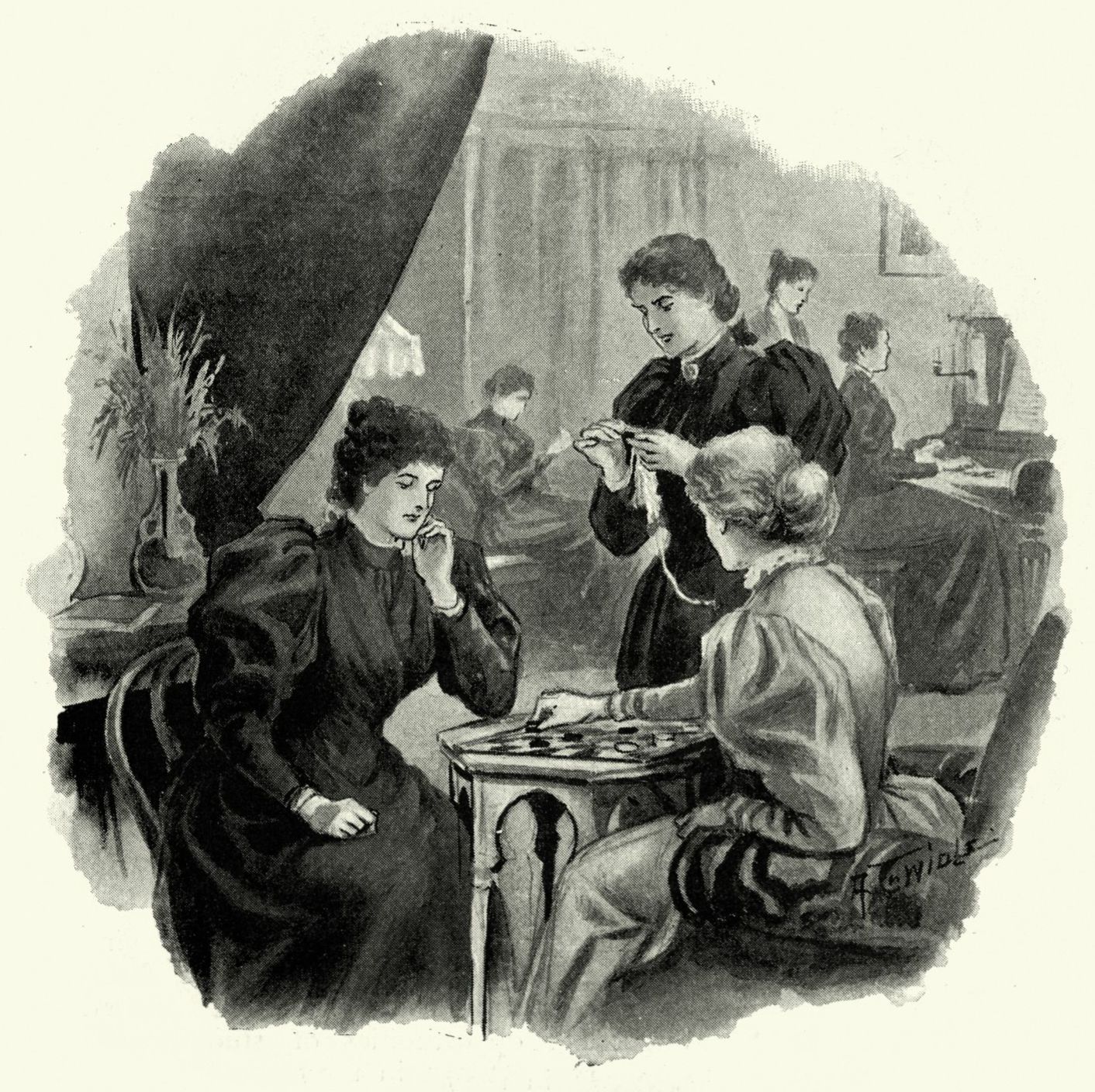
Then, as now, board games like chess, checkers, and backgammon were popular; but they limited play to only two people. What was a family to do to pass the time?
Family members often read aloud to each other (click here to read more about Isabella’s skill at reading aloud) or joined together to sing hymns or popular songs.

Newspapers and magazines published word games, and families often joined together to solve riddles like this:
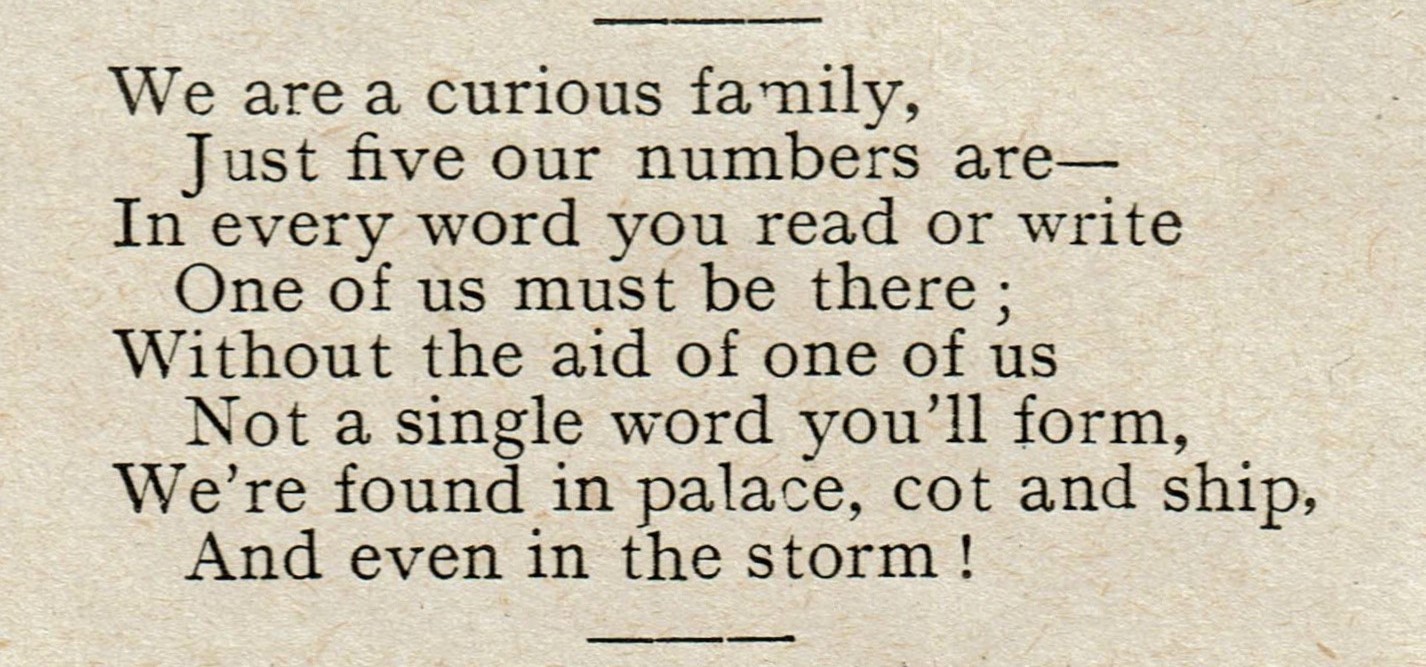
We are a curious family, Just five our numbers are. In every word you read or write one of us must be there; without the aid of one of us, not a single word you'll form; we're found in palace, cot and ship, and even in the storm!

Or this word scramble from a 1907 magazine:
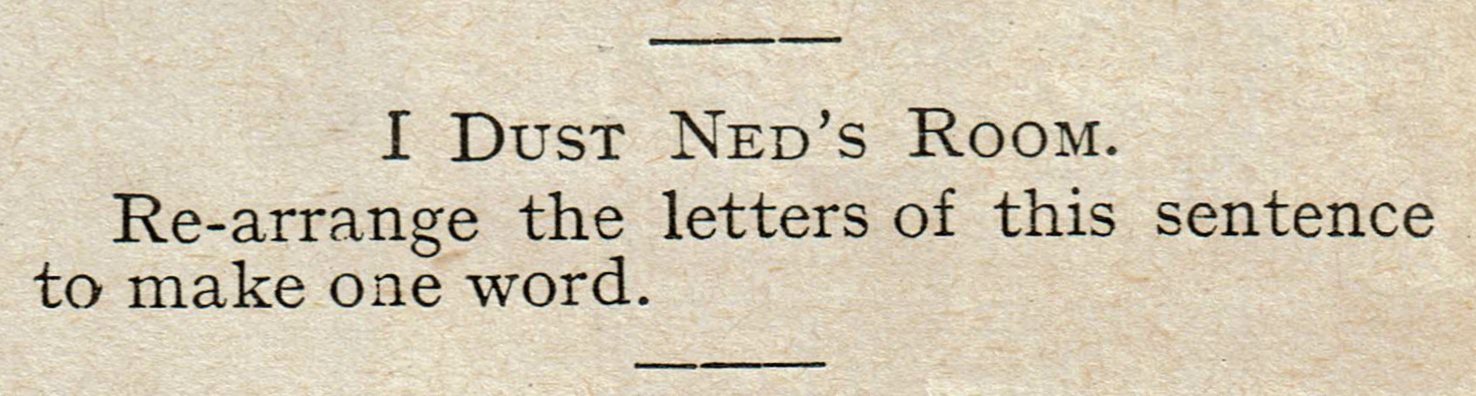
I Dust Ned's Room. Re-arrange the letters in this sentence to make one word.

(Scroll to the bottom of this post to see the answers to these two puzzles.)

But when friends came to call, or neighbors got together, playing parlor games was the most common way for people to pass those cold winter evenings.
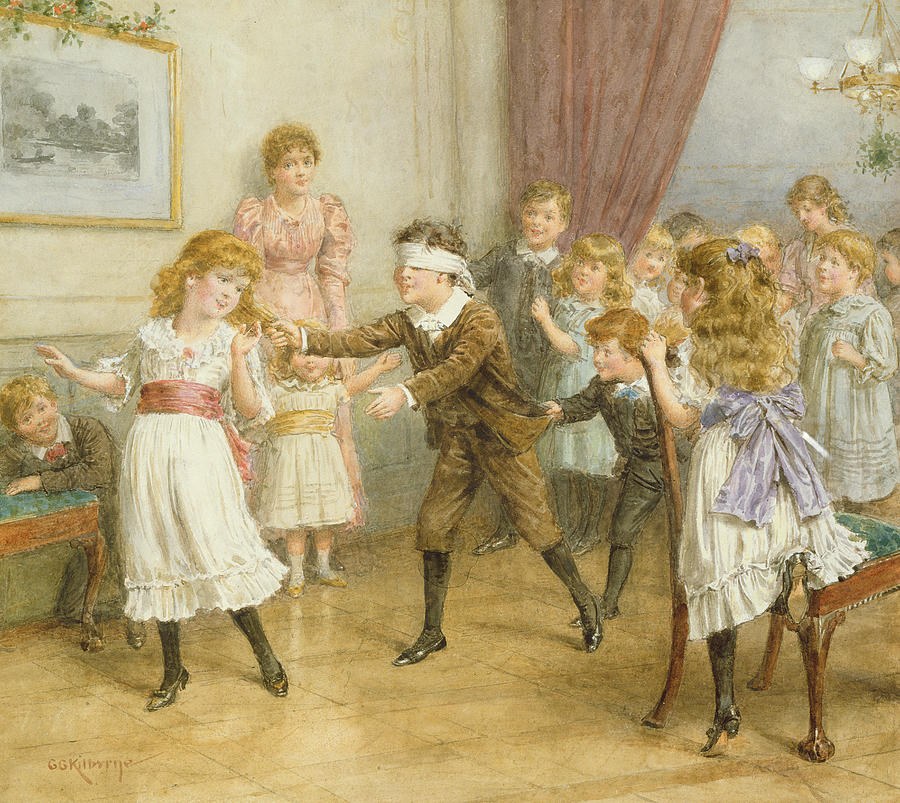
Children playing Blind Man’s Bluff.

The rules for most games were simple, and the games could accommodate any number of players, so they were ideal for entertaining children and adults. Here are a few parlor games that were in vogue during Isabella’s lifetime:

Blind Man’s Bluff:

Versions of Blind Man’s Bluff have been around since ancient Greece. The rules were simple; players were confined to a single room or space; one player was blindfolded and roamed the room/space freely, trying to catch one of the players. Once a player was caught, the “blind man” had to correctly identify him or her in order to win the round.

Savvy parents and alert chaperones usually limited this game to children, because teenagers and adults too often used it as a thin excuse to lay hands on each other.
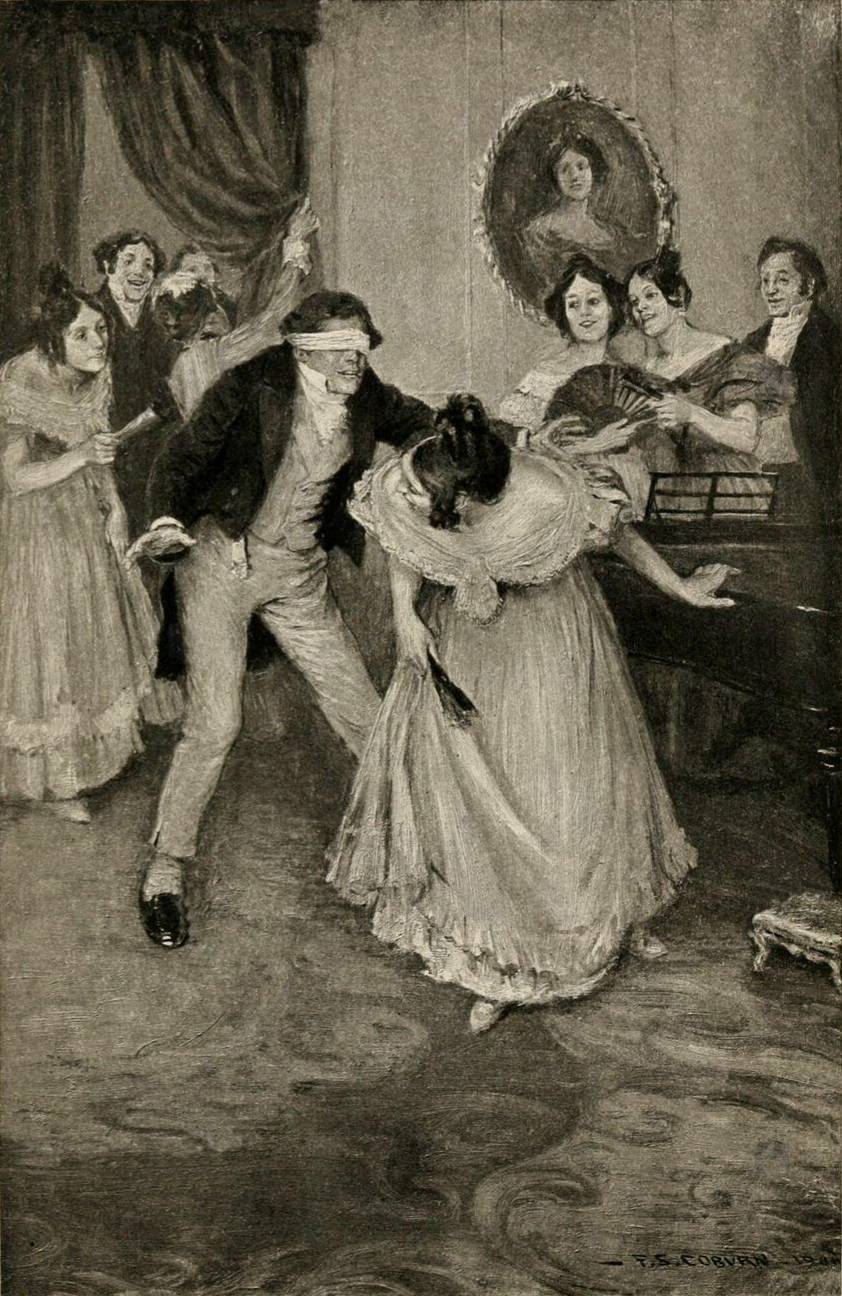
Isabella hinted at Blind Man’s Bluff in her novel, As in a Mirror, when teenaged Elfrida Elliott snuck out of her parents’ house to join a group of friends for a night of games:

Very foolish games they seemed to be for the most part, having the merest shred of the intellectual to commend them, and that so skillfully managed that the merest child in intellect might have joined in them heartily. But the distinctly objectionable features seemed to be connected with the system of forfeits attached to each game. These, almost without exception, involved much kissing. Of course the participants in this entertainment were young ladies and gentlemen. There seemed to be a certain amount of discrimination exercised by the distributor of the forfeits, yet occasionally such guests as “Nannie” and “Rex” and others of their class would be drawn into the vortex, and seem to yield, as if to the inevitable, with what grace they could. [There was] a laughing scramble between the said Nannie and an awkward country boy, who could not have been over fifteen. He came off victorious, for she rubbed her cheek violently with her handkerchief, and looked annoyed, even while she tried to laugh.

Pass the Parcel:

A favourite game for all ages was Pass the Parcel. Here’s how it’s played: a small object is wrapped in multiple layers of paper or cloth, and passed around the circle to music. Each time the music stops, the person caught holding the parcel gets to remove one layer of wrapping. The win goes to the first person who can correctly identify the object before it is unwrapped; or to the person who ultimately removes the final wrap to reveal the object.

Wink Murder:

Another favorite was Wink Murder. To play, everyone sits in a circle and closes their eyes, while one person walks around the circle of players, choosing a murderer by tapping him or her once on the head. They then choose the detective by tapping a player twice on the head.

The players then open their eyes and engage in conversation, while the detective moves to the center of the circle and is allowed three tries to guess who the murderer is. Meanwhile, the murderer “kills” the other players by making eye contact and winking at them, trying not to be caught by the detective in the process.

To add to the fun, the victims “die” dramatically before they leave the circle. If the detective doesn’t identify the murderer in three attempts, he or she remains detective for the next round. If the detective guesses correctly, the murderer becomes the detective for the next round.

Have you played any of these parlor games before? What are your favorite games to play with your family, friends, or church group?

The answer to the word riddle is: Vowels

The answer to the word scramble is: Misunderstood

Free Read: Mrs. Knowlton’s Investment

This month’s Free Read is “Mrs. Knowlton’s Investment” by Isabella Alden.

“I wouldn’t go on a Foreign Mission, not if I were the only woman left in the world to do it.”

Mrs. Knowlton doesn’t believe in sending missionaries off to foreign lands; not when there’s so much of the Lord’s work to be done at home. But when it comes time to donate to Home Missions, Mrs. Knowlton has a problem with that, too. She turns up her elegant nose over any mention of Missionary Societies.

When a friend in need begs Mrs. Knowlton to take her place at a Mission Meeting, she can hardly refuse, though she’d rather be anywhere else. But while she sits with the other ladies, busily fuming and finding fault with every portion of the meeting, Mrs. Knowlton makes a mistake—a mistake so horrible, it just may change her life forever.

You can read “Mrs. Knowlton’s Investment” for free!

Choose the reading option you like best:

You can read the story on your computer, phone, iPad, Kindle, or other electronic device. Just click here to download your preferred format from BookFunnel.com.

Or you can choose the “Read on My Computer” option to print the story and share it with friends.

When Pansy Was a Girl: The Scarlet Fever Scare

In 1889, when Isabella was 47 years old, she shared a memory from her childhood that holds many parallels to our situation today.


When I Was a Girl

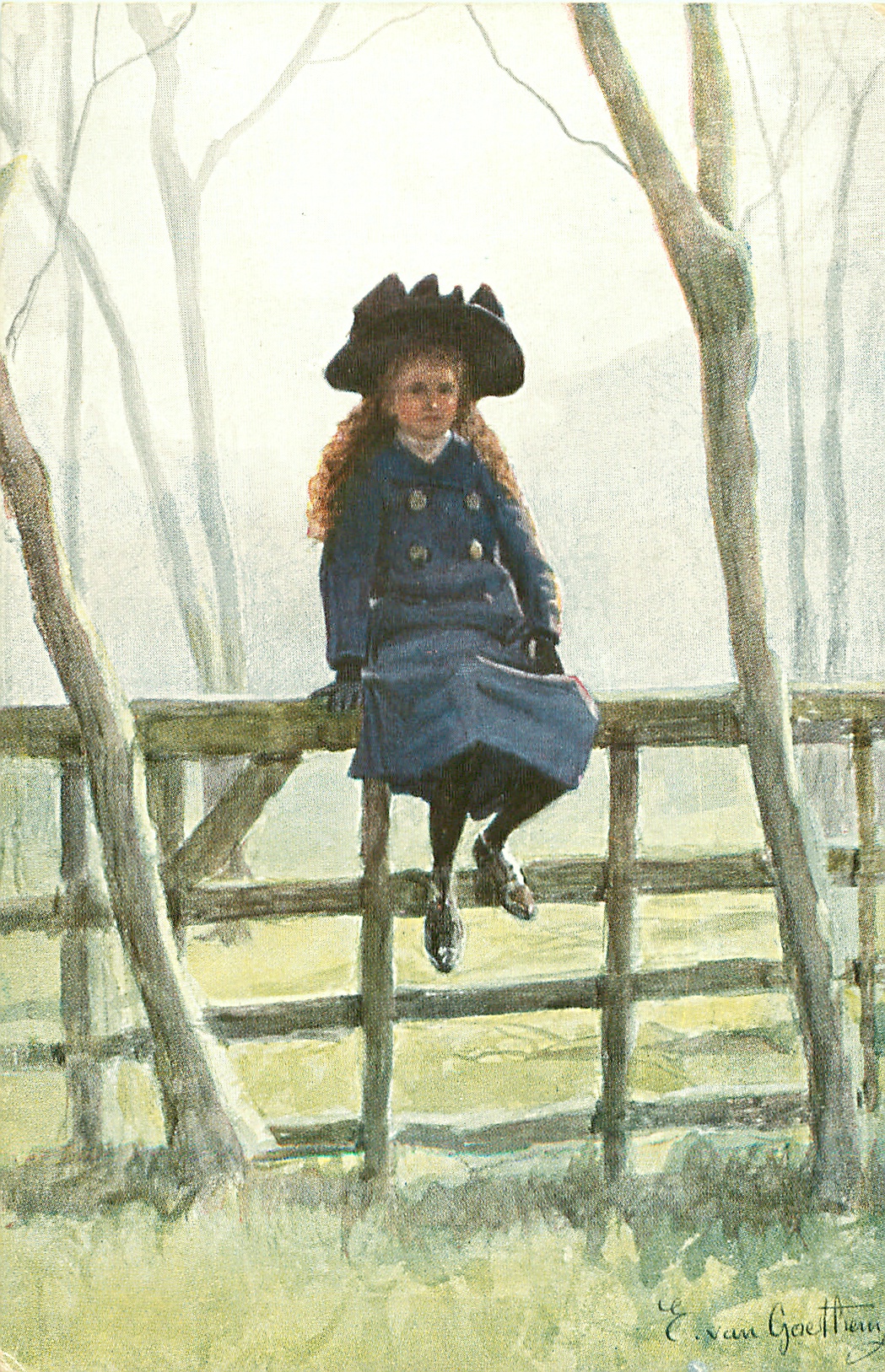
I suppose it would hardly be possible to find a girl who looked less as I did than the one whose picture I present to you. Nor for that matter, one whose surroundings were more unlike the things which surrounded me.

It is true we had a garden where old-fashioned flowers bloomed the summer through, and it is also true that there was a wide old seat which for some reason was called the “settle,” out in the sunshine very near the bowers, and there I used often to sit. But no such ugly back had our wide, low “settle,” nor did there ever hang an ugly black kettle just over our heads.

Yet for all that, there is something about the forlorn little girl sitting curled up on the settle that reminds me of myself. Perhaps it is the position—one foot under her, the other resting on nothing, the hands clasped drearily in her lap, the whole attitude one of deep dejection—which recalls a summer morning of long ago so vividly.

At any rate, I sat one morning on our settle and felt, and doubtless looked, as disconsolate as this little girl does. I was not by nature a dreary little girl, and my childhood was a very happy one. Perhaps for this reason I remember all the more clearly the gloomy days.

I will tell you about them. In the first place, mother was away from home. I think I have hinted that this was always a trying experience to me; but during these long, bright May days it seemed to me that my mother was always away, and in truth I saw very little of her from morning till night. It is a short story to tell, though it was a long story to live.

Into our pretty village sickness had come in a serious form—scarlet fever, which used to be less understood, I think, and dreaded even more than it is now. At least it had come among us in its most dangerous form, and many little children as well as older ones had been stricken. People were very much afraid of the homes where it had broken out. The day-schools had closed, and children who were well were kept closely at home, lest they should come in contact with the disease.

For myself, I remember I was not allowed to go outside the gate without some member of the family. Still I was happy enough. The yard was large, and my playhouse well stocked with broken dishes, and life did not seem weariful to me until one evening when father came home with a face graver than usual, and told about the family living near the saw-mill. Very poor they were, and with a house full of children. And the dreaded fever had appeared among them; two of the children were lying very low, one was dead, and tonight he had heard that two more were stricken. Yet even this was not the worst. The poor, half-sick mother had given out utterly and gone to bed.

No help could be had from any source; the people who were at leisure were afraid to go near the house, and there was so much sickness that really good help was very scarce.

There was actually no one to do for that miserable, half-starving family but the poor father, who had left the work which alone had kept them from starvation to do what he could.

How well I remember the look on my mother’s face when father ceased speaking, as she said, after, a moment of silence, “There are three of ours who have never had the fever, you know.”

“I know it, but—” and then he stopped.

I wondered why he did not finish his sentence, and what he could have been going to say. But mother seemed to understand. She asked no questions; they said not a word for several minutes. I was busy about my play and had forgotten to give them attention, when my mother spoke again in a grave tone which some way, I did not understand why, arrested my thoughts.

“I will go and help them out, if you say so.”

Then indeed I was startled. Mother had been very careful; she had cautioned my older sisters, she had given strict orders to the younger ones; she had even said anxiously to father, “Remember the children, and don’t go where you would be likely to bring the fever to them.”

Now she was calmly proposing to go herself. Of course father would not “say so.”

I looked for him to say, “No, indeed.” But instead he smiled—a smile I think my mother must have been pleased with—and said, “It is like you. And there seems to be no one else; they may die—in fact will die, for want of care, if someone does not go.”

“I will go,” mother said again, in the same quiet tone. “I will take every precaution, and the children need not see me until I have bathed and changed my clothing.”

That was the beginning of it, but by no means the end. She was true to her words, and the weary days which followed stretch themselves out even in my memory, and seem long. No mother at the table, no mother to run to a dozen times a day, no mother to kiss at night; for as the disease waxed fiercer, mother came less and less frequently, sometimes not at all, even for her night’s rest, which she had planned to take at home. When she came, we were often not allowed to see her—we younger ones—nor even to go to that part of the house where she was. Do you wonder that I sat often with one foot tucked under me on the old settle and swung the other listlessly, and wished that the summer would go faster?

Nor was this all; I began to be afraid. The fever continued to spread—to grow more virulent—and day after day the bell tolled and tolled for still another whose body was being carried to the village cemetery; for in those days the church bell used to toll in long, slow sobs as the procession, always on foot, wound its slow way around the curve near our home, with sometimes four and sometimes six men leading the way, bearing a coffin. I can close my eyes and see it all again.

Mother came home at last, her self-appointed duty done. Two of the children she had nursed recovered, one had died. Mother was too worn to go to others—there was some comfort in that. We had her at home once more; but she was grave, and I could see that she held us, her treasures, very closely those days, and watched us almost sternly, lest we should step unawares into danger.

And at times, when the bell would toll, she would look around for us, and put her hand suddenly to her heart, as though the breath came heavily. Day and night through the dreaded ten days in which she kept herself reminded that perhaps she had brought the poison to us, she told me afterwards that we were not out of her thoughts for a moment, sleeping or waking, it seemed to her.

A season to be remembered. I did not understand or at least appreciate my father and mother’s courage and sacrifice and faith as I have since. I knew they were criticized, my father and mother. I knew the neighbors said they were “tempting Providence,” and I wondered what that could mean.

I knew one woman said that when it came my mother’s turn to hang over her own children she would be sorry she had so coolly brought death to her door; that for her part she thought it was hard enough to take it when it came, without going out to bring it.

I pondered over all these things and was afraid. I did not know that I, as a middle-aged woman, would one day recall the disconsolate little girl swinging one foot in the sunshine and wishing for mother, and feel great throbs of joy that I had such a mother to wish for!

But there was one part of the story which impressed me then, and impresses me now.

The disease spent itself at last. The long, slow summer moved away, and life began to be more like itself; and we had this to think about and wonder over, almost with awe, even then:

All about us the fever had been. On either side of us the houses were close; the windows of one room where the sick were lying almost looked into the windows of our sleeping-rooms.

On our right, on our left, across the road from us, away up and down the streets on both sides of us, the fever came. In every home there was a victim; in many two or three. From many of them that slow procession moved, while the bell tolled. And on all the long street ours was the only house where no sickness came!

Did the dear Lord send a protecting angel to guard the home of the mother and father who put their trust in Him, and went forward in the hard road where they believed duty pointed?


Isabella also lived through the Spanish Flu Pandemic of 1918. You can read more about it by clicking here.

What To Do with Christmas Cards?

In a February 1883 issue of The Pansy magazine, Isabella turned an average question—What shall we do with Christmas cards we receive?—into a lesson for children in being thoughtful of others.

What Shall We Do with Our Christmas Cards?

All those bright pretty affairs that came flying in from the postman’s fingers at Christmas time to make us so happy—why can’t we make them give happiness to someone else the whole year? Someone sick and suffering, with little to brighten and amuse? Why, they would be very messengers of sweet charity to such.

Here is work for you, dear little Pansies who belong to the “P. S. Society.” Make a scrap book of all those cards which you think it right to give away, saying your whisper motto, For Jesus’ Sake, as you tuck in the dainty bit of color, and the pretty verses, then send it all on loving wing to the Children’s Ward of the hospital of your city.

Think of the eyes that will rest on it when the pain makes the tears come; think of the little ones who must lie on their beds, weary day after weary day, when you are running, and skating, and sleigh-riding!

And best of all, think how the children will love the book, just because some other child made it for them.

How many members of the “P. S.” will do this? Who will be first, I wonder?

If you want to make a very pretty book, cut leaves of white, and pink, and light blue cambric or sateen; tie them together at back with ribbon or braid, putting strings of same on front.

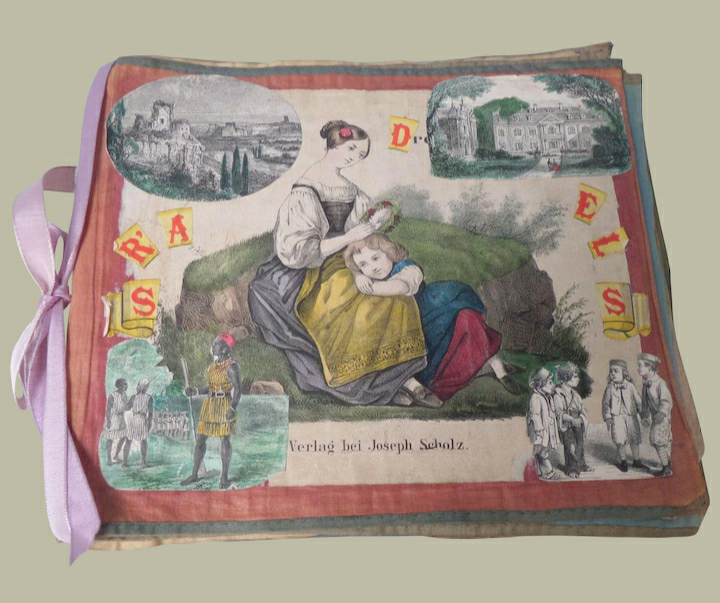
An 1869 home-made cloth scrapbook (from Worthpoint.com).

Paste all dark pictures on the white cloth; all delicately tinted ones on the colored cloth. The effect will be very lovely—I know the “Children’s Ward” will think so.

A cloth scrapbook from the 1860s (from RubyLane.com).

You can learn more about the “P.S. Society” and the “whisper motto, “For Jesus’ Sake” by clicking here.

Do you send and receive Christmas cards each year?

What creative things have you done with them once the holiday is over?