On this date in 1866 Isabella Macdonald married Gustavus “Ross” Rossenberg Alden.
In the writings she left behind, Isabella never gave a description of her wedding gown; however, based on fashion history for the period, we know her gown probably had a wide skirt, long sleeves and a narrow waist.
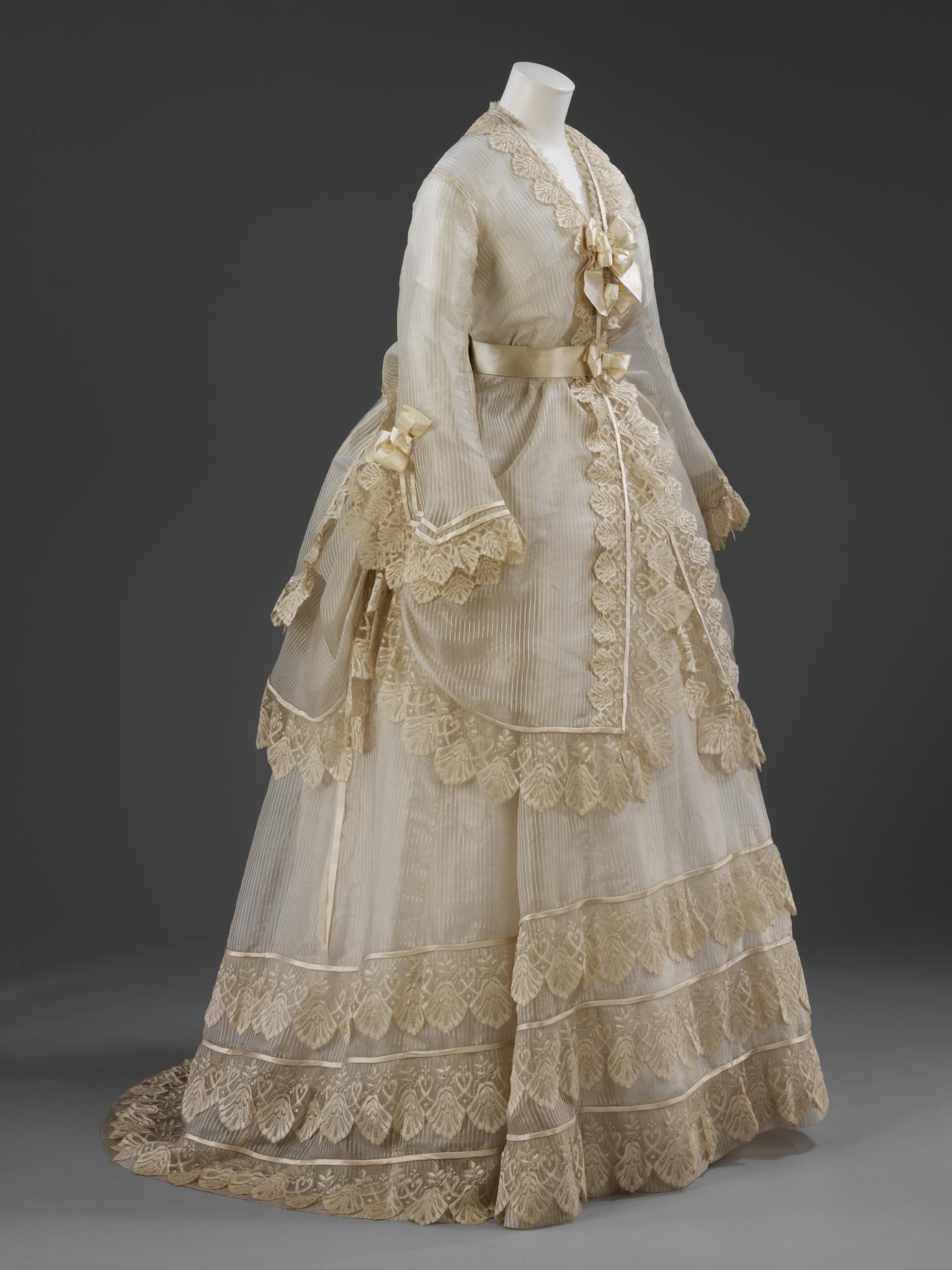
This wedding gown from about 1870 is an example of what Isabella’s dress may have looked like.
It is made of cream silk gauze, trimmed with cream silk embroidered net lace. Both the bodice (which fastens with hooks and eyes) and the polonaise overskirt are bordered with lace and silk satin ribbon bows. The gown is on display at the Victoria & Albert Museum in London.
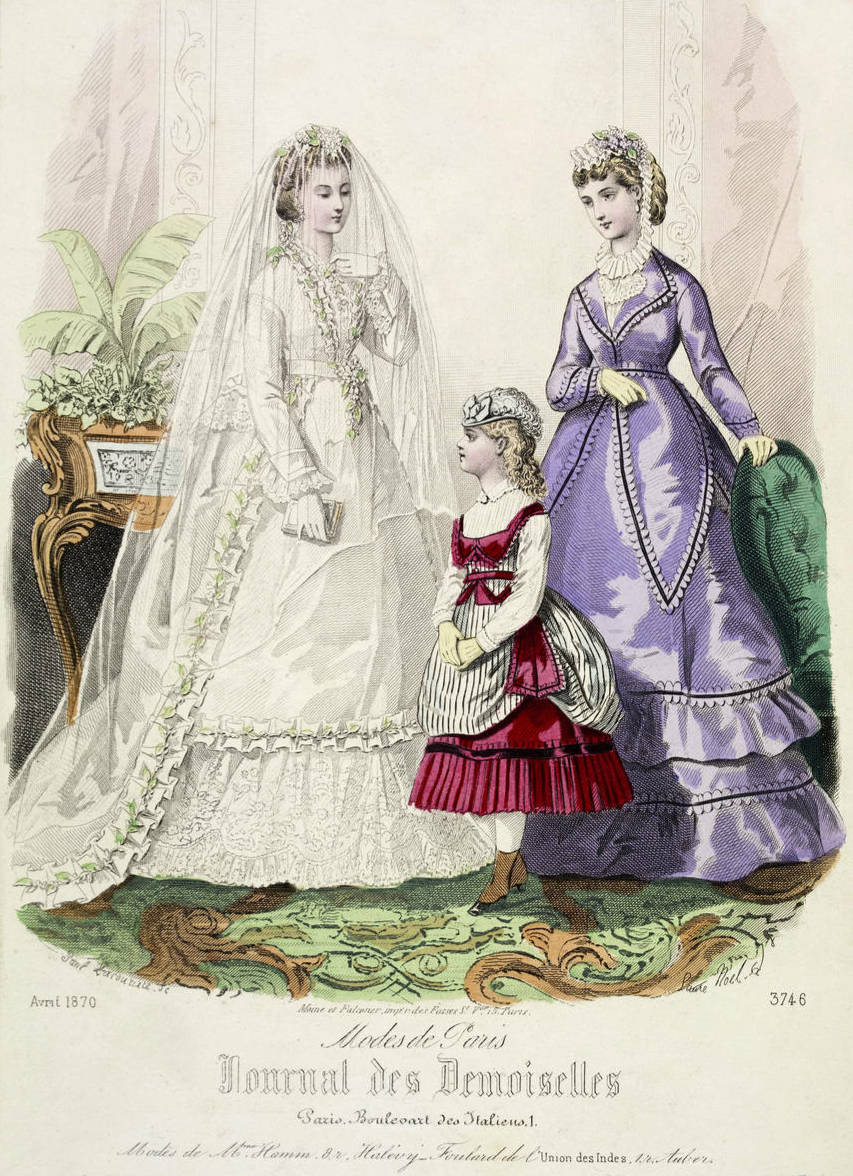
An 1870 French fashion plate depicting a fashionable wedding gown for the period.
In 1916 Isabella and Ross celebrated their golden wedding anniversary with about 150 close friends and relatives, who gathered at the Alden’s home in Palo Alto, California.
This photo commemorates the occasion. In the center of the photo stands a tall gentleman in cleric’s collar; that’s Ross Alden; Isabella is the woman holding flowers, and standing between them is their son Raymond.
Left of Ross, dressed in white and wearing a large shawl is Isabella’s sister Julia, who resided with the Aldens. The young woman seated on the right holding a young child is Raymond’s wife Barbara.
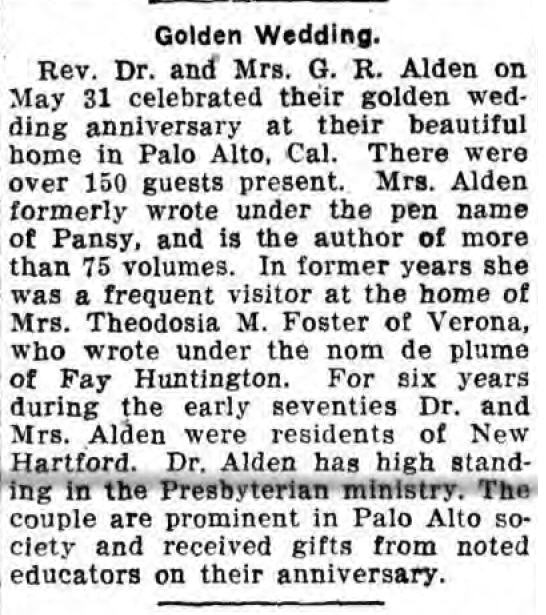
The celebration was written up in several newspapers, including a newspaper near Isabella’s home town of Gloversville, New York:
In all, Isabella and Ross were married almost 58 years, before Ross passed away in 1924.
Isabella Alden was one busy lady! In addition to writing novels and short stories, she wrote Sunday school lessons for teachers, and edited The Pansy magazine for children.
Along the way, she also wrote articles for many different Christian publications, including the monthly magazine Christian Endeavor World. Her good friend Amos R. Wells was the long-time editor of Christian Endeavor World, and through their mutual commitment to both the magazine and the Christian Endeavor movement, Isabella and Amos became good friends.
Isabella’s friend and fellow author, Amos R. Wells in 1901 at the age of 39.
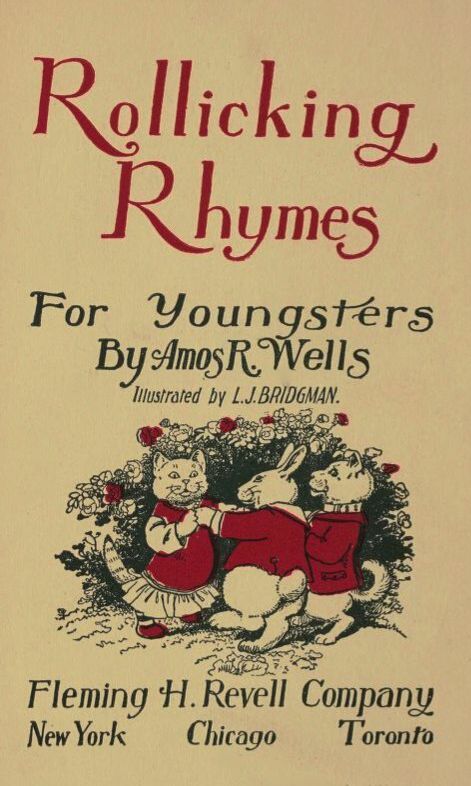
Their friendship was strong enough to withstand a good bit of teasing. In 1902 Amos published a new book of poems for children, titled Rollicking Rhymes for Youngsters.
Isabella promptly obtained a copy of the book and wrote a delightful tongue-in-cheek review , which was published in American newspapers on December 18, 1902:
Dear Mr. Wells:
I owe you a grudge; you have robbed me of an entire morning, and of no end of pocket money! Yesterday, just as I was seated in my study, all conditions favorable for work, the mail brought to me a copy of your latest book, “Rollicking Rhymes for Youngsters.”
I meant only to look at the covers and the type, and wait for leisure; but I took just a peep at the first poem and indulged in a laugh over a droll picture or two, then “Carlo” caught me, and we went together, “over the fields in the sunny weather.” On the way I met the “little laddie of a very prying mind” and—you know the rest.
It is the old story; somebody tempted me, and I fell. How could I remember that the morning was going, and the typewriter waiting, and the editor scolding? I never stopped till I reached the suggestive lines, “Two full hours ago, believe me, was this glorious day begun.” Alas for me, the morning was gone!
How delightful in you to write that which the children and their elders can enjoy together, not one whit the less because, sandwiched all throughout the fun, are charming little lessons that will sink deep into young hearts, and bear fruit. How cruel in you to write a book which a million weary mothers will have to read, and re-read and read again?”
Yours sincerely, Isabella Macdonald Alden.
Amos Wells probably had a good laugh over Isabella’s clever “mock review” of his new book, and Isabella probably enjoyed the chance to support her friend and fellow author (and indulge in some good-natured teasing at the same time).
You can also read many of Amos’ other books online. Like Isabella, he was a prolific writer and published more than 60 titles during his lifetime. And like Isabella, he had a passion for properly educating the men and women who taught Christian Sunday-school lessons; he wrote many books, pamphlets, and articles on the topic. Click here to read some of Amos’ other titles.
In 1910 it took a woman an average of 12 hours per day to do her housework; six of those 12 hours were for cooking alone!
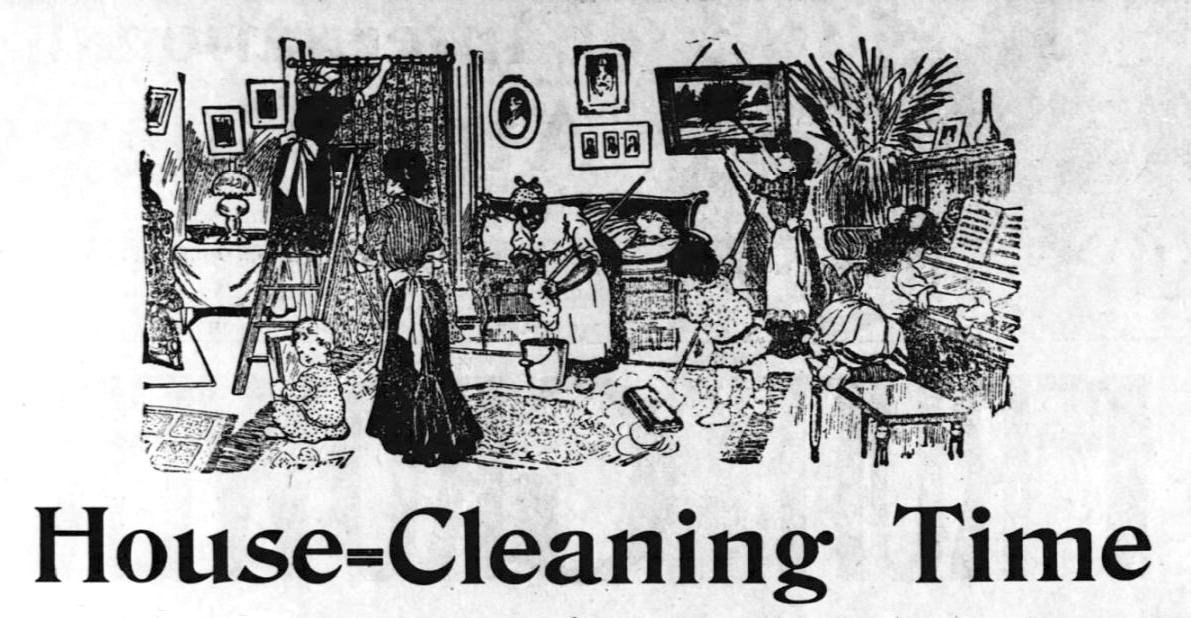
This 1909 newspaper illustration shows the women of the house (along with their daughters and hired helpers) working together to accomplish the annual Spring cleaning.
.
During Isabella Alden’s lifetime, housework wasn’t for sissies. Despite being referred to as the “weaker sex,” house cleaning was hard, physical work. Women hauled water; they built and maintained fires to heat the water; and scrubbed, brushed, polished and swept for hours every day. Even on good days the work could be exhausting; but in the Spring, when women took on the added task of giving their entire house a good, thorough cleaning, the work went on for days—sometimes weeks, depending upon the size of the house.
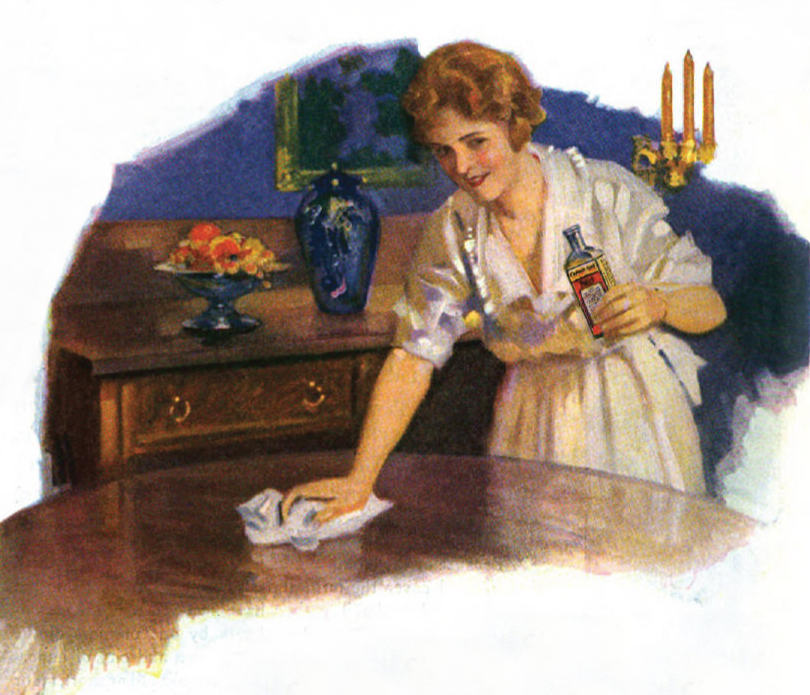
A 1921 magazine ad for furniture polish.
.
Spring cleaning was needed after a family’s house was kept closed up during the winter months to maintain warmth. But as soon as the temperatures began to rise in late April and early May, homemakers opened windows and doors, and began the task of airing out the house and furnishings.
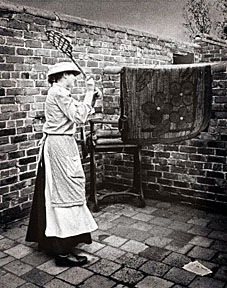
Women dragged heavy carpets outside, hung them, and physically beat the dirt out of them. They did the same with upholstered furniture and mattresses, using beaters made of cane or wire.
They scrubbed kitchen cupboards and drawers, and lined pantry shelves with newspaper. They whitewashed cabinets and walls, polished stoves, and scoured tiles.
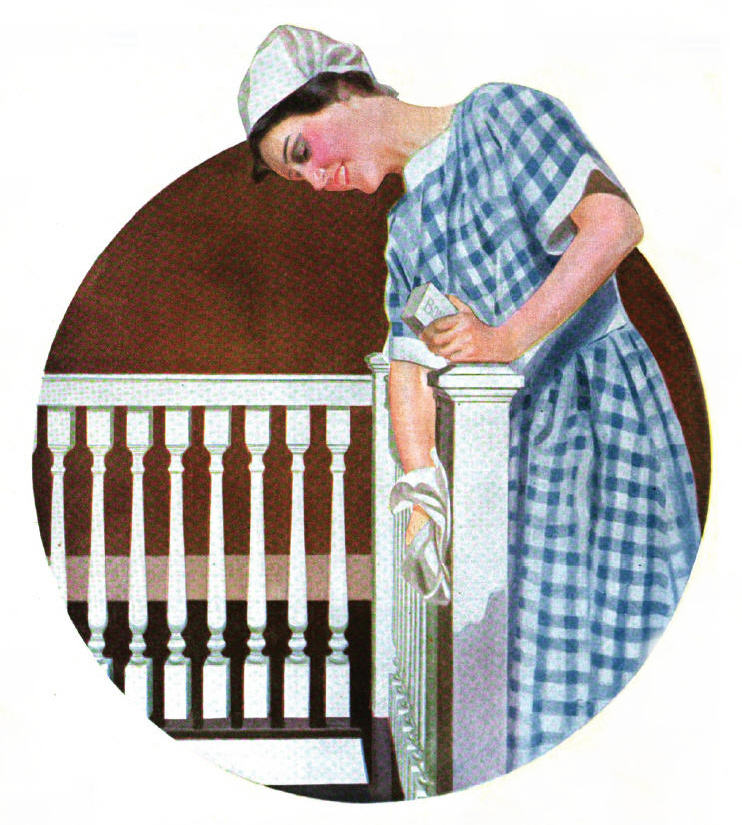
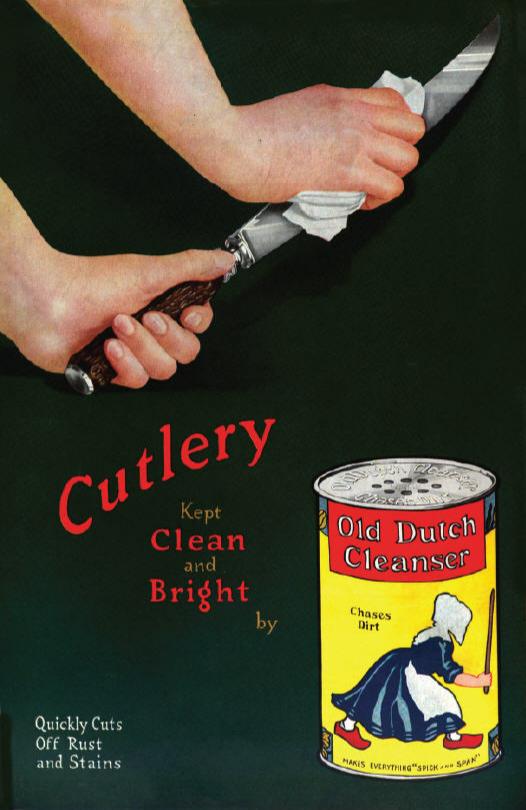
A portion of a 1921 magazine ad for Bon Ami cleaning powder.
.
The work was all done by hand. There were very few tools—besides brushes, brooms, and cloths—to make the job easier or faster.
A print ad for Old Dutch Cleanser, 1916.
.
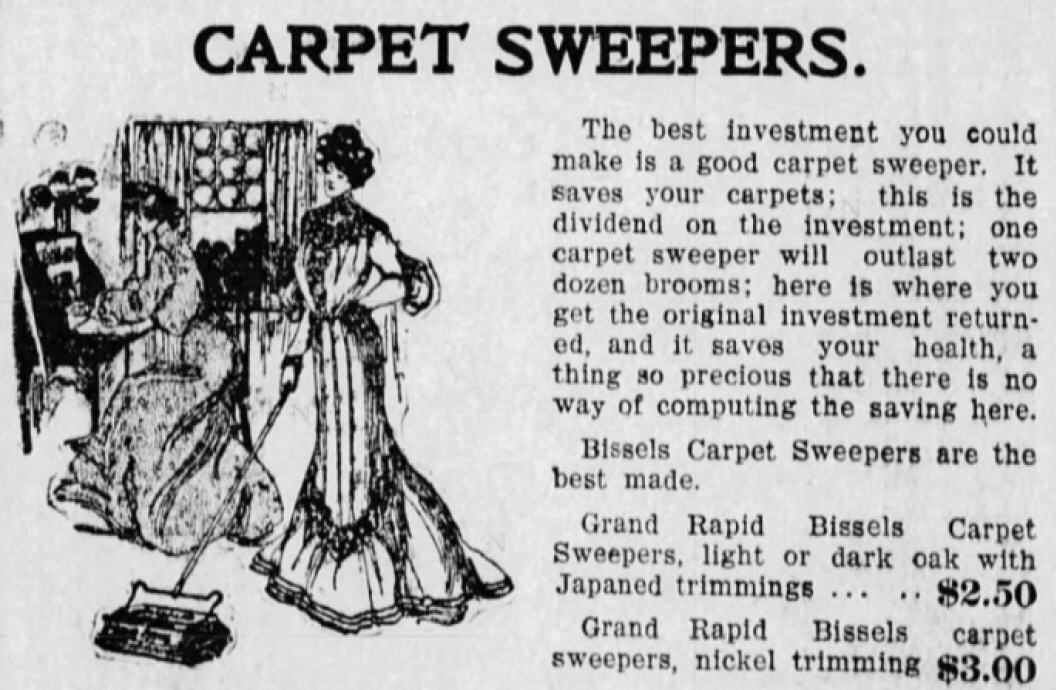
In the 1880s Bissell began selling carpet sweepers, which helped with daily cleaning of rugs and floors, but it wasn’t until about 1910, when more and more homes were wired for electricity, that Spring house cleaning became substantially easier for women.
From The Iola Daily Record (Kansas) May 22, 1906.
.
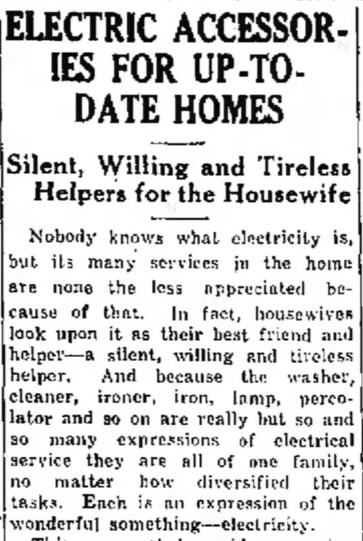
In the early 1900s electricity was new and mysterious to many people. By 1925 more than half of all American homes had electricity, but an Ohio newspaper article declared that:
“Nobody knows what electricity is, but its many services in the home are none the less appreciated because of that.”
.
Electricity may have been unexplainable at the time, but its introduction was a definite boon to women. It opened the gates for new household appliances to enter the market—appliances that saved women time and energy in their daily homemaking responsibilities.
Electric washing machines cut in half the time required to do a family’s laundry, because they took the place of galvanized tubs, washboards and elbow grease.
New Electric Washing Machine ad from the Burlington (Vermont) Free Press, 1909
.
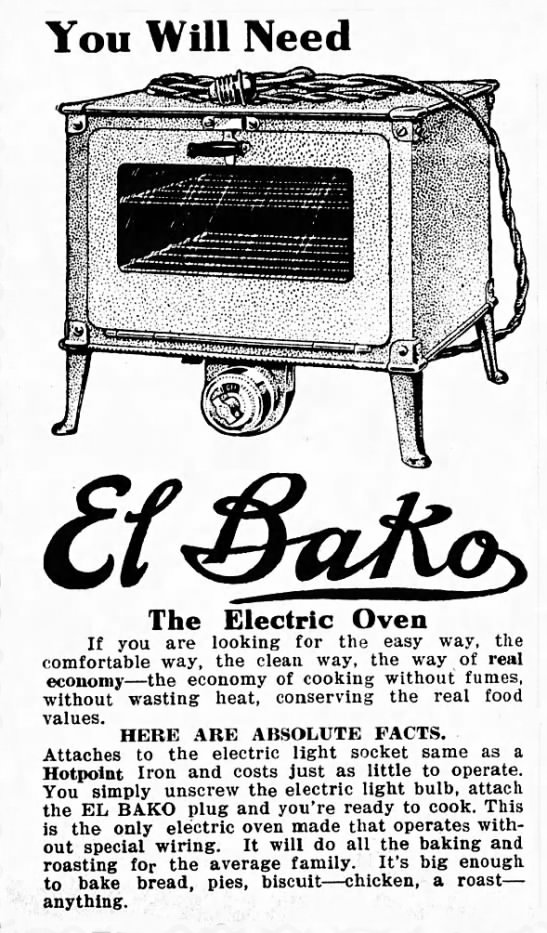
Electric stoves and ovens like this one eliminated the need for women to constantly tend kitchen fires needed to heat water and cook their family’s meals.
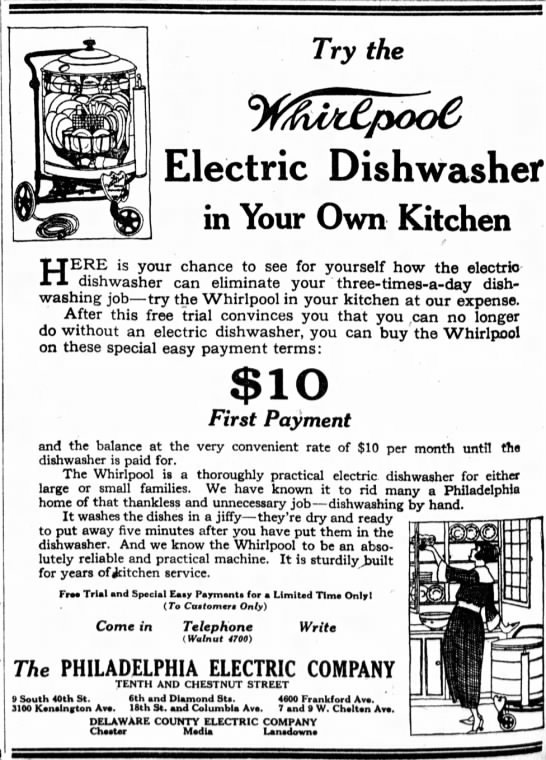
Electric dishwashers were a luxury because of their cost, but by 1920 Whirlpool was actively marketing their dishwasher models in newspapers and magazines across the country.
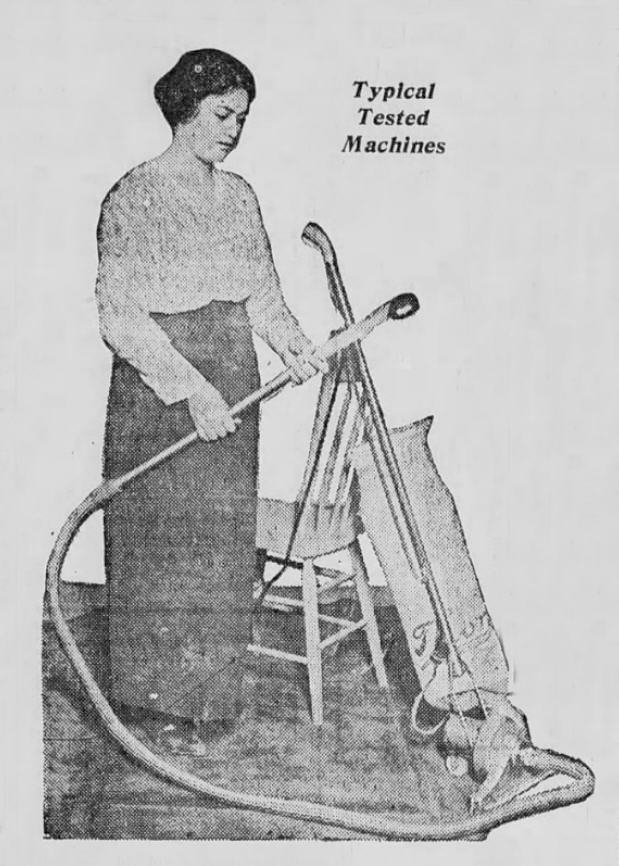
But one of the best time and labor savors introduced during that period was the vacuum cleaner. They eliminated the back-breaking work of carrying carpets outside to beat and brush them clean.
Newspaper ad for the 1912 Hoover Vacuum Cleaner.
.
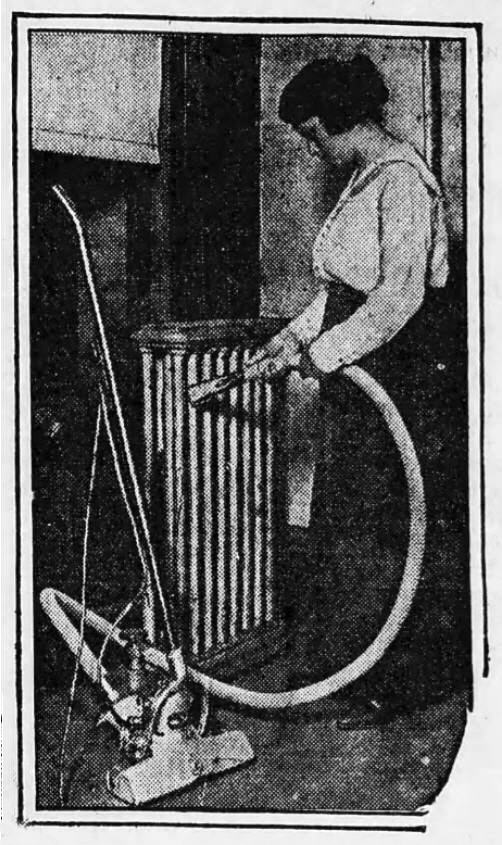
By 1920 most vacuums were sold with attachments that helped clean upholstery.
And the crevasse tool (which we still use today on our modern vacuums) was originally designed to clean 1920-era radiators.
These appliances revolutionized domestic life during Isabella’s lifetime, and paved the way for the time-saving appliances we use today.
Do you do an annual Spring clean at your house? How long does it take?
Do you have an old appliance—large or small—that you still use today? Tell us about it!
This month’s free read is a lovely short story written by Isabella’s sister Marcia Macdonald Livingston.
When Miss Esther Harlowe decides to visit the residents of a nearby Old Ladies’ Home, she only wants to bring a little bit of cheer to the residents’ lives. But when she meets Katherine Lyman, she feels a instant bond with the elderly Christian woman. Soon, Esther looks forward to their visits just as much Katherine does, and Esther quickly discovers her life will never be the same again!
You can read “My Aunt Katherine” on your smart phone, iPad, Kindle, computer, or other electronic device. Just click on the book cover to choose your preferred e-book format from BookFunnel.com and download the story for free!
Four farthings and a thimble, Make a tailor’s pocket jingle. —Old English Proverb
During Isabella’s lifetime, sewing and needlework were part of a woman’s daily life.
In her novel Workers Together; An Endless Chain Joy Saunders’ workbasket includes a “small gold thimble and her own blue needle-case.”
A 14k rose gold thimble dated 1903.
Some of Isabella’s female characters, like Mrs. Bryant, sewed every day because that’s how they earned their living.
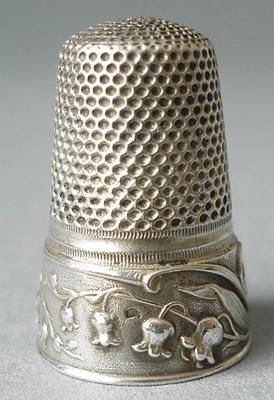
A sterling silver thimble decorated with Lily of the Valley.
Other characters, like wealthy Miss Sutherland, plied their needles to create fancy table linens and delicate trims, like ruffles and laces.
A sterling silver thimble and case from the 1890s.
In Isabella’s stories, thimbles were sometimes utilitarian—little more than tools to accomplish a task.
An example is in Ester Ried’s Namesake (Book 7 of the Ester Ried Series), when the president of the Ladies’ Aid Society called the meeting to order by “tapping with her silver thimble on the table.”
Other times, Isabella used thimbles help us understand how a character was feeling, as in this description of Helen Randolph in Household Puzzles:
Helen was in absolute ill humor. Some heavy trial had evidently crossed her path. She sewed industriously, but with that ominous click of the needle against her thimble, and an angry snipping of her thread by the pert little scissors, that plainly indicated a disturbed state of mind.
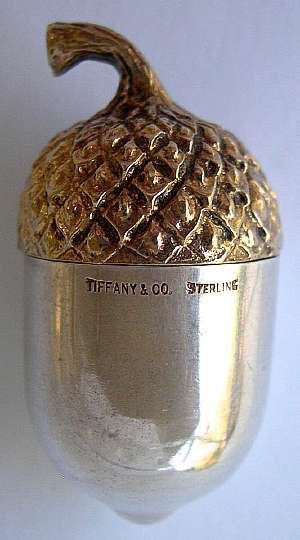
An antique thimble holder by Tiffany.
More often than not, though, thimbles appear in Isabella’s stories in very sweet ways. One example is in Miss Dee Dunmore Bryant, when little Daisy Bryant’s mother surprises her with the gift of a sewing box on Christmas morning:
There had been intense excitement over that box; for, in addition to the spools, and the needle-book, gifts from mother, there had gleamed before Daisy’s astonished eyes a real truly silver thimble, of just the right size for her small finger.
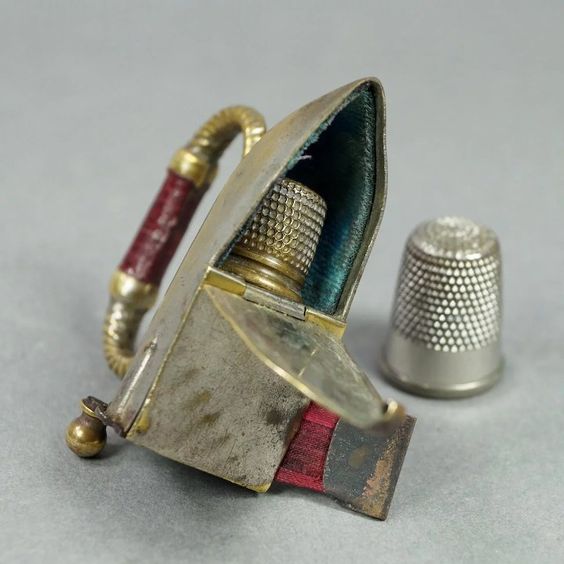
A child-size thimble. The case is shaped like an iron; at its base is a tape measure (circa 1890).
Another example appears in the novel, Pauline, when Mr. Curtis shows his love for his fiancé Constance by preparing a sitting-room in his house just for her:
It all looked charming to him that evening, with the departing rays of the sun glinting the needle, Constance’s needle, and touching also his mother’s small gold thimble that lay waiting. He had taken steps toward the assurance that the thimble would fit. On the day after tomorrow, when they stood here beside his mother’s chair, he would tell Constance how he had brought the gold thimble to his mother one day, and she had said, with one of her tender smiles, “I will wear it, my son, whenever I am taking stitches for you; and someday you will give it to your wife, and tell her from me that it has taken love stitches for you all its life and must always be kept for such service.”
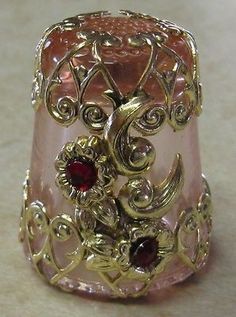
Filigree thimble over pink frosted glass.
Sometimes thimbles play a role in building bridges between Isabella’s characters, as in A New Graft on the Family Tree.
When Louise Morgan and her new husband move in with his family, she has difficulty winning over her resentful new mother-in-law, until she realizes they have a common interest: Needlework.
Presently she came, thimble and needle-case in hand, and established herself on one of the yellow wooden chairs to make button-holes in the dingy calico; and, with the delicate stitches in those button-holes, she worked an entrance-way into her mother-in- law’s heart.
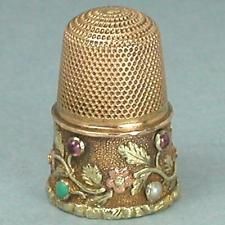
18k gold thimble, from about 1860.
Rebecca Harlow Edwards finds herself in the same situation (in Links in Rebecca’s Life). She and her new husband live in the same house with her mother-in-law, and in the early days of marriage, Rebecca struggles to find a way to fit in. So, one afternoon . . .
. . . about the usual hour for calls, she went daintily dressed in a home dress for afternoon, and with a bit of sewing-work in hand, and tapped softly at the door of her mother’s room.
“Are you awake?” she asked, “and are you ready to receive calls, because I have come to call on you?”
“Really,” Mrs. Edwards said, half rising from her rocker, and looking bewildered, “this is an unexpected pleasure! Am I to take you to the parlor, where I usually receive my calls?”
“No,” Rebecca said, laughing, and trying to ignore the quick rush of color to her face. “I am to be a more privileged caller than that. I have brought my work, and intend to make a visit. I used to go to mother’s room and make a call very often.”
The elder Mrs. Edwards was almost embarrassed. It was very unusual for her to have any such feeling, and she did not know how to treat it.
Rebecca, however, had determined to pretend, at least, that she felt very much at home. She helped herself to a low chair and brought out her thimble, and challenged her mother-in-law at once to know whether her work was not pretty. As she did so, it gave her a strange sense of her unfilial life, as she remembered that that same bit of work had been the resort of her half-idle moments for some weeks, and that yet she had never shown it to Mrs. Edwards before.
It proved to be a lucky piece of work. It gave Mrs. Edwards an idea, and suggested a line of thought that was so natural to her that she forgot the embarrassment of the situation at once.
It’s a sure bet that Isabella Alden was herself a sewer. She may have plied her needle to hem an everyday handkerchief, or she may have used her talents to create fancywork items for her home. But it’s a testament to Isabella’s skill as a story-teller that she could make a simple, everyday item like a thimble figure so prominently in some of the most important scenes in her novels.
How about you? Do you enjoy sewing? Do you use a thimble when you sew? Is it plain and utilitarian, or decorative? Old or new?
Reviews and giveaways for Christian fiction and sweet, clean fiction. Bringing readers information on great stories and connecting authors with their readers.














 Isabella Alden