
 Hereafter when I feel particularly tried with a person, I shall know that I am myself at fault toward that person, and shall ask God for a special view of my own heart concerning it.
—from Workers Together; An Endless Chain
.
.
.
.
.
Hereafter when I feel particularly tried with a person, I shall know that I am myself at fault toward that person, and shall ask God for a special view of my own heart concerning it.
—from Workers Together; An Endless Chain
.
.
.
.
.

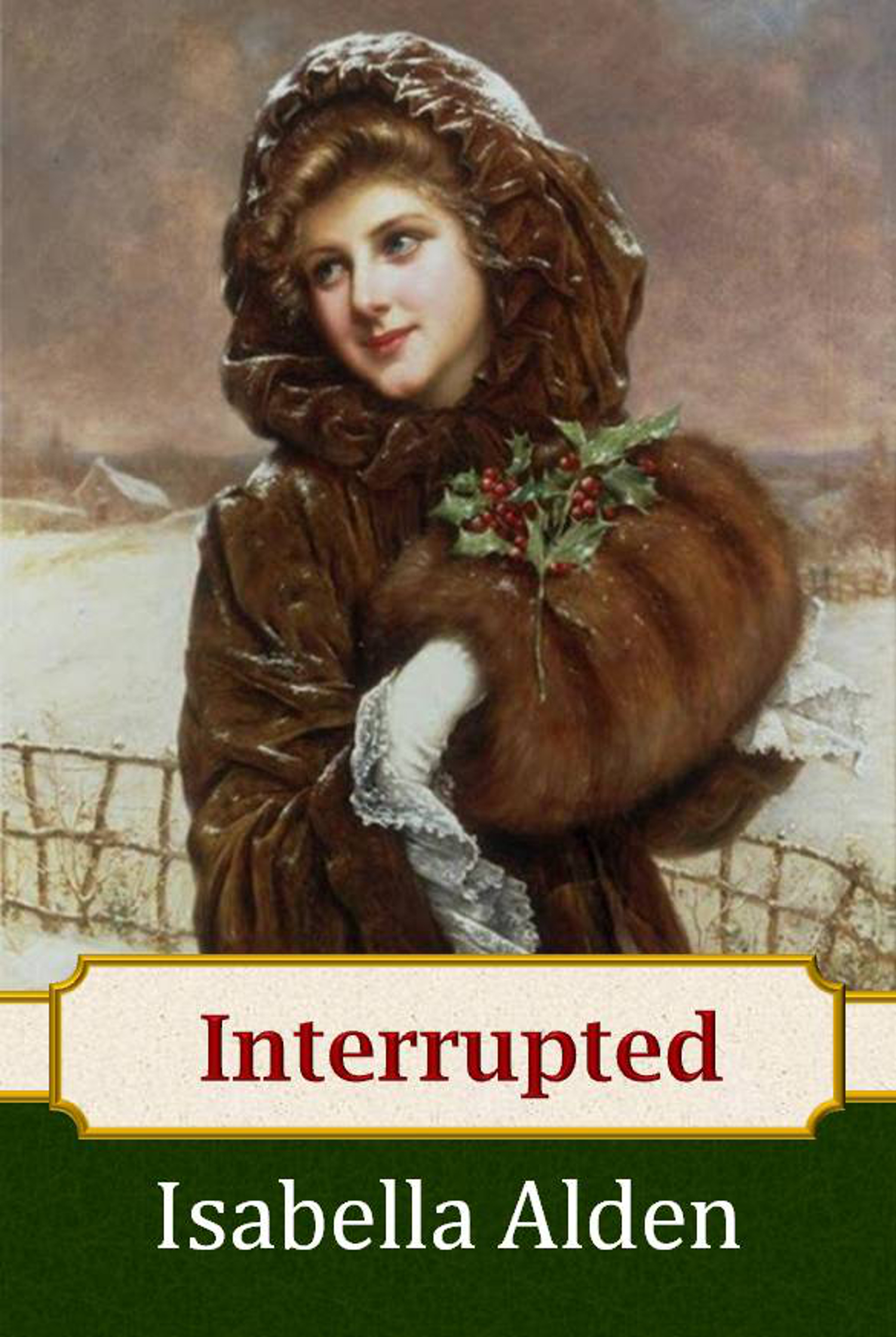 In the book Interrupted, Claire Benedict asked Louis Ansted if he was a Christian. When he said he was not (in a round-about way), Claire asked if he believed Christ “once lived in person on this earth, and died on a cross, and went back to heaven, and is to come again at some future time?”
Louis replied:
“Oh, yes; I have no particular reason for doubting prophecy or history on those points. I’m rather inclined to think the whole story is true.”
“Do you think his character worthy of admiration?”
“Oh, yes, of course; it is a remarkable character. Even infidels concede that, you know; and I am no infidel. Bob Ingersoll and his follies have no charm for me. I have had that disease, Miss Benedict. Like the measles and whooping-cough, it belongs to a certain period of life, you know, and I am past that. I had it in a very mild form, however, and it left no trace. The fellow’s logic has nothing to stand on.”
She ignored the entire sentence, save the first two words. She had not the slightest desire to talk about Bob Ingersoll, or to let this gay young man explain some of Bob’s weak mistakes, and laugh with her over his want of historic knowledge. She went straight to the center of the subject.
“Then, Mr. Ansted, won’t you join His army, and come over and help us?”
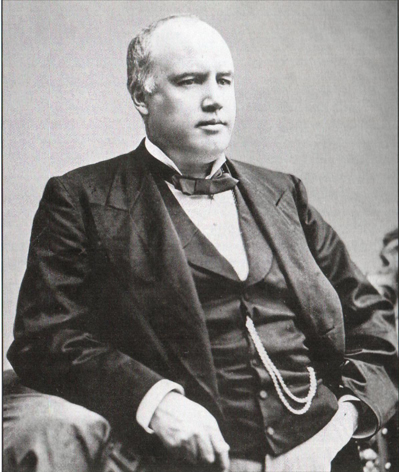
Bob Ingersoll wasn’t just a character in Isabella’s book. He was a living, breathing person and a very well-known figure of the time. Born in 1833 in New York, he had a reputation for being extremely intelligent. He educated himself and was admitted to the bar at the age of 21; his gift of oratory earned him a reputation as a brilliant lawyer.
But it was his talent for speech-making that gained him fame. He lectured across the country on free speech, women’s rights and, most notably, Christian doctrine. At a time when there were laws in some States that made it a crime to deny Christianity, Bob Ingersoll openly argued for a separation of church and state. He expounded on what he considered to be inaccuracies and fallacies of the Bible, and published several books that outlined his agnostic position. He had political aspirations, but his stance on religion made both the Republican and Democratic parties leery of nominating him for any elected office; however, at the age of 33 he was appointed Attorney General of Illinois.
 When Interrupted was published in 1885, Ingersoll’s book The Mistakes of Moses was very popular. In the book, he collected passages from the Pentateuch that contradicted scientific thinking of the time, and even contradicted each other. He used those passages to build a case against the Pentateuch, which Ingersoll called “a record of a barbarous people, in which are found a great number of the ceremonies of savagery, many absurd and unjust laws, and thousands of ideas inconsistent with known and demonstrated facts.”
So when Louis Ansted mentioned Bob Ingersoll, Claire knew exactly who he was talking about. He was known as The Great Agnostic and one newspaper characterized his growing school of followers as “light minded [people] whom brilliant oratory can persuade to most anything while the voice lasts and who are as easily dissuaded by the next fluent speaker.”
When Robert Ingersoll died in 1899, an obituary in The Courier (Lincoln, Nebraska) described him as:
neither better nor worse than the ordinary man. In his youth he became convinced that the Bible was a lie and he hated … the God whose existence he denied.
He was not a saint, neither was he an incorrigible sinner, but just an ordinary man who had lost his bearings in the relations of God to man and overestimated the significance of his own opinion of God and man.
Robert Ingersoll’s writings have found new life on the Internet; several sites make electronic versions of his lectures and books available for free. You can follow this link to The Huffington Post to read more about Robert Ingersoll’s life.
This YouTube link provides an audio recording of Ingersoll’s book, Why I am an Agnostic:

 The Lord knows you; knows just what place He has set you in; just how many people you can touch with your influence, and just what He is going to do with them all.
—from The Pocket Measure
.
.
.

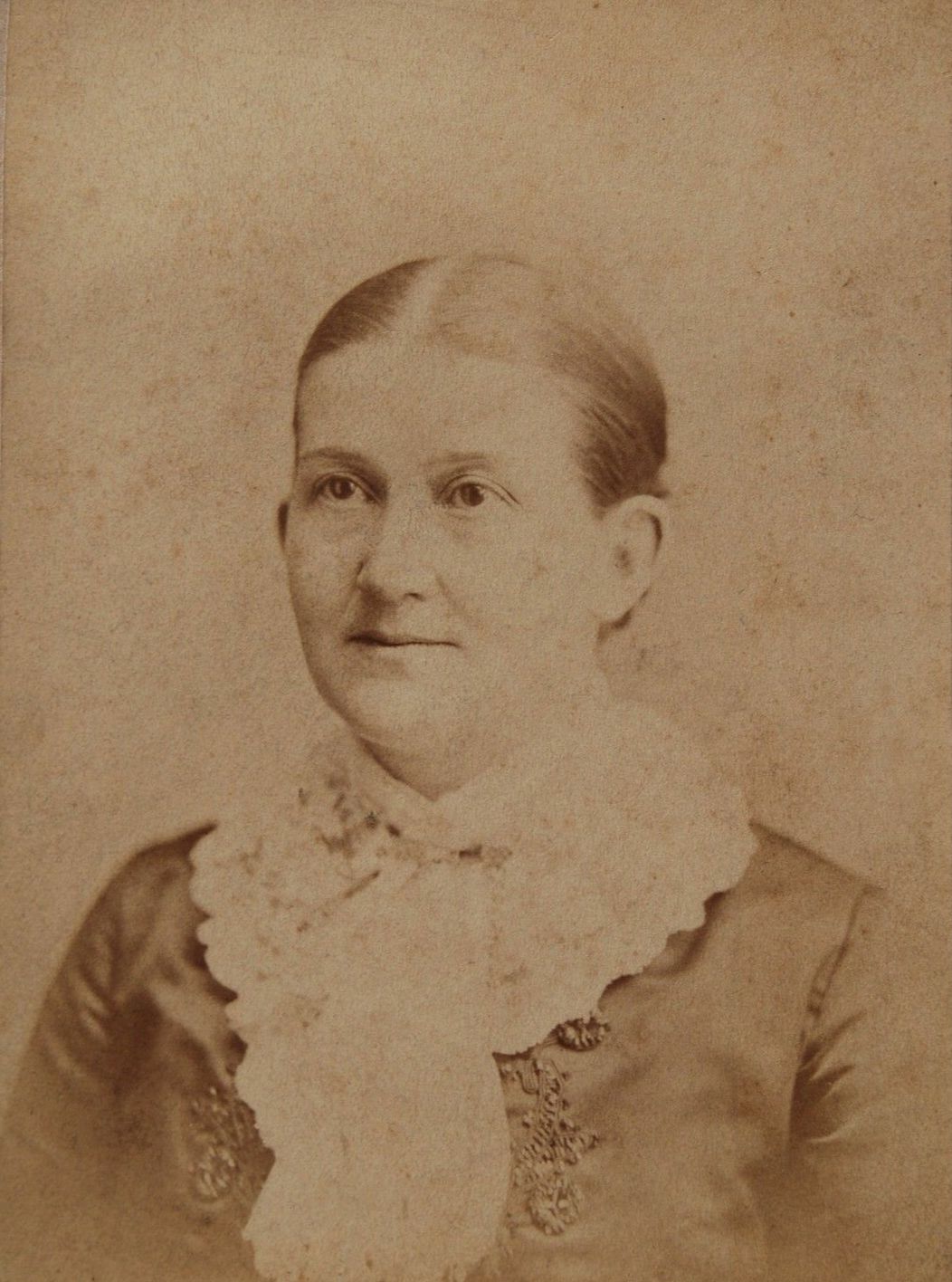
Isabella Alden was a busy woman. She had full-time duties as a minister’s wife, visiting members of the congregation, leading ladies’ prayer meetings, organizing mission bands, and teaching Sunday school classes. She wrote stories for and edited The Pansy magazine every month—all this at a time when she was producing an average of two books a year!
Somehow, she also found the time and energy to lecture before large audiences at Sunday School conventions, Chautauqua Assemblies, and women’s groups. She regularly addressed members of local CLSC chapters and traveled the country to meet with devoted readers of her books and The Pansy magazine.
This notice of one of Isabella’s lectures appeared in the Brooklyn Daily Eagle (New York) on January 14, 1882:

.
And this announcement for one of Isabella’s addresses before a Sabbath-school convention appeared in The Bloomfield Record (New Jersey) on March 11, 1882:

.
When she could, Isabella combined her speaking engagements with visits to family and friends. That was the case in 1878 when she visited her home town of Gloversville, New York.
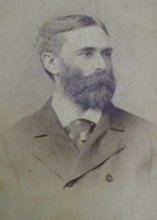
Years before (in 1866) Isabella married Reverend Gustavus “Gus” Alden and moved away from Gloversville; but her family remained in the area and she visited them as often as possible. In that late summer of 1878, she was able to visit her family in combination with an author speaking tour.
Isabella had just finished writing a short story she called, “People Who Haven’t Time.” The story was not yet published but she was ready to share it with her fans.
On Friday, September 20, 1878, she appeared at the Gloversville Baptist Church to give a public reading of the story.
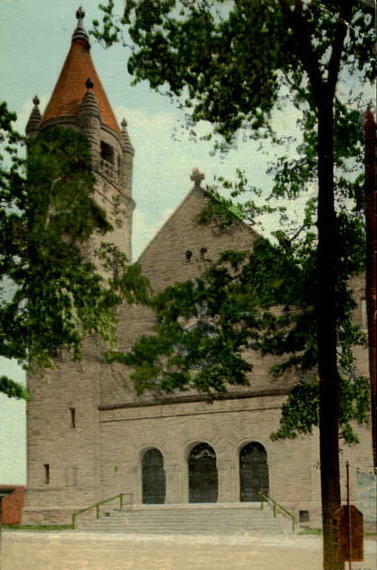
.
The local paper, The Gloversville Intelligencer, announced the event and encouraged attendance:

.
In the next edition, the newspaper gave a full account of the evening and proudly listed the many accomplishments of Gloversville’s favorite home-town girl. Here’s the full 1878 article from The Gloversville Intelligencer:

The story Isabella read at the church that night would eventually be given a final edit and named “People Who Haven’t Time and Can’t Afford It.” In 1880 the story was published in a volume that included another Pansy short story, “What She Said … and What She Meant.”

.
There are other accounts of Isabella reading her stories before audiences. For example, in 1879 she appeared before a Sunday-School convention in New York to read an original story:
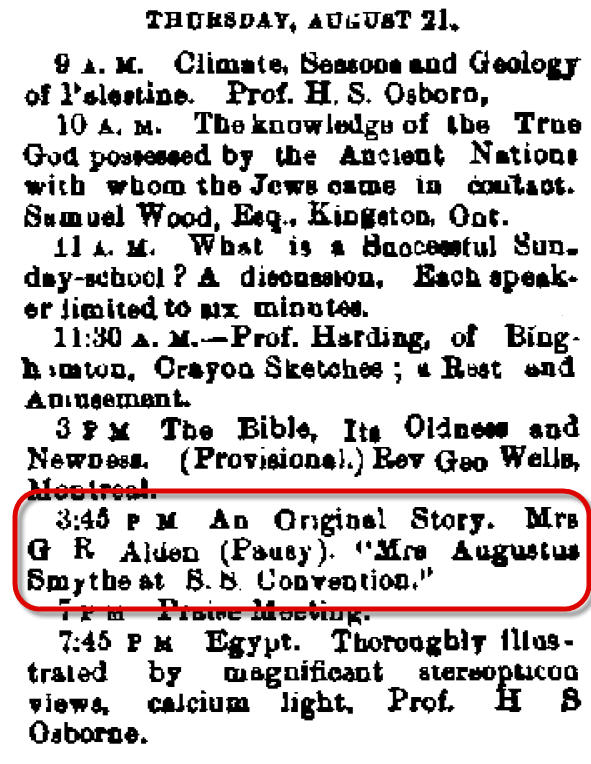
And in 1895 she read her story “Miss Priscilla Hunter” to an audience at the Presbyterian church to help raise funds for the Young Ladies’ Missionary society:


 They had been created each for the other; and God—who watches over human lives—had kept them apart and sacred in their loneliness until the hour when they should recognize their oneness. He believed this and yielded to the joy of it, and was as absorbed and as far from wise as any man of his acquaintance had ever been in like circumstances.
—From Pauline
.
.
.

He will not come into a divided heart; a heart which says, “In some things I will obey; but in this, and this, and this, I must have my own way.”
You would not expect even a human friend who had the right to direct you, to accept such a position as that, would you? How much less the Lord?
—from Eighty-Seven
.
.
.

Affordable Christian Fiction
Faith, romance, and a place to belong
Author of Classic Christian Fiction
Author of Classic Christian Fiction
Reviews and giveaways for Christian fiction and sweet, clean fiction. Bringing readers information on great stories and connecting authors with their readers.
 Isabella Alden