Jessie Wells, the heroine of Isabella Alden’s 1880 novel by the same name, never went anywhere without her jockey. Of course, when Isabella wrote about Jessie’s jockey, she didn’t mean someone who rides a horse . . . she meant Jessie’s hat.
Jockey hats were very fashionable from the 1860s through the early 1900s. The style of jockey hats changed over the course of those years, but the basic design remained the same: a jockey hat had a brim or peak that protruded in front and a rounded, narrow crown that fit close to the top and sides of the head. Jockeys were usually trimmed with a tassel or feather.
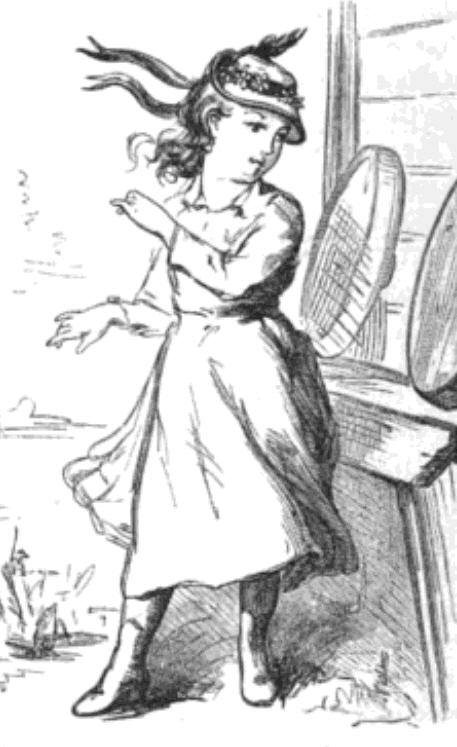
Elisabeth McClellan illustrated the 1860s style of jockey hat in her book, Historic Dress in America.
Illustration of a jockey hat from Historical Dress in America by Elisabeth McClellan.
.
The style of hat was so much in vogue in 1860s America, a popular song was written about it. You can click on the image below to read the song’s lyrics.
Cover to the sheet music for the 1860s song Jockey Hat and Feather.
.
Perhaps the most famous illustration of a jockey hat was the one fashioned for the character of Scarlett O’Hara to wear in post-Civil War Georgia in the movie, Gone with the Wind.
The famous jockey hat worn by Scarlett O’Hara in Gone with the Wind.
.
Though it was made of drapery fabric (as we all know), Scarlett’s jockey was quite fashionable with its styling and trim.
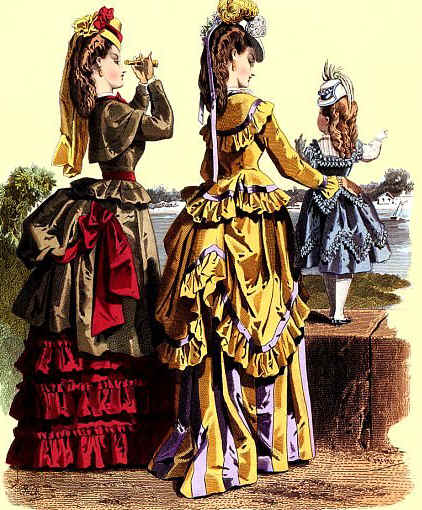
Jessie’s jockey hat would not have been as fashionable or as luxurious as Scarlett’s. Jessie’s jockey may have been made of straw, and the brim might have been more like a visor than a peak pulled low on her forehead, as this 1878 illustration shows:
.
Straw jockeys were in fashion in the 1870s and 1880s. Isabella may have imagined Jessie’s hat of straw, because she wrote scenes in the book where Jessie set her jockey down on the ground (an action that would have soiled a jockey made of fabric) and she often used her jockey to fan herself.
Version of a girl’s jockey hat from La Mode Illustrée.
.
In the late 1800s the styling of jockey hats changed again. Godey’s Lady’s Book and Magazine described the latest version in their November, 1883 issue:
.
Interestingly, what was fashionable in America was not so fashionable in other parts of the world. The British magazine, Household Words, published this warning about jockey hats in 1884:
.
In America, there were no such restrictions, however, and ladies wore their jockey hats sitting forward on their foreheads at a fashionably jaunty angle.
Fashionable jockey hats for ladies and young girls, from La Mode Illustrée.
.
Many thanks to blog reader Merry Chris for suggesting this topic.
You can click on the book cover to read more about Isabella Alden’s book, Jessie Wells.
Isn’t it a pity in this carping world we cannot oftener put ourselves in other people’s places, mentally, at least, and try to discover how we should probably feel, and talk, and act, were we surrounded by their circumstances and biased by their educations?
Before there was a Chautauqua, there was a Teachers’ Retreat. The first meeting was formally named “The National Sunday School Assembly,” and it was held at Fair Point, New York on Lake Chautauqua in August, 1874. In years to come, people would refer to it as the first Chautauqua Assembly; but at the time, no one who attended the modest gathering of Sunday school workers could envision what it would eventually become.
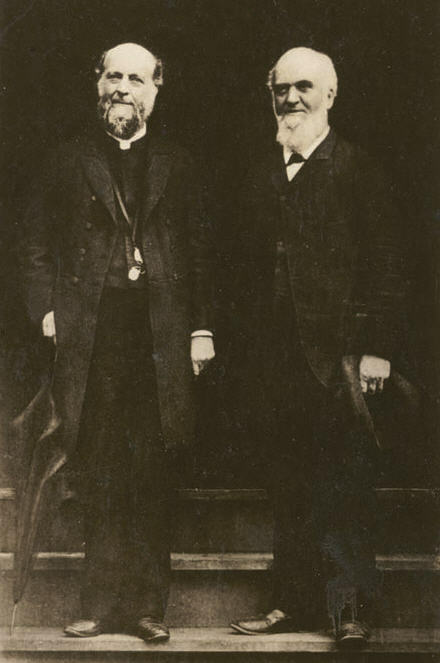
John Vincent and Lewis Miller
That first assembly was a meeting to talk shop about Sunday schools. Attendees studied a “definitive” course of instruction, heard lectures on “subjects illustrative of the Bible,” and learned teaching skills. At the end of the three-week-long assembly, attendees took a written examination on Bible knowledge and Sunday school work.
In charge of it all was the Honorable Lewis Miller, a Sunday school superintendent from Akron, Ohio and Dr. John Vincent of the Methodist Church.
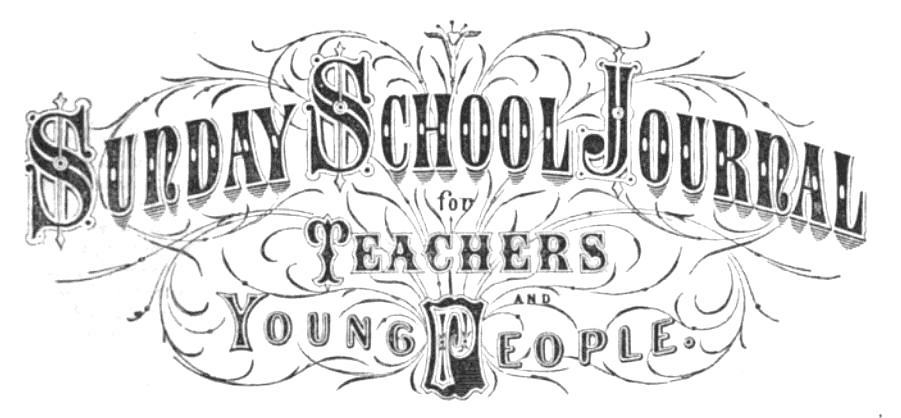
Dr. Vincent had long held the belief that Sunday school teachers must have appropriate training to be effective in leading their classes. As far back as 1864 he wrote a regular column in the Sunday School Journal, a monthly publication of the Methodist Church, advocating that ideal.
Together Dr. Vincent and Mr. Miller developed a plan to bring together a large group of Sunday school workers to study a proscribed course that included Bible lectures, ancient geography, and educational theory; and issue diplomas to those who passed a written exam based on the course work.
But it was Mr. Miller who is credited with the idea of holding the retreat in the woods, rather than in a city. He chose to convene the gathering in the Fair Point area on the shore of Lake Chautauqua in New York.
Fair Point with Point Chautauqua in the background.
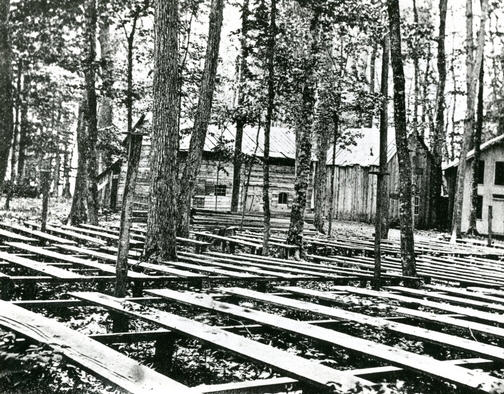
The main meeting place was out of doors where a platform had been set up in an open area that would eventually become Miller Park. Someone—maybe Mr. Miller himself—ironically called the gathering area the “auditorium” and the name stuck.
The original Chautauqua meeting area
The Assembly opened on Tuesday evening, August 4, 1874, with a brief responsive service of Scripture and song, offered by Dr. Vincent. He later wrote about that memorable first meeting:
“The stars were out and looked down through trembling leaves upon a goodly well-wrapped company, who sat in the grove, filled with wonder and hope. No electric light brought platform and people face to face that night. The old-fashioned pine fires on rude four-legged stands covered with earth, burned with unsteady, flickering flame, now and then breaking into brilliancy by the contact of a resinous stick of the rustic fireman, who knew how to snuff candles and how to turn light on the crowd of campers-out. The white tents around the enclosure were very beautiful in that evening light.”
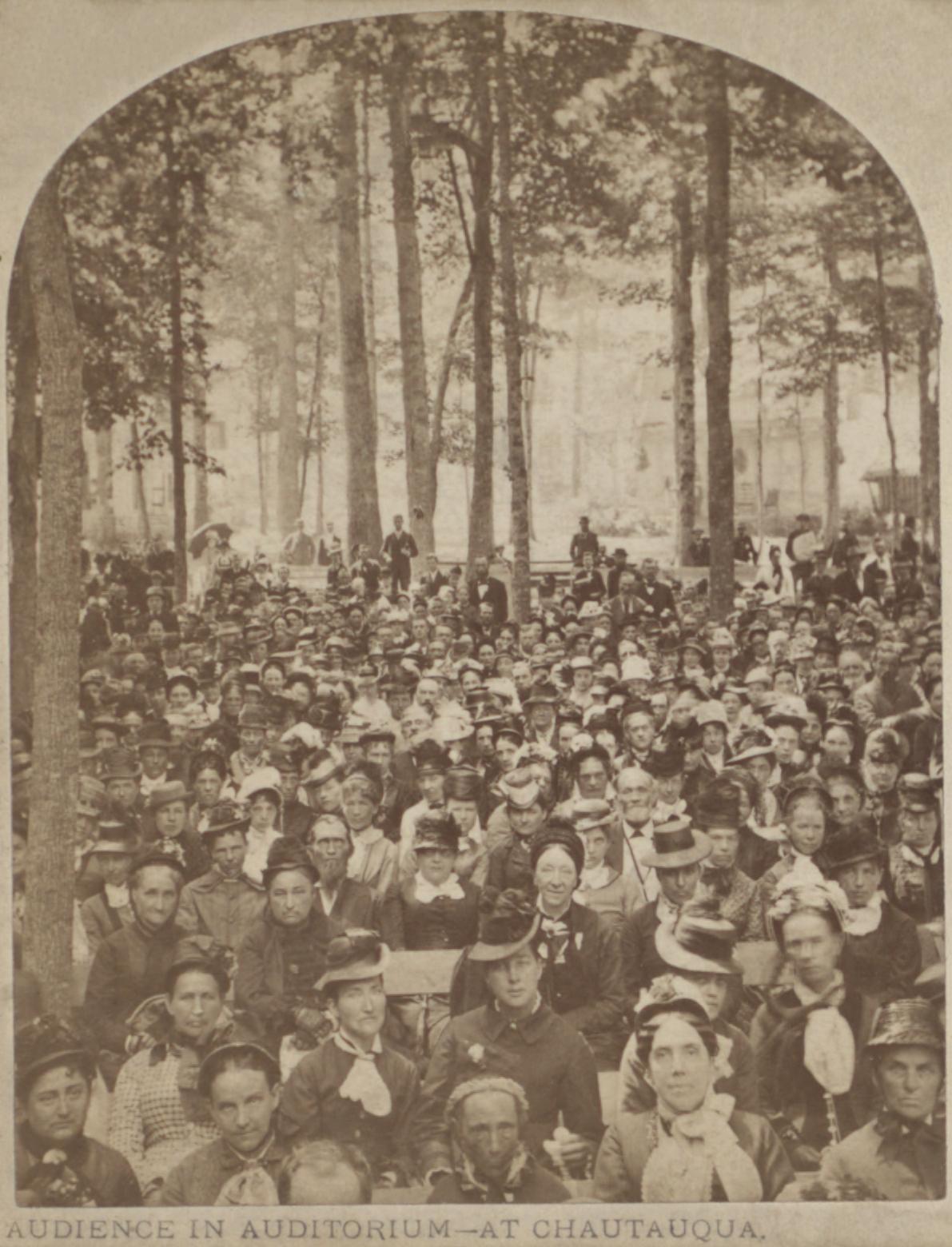
An early photo of an audience gathered in the original Auditorium
The tents Dr. Vincent mentioned were erected at each of the four corners of the auditorium where the first Normal classes were held.
The Reverend Jesse Lyman Hurlbut described how the Normal Class was conducted with precision.
“At eight o’clock the teachers of the different section-classes were called together for a conversazione concerning the subjects to be presented to the class. At ten o’clock one session of the Normal class was held for an hour. At 1:30 was a report and review of the morning lessons; and at two o’clock another session of the classes. The classes—for while all studied the same lesson there were four sections—each met in a tent. . . . Students were expected to attend the same tent regularly, but the instructors were changed daily from tent to tent. But, in spite of the rules, students would watch to see where favorite teachers entered, and would follow them.”
An early gathering at the original Chautauqua Auditorium
The examination was held on the last day of the two-week program. There were fifty written questions: twenty-five on the topics of Sunday school and teaching; and twenty-five on the Bible.
A later photograph of the Auditorium on the Chautauqua Sunday School Assembly Grounds. Still in the open air, the bench seats now have backs on them.
Reverend Jesse Lyman Hurlbut wrote many times about the exam and how tough it was. Those “who passed the examination and received the diploma were not more than a tenth of those who attended the classes.”
The first year over 200 people sat down to take the fifty-question exam. After five hours of wrestling with the questions, 184 people completed the exam; but of those, only 142 actually passed the exam and received diplomas.
In 1875, the second year of the Assembly, 123 passed the exam; and two years later, more than 300 Sunday school workers received diplomas.
Each year the course-work expanded. By 1883 the teachers’ retreat offered lessons in languages, crayon sketching, paint, choir practice, clay modeling, sciences, as well as instruction in teaching different grades. A Ph.D. from Dickinson College delivered several lectures on psychology and taught practical ways teachers could use principles of psychology in their work. Almost every form of instruction for teaching was covered.
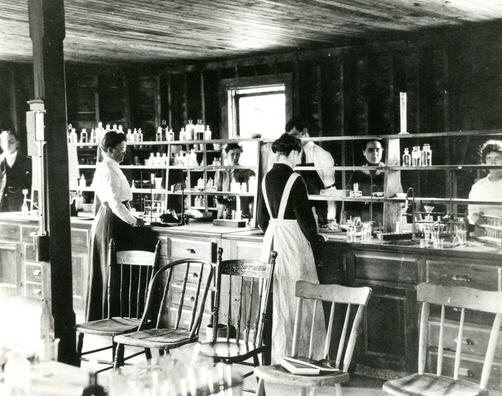
A Chautauqua chemistry class, 1885
The Teachers’ Retreat wasn’t just lectures and class work. Teachers attended concerts, competed in spelling bees, and compared notes while they mingled at receptions.
From year to year the subject matter expanded. By the time the Teachers Retreat celebrated its twentieth anniversary, the original premise of training Sunday school workers had become a small fraction of the Chautauqua University academic program.
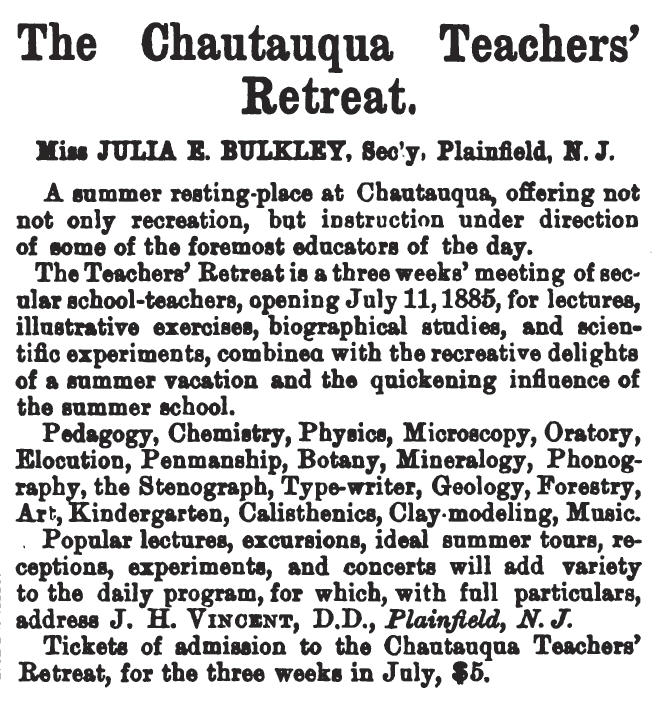
In fact, the Teachers’ Retreat had evolved into a meeting of secular school teachers by 1885, as this ad in the Journal of Education shows.
Advertisement in an 1885 edition of the Boston Journal of Education
There was a practical reason for the Chautauqua Teachers’ Retreat to expand its offerings as it did. In the nineteenth century, Sunday schools were often the only education many American children received. Children who could not, for one reason or another, attend school, could regularly attend church; and it was there that many received their only instruction in reading, writing, and arithmetic, in addition to training in the Bible.
As its catalog of academic classes expanded, so did the student body. Enrollment in the teachers’ retreat doubled, then tripled. By 1918 more than 3,000 students were enrolled and the faculty numbered ninety instructors.
Chautauqua Normal Hall as it appeared in 1895. The building was erected ten years earlier by the Alumni of The Sunday School Normal Classes.
Every year thousands of men and women left the Teachers’ Retreat and returned home with a new ideal of Sunday school work and an inspired plan for influencing others. Very quickly, Bishop Vincent’s office was overwhelmed with requests for information about the program and for teachers.
Soon, “daughter” Chautauqua Assemblies were established in different parts of the country so more people could attend. By 1890 there were over 30 active Chautauqua Summer Assemblies, ranging from Southern California to Maine, from Canada to England.
At the heart of each Assembly was the Teachers’ Retreat, where the best teachers learned their craft from Chautauqua’s visionaries and leaders, John Vincent and Lewis Miller.
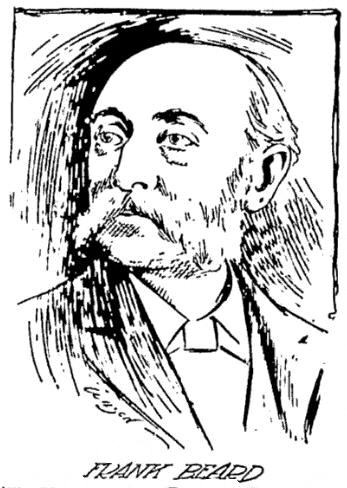
Frank Beard was one of the most popular lecturers at Chautauqua Institution. His Chalk Talk lectures drew standing-room-only crowds because of their pitch-perfect blend of humor, art and Biblical truths.
In an 1895 interview, Frank recalled how his Chalk Talks came to be:
“I was a young artist in New York, and had just been married. My wife was an enthusiastic churchgoer; and a great deal of our courtship was carried on in going to and from the Methodist church. The result was that I struck a revival and became converted. This occurred shortly after I was married, and like other enthusiastic young Christians, I wanted to do all I could for the church.”
Soon after he joined the church, the congregation put together an evening of entertainment. The ladies, knowing of his talent, suggested that Frank draw some pictures as part of the program. Frank agreed, but he felt that just standing in front of an audience and sketching without saying anything about the pictures “would be a very silly thing.”
He decided instead to make a short talk and draw sketches to illustrate his points. The talk was to be given as part of a Thanksgiving celebration, and Frank later joked that he rehearsed in front of his wife, his mother-in-law, and the turkey. “Well, my wife survived, my mother-in-law did not die while I was talking, and the turkey was not spoiled.”
When he gave his talk in front of the congregation, it was a great success. Soon, other churches asked him to repeat his talk, and in very short order he had more invitations to speak than he could ever hope to accept. His wife suggested charging a fee for each lecture, hoping that the cost would deter organizations from inviting him to talk at their functions. So Frank dutifully began charging $30 per talk. The requests continued to pour in. He increased his fee to $40, then $50, but his talks continued to be in great demand.
Announcement in the March 10, 1890 edition of the Illinois newspaper, The Rock Island Argus
That was the birth of the Chalk Talk, and Frank soon hit the lecture circuit. He was one of the first speakers at Chautauqua Institution in New York; and he lectured at many of the daughter Chautauquas. This 1899 clipping from the Los Angeles Herald recounts Frank’s Chalk Talk at the Long Beach Chautauqua (which named July 19, 1899 Frank Beard Day):
Announcement of Frank Beard Day at the Long Beach Chautauqua; from The Los Angeles Herald, 20 Jul 1899
The topics of his Chalk Talks ranged from morality tales to stories from the Bible, each told in a casual, funny, but reverent, way. He knew that people who wouldn’t listen to a “sermon” would listen to his Chalk-Talk if the truths were presented in an entertaining fashion.
In Four Girls at Chautauqua, Eurie Mitchell proved that very point. Eurie was so opposed to listening to “sermons” at Chautauqua, she refused to go to any of the lectures; but when she heard about Frank Beard’s caricatures, she decided to go see him for herself.
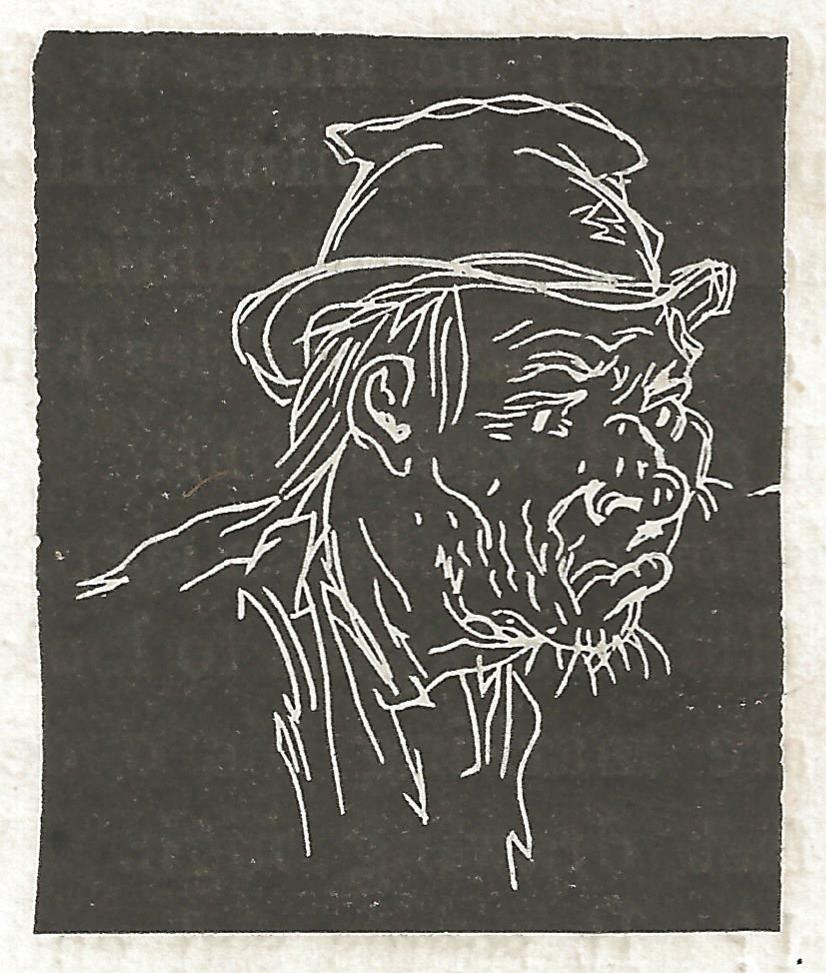
If you have never seen Frank Beard make pictures, you know nothing about what a good time she had. They were such funny pictures! Just a few strokes of the magic crayon and the character described would seem to start into life before you, and you would feel that you could almost know what thoughts were passing in the heart of the creature made of chalk. Eurie looked and listened and laughed.
In Isabella’s book, Frank’s Chalk Talk was able to do what no other lecture at Chautauqua could: reach Eurie’s heart and lead her, ultimately, to salvation through Christ.
“Pictures can often tell stories quicker and better than words,” Frank once said, “and I believe that cartoons can be used in the service of religion, righteousness, truth, and justice.”
To prove his point, he once asked, “If you were commissioned to teach a child the nature of a circle, would you begin by stating that a circle is an area, having for its center a point, and bounded by a circumference in the nature of an endless imaginary line, which at all points is at an equal distance from the center? No! You would do nothing of the sort, but you would [show] its nature and properties [by drawing a circle] in black and white.”
Sometimes the subjects of his Chalk Talks were very simple. He told a story, for example, of how a blackboard and chalk could be used to teach a Sunday-school class of young children who had never before seen the Christian symbol of a cross inside the shape of a heart. He started by drawing the simple outline of a heart on the blackboard.
“What is this?”
“A heart!”
“Yes, a heart. Now, I mean this to represent a particular heart—I mean it for my heart. What is it now?”
“Your heart!”
“Don’t forget that. Now, see what else I will draw.” And he drew a child’s face within the heart.
“Now what have I made?”
“A little boy!” “A little girl!” “A little child!” Variously cried the children.
“Yes, a little child; but where is the child?”
“In the heart.”
“In the heart?”
“In your heart.”
“That’s right. Now, what does it represent? When I tell you that I have a little child in my heart, what does it mean?”
“You mean you love the child.”
“Exactly. Now I will rub out the child and put a cross in the heart. What does that mean?”
“You love the cross.”
Then he went on to explain in a simple way what loving the cross meant.
He also shared an example of one of his lessons for older children and adolescents. He used this lesson to illustrate the concept of the narrow Christian path described in Matthew 7:13-14:
A young man is attracted by the appearance of beauty and the pleasure along the broad way. Timidly at first, for he is not bad and rather fears evil—but he loves play and pleasure—so he steps into it. He knows it is not the right way to take but he thinks to himself:
“After a while, after I have had a good time, I will go over to the right path and come out all right after all.”
Frank went on to explain how the young man fell in with evil companions and was drawn further away from the good path.
The young man learned to smoke and chew tobacco and read books “which mislead and give us wrong notions in life, that make heroes of scamps, thieves and liars.”
As Frank continued the lesson, he amended and enhanced his original drawing to show the progressive results of the choices the young man made in his life.
Wherever he gave his Chalk Talks, he was well received, and his reputation grew. But not everyone was a fan of using a blackboard and chalk as teaching tools in the Sunday-school. Frank shared a story about one church that decided to use a man in their congregation—they assumed he had talent because he was a sign painter by profession—to illustrate Sunday-school lessons. The man decided to illustrate the story of Samuel as a child, entering the apartment of the high priest Eli in answer to his summons. His efforts were not well received.
“Some objected to the bed-posts,” Frank said. “Some didn’t exactly know why, but the drawing didn’t conform to their idea of Samuel at all, and, more over, Eli’s nose was out of proportion.”
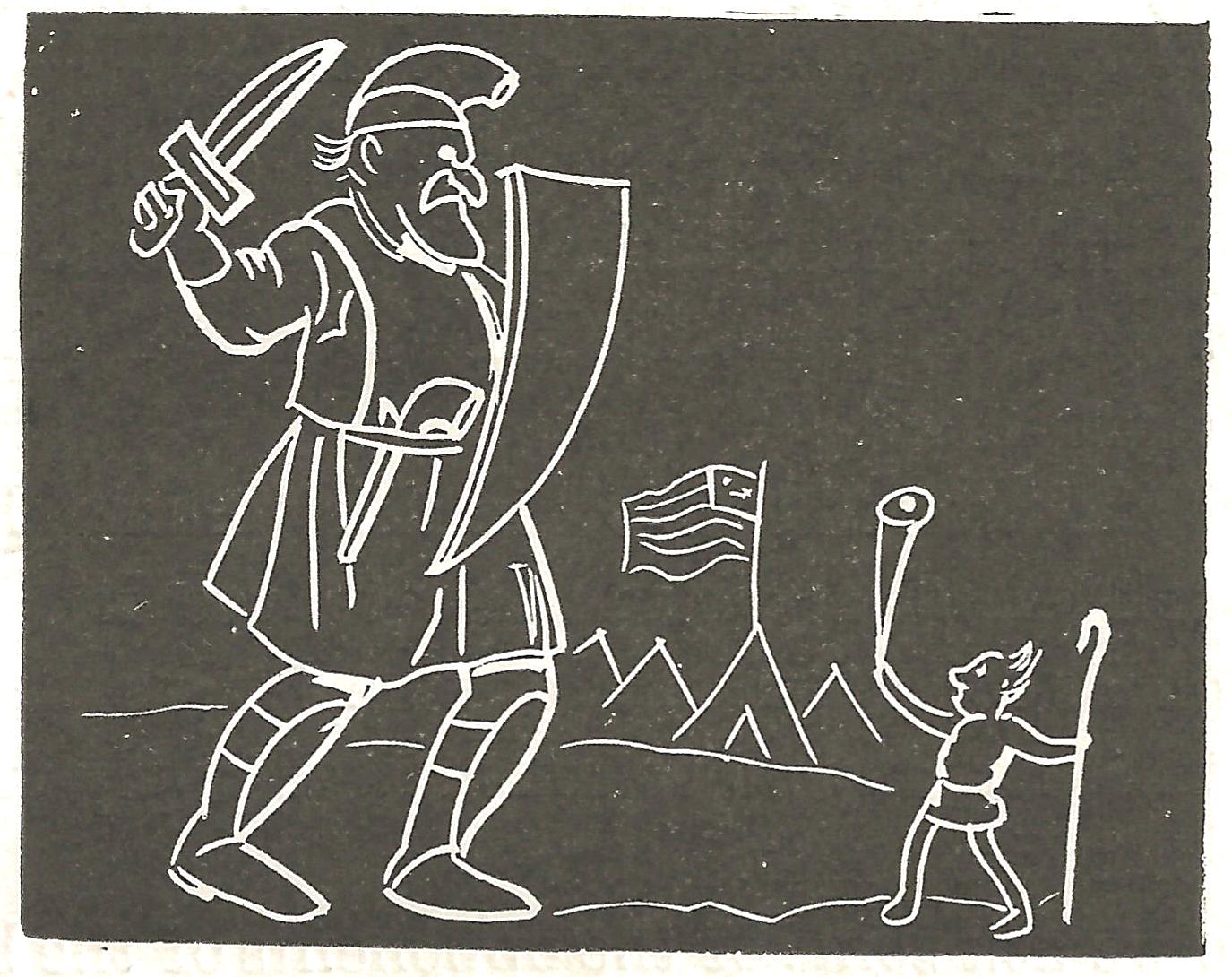
The man’s next attempt didn’t fare any better, when he drew Goliath about thirty-five feet high in proportion to David. In fact, the congregation didn’t like anything at all about the poor sign-painter’s efforts at the blackboard.
Isabella Alden’s book Links in Rebecca’s Life featured a character who also disliked Chalk-Talk style lectures. She was a Sunday-school teacher who hated chalk and blackboards.
“They are such horrid dusty things. You get yourself all covered with chalk, and just ruin your clothes. I can hardly wear anything decent here as it is. If I had a blackboard, I should give up in despair.”
“I should think it would be a great help in teaching children,” Rebecca said.
“Well, I don’t know. What could I do with it? I don’t know how to draw, and as for making lines and marks and dots, I am not going to make an idiot of myself. What’s the use?”
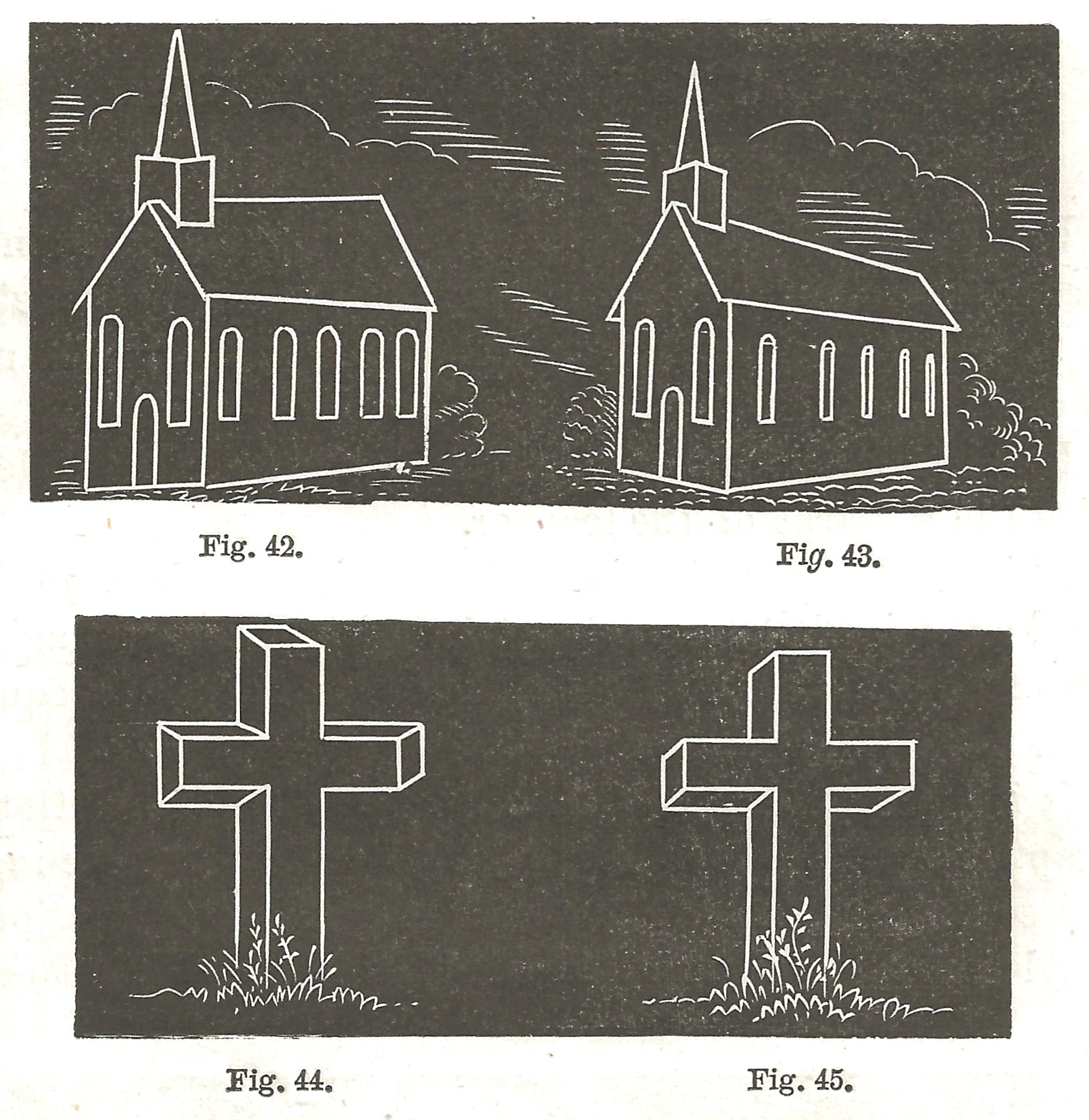
But Frank Beard believed no special talent was required for a teacher to incorporate chalkboard drawings into Sunday-school lessons.
“Many are apt to think some extraordinary genius is necessary to fit a teacher to use the blackboard,” he said. “It is a mistake. You can teach better with a pencil than without. You can learn to draw far better than you ever imagined possible.”
Illustrations from Frank’s book showing the right (Figures 43, 45) and wrong (Figures 42, 44) way to draw an image in perspective.
In 1896 Frank published a book for Sunday-school workers; in it he gave simple instructions for using the blackboard to illustrate Bible lessons.
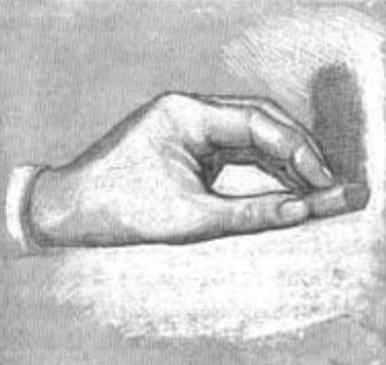
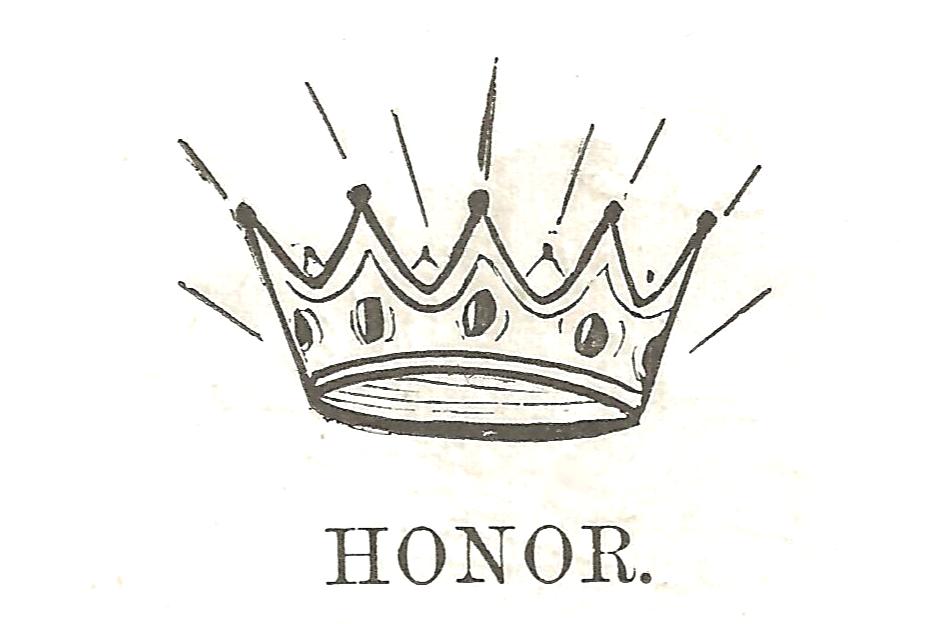
His book included how-to’s on perspective, lettering, and using easy-to-draw symbols as illustrations. Here are some of the symbols he illustrated:
The purpose of writing the book, he said, “is to show how the blackboard can be used in the Sunday-school, and to furnish such instruction in drawing upon it” so it can be done in the most effective way.
Illustration from Frank Beard’s book, Chalk Lessons
He was quick to say that he didn’t want the blackboard to monopolize the Sunday-school or supplant other useful forms of instruction. But, if used correctly, Frank Beard proved that the blackboard—and Chalk Talks—could be the “instrument which proves effective as a means of winning souls to Christ.”
In 1895 Frank Beard gave an interview to the Washington D.C. newspaper The Evening Star. Click on this image to read the interview in which Frank tells how he invented the Chalk Talk:
.
.
Click on the book cover to learn more about Links in Rebecca’s Life.
.
.
Click on the book cover to learn more about Four Girls at Chautauqua.
Aunt Hannah Adams is one of Isabella Alden’s most popular fictional characters. Aunt Hannah was a woman who loved the Lord, knew her mind, brooked no nonsense, and appreciated daily blessings. Most importantly, she knew when to give advice to others . . . and when not to. With all her life experiences, she grew wise in her older years; but, like any wise person, she also held her tongue until the time was right to share her own special insight with others.
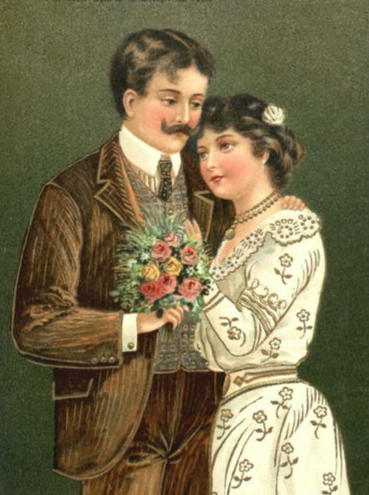
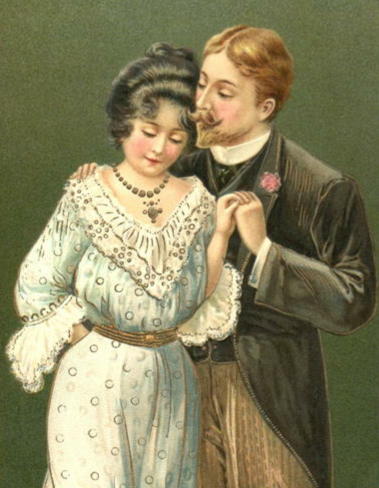
Here are some of Aunt Hannah’s wise thoughts and marriage advice that she shared with newlyweds John and Martha Remington:
It is best for young ones after they once fly from the home nest to set up independent of the old birds. I tried once to help two young robins. They were building a nest in the old apple tree right under my bedroom window, and they weren’t making it a bit comfortable according to my way of thinking. I watched them until I couldn’t stand it any longer. Then I hung little bunches of ravelings on the limbs in plain sight. The stubborn little things wouldn’t notice them, but kept on weaving in bits of straw and hay, as if, of course, they knew best.
One day they were both gone. I took a soft bit of wool and tucked it nicely into the nest. I thought when they once knew how warm it felt to the feet they would like it. But when that little housekeeper got back she was mad enough! She made angry sort of chirps that sounded for all the world like scolding, and he helped her along in it, like any foolish young husband. They flew around as if they were crazy, and tore that nest to pieces in no time. That taught me a lesson. I shall never meddle with any more nests.
When I married Nathaniel Adams it was because I should have been a most unhappy creature if I hadn’t. I don’t pretend to understand it all, how one year I never had seen him and the next I cared more for him than anybody in the world. It’s a great mystery. I always thought the Lord sent him to me. The Bible says that a good wife is from Him, and so, of course, a good husband must be. I only know that I never got tired of him. To the last day of his life a room was always pleasanter to me if he was in it.
Satan is never more busy with young people than he is the first year or two of their married life. The trouble is, a young couple start out, in spite of anything that is told them, expecting to find each other perfect. Of course, they are not; and so they are both disappointed. Now, if they would be more reasonable, and believe that they will discover some faults in each other, and that they must bear and forbear, and seek the help of the Lord in it, loving each other, faults and all, Satan would not get the hold of them that he does.
If a wife would speak out frankly to her husband when something worries her, it would be far better–not in a fault-finding way–little misunderstandings could be cleared up at once, but instead of that she takes some little thing that has hurt her and broods over it and sheds oceans of tears over it, and it grows and grows, and then she puts on the face of a martyr, and her answers are all in one syllable, and her eyes have a red rim around them. Her husband doesn’t know what is the matter, or he has forgotten if he ever did know. That is oftentimes the history, I dare say, of the beginning of trouble in unhappy marriages.
The right sort of a wife, who has a good husband, will not allow herself to worry about mere trifles–that is, if she has good sense. If she hasn’t, more’s the pity for both of ’em. When she is tempted to go distracted over some little thing about as big as the point of a pin, she will say, “Get thee behind me, Satan. You are not going to pick a quarrel this time. My husband means all right, and I shall trust him, even if he does forget some of the little attentions I’m used to.”
You know marriage is used again and again in the Scriptures as a figure of the union between Christ and the church. The marriage supper stands for the most glorious and joyful day that can ever come to us. And would He have said that a man was to leave everything and go with his wife, and that they should be one, if it was intended to be only a sort of partnership for convenience?
Did you notice that rose-vine at the east end of the front porch putting out new branches all over it? It will be full of roses pretty soon. That vine has been the wonder of the neighborhood for ten years. Now suppose I never watered it, or fed it with good rich earth from the woods, or dug about it, what a stunted, sickly thing it would have been! You have to take care of everything that’s worth having in this world. Love will die from neglect and abuse as quick as a rose-bush.
If there are any two in the world who should be one in principles and aims, it is those who are to spend their lives together. God meant it so. There is no happiness where a husband pulls one way and the wife another. Why should they wish to be together unless they are in harmony on what you might call the keynotes of life? It will only be one long discord. If a man and woman jar each other before marriage, a few words spoken by a minister is not going to change them.
What do you think of Aunt Hannah’s advice? What’s your favorite piece of advice from Aunt Hannah and Martha and John? What special advice has someone given you? Feel free to use the comments section to share your thoughts.
Reviews and giveaways for Christian fiction and sweet, clean fiction. Bringing readers information on great stories and connecting authors with their readers.




 .
.
 You can click on the book cover to read more about Isabella Alden’s book, Jessie Wells.




















 Isabella Alden