Christmas For Jesus’ Sake

In Alabama the Tuscaloosa Female College was a successful and popular boarding school for girls aged six through sixteen.
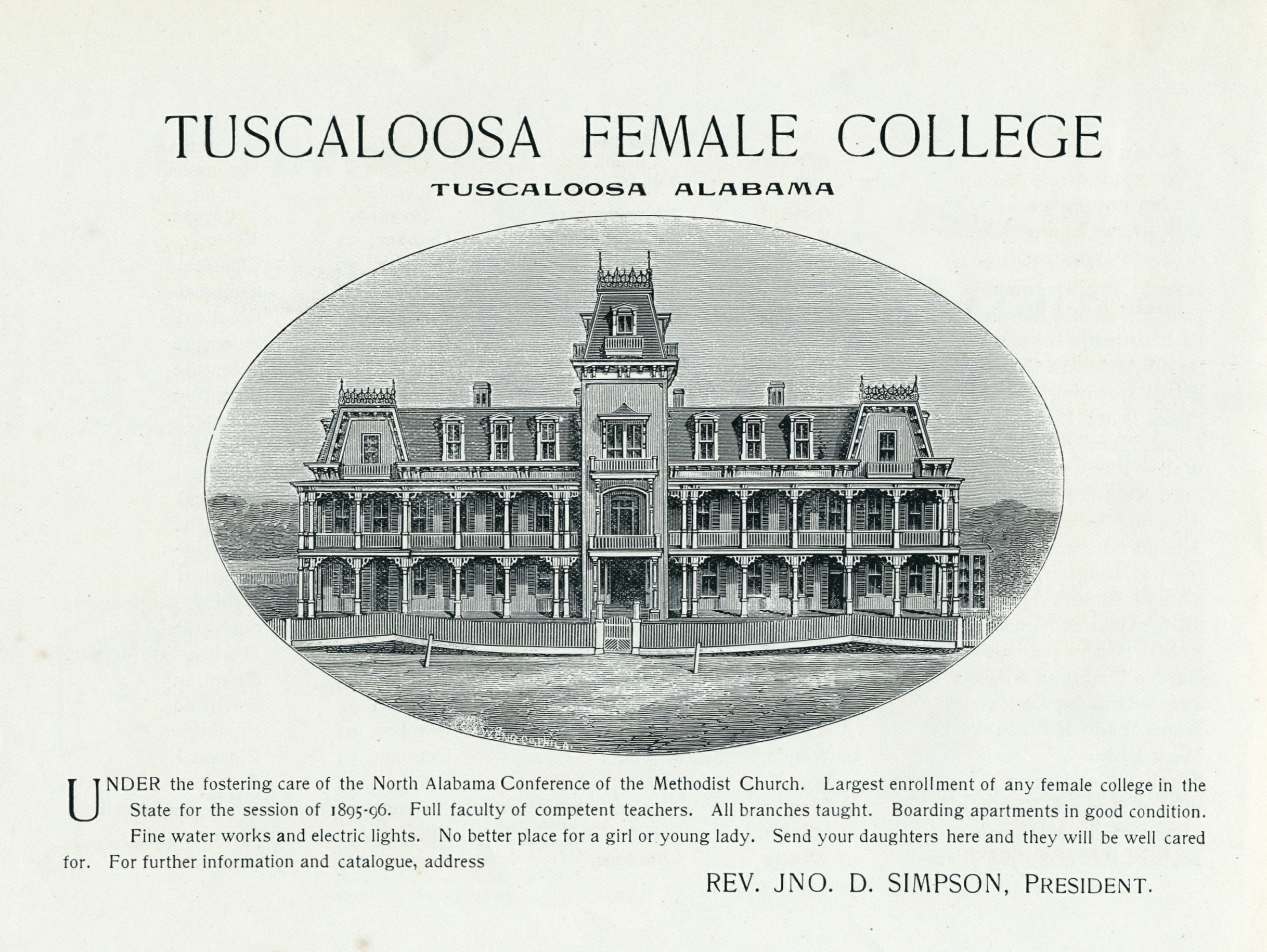
Black and white illustration of a large building, three stories tall built in an ornate Gothic style. The first and second stories have verandas that stretch across the entire front of the building.
Tuscaloosa Female College, from an 1895 brochure.

In addition to classroom studies, the school offered students a variety of different clubs they could join; one club that was available to the youngest students was a chapter of The Pansy Society.

Isabella created The Pansy Society of Christian Endeavor as a children’s version of the Christian Endeavor program that had taken teens and young adults by storm in the 1880s.

Black and white drawing of the Pansy Society logo. In large letters are the initials P.S.C.E. behind and surrounding them are drawings of pansy flowers, ribbon, and letter-size mailing envelopes with scribbled addresses and hand-drawn postage stamps.
Logo for The Pansy Society of Christian Endeavor

She wrote about The Pansy Society in stories and articles she published The Pansy magazine. Children who joined the society pledged to do good works and live their daily lives “For Jesus’ sake.”

That motto—For Jesus’ Sake—was a motto the students at the Tuscaloosa Female College took to heart. Under the mentorship of teacher Eloise Hemphill, the school’s Pansy Society chapter took a special interest in some newspaper articles written by a local reporter about an orphanage in Tuskegee that was in need of help.

Excerpt from a newspaper. Headline: Tuskaloosa Female College. Faculty for Session 1888-89. The article lists several names of teachers in the "Collegiate Department" and the "Academic Department." Under the heading "Primary Department" is only one name: Miss C. Eloise Hemphill, Principal.
From The Tuskaloosa Gazette, September 20, 1888.

So when it came time for the school’s Pansy Society to perform their annual Christmas cantata, they invited the same reporter who wrote the articles to attend so he could write about their performance for the newspaper.

Unfortunately, the reporter arrived late, after much of the performance was over, and after Santa Claus had distributed all of the presents under the Christmas tree. So he was very surprised when, as soon as he arrived, the students immediately halted the program and called him up on the stage.

Wary, he did as he was asked, expecting to “receive a ten-cent comic toy placed on the tree by some little girl, to have a good laugh at his expense.”

“Imagine, therefore, his surprise and gratification when old Santa Claus handed him an envelope, tied with a piece of pink floss, with the following inscription:

“A Christmas offering of five dollars to the orphans of Tuskegee; presented by the Pansy Society in the Primary Department of the Tuskaloosa [sic] Female College, December 25, 1887.”

Newspaper Excerpt. Heading: The Pansy Society. On Saturday evening the Pansy Society of the Tuskaloosa Female College gave a Cantata and Christmas Tree. The Gazette reporter arrived too late to witness the first part of the evening's performance, and when he got a few feet inside the door the little girls commenced to call him to the stage. Mustering up all of his courage he walked straight up to the rostrum, blinded as he was by the bright light from the chandeliers. He expected to receive a ten cent comic toy, placed on the tree by some little girl, to have a good laugh at the expense of "ye reporter." Imagine, therefore, his surprise and gratification when Old Santa Claus handed him an envelope, tied with a piece of pink floss, with the following inscription: "A Christmas offering of $5 to the orphans of Tuskegee; presented by the "Pansy Society" in the Primary Department of the Tuskaloosa Female College, Dec. 25th, 1887."
From The Tuskaloosa Gazette, Thursday, January 5, 1888.

In 1887, five dollars was a lot of money for little girls to raise; it was the equivalent of about $160 in today’s economy.

The reporter was so surprised and gratified, the gesture caused him “to lose his head and eyesight at the same time” as he stammered out his thanks.

Of course the editor of The Tuskaloosa Gazette printed the story of the evening’s events, and added:

“Miss Eloise Hemphill and the sweet little Pansy Society have acted nobly. Out of their own little savings, in the midst of the festivities of Christmas, these little girls have contributed the handsome sum of five dollars for the little orphans whom God hath bereft of father and mother. It was one of the most delicate little acts of kindness it has ever been our pleasure to witness.”

Black and white head-and-shoulders photo of young woman in her twenties from about 1890. She is wearing a white dress with a high neckline where a small  brooch is pinned. Her hair is dark; bangs curl around her forehead. The rest of her hair is loosely pinned up at the back of her head.
Miss Eloise Hemphill (from Ancestry.com)

The editor added:

“The seeds of charity that have this Christmas been planted in their hearts by their noble teacher, Miss Eloise Hemphill, will take root and grow and bloom as they develop into lovely womanhood, until, like angels of mercy, they will go about doing good as long as they live.”

Isabella encouraged every member of The Pansy Society to plant similar “seeds of charity.” Each Christmas she asked them to pause amid the merry bustle of the season to “make some little gift as a loving reminder to one who otherwise would have none,” and to do it “For Jesus’ Sake.”

Do you have a similar Christmas tradition of giving a christmas gift to someone who otherwise wouldn’t have one?

What’s your favorite way to share a small act of kindness “For Jesus’ Sake”?

You can read more about The Pansy Society of Christian Endeavor in these posts:

Nettie Beldon’s Motto

Have you read Isabella’s novel, Only Ten Cents? In the story young Nettie Beldon’s health is so poor, she is unable to leave her room.

One day, her mother returns from a trip to the store with a surprise:

Mrs. Beldon produced and untied an interesting-looking roll, and spread it out in triumph on the little stand which she drew up in front of Nettie. “There, isn’t that pretty? It is exactly like the things I used to work when I was a little girl. I haven’t seen one of them in I don’t know how many years, yet I used to make them ever so often. When I saw it lying there on the counter I thought of you right away, and thinks I to myself: I do wish I could get one of those for Nettie.”

Nettie raised herself a little from among the pillows, and an eager look began to come into her eyes, while a delicate pink flush appeared on her pale cheek. “For the barrel, mother? Something that I can make?” She looked curiously at the cardboard spread out before her—very familiar material to her mother, but new to Nettie.

“What queer little dotted stuff!” she said. “What is that marked on it? Letters? Why, mother, does it read something?”

“Yes, indeed it does,” said the mother triumphantly. “Here, let me hold it so that you can make it out. They are not very plain, you know: just a pattern to be worked. Take pretty blue or pink, or some kind of worsted or silk, and work the letters so that they stand out bright and clear. They are as pretty a thing as one need have. My, how many of them I used to make when I was a little girl!” She slipped a piece of paper under the cardboard, and then held it in the right light, so that Nettie could read quite distinctly: “Blessed are the pure in heart, for they shall see God.”

She read slowly, picking out the words that wound in and out amid a sort of scroll-work.

“Why, mother, how very pretty! And how very queer! I never saw anything like it before.”

“I have,” said the mother. “Once I worked this very motto for my grandmother, and she had it framed and hung in her room. It hung there for years.”

Nettie’s mother taught her to cross stitch the letters, and soon Nettie completed the “motto.” But Nettie’s handiwork never hung on any wall in her house; instead, it fulfilled a much greater purpose in the story.

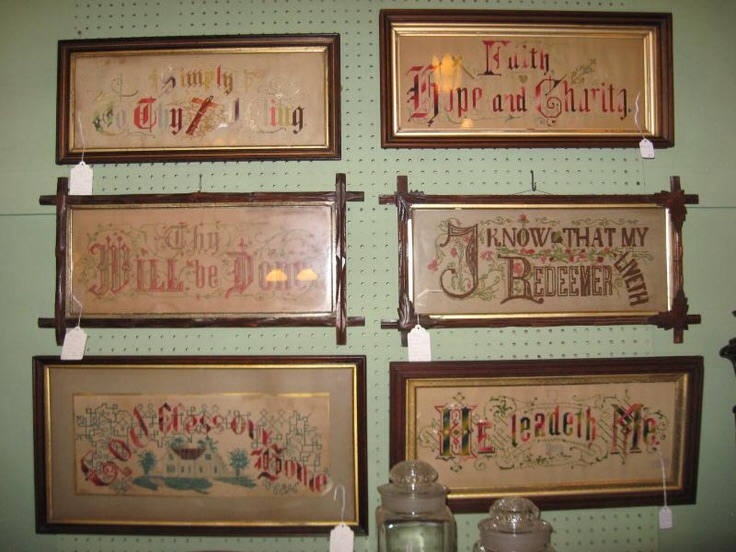
Karen, a long-time friend of this blog, found some great examples of what Nettie’s “motto” might have looked like.

What do you think? Have you ever stitched a motto yourself, or know someone who has? Are mottoes like these too old-fashioned to hang in a today’s modern home?

You can see more examples of mottoes by visiting this Pinterest page: 44 best Victorian Motto Sampler Shoppe

Thank you, Karen, for sharing these images!

You can click on the book cover to learn more about Only Ten Cents, by Isabella Alden.