A Feast of Good Things

Have you ever wondered what it would be like to be famous?

Black and White photo of a woman almost in profile. Her hair is a light color, parted in the middle of her head, and pulled back to form a large braided bun at the back of her head. She wears a dress with a high ruffled collar trimmed in white lace; a white lace jabot falls from the high collar down the front of her dress.
Isabella Alden circa 1880

Imagine walking into a room filled with people who burst into applause as soon as you enter. Then imagine that you’ve agreed to speak at an assembly that’s filled to overflowing with people, seated and standing in every available space, who hang on your every word.

That’s a little taste of what life was sometimes like for Isabella Alden. Today it might be hard for us to understand just how famous and beloved she was by people across the country. In a time before social media, television, and radio, Isabella had a nation-wide reputation as both an author and as a respected and knowledgeable public speaker on a variety of topics, including the development of Sunday-school lessons.

In 1886 Isabella and her husband, Rev. G. R. Alden, were living in Cleveland, Ohio, where Rev. Alden was pastor of a Presbyterian church. But when he wasn’t preparing sermons, and she wasn’t writing novels and stories for Christian magazines, the Aldens traveled the country to help churches design and implement well-organized, robust Sunday-school curriculums.

In June of that year they were invited to attend a conference in Wellington, Kansas, where the local churches hoped to find a way to better manage their Sunday-school offerings to children and adults. The Aldens accepted.

Newspaper clipping: A Sunday school institute will be held at the Presbyterian church June 13th, 14th, and 15th. The services of Mrs. Alden of Cincinnati, the well-known authoress of the "Pansy" books, has been secured, and it is expected that the interest of the institute will be greatly increased by her presence. She will also take part in the celebration of children's day on Sunday, the 13th. All Sunday school workers of the city and country are invited to attend and participate in the work of the institute.
From The Conway Springs Star (a Kansas newspaper) on June 11, 1886

As soon as the local newspapers announced that Isabella Alden would be among the featured speakers, the churches were guaranteed to have an excellent turnout for their conference.

Newspaper clipping: The committee in charge of the arrangements make this further announcement: “We desire again to call the attention of all parents, Sunday School workers, and especially all young people, to this unlooked for opportunity to meet and greet Mrs. G. R. Allen [sic], “Pansy.” She is known and loved as the author of such helpful and thrillingly interesting books as “Ester Ried,” “Four Girls at Chautauqua,” “The Hall in the Grove,” “One Commonplace Day,” etc. Her engagement with the State Sunday School Assembly at Ottawa, Kansas, brings her west at this time and we trust that a “crowded house” will show our appreciation of the extra effort she is making to come to Wellington. The other speakers from abroad, and those among us who have kindly agreed to assist in these meetings, will give us a feast of good things. Come everybody and enjoy the feast.
from The Monitor-Press (Wellington, Kansas) June 11, 1886

Here’s how the local newspaper described the scene on the first night of the conference when Isabella made her appearance:
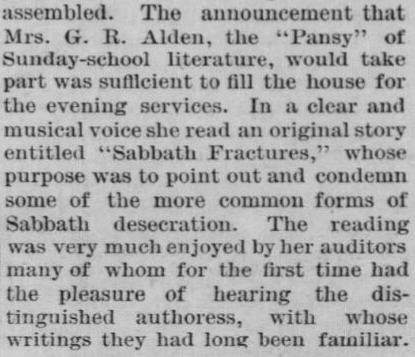
Newspaper clipping: The announcement that Mrs. G. R. Alden, the "Pansy" of Sunday-school literature, would take part was sufficient to fill the house for the evening services. In a clear and musical voice she read an original story entitled "Sabbath Fractures," whose purpose was to point out and condemn some of the more common forms of Sabbath desecration. The reading was very much enjoyed by her auditors many of whom for the first time had the pleasure of hearing the distinguished authoress, with whose writings they had long been familiar.
from The Wellington Monitor, June 18, 1886.

The meetings began on a Monday afternoon and Isabella took an active role, according to the agenda:

Newspaper Clipping: "Mention was made last week of the county Sunday school institute which will be held at the Presbyterian church on Monday and Tuesday, June 14th and 15th. The programme as published below shows many features of interest that ought to attract a large attendance of the active Sunday school workers of the county:" Follows an agenda including a "Primary conference" on Monday afternoon and a "Paper" reading Monday evening by Mrs. G. R. Alden, "Pansy."
from The Wellington Monitor, June 11, 1886

In one of the sessions she spoke about how to design Sunday-school lessons for children in the Primary Class age range of four to eight years:

Newspaper clipping: She sketched briefly and clearly a plan of work among the younger classes in the Sunday school that long experience had shown to be attended with the best results. She favored the division of the primary pupils into small classes of not more than seven members each, which should be taught if possible in a room separate from the rest of the school.
from The Wellington Monitor, June 18, 1886

In another session she participated in a discussion on the proper way to prepare teachers for the work of teaching meaningful lessons:

Newspaper clipping: Mrs. Alden conducted a conference on her favorite theme of primary work, of one hour’s duration. The spoke strongly against teaching children misty doctrines of general truth, of which the teacher lacked the skill to make definite application. The children’s quickness of apprehension, even at the earliest age when they enter the primary class should not be underrated. The danger of simply interesting the children with recitations of Bible stories, without bringing out the spiritual lessons they were meant to teach, was one point to be guarded carefully against.
from The Wellington Monitor, June 18, 1886

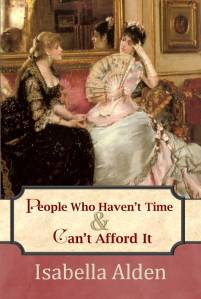
On Monday evening she read one of her short stories, “People Who Haven’t Time and Can’t Afford It,” which, the newspaper reported, “held the close attentions of the audience in spite of the discomforts of the crowded room.”
The rest of the conference was similarly busy for Isabella. The last night of the conference was “attended by an audience larger than the seating capacity of the church.” Isabella closed the evening session by reading a paper she wrote about “the Penn Avenue Church” and the difficulty the church had raising money for Sunday school purposes and for books to stock a small church library.

Eventually, Isabella revised that “paper” into a short story called “Circulating Decimals,” which was published two years later.
By every measure, the 1886 Sunday School Institute in Wellington, Kansas was a resounding success.

Newspaper clipping: The institute from every point of view was a great success, both as arousing new interest in the cause on the part of the Sunday-school workers of the city and county, and acquainting them with new methods of instruction. It will undoubtedly lead to the formation of a permanent county organization and the frequent and regular holding of similar institutes and conventions in the future.

And with Isabella’s many contributions—from offering practical advice to reading stories with a message—it truly was a “feast of good things.”

One final note:

Isabella may have been a famous celebrity, but when she and Reverend Alden made these trips, they rarely stayed in a hotel. Instead, they were usually invited to stay in the home of one of the local church members. In Wellington, Kansas, they stayed in the home of George and Laura Fultz. Mr. Fultz was a leading businessman in Wellington, and he and his wife were active members of the Presbyterian church.

Black and white photo of a man in profile. He wears wire rimmed glasses and his hair is wavy and dark. He is dressed in a dark suit of clothes that would have been in fashion in the 1890s. He wears a dark bow tie and has a high starched shirt collar.
George Fultz

How lucky were Mr. and Mrs. Fultz! Isabella and her husband stayed with them for five nights. Imagine having your favorite author sit at your dinner table, join you in a morning cup of coffee, or share an evening on your front porch, relaxing and watching the sun set together after a full day of meetings.

If you were fortunate enough to have Isabella as a guest in your home, what kind of questions would you ask her?

All of the short stories mentioned in the post are available for you to read for free. Just click on any of the highlighted titles or cover images to download your copy from Bookfunnel.com.

The First Pansy of the Season

“A plainly attired lady of medium hight [sic] wearing a brown dress and lace collar, was introduced to a large audience at the Case avenue Presbyterian church last evening as Mrs. G. R. Alden, or the first “Pansy” of the season after an unusually severe winter.”

Isn’t that a charming way to describe Isabella?

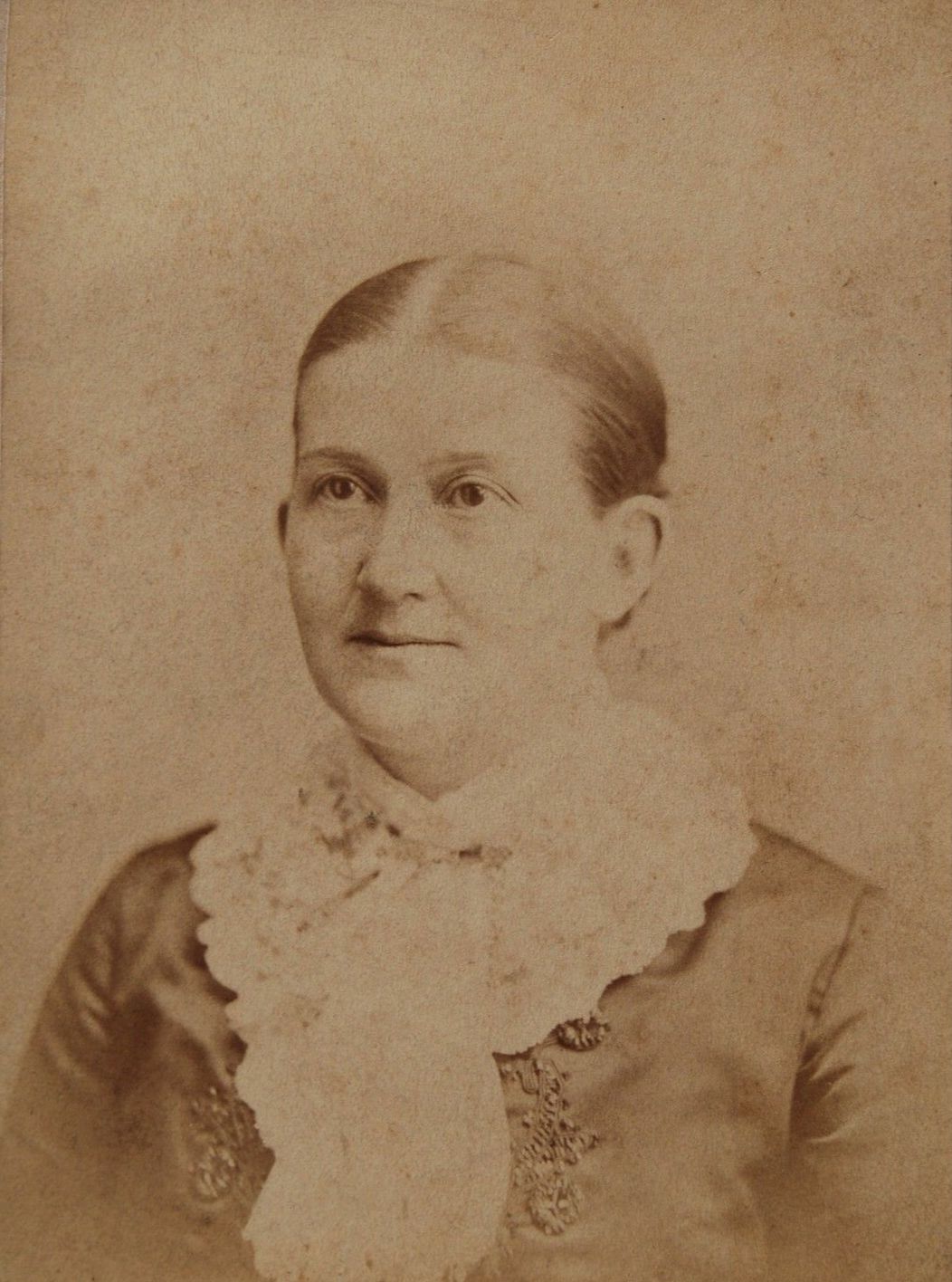
Sepia head and shoulders photograph of Isabella. She wears a dark-colored dress with long sleeves and embroidered flowers adorning the bodice, and a detachable lace color that buttons high on the throat. The lace is 3" to 4" deep, and hangs down into a jabot 4" to 5" long.
Photo of Isabella Alden about 1880 (age 39)

Those are the first lines of a newspaper article about a public reading she gave at a Cleveland church in 1885.

Isabella regularly drew large crowds whenever she appeared at an event, especially if there was a chance she might read one of her stories; and on this particular evening, she read chapters from her short story “Circulating Decimals.”

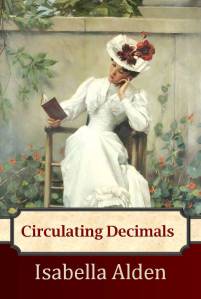
Cover of "Circulating Decimals" showing  a young woman in a white dress from the early 1900s, and a white hat with red flowers. She is seated in a wooden chair in a garden and is reading a book.

Here’s the newspaper’s full description of the event:

“PANSY” ON CHURCH SOCIETIES.

Mrs. Alden and the Adelbert College Glee Club Entertain an Audience.

A plainly attired lady of medium hight [sic] wearing a brown dress and lace collar, was introduced to a large audience at the Case avenue Presbyterian church last evening as Mrs. G. R. Alden, or the first “Pansy” of the season after an unusually severe winter.

Mrs. Alden, who is well known in the literary world as “Pansy” the Sunday school workers’ favorite authoress, read several chapters of her republished book “Circulating Decimal,” to the great delight of her hearers. She is a pleasing and natural reader, and knows how to interest an audience. She read of the trials and tribulations of Sunday school societies, described the efforts of the young ladies to “get up” a church fair and the cantata of “Esther,” how they quarreled over the leading parts and how they netted the enormous sum of $19.02

In the course of the evening the Adelbert college glee club entertained the audience with several excellent selections, capitally sung, among which were “Nellie was a Lady,” “Way Down Upon the Suwanee river” and “George Washington.”
From the Cleveland Plain Dealer, April 15, 1885

You can read Isabella’s story “Circulating Decimals” for free!

Choose the reading option you like best:

You can read the story on your computer, phone tablet, Kindle, or other electronic device.

Just click here to download your preferred format from BookFunnel.com.

Or you can select BookFunnel’s “My Computer” option to receive an email with a version you can read, print, and share with friends.

A Nice Oyster Supper

There’s a recurring theme in many of Isabella’s books you may have noticed:

Whenever a group of characters needed to raise money for their church or favorite cause, their first inclination was to earn the money through a social event.

Ad from a 1918 North Carolina newspaper.

Isabella’s characters held fairs and festivals, old folk’s suppers and young folk’s concerts, character parties and tableaux, strawberry soirees and ice cream socials—all in the name of raising money for their church or charity.

Announcement in Fort Mill Times (South Carolina), November 17, 1910.

Carrie Spafford in The Pocket Measure didn’t see the sense of it. She asked:

“Why do you suppose we always think of devices of this kind whenever we talk about money for the cause of Christ?”

Carrie asked a good question. Whenever there was money to be earned, Isabella’s characters—much like the people in churches Isabella observed first hand—spent long hours and lots of money to stage events by which they hoped to receive donations for their cause.

The Camden (Tennessee) Chronicle, February 9, 1912.

The most popular method Isabella’s characters turned to for raising money was the oyster supper.

That’s what happened in Isabella’s short story, “Circulating Decimals.” As soon as the ladies of the Penn Avenue Church realized the church library was in need of new books, they decided to take action.

Up rose the women, the respectable, middle-aged, matronly women. The library must be replenished, the money must be raised. They—the matrons—would do this thing speedily and quietly. They would have an oyster supper on a large scale, make preparation for a great many guests, furnish oysters in every possible style, and with them such coffee as only they could make, to say nothing of the inevitable cake and cream, and side dishes for those who did not relish oysters. So they went to work quietly, skillfully, expeditiously. Baking, broiling, frying, stewing!

A portion of a comic appearing in the Washington DC Evening Star, January 1, 1911.

Oysters were also the go-to choice when Isabella’s characters entertained guests in their home.

Preparing an oyster supper; and 1873 print.

Flossie Roberts served oysters with jellies and sauces to the rough boys in her Sunday-school class in Ester Ried Yet Speaking.

Oysters with Lemon, a painting by Otto Scholderer, 1891.

And when the impoverished Cameron family in What They Couldn’t struggled to find a way to entertain their society friends with little money, they decided to invite their discerning friends to a simple lunch:

Their ideas of simplicity would have bewildered some people. A lunch without salads was not to be thought of, of course; and chicken salads were the best. No matter if chicken was very expensive just now, it did not take a great deal for a salad. Then oysters were just getting nice, and, after the long summer, seemed so new; raw oysters were the very thing with which to begin a lunch. Served on the half-shell and properly garnished, there was no simple dish which looked more inviting.

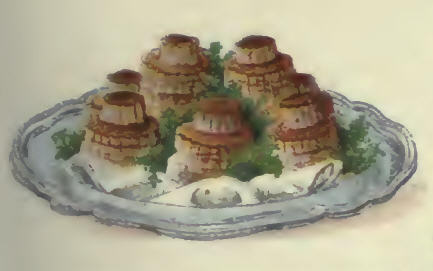
A plate of oyster patties from Mrs. Beeton’s Book of Cookery, 1907.

In these stories, and many others, Isabella was sharing a very real circumstance of life in late 19th and early 20th century America:

America loved oysters and ate them in abundance.

Business card for an oyster dealer, 1880.

Fresh oysters were prized, but thanks to advancements in canning methods, oysters could be shipped inland to Midwest cities that previously had no means for buying and consuming seafood.

And new techniques for harvesting oysters made them so abundantly available, their cost was half as much as beef, per pound. They were inexpensive and popular, and Americans couldn’t get enough of them.

A plate of grilled oysters, from Mrs. Beeton’s Book of Cookery, 1907.

Cook books of the time had recipes for stewed oysters, fried oysters, broiled oysters, and pickled oysters.

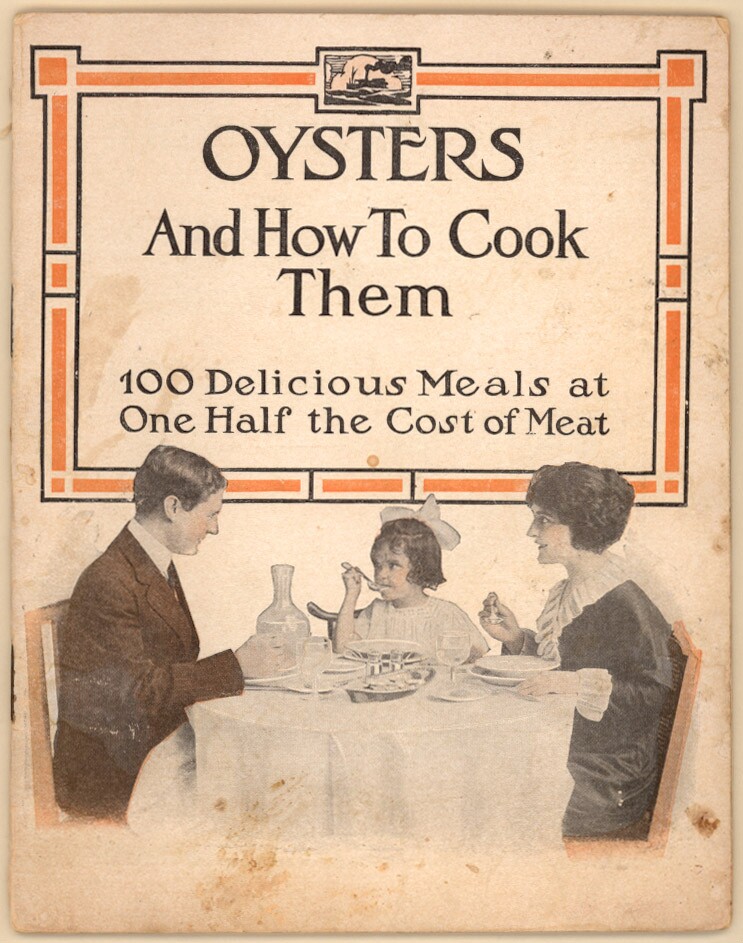
A 1915 cookbook published by the Oyster Growers and Dealers Association of North America. You can click on the cover to see the entire cookbook.

Americans served oyster patties, oyster pies, and soups. They added oysters to their meats, stuffed them in turkeys, and scrambled them with eggs.

For those who didn’t want to prepare oysters themselves, they could find oysters on the menu of most restaurants and public houses.

The Union Oyster House in Boston, Massachusetts was founded in 1826 and is still in business today.

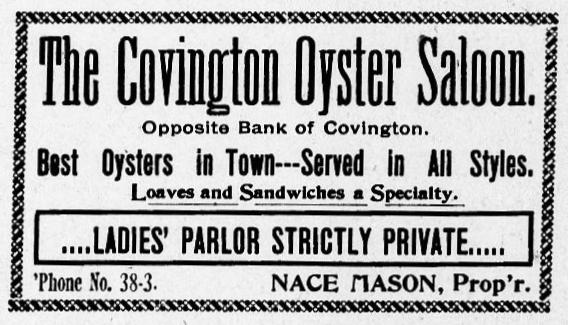
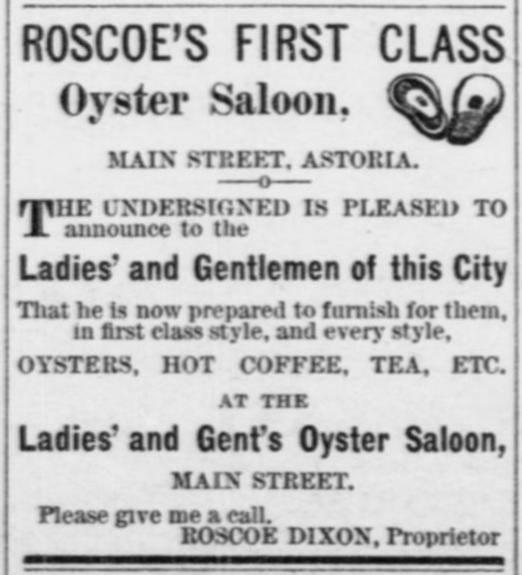
Most major towns in America could boast an oyster parlor or oyster saloon.

A 1903 newspaper ad for a Louisiana oyster saloon offering a ladies’ private parlor.

Many such establishments had private dining rooms for ladies, where they could eat oysters in an environment that did not offend their delicate sensibilities.

An 1881 ad for an oyster saloon in Astoria, Oregon.

Americans’ love for oysters spawned an entirely new industry of serving plates and utensils designed specifically for oysters.

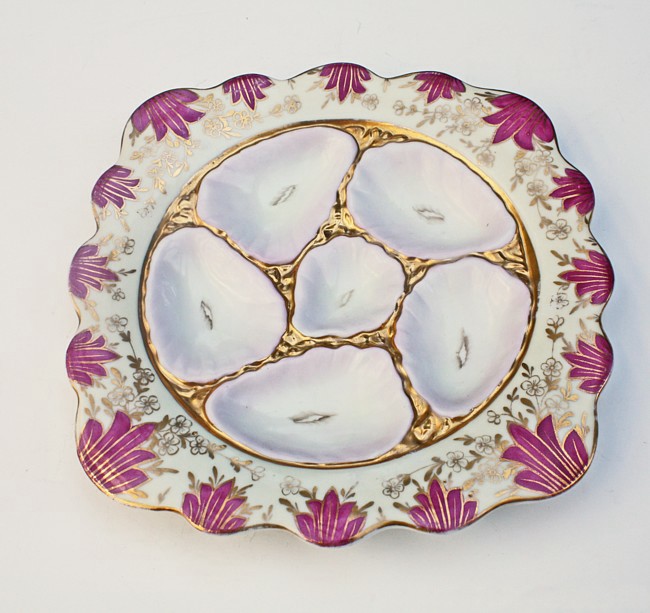
An oyster plate from the late 1800s. With six oyster wells, it is decorated in the Chinoiserie style popular at the time.

It’s no wonder, then, that when Isabella’s characters planned a dinner or a party, they naturally thought to put oysters on the menu. They were inexpensive, easy to prepare, and almost everyone liked them.

A silver oyster fork from Tiffany & Company, dated 1872

But cooking and selling oysters didn’t guarantee that a fund-raising event would be successful. Though festivals and dinners and other fund-raisers were very stylish, Isabella believed that more money and effort were spent on putting the events together than the organizers ever made from donations.

When talk turned to having a fund-raising festival of some kind in The Pocket Measure, Callie Spafford stated Isabella’s opinion plainly:

“Haven’t you often seen gentlemen eat fifty cents worth of oysters and cake and cream and fruit and celery, and I don’t know what else, and pay twenty-five cents for it all, and think they were being benevolent?”

Despite the questionable economics, oyster suppers remained a favorite form of charity fundraisers in America . . . and in Isabella’s novels.