Blog

The Edison Connection

In the summer of 1885 inventor Thomas Alva Edison was a rock star in American culture.

An 1899 advertising poster for Edison's Concert Phonograph.
An 1899 advertising poster for Edison’s Concert Phonograph.

Americans admired his intelligence and strong work ethic. They revered him for inventing products that made the average American’s life easier and more enjoyable.

Advertising trade card for the Edison phonograph ca. 1910

He was affectionately called “The Wizard;” reporters and photographers followed him wherever he went; and authors wrote imaginative stories endowing Edison with cartoon-like super-hero powers (at the bottom of this post you can read an example).
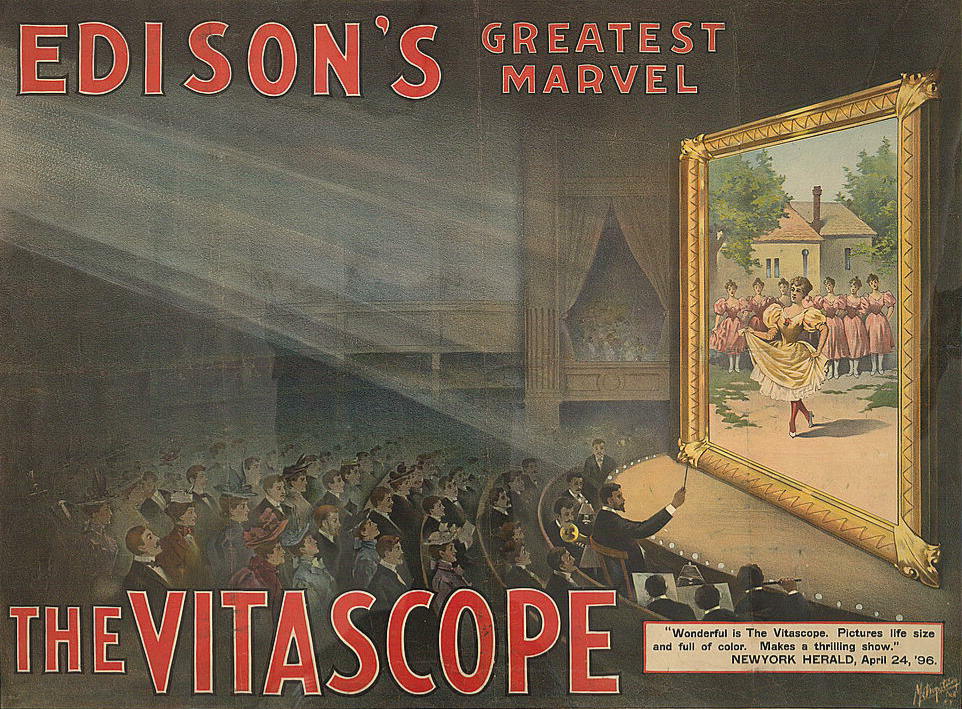
Advertising card for Edison's Vitascope motion picture process, 1897.
Advertising card for Edison’s Vitascope motion picture process, 1897.

In the summer of 1885 Edison was 38 years old. He was touring Mount Washington, New Hampshire with a party of friends, when a reporter asked him for a quote for his newspaper.

Thomas Edison, ca. 1880.

This was not an unusual occurrence; reporters were used to Edison spontaneously offering up heady scientific thoughts or pithy quotes for them to print.
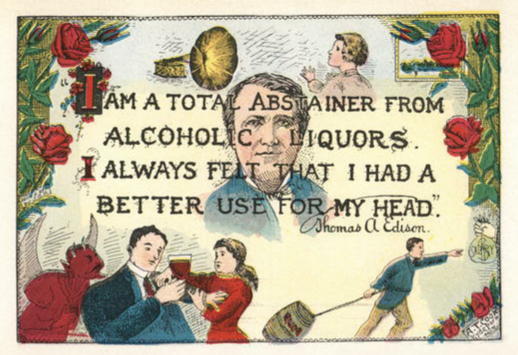
Edison Quote Abstinence

But on this particular day, Edison took the newspaper reporter’s pencil and pad and wrote on it:

Miss Mina Miller of Akron, the most beautiful woman in Ohio, is today a guest of Mount Washington.

It was a stunning revelation: The Wizard of Menlo Park—known for being so focused on his work that he usually slept in his laboratory rather than going home to his family—had a romantic streak! But who was Mina Miller?

Mina Miller about the time of her marriage to Thomas Edison in 1886 when she was 20 years old.

Mina Miller was the 19 year old daughter of Lewis Miller, co-founder of the Chautauqua Institution and an inventor himself. He had made a fortune designing and manufacturing farm equipment.

Lewis Miller, inventor and co-founder of the Chautauqua Institution.

That summer Mina was one of Edison’s party touring Mount Washington. She had just graduated from a ladies’ boarding school in Boston and was pursuing her music studies when she met Edison through an introduction in a mutual friend’s drawing room. Edison fell instantly in love.
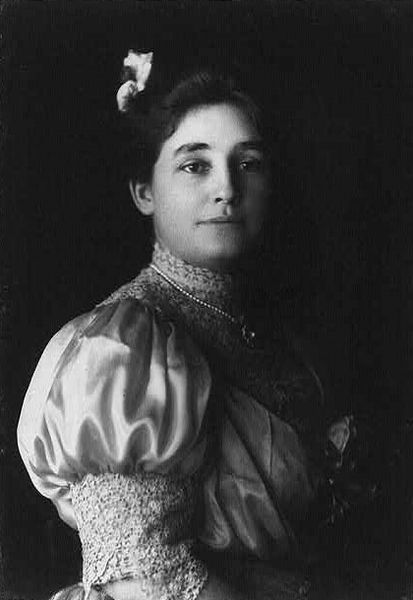
Mina Miller Edison, about 1906

A widower, Edison had been married before to Mary Stillwell, a young woman who worked in his laboratory. An 1896 article in a Louisiana newspaper described his courtship of Mary:

Opelousas Courier 1896

While Edison’s first marriage may have had a very practical beginning, his second marriage was undoubtedly a love match.

Edison himself joked that he was so distracted by thoughts of Mina, he was almost run over by a street car. When Mina and the rest of the Miller family removed to Chautauqua Institution for the summer, Edison followed, determined to win Mina’s heart and the good opinion of her parents.

He taught her Morse Code so they could converse privately when other people were around. It was while they were riding in a motor car with friends that Edison tapped out his marriage proposal on the palm of Mina’s hand. She tapped out her acceptance.

Mina and Thomas Edison in their locomobile

Six months later they were married in Mina’s home in Akron, Ohio. Newspapers of the time described every detail, from the cost of the floral decorations, to a description of the extravagant wedding gifts they received.
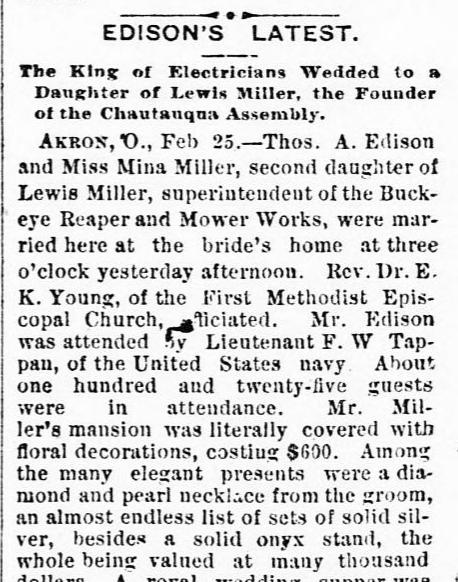
Headline wedding

America embraced the new Mrs. Edison with the same spirit in which they admired Thomas Edison. Newspapers described her as “young and fine looking,” “vivacious,” “brilliant,” and “sweet.”

Edison proved to be a thoughtful and attentive husband, even though he still worked long hours on his inventions and many business endeavors. He built Mina a new home, which they named Glenmont. Mina decorated the home with exquisite taste and filled the rooms with music and friends.

Glenmont, the Edison's home in West Orange, New Jersey.
Glenmont, the Edison’s home in West Orange, New Jersey.

Because her father was a noted inventor, Mina knew the peculiarities of living with someone who worked when inspiration struck. When her husband spent whole days and nights at a time in his laboratory, Mina didn’t complain; instead, she slept on a cot near his workbench so she could be with him.
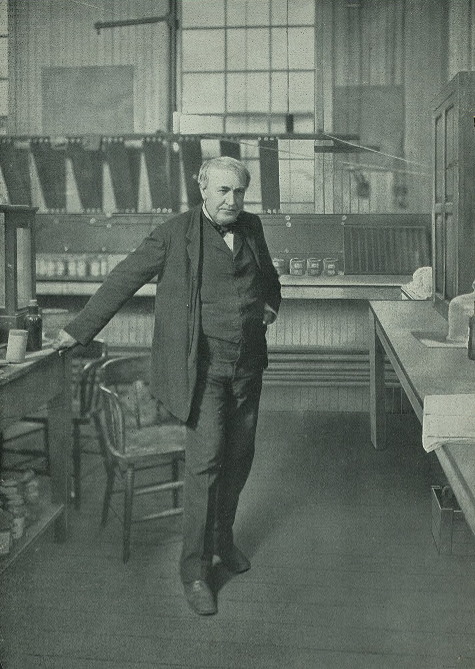
Thomas Alva Edison in his laboratory.

She was active in the Temperance Movement, and served on committees, councils, and boards for charities and civic causes.

Eleanor Roosevelt (third from left) and Mina Miller (far right) in 1934. They worked together on charitable endeavors.
Eleanor Roosevelt (third from left) and Mina Miller Edison (far right) in 1934. They worked together on charitable endeavors.

Mina also succeeded in one area where many others failed: She got Thomas Edison to take time off from his work and relax. They were frequent visitors to Chautauqua, and often stayed at the Miller cottage. They invited friends to stay with them, and entertained Henry Ford and his wife on a number of occasions.
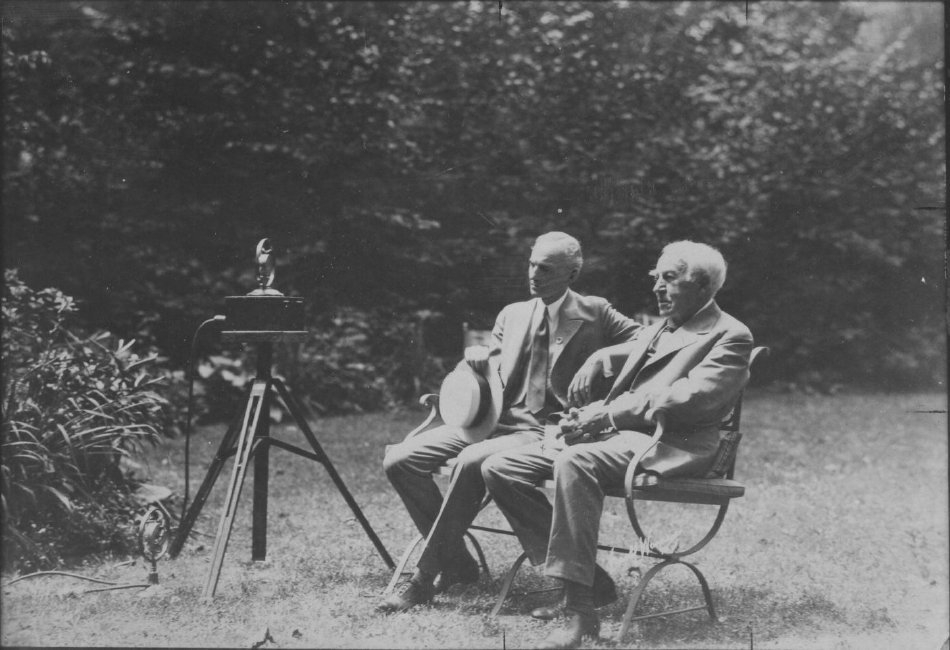
Henry Ford and Thomas Edison in the garden behind Miller Cottage, 1929.

Edison, who never went to college, joined the Chautauqua Literary and Scientific Circle, and was a member of the “Edison Class” of 1930. No mention was made in the press about whether Mr. Edison walked with his class on Recognition Day.

C.L.S.C. banner for the Edison Class of 1930.

The Edison’s happy marriage lasted 45 years until Thomas Edison’s death in 1931. Mina died in 1947.
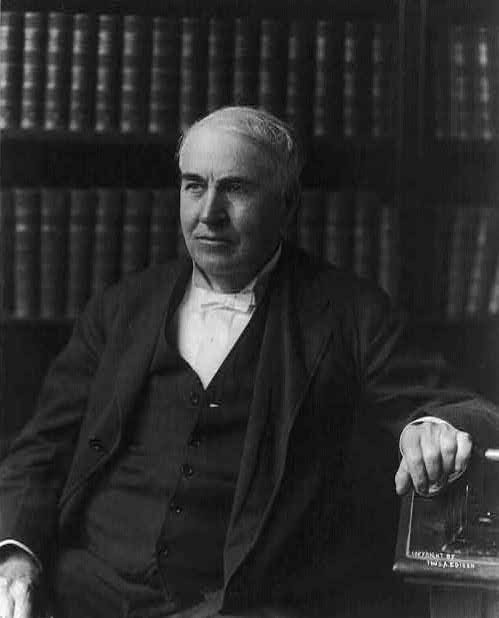
Thomas Edison in 1913.


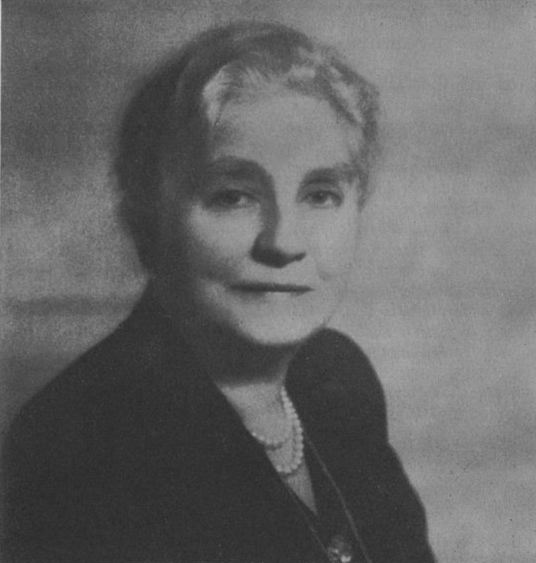
Mina Miller Edison in her later years.

They are buried side-by-side at Glenmont (now a property of the National Park Service), where thousands of people visit to pay their respects to the Wizard of Menlo Park and his brilliant wife.
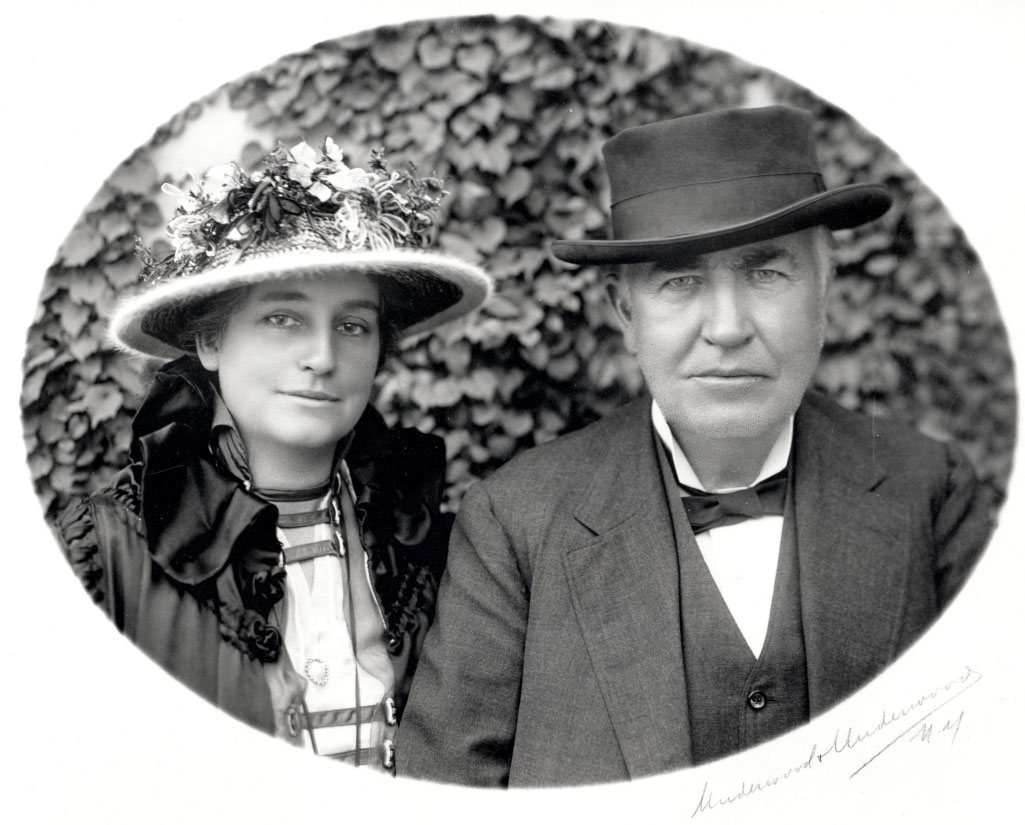
Mina Miller Edison and Thomas Edison

Would you like to read more about Mina Miller Edison? Click here to visit EdisonMuckers.org. Be sure to scroll to the end of the post where you can see some of the Edison family recipes. You can also download a very nice biography of Mina Miller Edison by John D. Venable that contains several seldom-seen photographs.

You can also learn more about Glenmont, the Edison’s home in New Jersey by following these links:
EdisonMuckers.org
ThomasEdison.org

Here’s an example of some of the popular fiction written around the turn of the century featuring Thomas Edison in the story. Follow these links to read the 1898 serial, “Edison’s Conquest of Mars.”

Chapters 1 and 2

Chapters 3 through 5

Chapters 6 through 8

Chapters 9 and 10

Chapters 11 through 13

Chapters 14 through 16

Chapters 17 and 18

Chapters 19 and 21

Chapters 22 and 23

Chapters 24 and 25

New Free Read: The Chautauquans

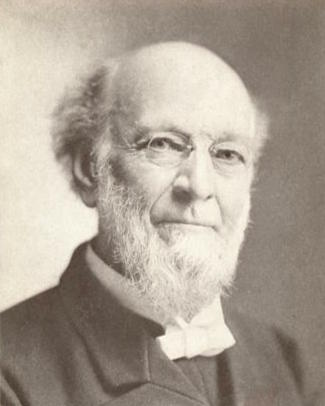
Bishop John Heyl Vincent

John Heyl Vincent co-founded Chautauqua Institution based on one over-riding theory:

Life is one. Religion belongs everywhere. Our people, young and old, should consider educational advantages as religious opportunities.

With this in mind, he set out to prove that education was the right—and the responsibility—of all people, not just the privileged few. To Bishop Vincent, no man had the right to neglect his personal education “whether he be prince or ploughboy, broker or hod-carrier.”

He created the Chautauqua Literary and Scientific Circle (“C. L. S. C.”) as a means of bringing education to people, thereby eliminating geography or personal circumstance as barriers to learning. And he made it easy and inexpensive for people to form C. L. S. C. “circles” in their own towns. Circles popped up across the country in every possible venue: house, shop, farm and market; anyplace people could gather to exchange curriculum books and discuss what they’d read.

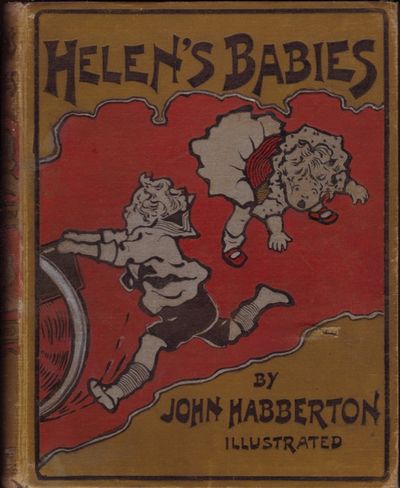
One of those C. L. S. C. members was author John Habberton. He was a popular writer in the late 1800s, most famous for his children’s book, Helen’s Babies. He was a frequent visitor to Chautauqua Institution and served as president of the C. L. S. C. class of 1894.

Helen's Babies by John Habberton (1899 edition)
Helen’s Babies by John Habberton (1899 edition)

Like Isabella Alden, he was inspired by the Chautauqua ideal; he knew from experience the good that resulted from the C. L. S. C. curriculum. And like Isabella, he wrote a book about his experiences.

Cover The ChautauquansHis novel The Chautauquans tells the story of the residents in a small town who come together to form their own C. L. S. C. chapter. It’s a charming story you can read for free. Just click on the book cover to start reading.

You can also find out more about Bishop John Vincent’s ideas that inspired the creation of Chautauqua Institution and the C. L. S. C. His book The Chautauqua Movement is available for free on Google Books. Click on this link to read it.


Good-bye to the Chautauqua Amphitheater

For over 130 years the Amphitheater has been the centerpiece of Chautauqua Institution.

The existing Amphitheater as it appeared about 1915

From its humble beginnings as a simple speaker platform, the Amphitheater has evolved and expanded as Chautauqua Institution grew.

The original 1874 speaker's platform (ciweb.org).
The original 1874 speaker’s platform (ciweb.org).

.

Black and white photograph of men and women seated in the Auditoriam amid the trees
An early gathering at the original Chautauqua Auditorium under the trees

When Chautauqua’s leaders built the current Amphitheater in 1893, they designed it to last 100 years. It certainly has done just that, but not without some trouble along the way.

In just the last twenty years alone, the Amphitheater has undergone major renovations to update the electrical capacity for lighting and sound, repairs to the foundation and roof, and the addition of accessible ramps for the disabled, all requirement which could not be envisioned when the original structure was built.

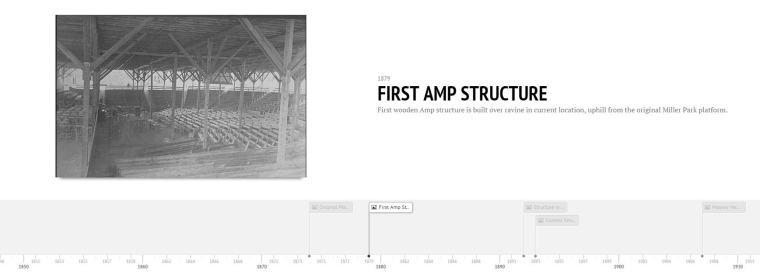
You can click on the illustration below to see a timeline of the Amphitheater’s history and changes over time:

Click on the image to view a timeline of the Amphitheater's history

Every repair and update was a challenge. Chautauqua Institution’s leadership has long tried to balance the needs of a modern age with a desire to preserve the much-loved character of the structure. But, section by section, the Amphitheater has been torn down and rebuilt again and again over the years.

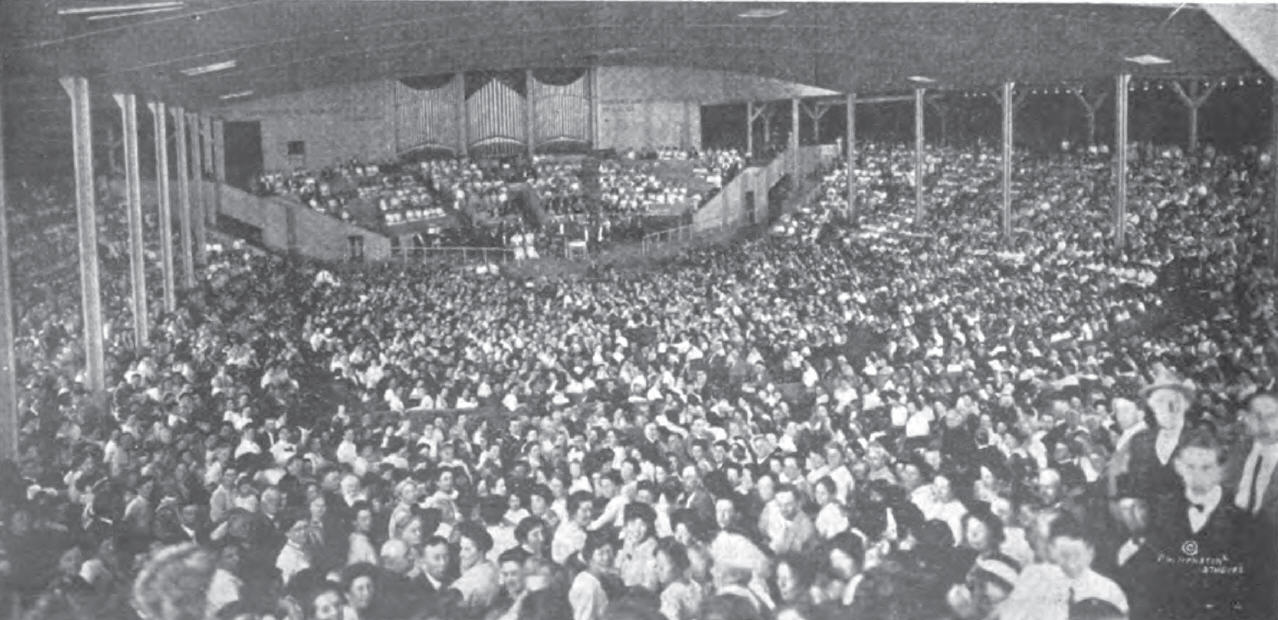
Filled to capacity; a view of the stage from the back of the Amphitheater, 1913.

Last year, Chautauqua Institution’s governing board at last cried “uncle” and determined that no amount of updates and renovations could prepare the existing Amphitheater for the needs of current and future generations of Chautauquans.

So in last December Chautauqua Institution announced a major remodel of the Amphitheater.

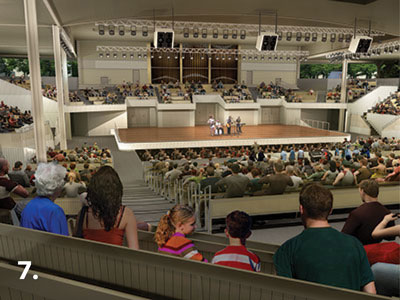
An artist's rendering of the new Amphitheater, looking toward the stage from the rear of the building
An artist’s rendering of how the new Amphitheater will look, viewing the stage from the rear of the structure. (www.ciweb.org)

Construction has already begun on the grounds surrounding the Amphitheater. This fall, after the 2016 season has closed, the existing Amphitheater will be thoroughly remodeled and updated. Essentially, a brand new structure will be built. If all goes according to plans, the new Amphitheater will be completed in time for the 2017 summer season.

An artist's rendering of the view from the stage toward the rear of the structure. (www.ciweb.org)
An artist’s rendering of the view from the stage toward the rear of the structure. (www.ciweb.org)

You can see all the artist’s renderings of the new Amphitheater design by clicking here.

If you’ve ever thought about visiting Chautauqua Institution to see the Amphitheater and the incredible Massey Memorial Organ as Isabella Alden once saw them, 2016 will be the last year you will be able to do so.

Some people are saddened by the change. It’s the end of an era, but the beginning of a beautiful future for Chautauqua Institution’s Amphitheater.

Playing with Paper Dolls

If you’re a female born before 1970, there’s a good chance you played with paper dolls when you were young.

Paper dolls were a popular toy because they were inexpensive to produce and they were often free to consumers. To play paper dolls, a little girl only needed a pair of scissors and a modicum of adult supervision during the cutting phase.

In the early 1900s newspapers printed paper dolls with educational themes. In 1909, for example, major newspapers printed the syndicated Dorothy Dot paper dolls that featured Dorothy traveling the world, meeting new friends and learning about foreign lands.

Dorothy Dot paper doll in a 1909 edition of the Washington DC newspaper Evening Star


"Antoinette" paper doll, published in the Los Angeles Herald newspaper in 1909.
On her travels, the fictional Dorothy Dot visited “Antoinette,” a French paper doll (published in the Los Angeles Herald newspaper in 1909).

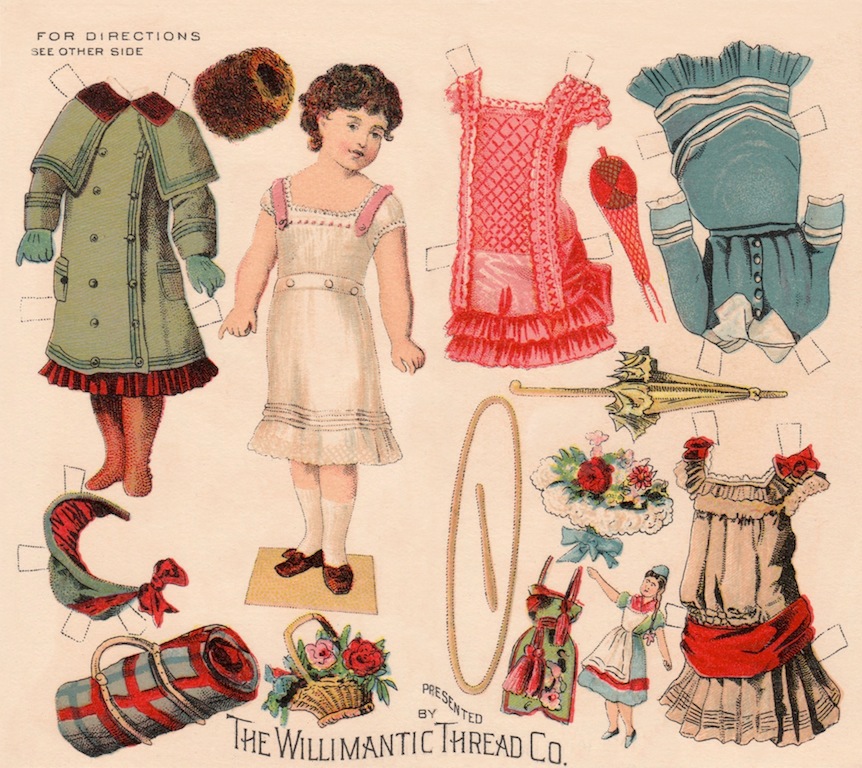
Companies used paper dolls in advertisements for many different products, from ladies’ corsets to sewing threads.

Paper doll printed by Bortree Corsets


The Willimantic Thread Company published this paper doll


A paper doll compliments of Brook's Spool Cotton Thread.
A paper doll compliments of Brook’s Spool Cotton Thread.

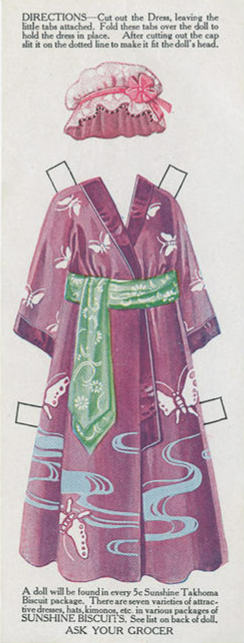
Sunshine Biscuits (still in business today as the makers of Hydrox cookies and Cheez-It crackers) often included free paper dolls in their product packaging.

Paper doll from Sunshine Biscuits

Other times, they used paper dolls to increase sales. For example, they included this paper doll kimono in one of their magazine advertisements, but the doll could only be found in packages of Sunshine cookies.

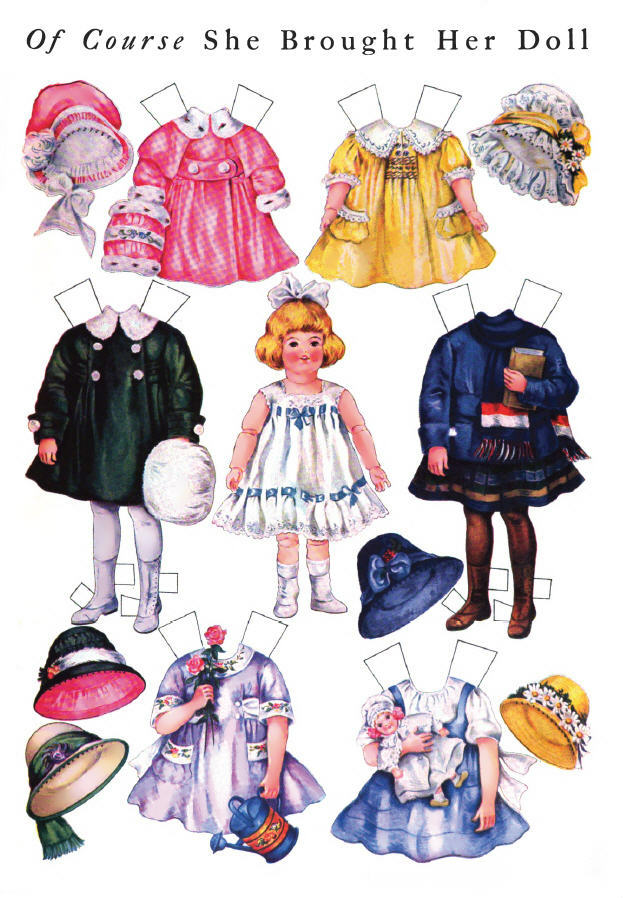
But it was American magazines that really popularized girls’ paper dolls. The Ladies’ Home Journal and Good Housekeeping magazines led the way, publishing high-quality paper dolls with wardrobes in color. This two-page spread from a 1919 edition of Good Housekeeping was typical for the magazine:

Paperdoll - Good Housekeeping Sep 1919 02e

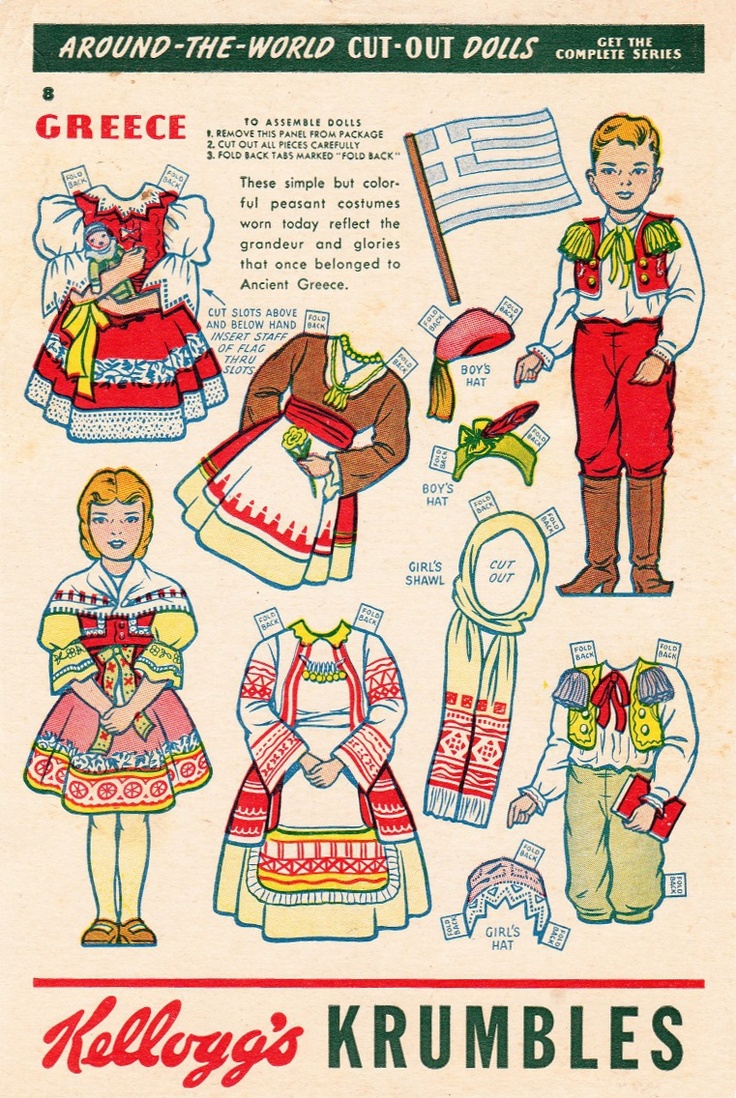
By the time paper dolls really hit their zenith of popularity in the 1950s, they were even on cereal boxes, like this Kellogg’s cereal:

Paperdoll - Kellogs Krumbles

Isabella Alden didn’t mention specific paper dolls in her books, but given their popularity, there were probably many girls of Isabella’s acquaintance who played with paper dolls.

And there are many adults who love them, too! Visit Etsy and you’ll find many vendors who create new paper dolls or reproduce vintage paper dolls from different eras.

And we found a great site that explains the history of paper dolls and features an interesting blog with many examples of dolls from different decades. Just click here to visit.

How about you? Did you ever play with paper dolls? Which was your favorite?

Which Way?

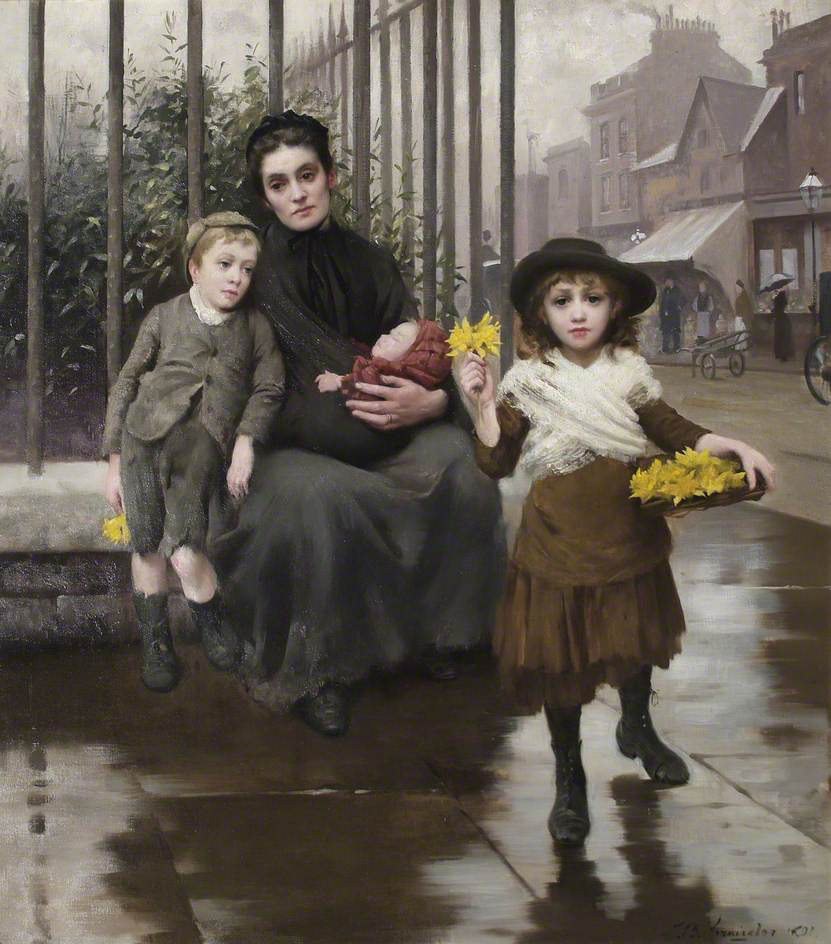
Isabella often wrote stories that featured children trying to earn money to help support themselves or their families.

"The Pinch of Poverty" by Thomas Benjamin Kennington, 1891.
“The Pinch of Poverty” by Thomas Benjamin Kennington, 1891.

Long before today’s labor laws and social service programs existed, children worked long hours in factories or in the homes of wealthy people, usually for pitiful wages.

"Homeless" by Thomas Benjamin Kennington, 1890.
“Homeless” by Thomas Benjamin Kennington, 1890.

Eleanor H. Porter, the famous creator of the Pollyanna books, wrote about the plight of one such child in her novel Cross Currents.

Cover_Cross Currents

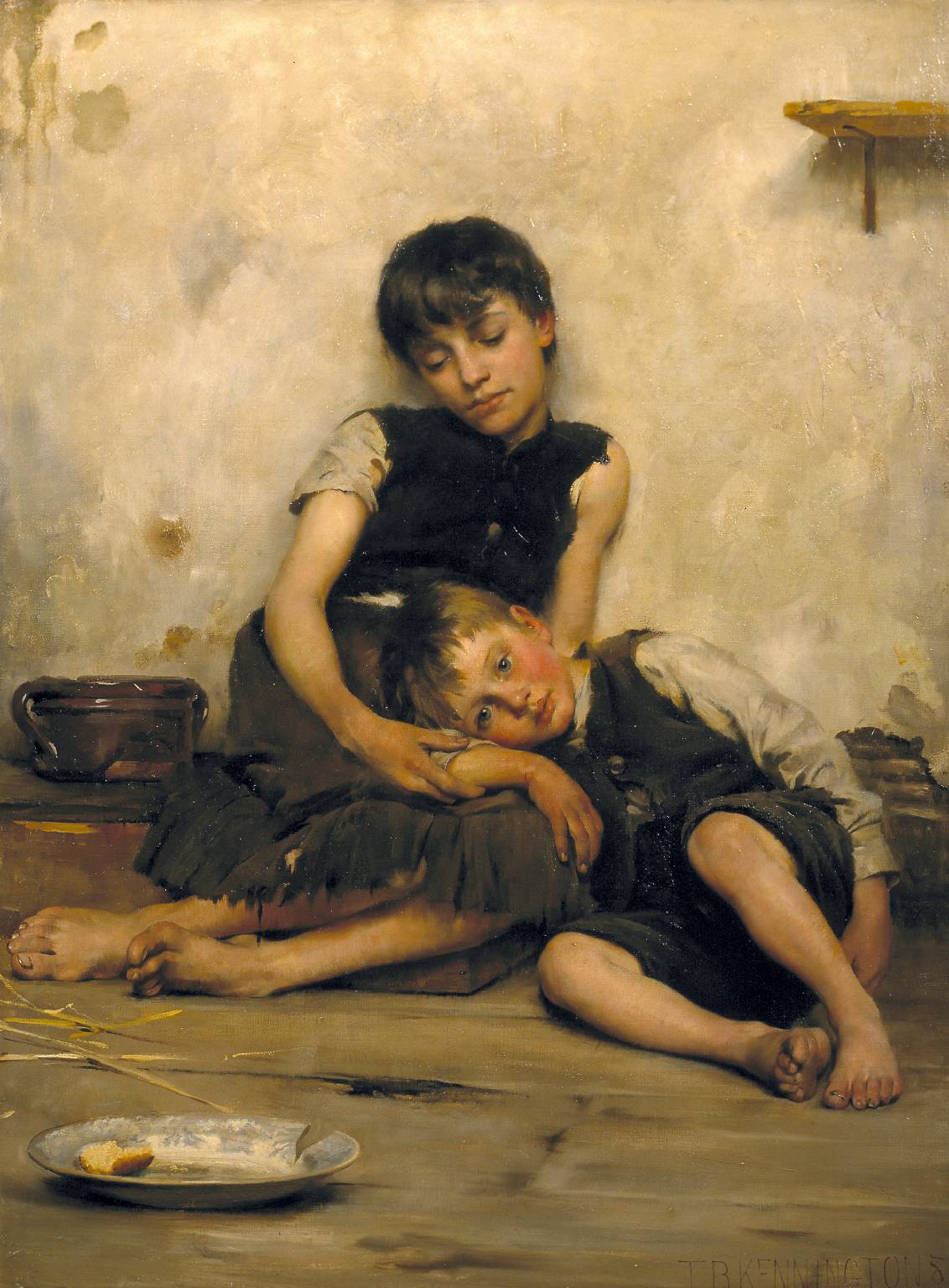
And famed artist Thomas Benjamin Kennington painted a series of portraits of homeless and destitute children in an effort to raise awareness of the problem.

"Orphans" by Thomas Benjamin Kennington, 1885.
“Orphans” by Thomas Benjamin Kennington, 1885.

Isabella’s novels The Man of the HouseMiss Dee Dunmore Bryant and Twenty Minutes Late all dealt with the issue of children’s working conditions in cities across America; but Isabella always  made certain her books had a happy ending. She imbued her young characters with high ideals and strong work ethics that often brought them to the notice of a wealthy benefactor who changed their lives.

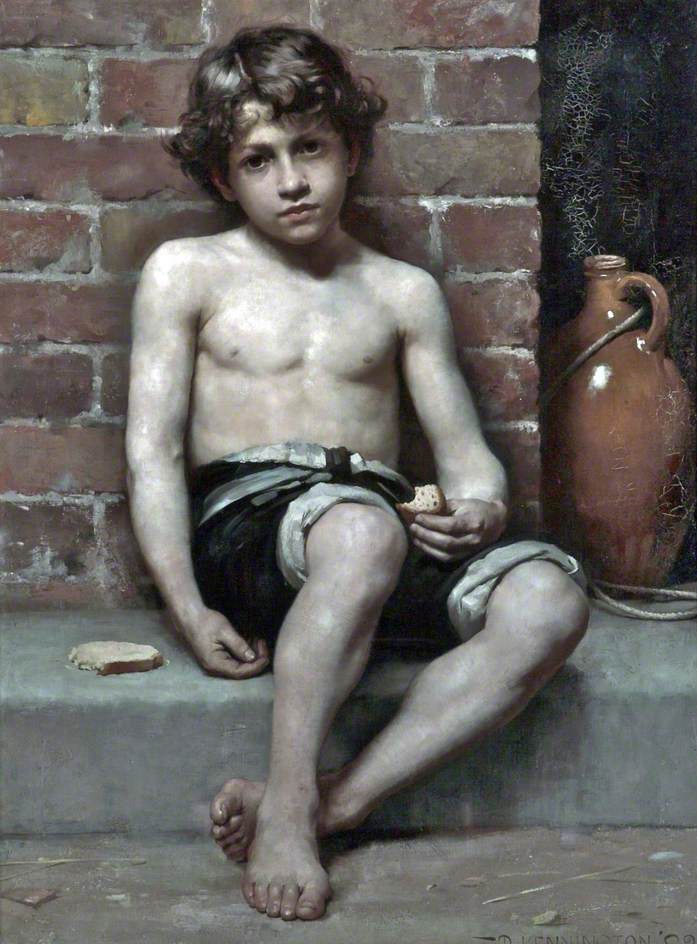
"Daily Bread" by Thomas Benjamin Kennington, 1883.
“Daily Bread” by Thomas Benjamin Kennington, 1883.

That was the case in Isabella’s short story, “Which Way?” about a twelve-year-old boy trying to make enough money to pay the rent on his family’s home. It first appeared in The Pansy magazine in 1889 and you can read it here:


Which Way?

He was a curly-headed, pleasant-faced boy, of about twelve; his clothes were growing short at the ankles and wrists, and were a good deal patched, yet there was a neat trim look about them that one liked to see.

He stood at the corner where two roads met, balancing in his mind the important question which way to go. Both roads led homeward, by an almost equally direct route; one was a trifle sandy part of the way, the other was up hill.

“Hill or sand?” he said to himself, with a smile. “It makes a lot of difference in a fellow’s lifetime which! What if it did, though? What if it should make a difference all the rest of my life? He told about smaller things than that bringing great things out of them. If I had a penny I might toss it up, only I don’t believe he thinks that’s the way to decide things.

“He” meant a stranger whose satchel the boy had carried that afternoon, and who, as they walked along, had spoken a half-dozen cheery words to him about the importance of little things; helping the boy to think more gravely, perhaps, than he ever had before. Then the stranger had gone his way on the three o’clock train, and Jamie never expected to see him again; but he could not help thinking a little about the words. To tell the truth, but for these words to think about he would have been very downhearted.

It was toward the close of a long summer day, in which he had been tramping from one end of the town to the other in search of work, and had failed. It was the old story, father dead, mother hard-worked and poor, with two children younger than Jamie to care for. There was great need that he should find work to do. The dreadful rent, which seemed to eat up every penny, was nearly due again, and little Eddie had been sick for a week, hindering his mother from going out to her regular day’s work, so that times were harder than ever before.

On Monday morning Jamie had started out with a brave heart, sure that for a strong and willing boy of twelve, there must be plenty of work to do; but now it was Thursday evening, and though he had tramped faithfully from morning till night, no steady work could be found, only a few odd jobs; which, though his mother told him would help a great I deal, seemed very small compared with what he had meant to do. It seemed hard to have to go home and say that he had failed again. This was why he loitered by the way, and tried to fill his mind with other things.

“I’ll go this way,” he said at last, dashing down the less familiar street. “Who knows what may happen?”

What “happened” was that the hostler at the great stone house on the corner, who had been kind to Jamie, called to him as he passed to ask if he would take a note to his cousin Mary Ann who lived at Mr. Stewart’s on the next corner.

Of course Jamie was glad to accommodate him and made all speed to the great house of whose gardens he had often wished he could get a closer view. A game of tennis was in progress here. Jamie stood a moment watching the graceful movements of the players; wondering, meantime, which way to turn to find Mary Ann. Presently the lady who seemed to be the chief one of the group noticed him, and he made known his errand.

“Mary Ann? Oh, yes, she is in the laundry, I think; or no, she is  probably upstairs by this time. Wait a moment, my boy, and I will see if I can find her,” and she took her turn in the game.

“Are you in haste?” she asked presently, turning to him with the pleasantest smile Jamie thought he had ever seen in his life.

“Oh, no, ma’am,” he said, returning the smile, “I’m never in a hurry.” His face sobered instantly as the fact that he had no work to make him feel in haste, came back to him unpleasantly. It appeared that the game was very near its close; a few more turns, and with much laughter and many pleasant words the players said good-night, leaving the young lady and Jamie alone. He was glad that her side had beaten.

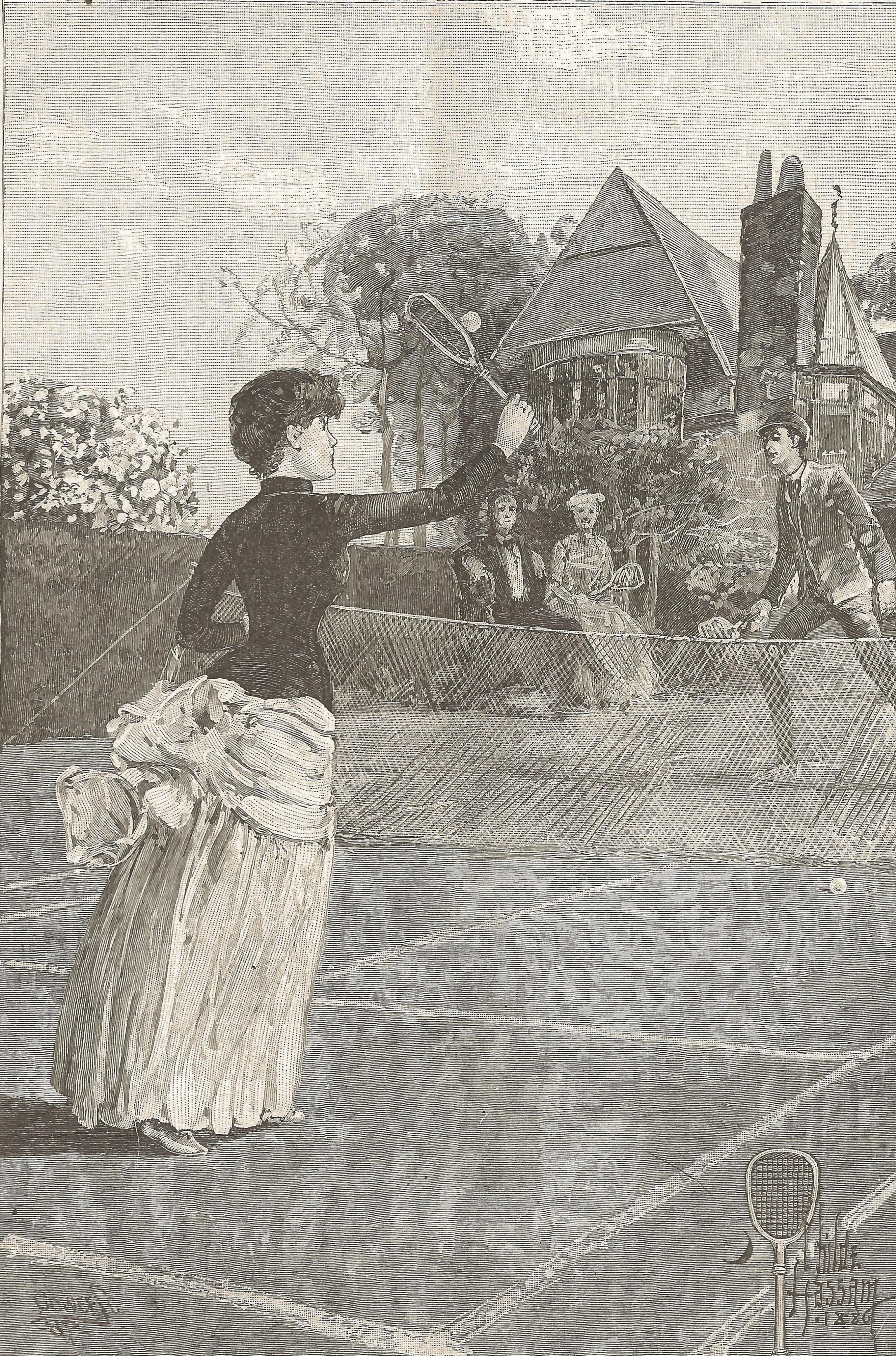
Original illustration by Childe Hassam for the story "Which Way?"
Original illustration by Childe Hassam for the story “Which Way?”

She turned toward him, smiling. “So you are never in a hurry; that must be a rather pleasant state of things.”
“I don’t know, ma’am,” said Jamie again. “I guess I’d like to have a chance to be in a hurry.”
“Would!” with lifted eyebrows and an amused, questioning look. “That is strange! I’m in a hurry a great deal of the time, and I don’t enjoy it always. There is Mary Ann at this moment.” She signaled the red-faced Irish girl to approach, and Jamie delivered his note, then turned to go, having made a respectful bow to the lady. But apparently she was not through with him.
“Why do you go away so soon, if you are never in a hurry?” she said pleasantly.

“Why, I’ve done my errand,” said Jamie, “and I supposed the next thing was to go.”

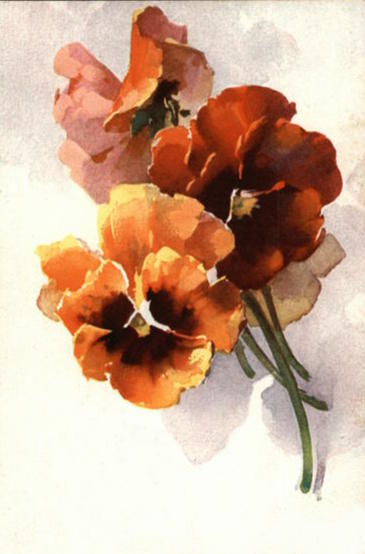
“Why shouldn’t the ‘next thing’ be to come and look at my roses? Bright red and yellow ones. You like them, don’t you? In the meantime you can tell me how you manage it so as not to be in a hurry.”

Jamie followed her with great satisfaction, but finding she waited for his answer, said:

“Why, you see, ma’am, the way of it is, I’ve got nothing to hurry about, and I wish I had. I’ve been hunting for work for three days as steadily as I could, and haven’t found any yet, and am not likely to. That was what I meant.”

“Oh! I understand in part, but I should think your lessons would give you almost enough to do without a great deal of work.”

“I’m not in school, ma’am,” said Jamie, speaking low. “There are reasons why I can’t go very well; mother needs me to help earn the living, so I’m looking for a chance.”

“I begin to understand quite well. What sort of work do you want?”

“Any sort under the sun that I could do; and I could learn to do anything that other boys do if I had a chance,” he said eagerly.

“Such as weeding in a garden, for instance, and picking strawberries and peas? How long do you think it would take you to learn such work?”

“I was born on a farm, ma’am; mother only moved here this spring. It’s just the kind of work I’ve been looking for, but I can’t find any.”

“That is simply because you didn’t come to the right place. My mother has been looking for you all day. I dare say at this moment she is wishing you would come and pick some strawberries for tea, and I’m sure I do, for if you don’t I’m much afraid I shall have to do it myself. I think we would do well to go at once and talk to her about it.”

Jamie, as he followed her up the steps of the broad piazza, his heart beating fast with hope, told himself that he had never seen a sweeter lady in all his life.

Afterwards, while they were picking the strawberries—for she went with him to “show him how,” she said with a merry smile—he told her how he came to take the road home which led past her door; and then, in answer to her questions, how he was led into that train of thought by the earnest words which the strange young man said to him that morning.

“So you carried my brother Harvey’s satchel, did you?” she said, with a bright look on her face. “Very well; one of the ‘little things’ he told about has happened to you. Now you are sure of plenty of work about this house as long as you want it, provided you are a faithful, honest boy, as I seem to know you will be. I think I must have been looking for you; but I’ll tell you what I think, my boy; I don’t believe it is a happen at all. I believe your Father sent you.”


You can click on the cover images to find out more about the books mentioned in this post.


Cover_Cross Currents    Cover of Miss Dee Dunmore Bryant    Cover of Twenty Minutes Late