Blog

A Scolding Mood

Do you have a pet peeve?

Is there some irritating little thing others do that seems to steadily accumulate until you can’t help but be angry?

Isabella found herself in just such a situation regarding the many letters she received each month from readers of her magazine and books. Here’s what she had to say about it (as published in a Christian magazine):

A Scolding Mood

Photograph of Isabella Alden from about 1898. She is seated at a table. In her lap she holds a piece of paper. Her right hand holds a pen poised above a piece of  paper on the table.
Isabella Alden at her writing desk.

Perhaps it would be well for me to own at the outset that I am in a scolding mood this morning. On my desk lie three letters written with as much care and thought as I could give them. Out of my busy life I took time to do my best for the three earnest girls who wrote me on important subjects, all of them of such a character that it was either not wise to bring them into print or so important as regards time that it seemed not well to wait for the printed page. Yet what was the result? Within ten days of their writing, all three letters were returned to me with the words, “Person not found,” written on the envelope.

Now whose fault is that? Not the postmasters’ or postmen’s certainly; for, judging from the appearance of the returned letters, much care has been taken to find their owners. In one instance the information has been volunteered, “Address incomplete.” As if the writer did not know that! But how was I to help it? A name, and the name of a certain city in a certain State; this was all. No street, nor number, nor post-office box—nothing to indicate where in the great city the person was to be found.

If this had been my experience but three times in my life, I should indeed be a happy woman; but oh, dear, the innumerable times I have exhausted my knowledge on a given theme for the attempted benefit of another, only to have to consign my work two weeks afterwards to the waste-basket, and to go about with the injured feeling that someone who had opened her heart to me was smarting under the sense of having been rudely treated!

Dear friends, is not the moral plain? Why will you not give a carefully detailed address? If you are visiting in a strange city, expecting to be there but a short time, by all means give the full address of the person whose guest you are, or of the hotel or boarding-house where you are stopping. If it is possible that you may leave the town before the reply to your letter reaches there, consider how it would expedite matters if you would instruct your correspondent to write on the envelope, “If not there, please forward to —,” etc.

While we are on this subject and I am in the mood, suffer me a few more growls.

How many letters do you suppose I get, asking for immediate replies, with not so much as a postage-stamp enclosed? In most cases this is pure forgetfulness; but if one receives—let us say—one hundred letters a week, requiring private replies, and fifty of the writers have forgotten the return stamp, in the course of a year this amounts to quite a sum.

Let me tell you something. Instead of the stamp (which every well-informed person now encloses when he does not forget it), if those who desire a prompt reply would enclose an envelope properly addressed, with the stamp securely stuck on its own proper corner, their chances for very prompt response would be largely increased. One who has not a large list of correspondents can hardly be made to understand what a relief it is to find letters so prepared, nor what an amount of work it saves in the course of months. So small an item for the writer, such a load lifted from the shoulders of the burdened!


What do you think? Did Isabella have a good reason to scold her readers a little bit?

What’s your pet peeve?

A Character Sketch of “Mrs. V”

Isabella Alden was an esteemed teacher, a successful author, and a beloved minister’s wife. During her life she was widely admired by those who knew her, and she was an inspiration to women across the country. But who inspired Isabella?

She gave us a hint to the answer in 1894 when she wrote an essay about a beloved friend she greatly admired. Here’s how she described “Mrs. V”: 


Something—a chance sentence of one who lingered for a moment in my room—has sent my mind back over the past, and recalled a vivid picture of one friend for whom the gates opened heavenward years ago; yet she lives so distinctly in my memory that it seems but yesterday that I saw her quiet, pleasant face, and heard her low, kind voice.

Today I have set myself to earnestly studying why she influenced me so steadily, and why her memory lives so plainly, not only with me, but with many others who were not bound to her by any closer tie than that of friendship.

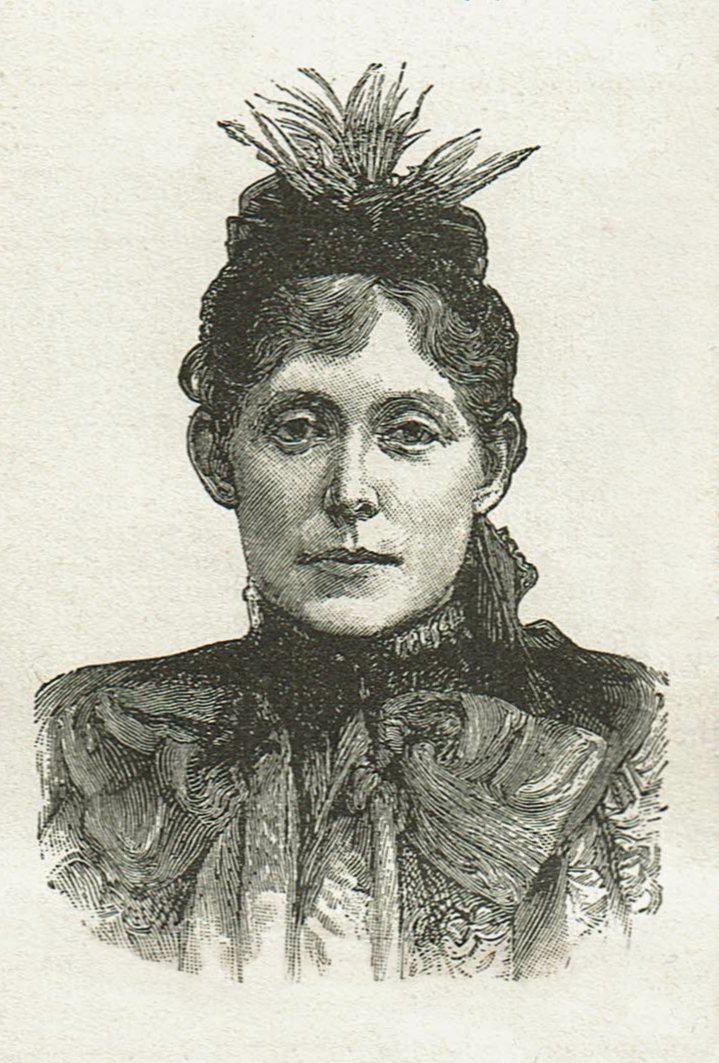
Illustration of a woman's shoulders and heads. She is dressed in a high-neck gown that was in stile about 1895. Her hair is pinned up and on top of her head is a modest pill-box style hat with short feathers stick out from the top.

I remember her as one who was always at our women’s prayer-meeting. There were a dozen or twenty of us who were more or less regular in attendance. Several women we could count upon if the day was reasonably pleasant; others would be there if there had not been something exhaustive the day before, like a church sociable, or festival; but Mrs. V established such a reputation for regularity, that in the few times she was absent during the years of my intimate acquaintance I distinctly remember seeing anxious faces and hearing questionings like this:

“Did any of you know that Mrs. V was ill?”

“Oh, no; I haven’t heard from her, but she isn’t here.”

She was not a woman gifted with a great command of language. She had no startlingly original ideas of any sort to offer. A superficial listener might have called her commonplace. Perhaps she was. When one stops to think of it, many things which we prize the most are really commonplace. I suppose love is. And mothers are very common, and homes.

Mrs. V was a low-voiced, quiet woman. She shrank from notoriety; she was not made president of any of the church societies.

“Oh, no,” she would say, when someone mentioned her name; “choose Mrs. Jones, or Mrs. Smith; either of those will fill the office better; they know how; and I will work just the same in any way that I can.” She meant these negatives, and pressed them until she was taken at her word.

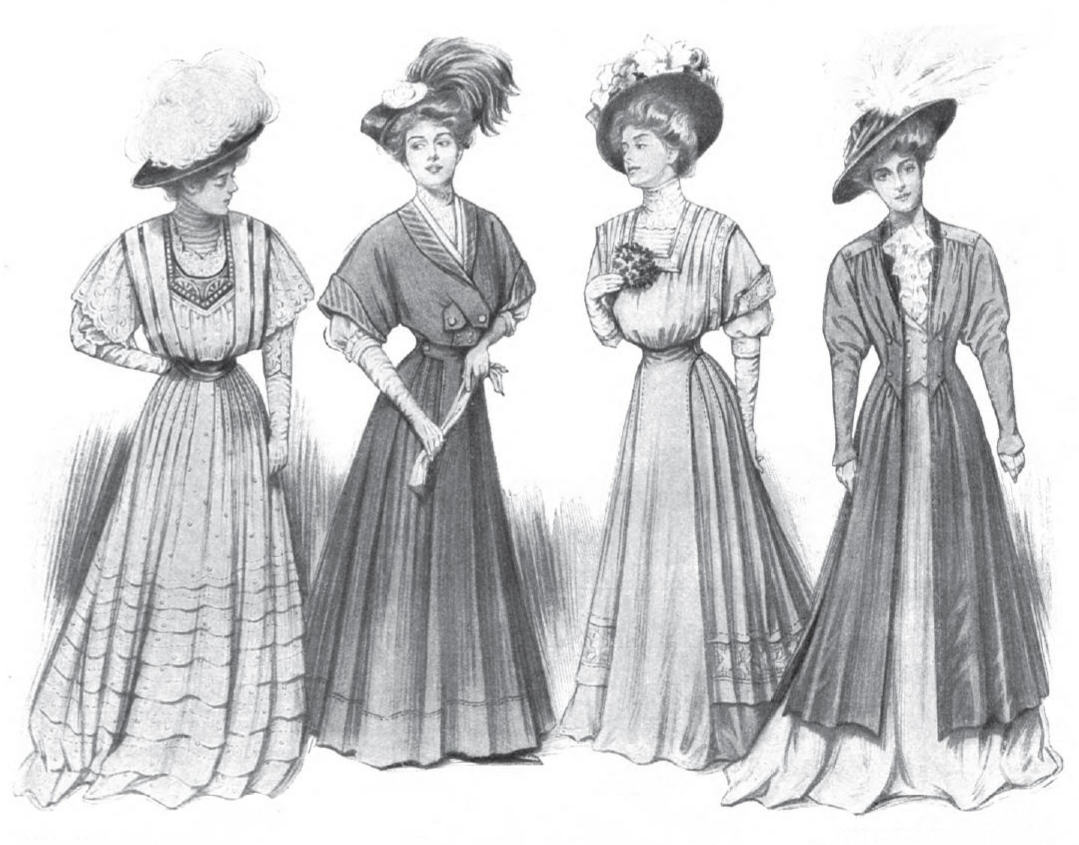
Illustration of four women standing in a line dressed in clothing from about 1905. Each is dressed for going out; one in a long coat, one in a short, waist-length jacket; and two in long-sleeved dresses with high collars. Each wears a wide-brimmed bonnet adorned with different kinds of featheers.

“Mrs. V shrinks from office,” we said. “She is timid.” But she did not shrink from work. No matter what the scheme—whether it included baking, or frying, or broiling, or one’s self and one’s nice things—Mrs. V could be counted on.

“I will try to do my share,” she would say, cheerfully, and we were always anxious to let her decide for herself what her share was. No one thought of apportioning to her all the things which she quietly took upon herself. Neither did we ever say to her, “Mrs. V, will you do this or that?” singling out the pleasant places or the pretty part of the work. It was not hopeless selfishness upon our part which made us never select these places for her, but because she would be too quick for us.

“I will see that the dishes are in order, and attend to spoons and forks and all that sort of thing,” she would say when we were planning a campaign; or “I will get the church parlors ready for evening.” This would be long before we had reached dishes or parlors. In the course of time we learned to depend on her for all such things.

Illustration of a woman dressed in a blouse and long skirt from about 1905. She stands at a table she is setting for dinner and arranges flowers in a small bowl.

“Mrs. V will look after that,” was a sentence often upon our lips, and I do not think it was until afterwards that some of us realized how often the sentence referred to drudgery; though one of our ladies had said once, significantly:

“Mrs. V will dust and arrange the parlors, and put everything in perfect homelike order, and Mrs. W will entertain the guests; we believe in division of labor.”

Illustration of two women dressed in clothing from about 1905. One is polishing a small vase. One is wearing a dust cap and uses a feather duster to dust off the back of a wooden chair.

But while Mrs. V. shrank from office, and was always proposing the names of others, there was one duty from which she never drew back. Always, even at very short notice indeed, we could depend on her to lead the woman’s prayer-meeting.

“I am not gifted in that direction,” she would say, meekly, “but I will do the best I can.” And the meetings which she led proved the truth of her pledge; moreover, her “best” was something to remember.

Illustration of a group of five women praying and singing in a church. They are dressed in gowns and bonnets that were in style around 1890.

She may not have been “gifted”; I do not think we ever talked about her as one who was, nor said to one another: “Wasn’t that a beautiful talk she gave today?”

One good woman voiced the thought of our hearts when she said as we went quietly out from a meeting which Mrs. V had managed:

“We ought to be better women all the week after such a meeting as that. The Lord led it, didn’t he?’ Perhaps that is the feeling which Mrs. V’s work gave us as much as words can express it: she was taught of God.”

I recall so many quiet, pleasant things about her; things which were not much thought of at the time, but which have left their impression.

She had a little grandson, a sweet, shy boy, who shrank painfully from any contact with strangers, and was long in making acquaintances. She was very anxious to have him become a member of our primary department in the Sabbath-school, and tried in various ways to win him to go with some of the children, without success. Finally she said to me:

“I think if I may come with him a few times, he will overcome his timidity.”

Illustration of a little boy standing on tiptoe on a footstool in order to reach up to wrap his arms around a woman's neck as she bends over him.

Of course she was invited to do so; we gave her a seat in the visitors’ corner, and used all our skill to win the timid little fellow by her side into our youngest class. All in vain. He was contented and happy beside grandmother, but his fair, pale face would grow red, and his lip quiver pitifully, at the mention of a separation.

After weeks had passed, and he made no progress, the dear grandmother said, “I think I will have to become one of your teachers with my boy for a pupil. May I not come every Sunday and keep him beside me, and teach him what you teach the others as far as I can, until he learns to come without me? I want him to form the habit of coming here, and to be happy in coming.”

We joyfully welcomed her and her one lambkin, and all summer, not only, but through the long, cold, stormy winter, not a Sabbath afternoon passed but grandmother and little one were in their corner, and, so far as I could judge, a more interested pupil did we have than the fair-faced little fellow, who bent earnest eyes on card, or picture, or whatever his teacher used to hold his thoughts.

Drawing of a woman and 8 children sitting on wooden chairs in a circle. All are dressed in clothing from about 1900; the woman and girls wear bonnets and dresses; the boys wear little suits. The woman is holding an open book and point to a place on a page.

In the course of time he learned to rise and join with the children in reciting the golden text, or in singing their motion songs, his grandmother always rising with him, and going gravely through the motions, as if she were a child. I remember nothing sweeter, in its way, than the gravity with which she would repeat with the children the verse:

"I've two eyes to look to God,
I've two ears to hear his word;
I've two feet to walk his ways
Two hands to work for him all my days."

She would touch her fingers to her eyes and ears, and bow her head to look at her feet, and spread out her hands, exactly as the hundred or more children were doing all about her; and seemed able to forget that she was not five, instead of quite past fifty. Also, it was a curious thing that the children seemed to forget it; they accepted her as one with them. I do not recall so much as a smile on the faces of the little ones, growing out of the fact that dear Grandmother V said the verses just as they did.

“My little fellow is a mixture,” said the grandmother to me. “He is too shy to do many of the things which others do, but he is also too large. He confides to me the fact that he is only going to do what fathers and mothers and grandmothers do, and not be like little specks of children! And I want him to understand that eyes are never too old to ‘look to God,’ nor hands too old to work for Him. And as example seems to do so much more for little people than precept, I join in all the exercises to prove to him that Grandmother is not too old for any of them; then I try to explain to him afterwards in what ways he and I can use our eyes and ears and hands and feet for God; the ways are different, I tell him, but the heart is the same.”

Sweet, wise grandmother! Happy little grandson to live in the daily atmosphere of such careful, tender precept and example.

When I heard that she had left them and gone to heaven, I think my tears fell first for the grandson bereft of so much, even before he was old enough to fully realize its worth.

In the woman’s prayer-meeting of which I have already spoken, and which was an altogether social gathering where topics of general interest were discussed in as informal a manner as we would have discussed them had we met in one another’s parlor by accident for a social call, Mrs. V used often to let drop quiet little words, generally in answer to some question, which would illuminate the topic before us as nothing else had done.

At one time we were talking about women taking part in the general prayer meeting of our church; a matter in which the pastor was deeply interested, and which he urged persistently.

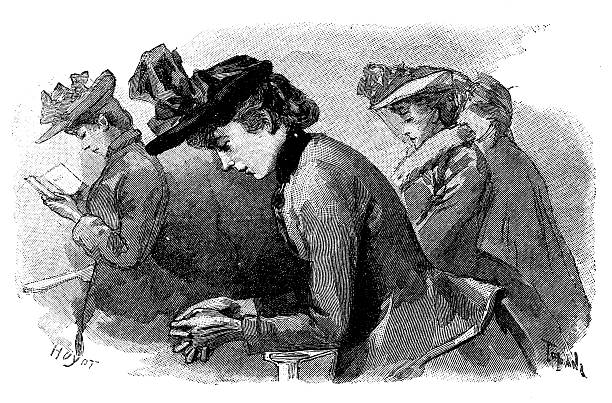
Illustration of four women kneeling in prayer in church. All wear coats and bonnets. One holds an open prayer book.

One lady said she had not the slightest objection to it; indeed, she liked to hear other ladies. She thought it made the meeting seem more social; but for herself she could never do it; she might think over a sentence at home, even commit it to memory, but the moment she tried to give it in prayer meeting it would stick in her throat, and choke her, she knew it would!

Then she turned to Mrs. V and said, “I am always surprised to see how quietly you recite a verse, or say a few words, exactly as though you were in your own home with your intimate friends. Your voice does not tremble, and you never look confused. Why, I believe I should faint if I should attempt it! And you are a very timid woman; how do you manage?

“I don’t believe I manage,” said Mrs. V, with a quiet smile. “I have nothing of any particular consequence to say, so it never takes any managing. I just remember that we are all brothers and sisters gathered for an hour to talk about things which have to do with our journey Home, and I think it would be very strange if I, who am in the midst of the journey, farther along than many of the others, could not have a friendly word of cheer for them, or a promise to remind them of. It is just a family gathering for conversation with one another, and with the Elder Brother, you know. I always take my part in our family gatherings at home; not a very large part, perhaps—I am not much of a talker, you know, anywhere—but still I always have a word to say; and I try to make the prayer meeting feel just like that, and not think about what words I am using, or anything of that kind.”

Her questioner stared, as one bewildered. I do not know that to this day she realizes anything of the sweetness and fullness of her answer, nor dreams how much of spiritual fellowship was embodied in it; but some of us felt its power.

“It is just a family gathering for conversation with one another and the Elder Brother,” repeated a dear friend to me, as we passed out. “I shall always think of that after this, when I am in a prayer meeting. What she says in the meetings fits that thought, doesn’t it?”

Yes, it was true that while some of those who could manage an oyster supper or a carnival, from its first inception through to the distracting and oftentimes bitter end, could not open their lips in the general prayer meeting, would have “fainted at the thought,” she, the timid woman of our number, always responded to the pastor’s invitation; often among the first. Never saying much; rarely saying anything which could have been quoted and commented on, yet forever leaving her impress on the gathering, so that on one of the rare occasions when she was absent from her accustomed seat, I recall the fact that the pastor said, “I feel as though we have lost a benediction tonight; Mrs. V is not here.”

At another time, in the woman’s meeting, we were talking about regularity in attending the Sabbath services, and some were bemoaning the fact that they had a great deal of company during the summer, and were often detained at home.

One lady said, “It does seem to me that I have more company, who have a habit of staying home from church on the slightest pretext, than any other people do. If it is a trifle warmer than usual, or cloudy, and looks as though there might possibly be a shower some time or other, it is seized upon as a pretext for lounging at home. I always dread to ask the question, when my house is full of company, lest I may be doomed to stay with some indolent guest who simply does not want to take the trouble to get ready. Mrs. V, you always seem to have company, and I notice that they are always in church with you; how do you manage? When you ask if they are going out that morning, and they say they believe they won’t go until evening, they have a little headache, do you say they must?” The question closed with a half laugh, for so informal were our meetings that even a laugh did not frighten anybody; but we listened with interest for Mrs. V’s answer.

She considered the lady thoughtfully for a moment, with retrospective air, as though she might be looking back over her past for illustration, then said, “I do not believe I ever ask that question. I cannot recall an instance when I did. I am in the habit of saying at the breakfast table that our church services commence at half-past ten, and that we try to start from the house promptly at twenty minutes past ten, which will give us ample time to walk leisurely; and that we are in the habit of meeting in the parlor and all going together. I think I take it for granted that everybody is going, children and all, and they never disappoint me. I have always found that there was so much gained in taking some things for granted. You know we have to do that way with children. I had a little fellow once to whom it would have been fatal to have said, ‘Are you going to church this morning?’ When I saw the spirit of insubordination creeping over him I had to say, ‘You may wear your new collar to church today,’ or something like that, forestalling any objections to going. Perhaps I have fallen into that habit with company.”

“I’m sure it is a very good habit to fall into,” said one. “I’m afraid I should not have the courage to carry it out.”

For certain reasons I wanted to draw her out more fully, and I said, “Suppose, for purposes of illustration, Mrs. V, that you have a friend who, although not ill, is yet not inclined for church, and she says to you that she thinks she will not go this morning, do you remain with her?”

“By no means,” said Mrs. V, quickly. “I furnish her with as comfortable surroundings and as good a book to read as I can and excuse myself.”

“That will do for Sunday,” said one, “but suppose it is prayer meeting evening; I have a great many callers on Thursday evenings, just at church-time. Do you ever, Mrs. V? And if so, what do you do with them?”

“Plead an engagement and invite them to join me,” said Mrs. V, smiling.

“No! Do you really?”

“Why, certainly,” said Mrs. V, looking almost bewildered. “What else could I do? I am under covenant obligations to be at prayer meeting when I can; and I should not consider callers a sufficient excuse for my pastor’s absence; why should it be for mine?”

There is a bit of personal experience which comes to me so tenderly that, even after the lapse of years, I can scarce keep back the tears at the thought of it. Just one of those little things—commonplace, so called—a thing which one had to receive simply as a matter of course, and yet it was far from being that.

The occasion was an evening wedding in our church—a wedding where everything was expected to be arranged according to approved ideas. In some way I had gotten the impression that no bonnets were to be worn by the guests, and I therefore appeared late, in the vestibule, with no other covering for my head than an old veil which I had hastily snatched to protect my hair, to discover that I was the only bonnet-less one of that large company. There was no time to return home and make the necessary changes, and I certainly would be unpleasantly conspicuous as I was.

While I stood there in doubt and annoyance, Mrs. V and her party entered. She was faultlessly dressed, and wore a handsome new bonnet which exactly fitted her. In a moment I had told her my trouble, because she was one to whom people naturally told troubles, great and small, not because there was supposed to be anything that she could do.

Illustration of two women talking. Both wear clothing from about 1910. One woman is sitting on a bench, without a hat. The other woman is standing, wearing gloves, a short jacket and a hat.

I looked to hear her say, “I’m sorry you did not understand; they ought to have told you,” or “I wouldn’t mind; just go in as you are; there is such a large company people will not notice you much,” or some other equally comforting commonplace which people say in the face of the annoyances of others. She did differently.

“Oh, we can arrange that.” she said. “The immediate family are to be bonnet-less, and they will be here in a moment. I am an immediate friend, and you are the pastor’s wife; nothing could be more appropriate than that we should be exceptions to the others. I’ll whisk off my bonnet in a twinkling; my hair isn’t exactly arranged to appear without it, but that’s no matter, and we’ll go in together and pose as guests of honor.”

It had all been done so quickly, there was no time for protest. The handsome new bonnet was hastily consigned to the care of an attendant, and in a moment we were moving down the aisle, being recognized by the usher as special guests, and being shown into the be-ribboned pew which, it seemed, had been set apart for the wife of the pastor. Nobody stared; the quick-witted woman had made everything look reasonable and in order, and the family party followed almost immediately.

A very trifle? Yes, I told you so, but not one woman in twenty would have done it. Half of them would not have thought of it at all, and the other half would not have sacrificed their new bonnet, and worn their hair in an unbecoming fashion, merely to save another from a moment’s annoyance.

“Don’t speak of it,” she said, laughing, when I tried to murmur my thanks. “I am the one to be grateful; don’t you see, I secured a place of honor by the means, and a little of the reflex glory fell on me, I am sure.”

It is ten years since that time, yet I have never forgotten the little kindly, unselfish act, but laid it away with dozens of others connected with this sweet, inconspicuous, quiet woman who never for a moment imagined that she was doing or saying anything worth mentioning or remembering. Yet so many remember her. They crowded about her quiet grave and paid their tribute of tears. People whom her family did not know at all; people to whom she had given some kindly word or look, that had lived and borne fruit in their hearts.

Heaven must be full of sweet surprises to Mrs. V. Sometimes I try to fancy what it is to hear one and another, as they gather up there, tell her of the flowers she planted unawares. Someday I mean to tell her myself certain things which I know will surprise her to hear.

Why am I paying this tardy tribute to a friend who has been so long gone from us? Because, as I grow older, I realize more and more how rare she was, and recognize more fully that it was her Christ-like self-forgetfulness and her Christ-like interest in others which made much of the charm of her life. Long ago, the Master must have spoken to her—her face full of surprise and wonder the while—his blessed “inasmuch.”

What do you think of Isabella’s essay?

Have you ever known someone like “Mrs. V”?

Pansy’s Ministers

Before Isabella’s novel What They Couldn’t was published in 1895, it appeared as a serial story in a Christian magazine.

Book cover showing four young women near a table; two stand with their arms around each other; two are seated while one plays the guitar. An older woman stands at the table stirring the contents of a silver chafing dish.

The story centers around the Cameron family and the difficult adjustments they face when their wealth disappears. Not only do they have to learn to pinch pennies, they also have a difficult time figuring out who they can trust, and that includes the Reverend Mr. Edson.

One subscriber to the magazine who read the story was upset by the way Isabella portrayed Mr. Edson as a social-climber himself. The reader was so upset, he wrote a letter to the magazine’s editor to complain:

A subscriber calls attention to the portrayal of the young minister in Mrs. Alden's story, and asks: What percent of Presbyterian pastors would make use of such language as is there put into his mouth? Has any member of your force ever known a minister to speak such words about a member of his congregation? If Mrs. Alden knows such a pastor, it would be better to give his true name, and not attempt to make the impression that he is representative.

He was certainly upset enough to close his letter by issuing a direct challenge to Isabella!

If Mrs. Alden knows such a pastor, it would be better to give his true name, and not attempt to make the impression that he is representative.

Luckily, Isabella didn’t have to respond because others responded for her. The magazine published this response:

Mrs. Alden does not put the character forward as a representative of the ministry in general. No writer of the day has a higher appreciation of the ministers, or does more to help them in their work, than she.

And here’s what one of her defenders wrote in a letter that the magazine published the following month:

One Case. Here in the State of Washington was just such a minister as the one Pansy speaks of in her story. In fact, he told me that his congregation did not suit him; that he could not preach a good sermon to it because the people in it were not refined and intelligent enough. I will add that he is supposed to have left the ministry. [signed] M.H.M.

Of course, What They Couldn’t was fiction and—as authors often state— “any resemblance by any character to persons living or dead is purely coincidental.” But in her years as a teacher and as a minister’s wife, Isabella probably met a church pastor or two who, like Mr. Edson, was more concerned with ministering to the wealthy members of his flock than the less privileged congregants who could have benefited from his guidance.

Have you read What They Couldn’t? If not, you can read it for only 99¢ from your favorite online retailer:

New Free Read: How Barbara Helped

Isabella knew that non-believers sometimes judge Christians by their deeds rather than by their words, and this month’s free read illustrates that point.

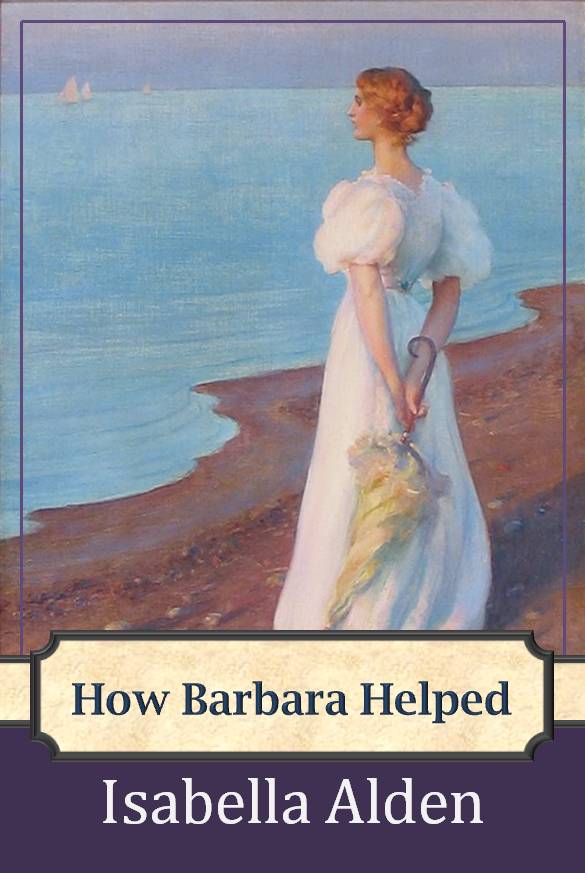
Book cover with image of young woman in long white gown standing on the shore of a lake. Her hands are clasped behind her back and she holds a yellow parasol. She looks out across the water and watches sailboats in the distance.

Miss Fannie Fletcher has important work to do! A girl in the Sunday-school class she teaches is a new Christian, and Fannie is determined to help her grow in faith. But how can she ever hope to accomplish her dearest desire when her family makes constant demands on her time?

You can read “How Barbara Helped” for free!

Choose the reading option you like best:

You can read the story on your computer, phone, tablet, Kindle, or other electronic device. Just click here to download your preferred format from BookFunnel.com.

Or you can select BookFunnel’s “My Computer” option to receive an email with a version you can read, print, and share with friends.

A Hard Text about Gifts

Isabella’s brother-in-law Reverend Charles M. Livingston wrote several articles for The Pansy magazine in which he explained Bible verses that might seem confusing to children. Here’s one he wrote in 1892:


Matthew 13:12:

For whosoever hath, to him shall be given, and he shall have more abundance; but whosoever hath not, from him shall be taken away even that he hath.

No, it does not seem fair at all to give to him that has something, and to refuse it to one that hasn’t anything scarcely, and even to take away what little that one has! Just think of giving a rich Pansy five hundred dollars more, and then snatching away the last penny from a poor Pansy!

Surely you don’t suppose the loving, gentle, merciful Lord Jesus meant any such thing? Of course he didn’t.

What did He mean?

Why, simply this, my dear: that one who makes good use of his gifts will have more gifts. He will grow wiser and better, and go up higher all the time, just like a tree that uses well the good ground and good air and good dew around it.

And the tree that, for some reason, won’t send its roots down this way and that, and set every one of its leaves to breathing—such a lazy tree will lose all its life and die, the first wide-awake tree sucking up that very life.

It may be just so with two Pansies. One is good, true, active; the other one isn’t—how one will go up and the other down; how one will increase and the other decrease until one seems to have all the good, even the little the other started out with.

Think on it in this way:

You borrow from a bank one hundred dollars and pay it back with interest when your note is due, and quite likely the bank will loan you two hundred dollars then, if you want it, and so on, increasing it just as you are faithful.

But if you don’t pay as you promised, your one hundred dollars will be taken from you and loaned to one who may have ten thousand dollars, because he makes good use of it.

We are all on trial. How happy we should be to be trusted by the Lord! It’s a fearful thing when he will not loan us any more.

What do you think of Rev. Livingston’s explanation?

You can click on the links below to read more of Rev. Livingston’s “Hard Text” articles:

A Hard Text about Burdens

A Hard Text about Swearing

A Hard Text in Matthew

A Hard Text: Matthew, Mark and Luke

A Hard Text

A New Chautauqua

Isabella Alden had strong ties to Chautauqua Institution in New York. She and her husband Ross were early contributors to the assembly’s success. For years Isabella served as president of the Chautauqua Missionary Society and was superintendent of the Primary Department of the Sunday-school.

Profile photo of Isabella Alden at about age 35. Her hair is parted in the middle and pulled back to a large braided bun at the back of her head. She wears no jewelry. She is dressed in a garment with a high neckline, with a ruffle at the base of the collar. A lace jabot peaks out above the high collar and spills down the front of her bodice.
Isabella Alden, in an undated photo.

Several years later, in 1885, the Aldens were instrumental in opening a new Chautauqua in Florida. You can read more about that here.  

So it’s no surprise that Isabella was among the first to get involved when a new Chautauqua assembly was organized in Ohio.

News clipping: FROM LAKESIDE. An Inter-State Sunday School encampment is now being held at Lakeside. This place is on the peninsula twelve miles south of Put-in-Bay and about the same distance from Sandusky. This is the second meeting of the kind that has been held here. The other one held last year was a success. There were present able teachers and lecturers. The present meeting has been a success so far.
Excerpt from The Tiffin (Ohio) Tribune, August 1, 1878.

Much like the original New York Chautauqua, the Lakeside Chautauqua (established on the shore of Lake Erie) began as a camp meeting in 1873 with a series of revival meetings.

Photo of a promontory point of land on the shore of the lake. a short pier extends from the land out onto the water. Beside the pier is a white building with a tower. To the right along the shore line is a grove of mature trees and a park.
View of the Tower and Park 1909. Caption: This 1909 photo shows the Lakeside tower and dock where steam boats delivered passengers every summer. The dock tower is similar to the one at the original New York Chautauqua.

The early meetings were so successful, attendance grew by leaps and bounds the following years.

Old sepia photo about 1910 of an open park area with children playing and standing in groups. Behind them is an elevated band stand. Behind the band stand and to the left is a grove of mature trees. People sit in groups in the shade or walk under the trees.
An early band stand in the park at Lakeside Chautauqua (courtesy Lakeside Heritage Society)

In 1877 Lakeside officially joined the Chautauqua movement and held its first Sunday-school training session.

Old photo about 1899 of a family posing on the steps of their cottage. The porch has numerous flowering vines that weave in and out of gingerbread trims. On the steps stand two women and a little boy in a sailor suit. Behind them, two men stand and one man sits; each wears a full suit and hat.
Family on a Lakeside cottage porch 1909 (courtesy Lakeside Heritage Society)

The following year, Isabella visited Lakeside Chautauqua to conduct training sessions for children’s Sunday-school teachers.

A normal class meets every day for which good instructors are provided, also an exegetical conference to which is given an exegesis of passages of Scripture difficult to interpret. This is conducted by Dr. Vall, of New York. There is also a children's class meeting every day. One of the instructors is Mrs. Alden, better known as "Pansy." A music class under the direction of Prof. N. Coe Stewart, of Cleveland, also meets daily.
An excerpt from The Tiffin Tribune, August 1, 1878.

Lewis Miller (one of the founders of the original New York Chautauqua) and “Chalk Talk” artist Frank Beard also participated in the Lakeside summer program of 1878.

At 2 P.M. we had chalk-talks by Frank Beard, Esq., of New York. His lecture was very entertaining. It is wonderful how quickly and accurately he does his caricaturing.
Excerpt from an article in The Tiffin Tribune, August 1, 1878.

Frances Willard, President of the Women’s Christian Temperance Union, was also a featured speaker that summer.

Frances Willard in an undated photo
At 3 P.M. Miss Frances E. Willard, of Chicago, delivered an address on "Our danger and deliverance." It was a priviledge [sic] to listen to her. She is a great temperence [sic] worker. God speed all such.
Excerpt from an article in The Tiffin Tribute, August 1, 1878.

Add to this the daily lectures and Bible studies conducted by leading theologians and academics of the day, and the new Lakeside Chautauqua was off to a brilliant start!

Lakeside Chautauqua is still a operating today and offers a thriving summer program. You can learn more about Lakeside Chautauqua by visiting their website here.

And the Lakeside Heritage Society has many charming historical photographs of Lakeside Chautauqua, which you can view here.

Have you ever visited a Chautauqua?

There are 18 Chautauquas still operating today in the U.S. and Canada. Click here to find one near you.

Getting Ready to Travel

As a minister’s wife, Isabella knew a thing or two about thrift. She knew how to prepare nutritious and economical meals, how to decorate a home on a barely-there budget, and how to create useful household items from everyday materials.

She also admired those traits in others, and shared this anecdote in an 1897 magazine article she wrote:

I will tell you a little incident connected with the lives of two girl acquaintances of mine.

They belonged decidedly to the work-a-day world, and something unusual had come into their lives in the form of an opportunity for a short journey.

They met one evening to talk the matter over.

“Each pleasure hath its poison,” quoted one. “Mine comes in the shape of having nothing in which to pack my voluminous wardrobe. There is not a valise owned in our family, except an old carpetbag affair that looks as if Noah’s wife used it. And even that isn’t available. Tom must needs take it.”

Drawing of an old-fashioned satchel with brass buckles and straps to keep it closed.

Mary, who was to be her companion in travel, regarded her thoughtfully.

“It is queer that our perplexities should be the same,” she said. “Only there is no satchel of any sort in our family. I brought away my belongings in an old family trunk so large that it was a question, for a time, whether I had not better set up housekeeping in it, if I could have afforded ground-rent.”

drawing of an old-fashioned steamer wardrobe standing open. On the left side of the wardrobe is a space to hang clothes. On the right is a series of drawers in difference sizes to hold clothing and accesspries.

Then the girl who had complained of the satchel looked remorseful and sympathetic. What were old-fashioned satchels, when one had father and mother and Tom?

“Never mind!” she said cheerily. “We can do our things up in newspapers. It won’t take a very large one to hold mine.”

We did not see them again until two days afterwards, when we met at the train. She of the “carpetbag” came first. Her bundle was characteristic of her, and awkwardly wound about with cord unnecessarily heavy. It was not wrapped in newspaper, it is true; but the brown paper was too stiff. It refused to listen to coaxing fingers, and crackled a good deal.

“I don’t know how to tie up bundles,” its owner said merrily, “and I did this in an awful hurry. I thought I was late. Hasn’t Mary come yet? Oh, here she is. Why, Mary Sheldon!”

The exclamation evidently belonged to Mary’s dress-suit case. That was what it looked like. A neat, trim valise, holding evidently quite a wardrobe, yet so compact and of such shape that it was easy to carry.

Drawing of an old suitcase with brass closures and corner guards.

“Where in the world did you borrow that? How nice it is! It will be ashamed to have my old bundle for a travelling companion.”

“It isn’t borrowed,” said Mary with dignity. “It belongs to me. It cost fifty cents.”

We gathered around her with exclamations and inquiries, and evolved this:

One of the boarders in the act of moving threw out as rubbish a pasteboard box in which a suit of clothes had been sent home from the tailor’s. It was about two feet long, one foot wide, and six inches deep, with a cover exactly the depth of the box.

Drawing of an old box-style suitcase with straps to hold it closed.

Mary, taking possession of it, covered it with dark-green cambric, at seven cents a yard. It took two yards. This was for strength. Then she re-covered it with plain wall-paper of a tint that suggested leather. Nine cents furnished enough for box and cover.

Drawing of various sewing tools: a needle with thread, a paper package of needles, a needle threader, a pin cushion with pins, a cloth tape measure and bolts of fabric.

By that time she thought that she had a very good travelling-case; but, having grown ambitious, she determined to make it still more useful. Twenty-five cents bought a yard of strong gray denim. This she cut and fitted at sides and ends, and, having bound it with dark-green braid, and sewed strings on it at intervals, she had a neat protective cover for her travelling-case, and one that added materially to its strength, as well as to its capacity, should occasion require. A shawl-strap to carry it by (which she already owned) completed the neat outfit.

Drawing of a large suitcase and satchel. Both have brass closures and leather straps.

“You are a regular genius,” said the girl with the bundle, admiringly. “I might have invested fifty cents myself. But then, it was an awful bother to make it.”

Which, let me explain, was the marked difference between the two girls. It was not so much the inventive talent that the one possessed above the other. It was the habit that the other had of considering little common-place efforts of that character “an awful bother.”

I wonder how many girls who are sighing for “Boston bags,” or leather hand-satchels, or even neat, trim two-dollar “telescope bags” as beyond their means, will get a hint from my friend Mary’s management? I see ways of improving on her work. Do any of you?

Drawing of a stack of four old suitcases.

New Free Read: A Vacation Endeavor

July’s free read is a short story Isabella wrote in 1894 about a subject she felt strongly about; namely, that Christians were never “off duty” when it came to influencing others for Christ.

Kay Morse and her friends are enjoying a perfect summer vacation together, until Kay’s conscience puts her at odds with everyone. Can she help them understand why they must follow their Christian Endeavor principles—even while they are on vacation?

You can read “A Vacation Endeavor” for free!

Choose the reading option you like best:

You can read the story on your computer, phone, tablet, Kindle, or other electronic device. Just click here to download your preferred format from BookFunnel.com.

Or you can select BookFunnel’s “My Computer” option to receive an email with a version you can read, print, and share with friends.

Pansy’s Letter-box

In 1876 Isabella Alden was serving her second year as editor of The Pansy magazine. At that time the magazine was published monthly and by all accounts, it was a success!

Children regularly wrote letters to her, telling how much they enjoyed an article or story. Some sent in word puzzles they had made, in hopes their puzzles would be published to delight (or possibly stump) other readers.

They also wrote to Isabella about their birthdays, how they spent a holiday, and the difficulties they encountered in daily life.

A little boy picks up a little girl up so she can put a letter in a post office mailbox. In the foreground is an envelope addressed "To Pansy"

Here’s a letter a boy named Orvie B. Strain wrote to Isabella about the fun he had on April Fools’ Day.

Dear Pansy: 
I will tell you some of the funny things that happened to me April first. I took an empty oyster can, done it up in brown paper, and laid it on the sidewalk. A young man came along, looked at it a minute, and then kicked it off the sidewalk, and I didn’t watch it any longer. Late in the afternoon, I went to look for it, and I found it all mashed fine. 

As I came from the post-office, I forgot about its being April fool-day. I saw a two-cent piece lying on the side walk; I stopped to pick it up, and it was nailed fast. I had lots more fun, but I’ll not write about it this time. I am nine years old. May I belong to your ‘Pansy bed?’ This letter is written with my left hand.
A little girl holding a bundle of letters stands in front of a post office mailbox. Beside her a little dog holds a letter in his mouth.

Not only did Isabella publish many of the letters she received like Orvie’s, she replied to them all! Sometimes she sent individual replies by mail. Other times she simply wrote a quick reply in the next issue of The Pansy magazine.

Here are a few of those replies from the June 1876 issue of The Pansy. They give us a glimpse into Isabella’s personality and how she interacted with children:

LENA DARLING: 
Delighted to hear from you, my darling. The story is good, and will appear in The Pansy one of these days. Give my love to “Rubie.”
NELLIE MILLS: 
Such a nice little printed letter, with three new people in it! I am glad you think the Pansy “very nice.” Do you know, little darling, that you make Ns up-side down?
FRANKIE PAGE: 
I am glad that you have learned to write. Fifteen cows! Oh my! Can you milk any of them?
A large dog holds a letter in his mouth and stands on his hind legs so he can place the letter in a post office mailbox.
LAURA KESSNER: 
Welcome to the Pansy bed. You must wait patiently from month to month. Pansies have to grow, you know.
IDA T. DERBY: 
How many words did you miss at spelling school? Tell us all about it. Are there no little people in your “garden,” to make a Sunday-school of? Can’t you start one?
BERTHA WOLCOTT: 
I am glad to hear you think so much of our paper; but you must not expect Pansies to blossom every week! You have made a splendid selection of verses for your acrostic [puzzle].
A little girl in a pink dress and hat holds a large bouquet of purple and pink flowers in one hand. In her other hand she holds an envelope with a red was seal.
CHARLIE FISK: 
Your puzzle is good. It will appear in The Pansy some time. Are you practicing on your verses?
PUELLA HALBERT: 
Have you enjoyed my visits? May you be one of His “little ones.” We must all keep young hearts. See Matthew xviii. 3.
IDA MAY HATFIELD: 
There was good news in your letter. It is very easy to “live a Christian life,” if we always “love to pray.”
JOSEPH WASSON: 
We too have a pony, and his name is Tony. We haven’t any dog; but our Ray, whenever we ask him what he would like to have for a birthday present, says: “A big, black dog.”
A little boy and girl stand at a mail box. The boy holds open the lid of the mail deposit slot so the girl can slip a letter inside.
WATSON BEAR: 
I’ll answer your questions with pleasure. There’s a lady edits the paper, and her name is Pansy, and ever and ever so many thousands of children take it. You write a letter to all the Pansies, and if it isn’t more than twelve lines long, I’ll publish it. That is a good idea.
HORACE A. STRAIN: 
Yes, indeed; you shall belong to the “Pansy bed.” Will you be a great, purple Pansy, or a little bit of a white one? You got pretty high up in school, didn’t you, and only seven years old? Well done.
EVA HATFIELD: 
Welcome, Eva. We shall not consider you a stranger any longer. We all belong to the same garden. I hope we are all trying for the same home.
A little girl in a blue coat and hat holds a letter close to her chest. She stands beside a post office mail box. A little dog peaks from behind the mail box, watching her.
ALBERT P. OVERMAN: 
Poor little Ralph, or, rather, Ralph’s mamma. How sorry we are for her! You miss him from the Sunday-school, but think what a great army of Sunday-school children he has joined!
MINNIE L. SMITH: 
The puzzle is very nice. It will appear just as soon as we get to it, but there are about twenty-five ahead of you. I am glad you like The Pansy so much. We are going to make it semi-monthly one of these days. What was your prize, and for what was it given? Kiss “Tidy” for me. I think Benny gave her a very pretty pet name. I am glad of the good news about yourself.

Two of Us

Isabella’s husband the Reverend G. R. Alden regularly wrote poems, which were published in The Pansy magazine. In June 1891 he celebrated the closeness of siblings with this delightful poem:

"Twice one is two." 
That's a text for you. 
Whether at work or play,
Whether by night or day,
Whether in school or store, 
On table, or shelf or floor, 
This is the thing we do — 
We prove the rule is true.
One cannot truly love alone, 
No more than could a granite stone; 
Better eat dinner without bread, 
Or think sweet thoughts, without a head.
The heart all empty is, you see, 
And one must enter there and be 
The tenant, and fill up the hollow, 
Just like the dinner you would swallow.
Quarrel alone! That would be funny! 
Sooner have bees, but never honey! 
Better a cart with but one wheel, 
Better a flint, with never a steel.
With half a shears, if you were clever, 
You might do work; but you could never 
Quarrel alone, in all your life; 
Someone must help you in the strife.
S'pose that is why God made us two, 
That we might love each other true; 
Not hate and quarrel, scratch and fight, 
So drive away his love and light; 
But helping each, in work or play, 
We'll hurry on the heavenly way, 
And by and by together stand, 
Before his throne, each hand in hand.

G. R. Alden