A Dose of Beef Tea

In the latter half of the 18th Century and the early 19th Century, illness of any kind was not to be taken lightly. A simple head cold or case of influenza, if not properly cared for, could easily prove fatal.

Isabella Alden illustrated the point in her novel Jessie Wells, when Jessie’s friend Mate came down with a cold and died within days of complications from a fever.
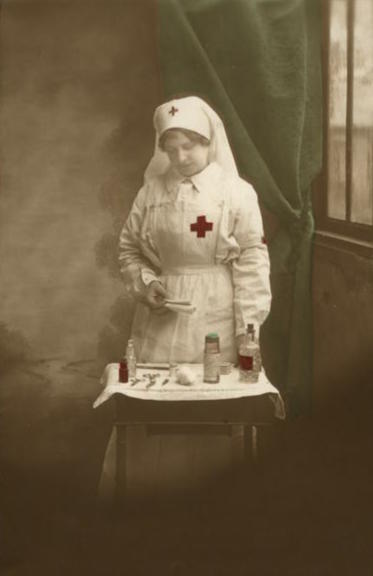
Nurse with medicine bottles

Illness, disease and death were topics Isabella Alden regularly dealt with in her books; but she also gave insight into the remedies of the time. Patent medicines were widely available but home cures were even more popular. (You can read a previous post about the Molasses Cure by clicking here.)

By far the most popular cure Isabella mentioned in her books was beef tea, and for good reason. Beef tea was more frequently prepared for invalids and patients than any other curative. In 1863 The New York Times published an article about care Union soldiers received during the Civil War, citing their “beef-tea diet” as part of “their daily fare in hospital, its excellence and variety, and the admirable arrangements for their comfort.”

Illustration of invalid cookery from The Book of Household Management.

 An 1886 article in Arthur’s Home Magazine called it “the food which is perhaps more valuable and more frequently prepared for invalids than any other.”

“When first supplied in cases of weakness, beef-tea is usually taken with great relish. It seems to give strength and to supply just what is wanted, and a patient will look for it and enjoy it heartily.”

Woman holding tea cup and saucer

.That was certainly the case in Workers Together: an Endless Chain. In the story Mrs. Saunders took a sick young man named Robert into her boarding house. Following doctor’s orders, she immediately began nursing Robert with doses of beef-tea:

The new nurse was ready-handed and cheerfully authoritative. She tucked a fine damask napkin under her patient’s chin, and skillfully fed him with spoonfuls of beef-tea from a solid silver teaspoon. When she decided that he had taken nourishment enough, she whisked away spoon and cup without question, straightened the bed-clothes, beat up another pillow and arranged it dexterously under his head, telling him, meantime, that he looked better already, and that he must keep up good courage, which was always half the battle in everything. Then she drew down the shades, and told him to mind the doctor and go to sleep; and assuring him that Tommy, the bell-boy, should sit just outside the door and would hear if he but just touched the little silver bell by his side, she disappeared before Robert had time to reflect on the questions that he wanted to ask her.

Tea Cup Vine-GraphicsFairy

In Her Associate Members, Chrissy Holmes served her husband a cup of beef tea every night to help him recuperate from an illness. When she found out her neighbor Mrs. Carpenter was ill, too, Chrissy took some of the beef tea to her:

“I should recommend some beef broth for a change, and fortunately I put into my basket a bottle of some which I made fresh today for my husband. I brought my little spirit-lamp along also, to heat it on, for the day is so warm I thought you might not have any fire.”

While she spoke she busied herself in getting out the bottle and  lamp, and a delicate china cup, tinted in pale blue. Mrs. Carpenter watched her with severe eyes.

“Mrs. Holmes,” she said, at last, “there isn’t the slightest need for that, and I wish you wouldn’t. If you think you make me more comfortable doing it, you don’t. I would much rather be let alone; I’m not used to being taken care of. I have had no care since I was a young girl, and I never expect any again. I don’t want it. All I ask of this world is a chance to work and be let alone.”

Tea cup floral


Chrissy did not react to Mrs. Carpenter’s ungrateful comments.

In silence she poured out and administered the beef tea once more, standing silently by while the contents of the cup were being drained again and pronounced very good.

“I can feel that it is giving me strength,” said Mrs. Carpenter, as she returned the cup; “and I am obliged to you, though I’ve almost forgotten how to express such feelings.”

Armour & Company advertisement, 1900.

Beef tea was widely believed to give strength to the ill, but by the 1880s the medical community began to frown on it as a cure.

“Beef tea is a stimulant rather than a food. A person may be hungered to death on it,” declared J. Milner Fothergill, M.D., in an 1880 paper to the Royal College of Physicians in London.

But by that time, belief in the healing powers of beef tea was deeply entrenched in public lore, helped in large part by the manufacturers of beef extracts. The products were a boon to homemakers, since making beef tea in the kitchen was time consuming and wasteful (a pound of beef yielded barely a pint of tea.)
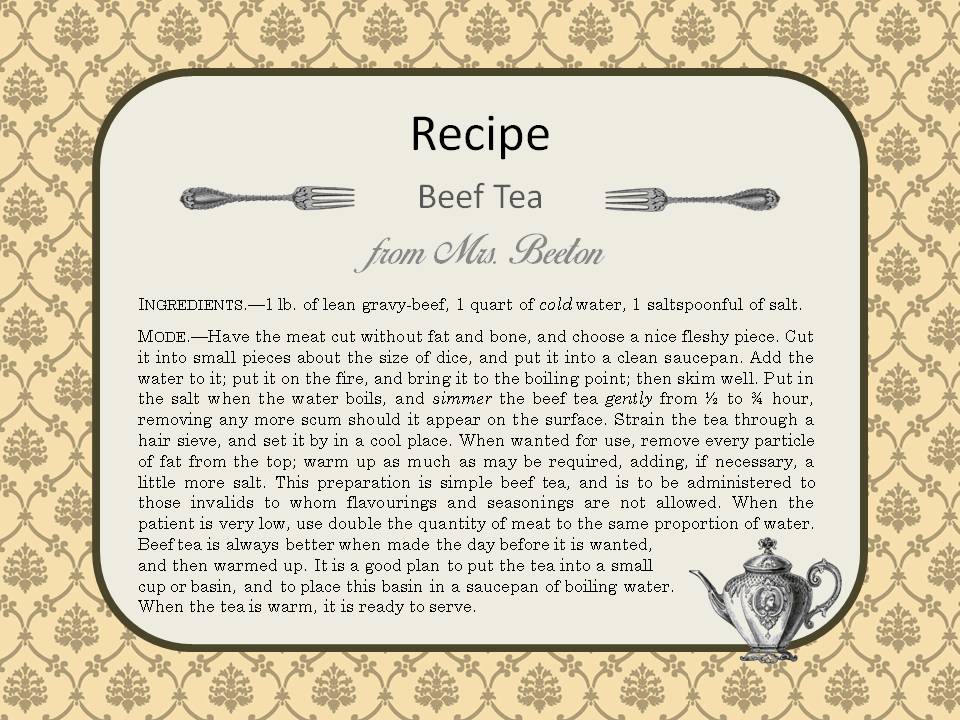
Recipe Beef Tea


This 1896 trade card for Armour’s Extract of Beef promotes the product’s use in making soups.

Armours Extract trade card 1896 front    Armours Extract trade card 1896 back

But in other ads, the same company also promised health benefits to people who used their product, as this 1895 magazine ad shows:

Armour's print ad 1895

In the 1860s a whiskey distiller in Cincinnati, Ohio began producing a “tonic elixir and liquid extract of beef” they claimed could cure “female diseases,” indigestion, and weaknesses of all kinds.
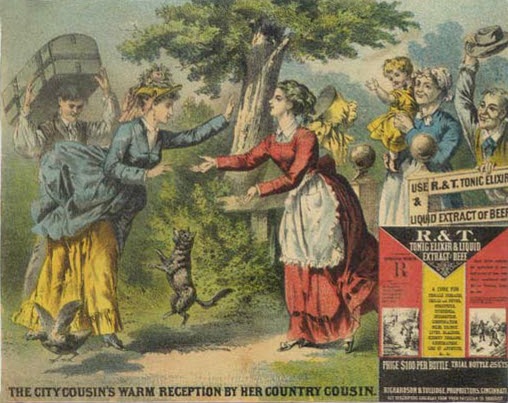
R&T Tonic Elixir ad, 1870

American companies like Cudahy Packing Company and Armour & Company—which originally manufactured beef products to make broths, soups, and gravies—boosted their sales by claiming healing properties in their products.
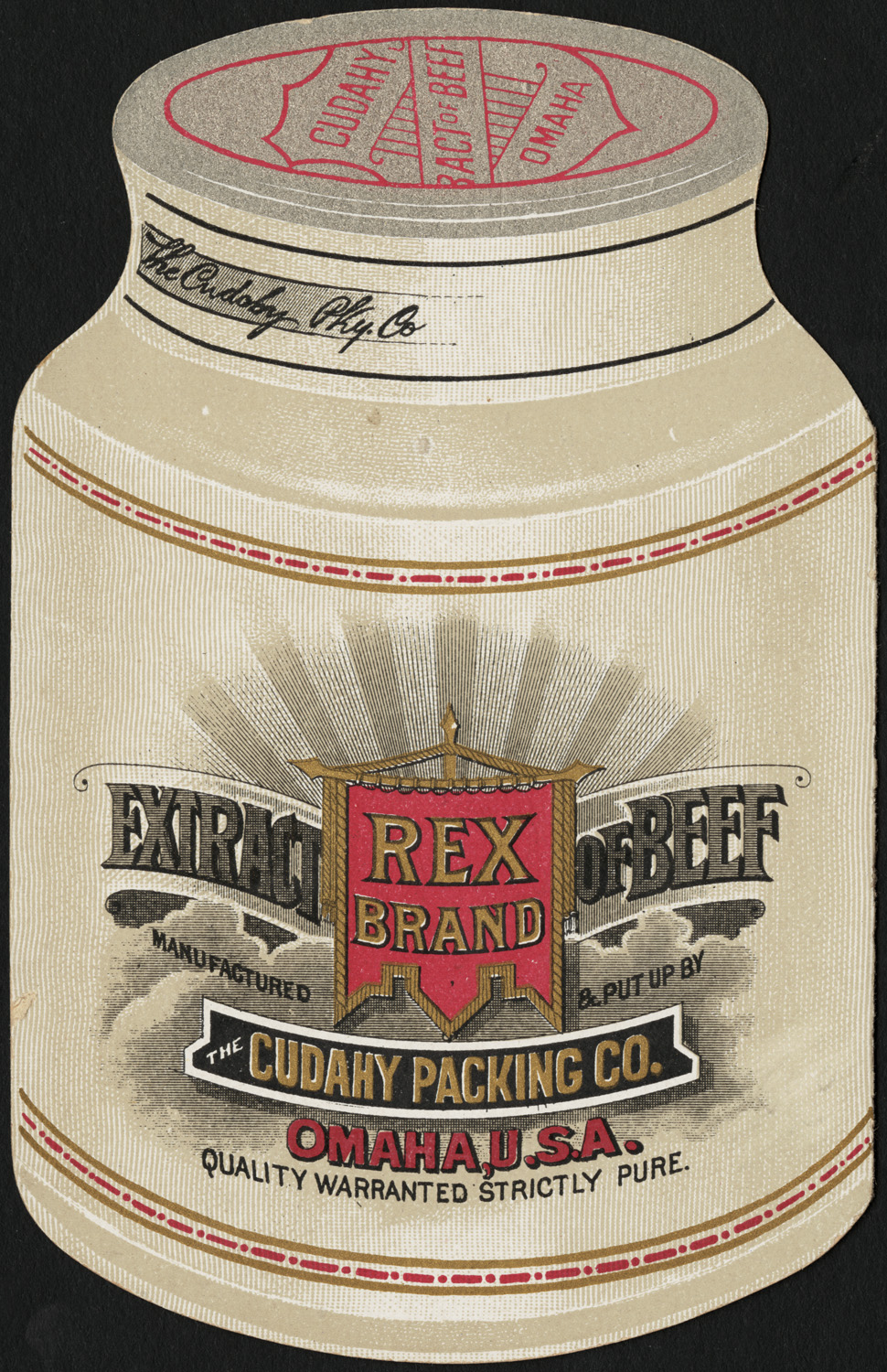
Cudahy's Rex Brand Fluid Beef trade card front      Cudahy's Rex Brand Fluid Beef trade card interior

Johnston’s Fluid Beef, which originated in Scotland, took great care to publish testimonials in America that strengthened their health claims:

Johnstons Fluid Beef testimonial

Soon other companies like Liebig Company followed suit. They promised good health, strength and vitality to individuals who consumed their product.

Liebig Trade Card 1885      Liebig ad 1899

Bovril, a British product developed by Johnston’s Fluid Beef of Scotland, didn’t promise simply to cure American consumers of disease. They went one step further and promised to prevent disease.
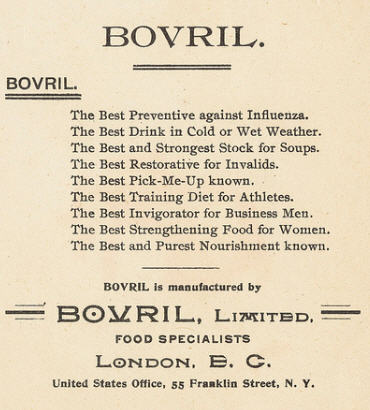
Bovril benefits ad undated

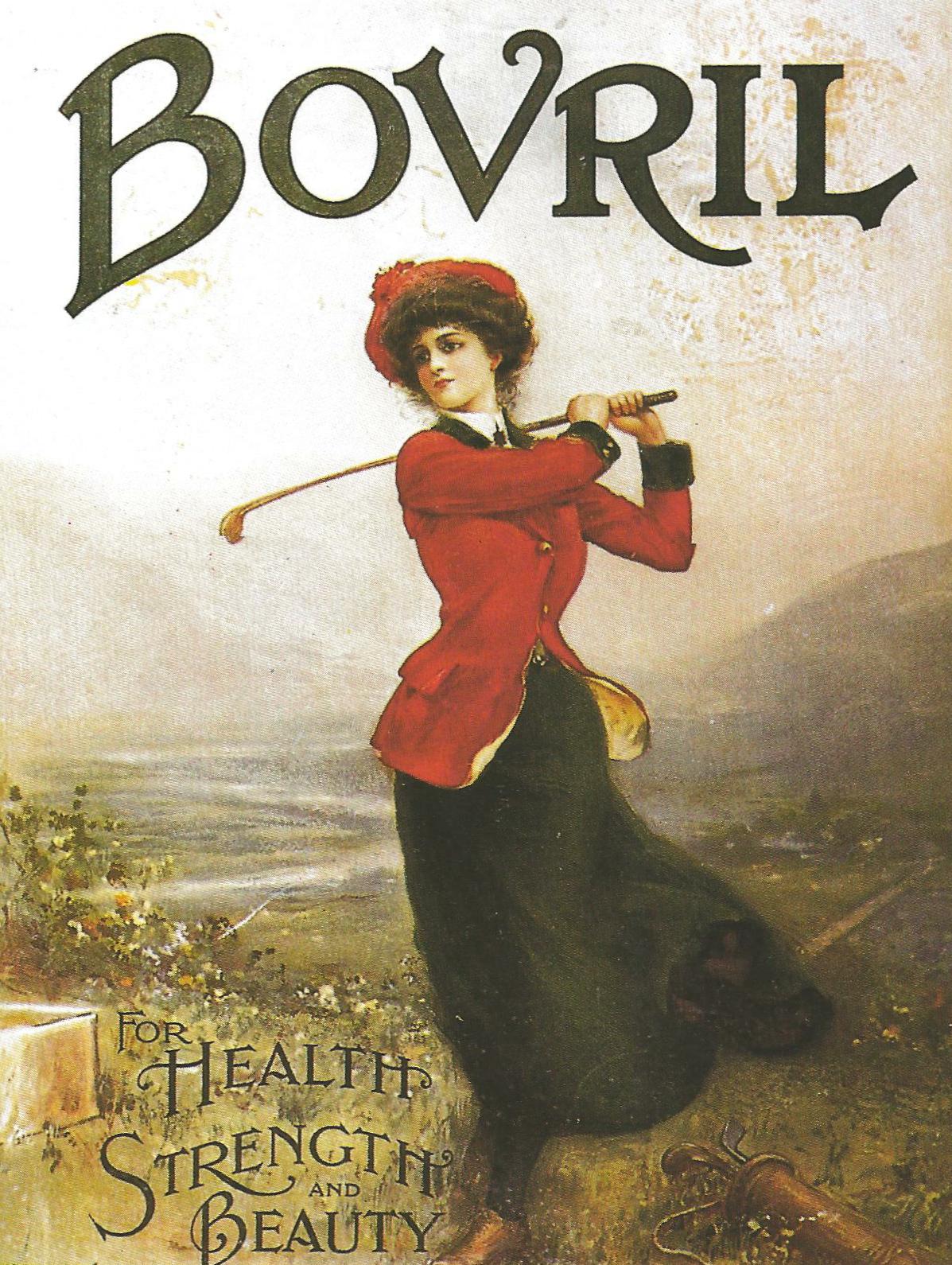
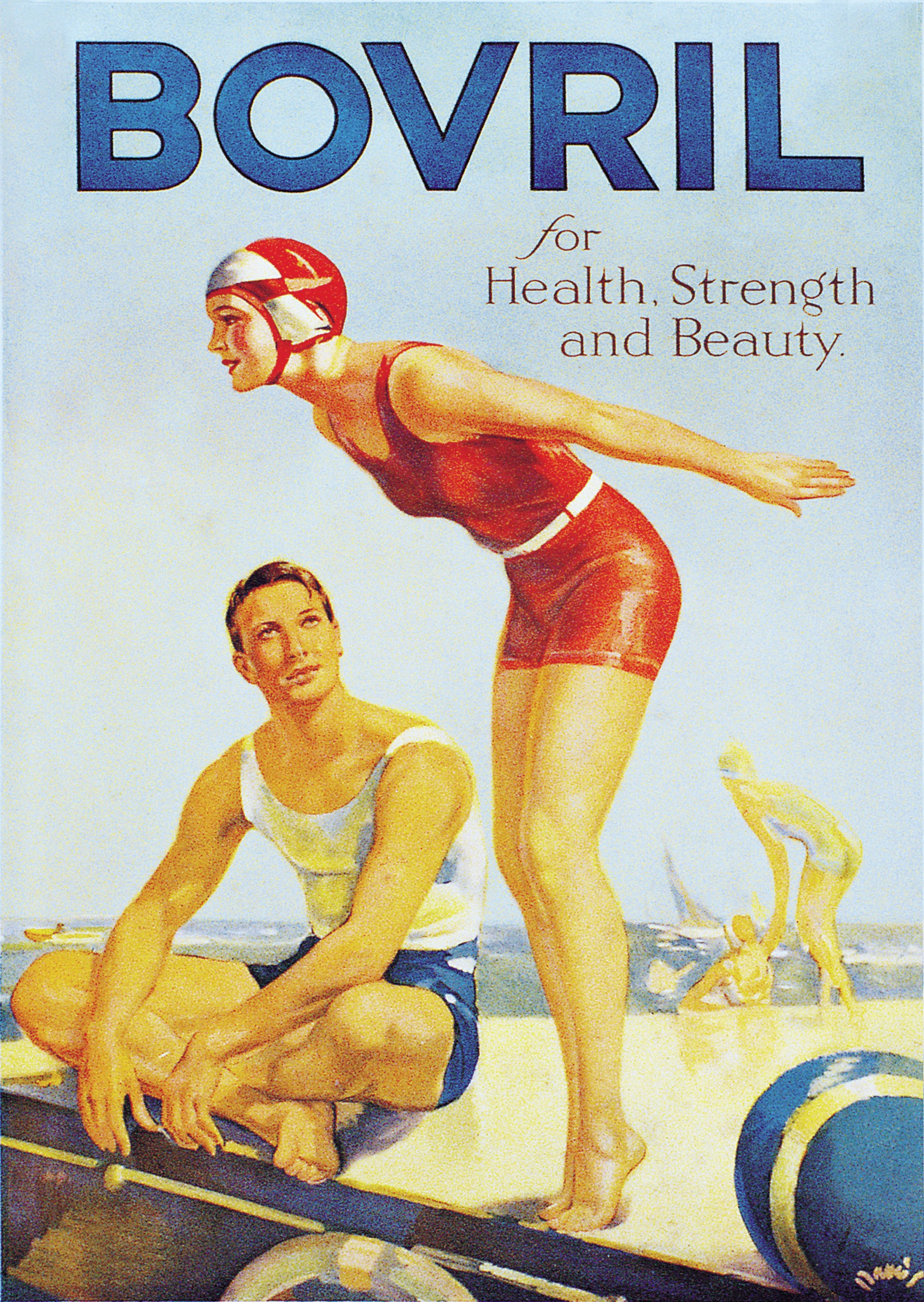
Bovril’s advertising to Americans typically featured images that reinforced their claims of strength, vitality and energy. Strong, charging bulls, healthy, masculine men and beautiful, energetic women graced Bovril’s advertisements.
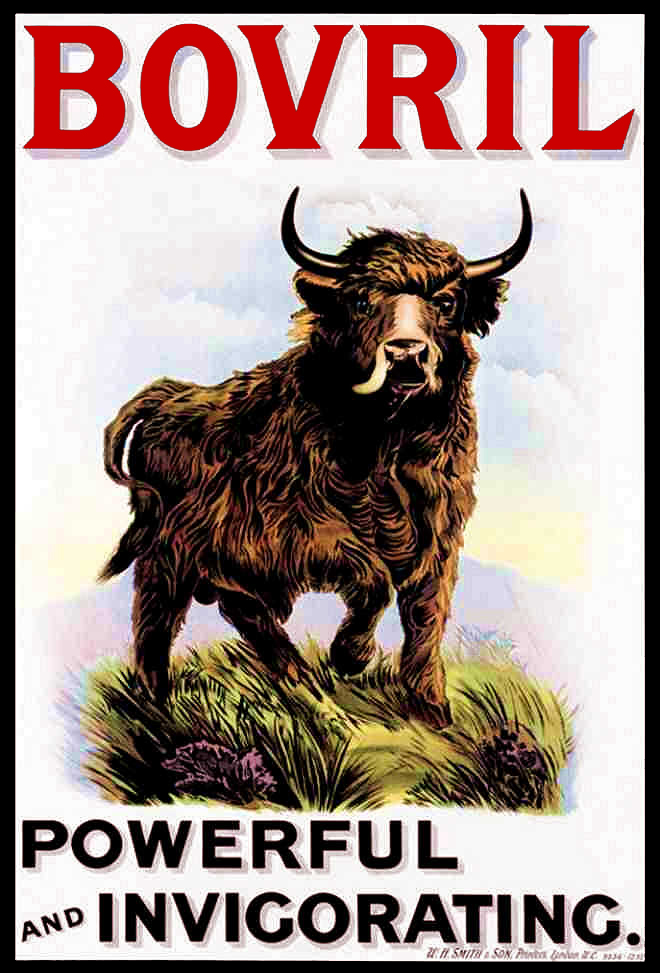
Bovril Steer undated    Bovril Steer ad card

Bovril trade card 1903    Bovril Swimmers

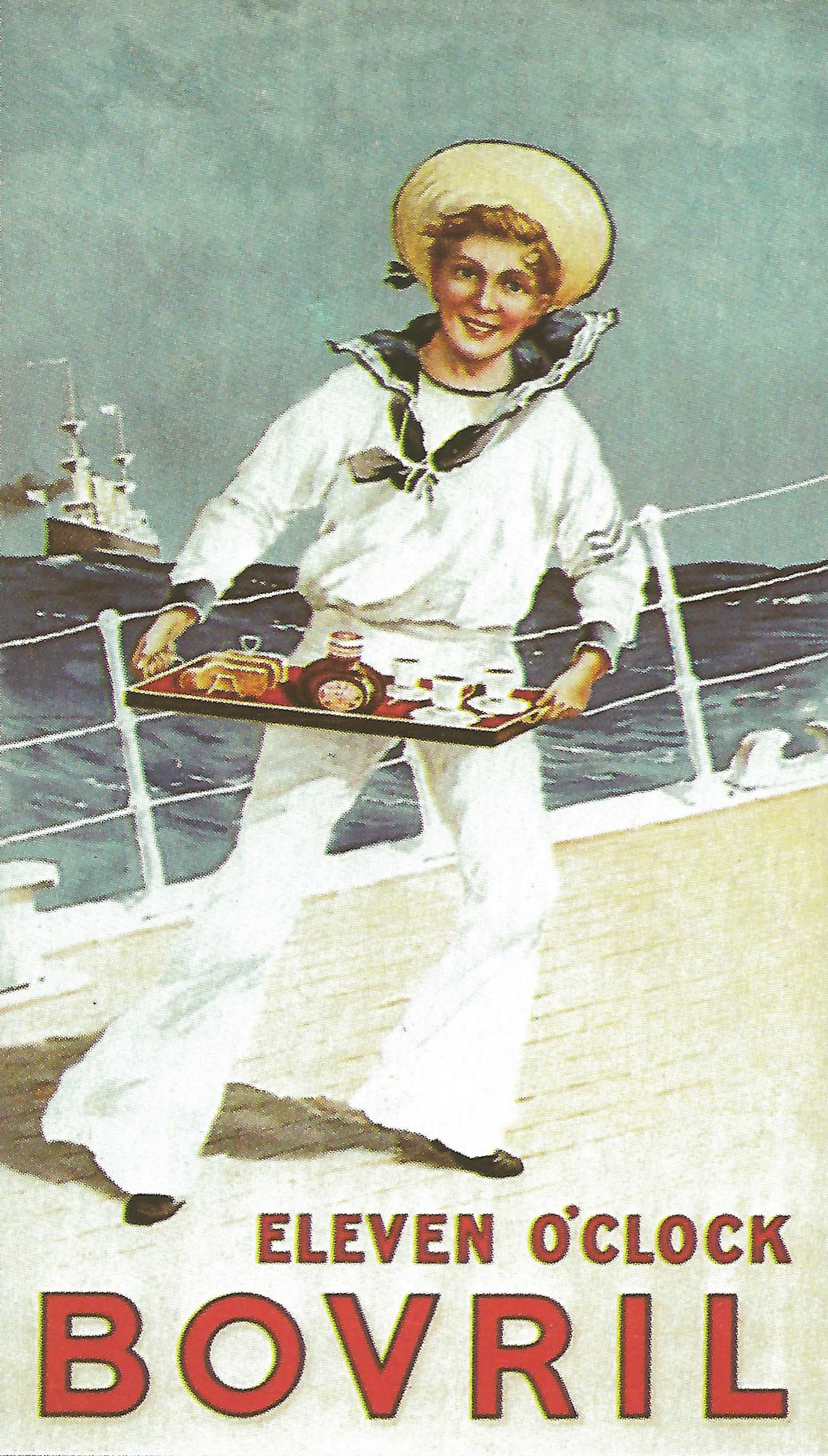
Bovril British Navy ad 1903     Bovril Sailor ad 1903

And this ad conveyed a subliminal message that if Bovril was used in hospitals throughout the world, the product’s health claims must be true.

Bovril ad hospitals

Today Bovril is still marketed around the world, although the company no longer makes inflated health claims based on dubious scientific testimony. The product has a loyal following, particularly among fans of football (that’s soccer to us in America), who take it along as a hot drink to sip while cheering on their favorite team on chilly mornings.

Bovril Today
The distinctive Bovril pot.


A Tour of Chautauqua: Lectures and Classes

(Note: You can click on any of the images in this post to view a larger version.)

The Chautauqua Assembly had a modest beginning in 1874. It was originally conceived as a summer training program for Bible teachers; but from the start, the Chautauqua Assembly differed greatly from accepted Bible training of the time. At Chautauqua, Sunday school teachers gathered not in convention halls to hear reports and listen to speeches. Instead, they spent two or more weeks in the out-of-doors studying the Bible, attending classes, and collaborating together to create Sunday school lesson plans for use in churches across the country. From that modest beginning, the Chautauqua Institution grew and its mission expanded, as did its fame.

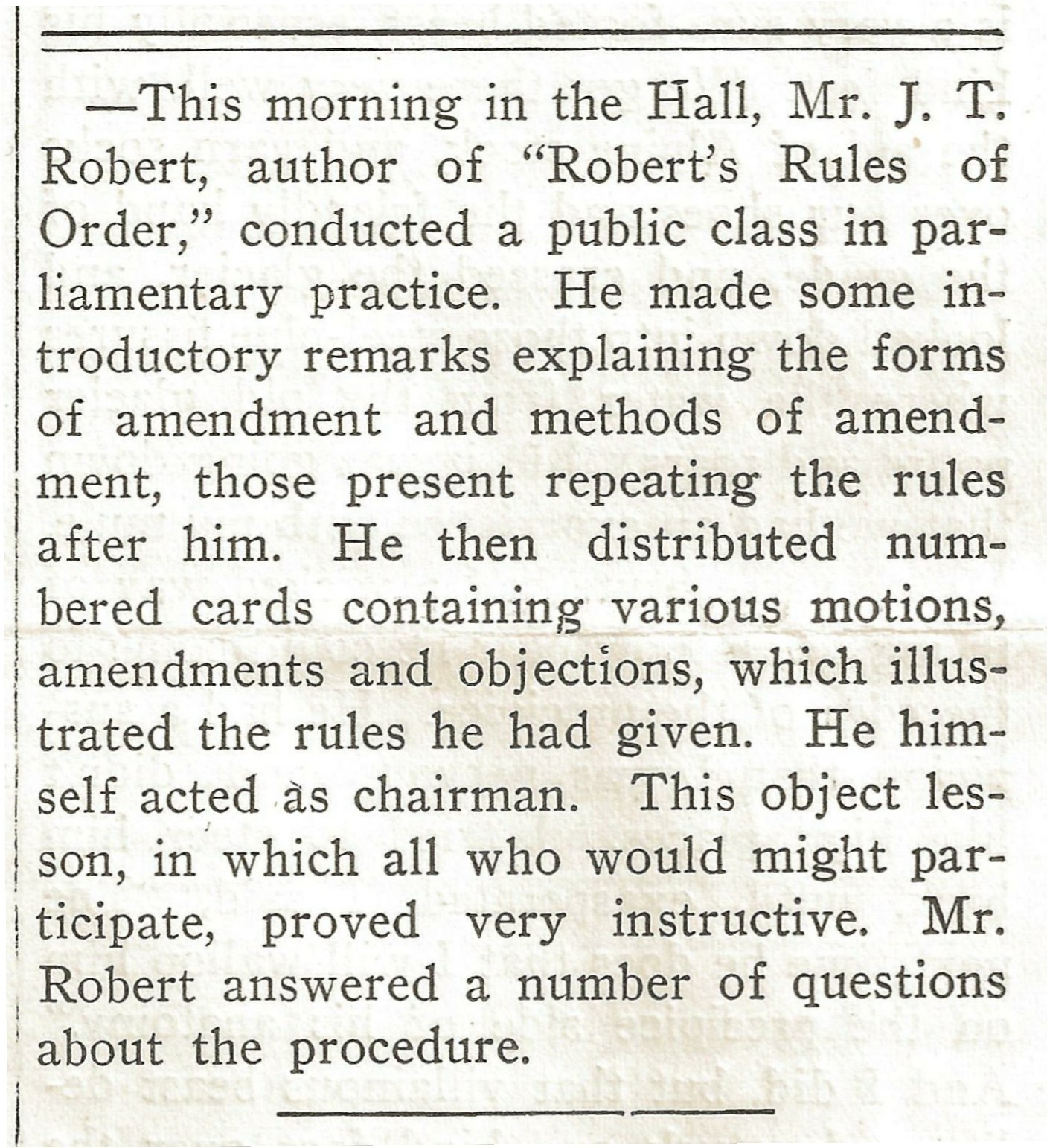
Report of a summer class on Robert’s Rules of Order, 1901

By 1885, when the twelfth annual Chautauqua Assembly was held, over seventy-five thousand people gathered—some for a day, some for a week and several thousand for the entire eight-week term of the Summer Assembly. While many still came to be trained and inspired as Sunday school teachers, others came to hear lectures and attend classes on the Bible, ancient history, science, and philosophy. They participated in experiments in chemistry, and studied the stars through telescopes. They learned languages of the world, including Hebrew, Latin or Greek; and received instruction in music and vocals.

Report of a Harvard Professor’s Lecture; 1901.

A remarkable element of the Chautauqua Summer Assembly was the level of course instruction. The best lecturers and teachers in the world came to Chautauqua. Renowned clergymen, famous statesmen, and college presidents lectured at the Assembly, as did Nobel Peace Prize winners and military heroes. Students with grade-school educations sat beside college graduates at lectures given by professors from Yale, Harvard, Cornell, Wellesley, Johns Hopkins and other prominent universities from the U.S. and Canada.

Chautauqua’s democratic culture extended beyond the classroom. The Reverend Jessie Lyman Hurlbut told of a woman who once said:

“Chautauqua cured me of being a snob, for I found that my waitress was a senior in a college, the chambermaid had specialized in Greek, the porter taught languages in a high school, and the bell-boy, to whom I had been giving nickel tips, was the son of a wealthy family in my own State who wanted a job to prove his prowess.”

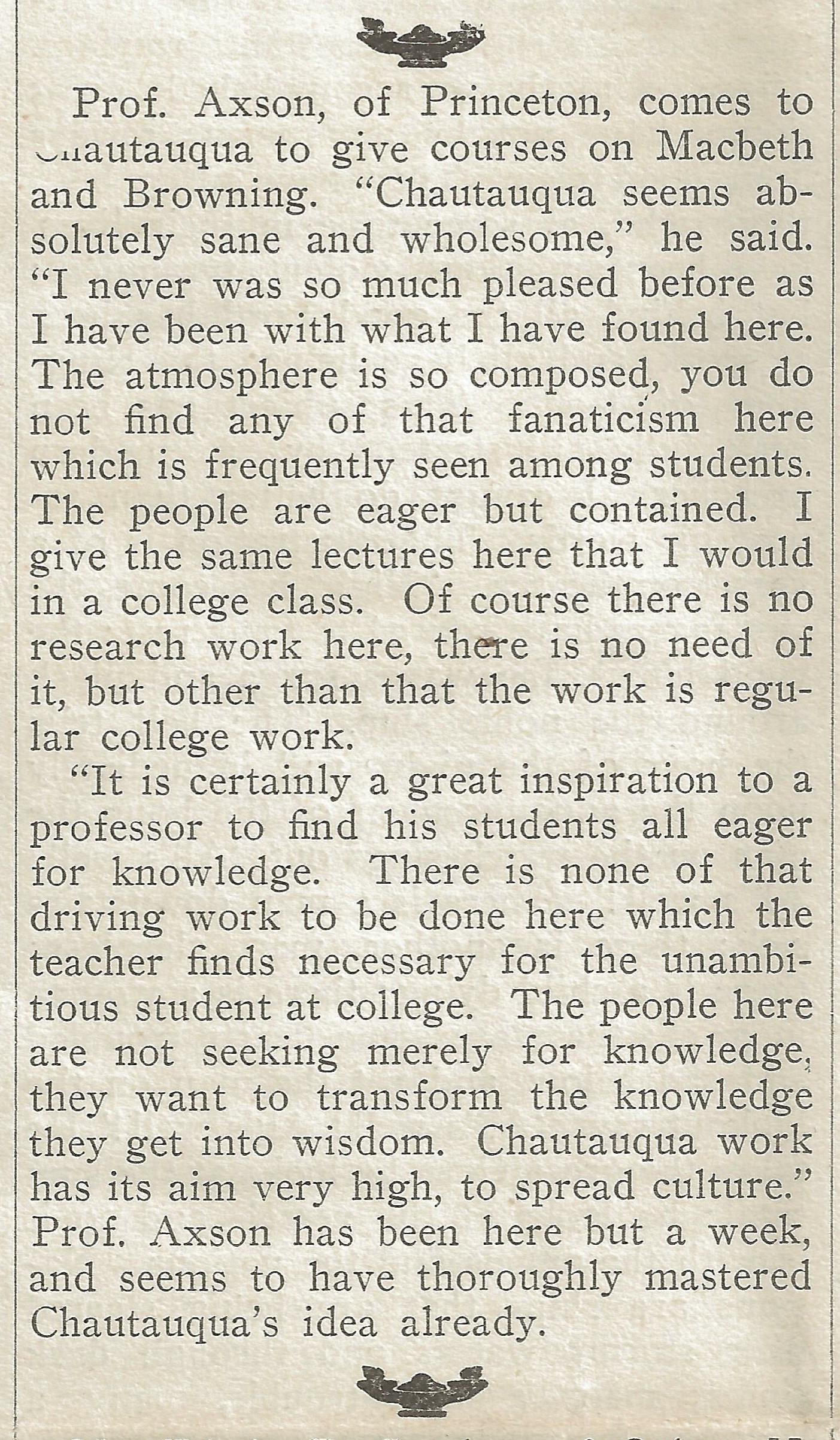
1901 announcement of classes offered by a Princeton professor.

But not everyone was as open minded. Reverend Hurlbut also recalled chatting with a highly respected clergyman from England as they sat together at a hotel table. When he explained to the clergyman that their waiter was a college-student, working to earn money to continue his college coursework, the clergyman was offended. “I don’t like it, and it would not be allowed in my country. I don’t enjoy being waited on by a man who considers himself my social equal!”

Theodore Roosevelt
Theodore Roosevelt


The names of guest lecturers read like a Who’s Who of the time: G. K. Chesterton, H. G. Wells and George Bernard Shaw. Theodore Roosevelt attended four different years and when William Jennings Bryan took the podium, Chautauquans packed the Amphitheater to its utmost corners to hear him speak.

Lectures and classes were designed to educate and stimulate, to encourage Chautauquans to think globally and broaden their views. Students were urged to discuss lecture contents and ask questions so they had a full understanding of the issue or topic at hand.

06Chautauqua College
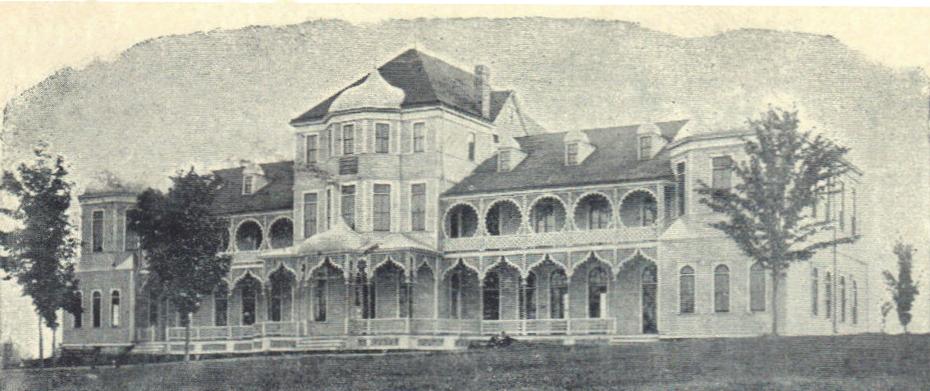
The Chautauqua College building.

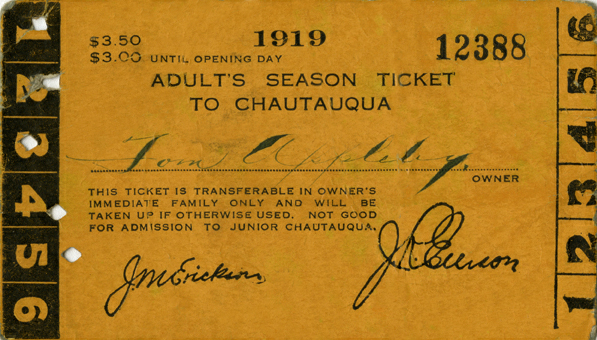
The Chautauqua Summer Assembly was part of a wider Chautauqua system of education that included as many as eight different departments. Each department offered classes and lectures throughout the summer months of July and August.In July 1884 an individual could purchase a one-day admission to the Summer Assembly for 25¢. That admission cost gave them access to all lectures, classes and meetings except those conducted by the School of Languages and the Teachers Retreat. In August the cost of a one-day admission rose to 40¢.

Chautauqua Ticket, 1919

If you planned to stay longer, you could purchase admission for a week in July for $1.00, or $2.00 for a week in August. Or you could stay the entire summer term for $4.00.

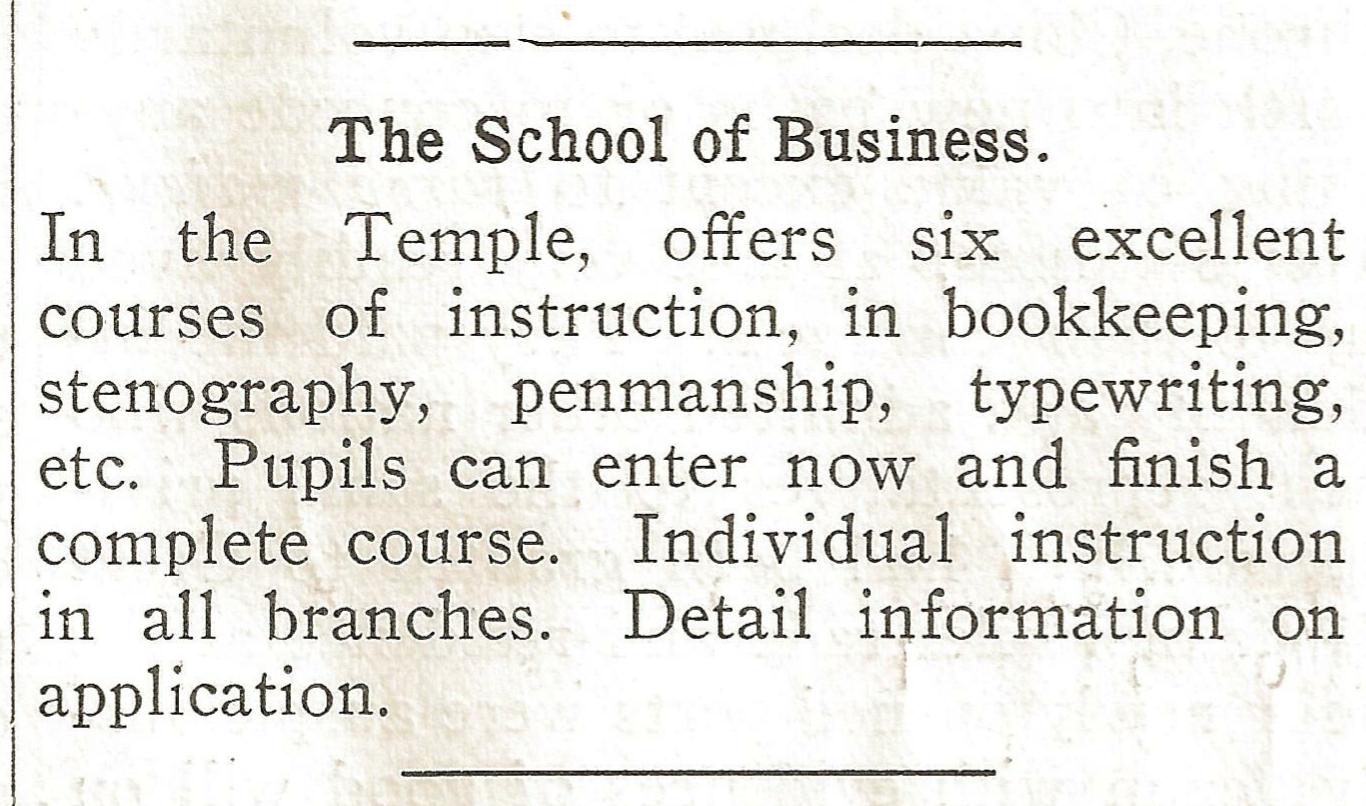
Courses offered by the School of Business, 1901

Some special classes required a separate ticket. For example, 15 lessons in penmanship (including stationery) cost $2.50; a course in bookkeeping cost $3.00; 10 lessons in elocution cost $4.00; and 4 weeks of instruction in Hebrew cost $10.00.

Newsboys of the Chautauqua Assembly Herald

With so many available classes and so many activities to attend, Chautauquans had to schedule their days with precision. They mapped out their daily classes, lectures and activities by reading The Chautauqua Assembly Herald. This newspaper, published on-site every day but Sunday, listed the weeks’s offerings. It also gave an account of the speakers, meetings, and activities from the previous day. Eager Chautauquans took advantage of as many offerings as they could, often running from one event to another from 8:00 a.m. until 10:00 p.m.

Click on this link to view the July 29 and July 30, 1901 editions of  The Chautauqua Assembly Herald. On page 4 of each edition you’ll find a list of the week’s programs, meetings, lectures and classes.

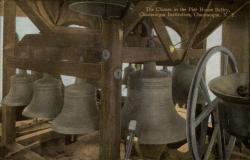
11 Chautauqua Chimes 1924The Chautauqua Institution kept things running in a timely manner. Five minutes before the hour a bell rang, giving notice that the next event or class would begin promptly at the top of the hour. The sound of the bell usually resulted in a throng of people streaming out the door of one class in order to get to the next class on time. Bells marked the hour until 10:00 p.m. when the last night bell rang signaling quiet.

In Four Girls at Chautauqua, Flossy Shipley overheard a man say, as he ran past her, “Confound it all! Talk about getting away from these meetings! It’s no use; it can’t be done. A fellow might just as well stay here and run every time the bell rings. I heard more preaching today on this excursion than I did yesterday; and a good deal more astonishing preaching, too.”

An afternoon class in German, circa 1895.

With each passing year, the number of people attending the Summer Assembly increased, as did the number of schools and courses offered. For instance, in 1901 the School of Languages added Arabic and Assyrian to their offerings of French, German, Spanish, Latin, Hebrew and Greek. Students took classes in mathematics, oratory and expression, mineralogy and geology.

Art Lessons

There were classes in clay modeling and china painting, as well as classes in music and singing. Small cottages were erected in a far-away corner of the grounds where music students could practice their scales and exercises without disturbing their neighbors. One instructor wrote, “I am told that forty-eight pianos may be heard there all sending out music at once, and each a different tune.”

Cooking Class.

The School of Domestic Science attracted great attention. One instructor, Mrs. Emma Ewing, erected a model kitchen and taught ladies from all walks of life to make bread, prepare meals, and serve tables with refinement.

A class in Library Science, 1904

The Summer Assembly offered career training, as well. Students learned shorthand and typing, grammar and composition, library sciences and bookkeeping.

15 School for Library Training
Announcement of the School of Library Training, 1901.


Standing room only at an open air lecture. About 1896.

In the early years of the summer Assemblies, classes were held in tents but as Chautauqua grew, buildings were erected to accommodate students.

The majority of the lectures were held in the Amphitheater. Erected in 1897, it could hold 5,500 to 5,600 people; but some lectures proved so popular that the Amphitheater overflowed.

Chautauqua crowds listen to a speaker in an open area.

Other lectures were held in the park, or anywhere else that could accommodate large numbers of attendees. The subjects were widely diverse, covering a broad array of topics:

  • The Last Days of the Confederacy
  • Going Fishing with Peter
  • The Women of Turkey
  • The Physiological Effects of Alcohol
  • Ideals of Modern Education
  • Christian Life in the Modern World
  • Shakespeare as a Moral Teacher
  • America’s Leadership in World Politics
  • The Knights of King Arthur
  • Does Death End All?
  • A Study of the Lynch Law
  • The Juvenile Court
  • The Drama and the Present Day Theater
  • Beyond the Grave
  • The Artisan and the Artist
  • The Ideal of Culture
  • French Literary Celebrities
  • The One-Hundred Worst Books
  • A Dozen Masterpieces of Painting
  • Mountain Peaks in Russian History
  • Growth and Influence of Labor Organizations

 Click on this link to read the text of a lecture presented July 26, 1901 by Dr. P. S. Henson of Chicago on the topic of grumbling. (Yes, grumbling!) You’ll find it on page 3 of The Chautauqua Assembly Herald.

Isabella Alden was arguably the best chronicler of the Chautauqua Summer Assembly experience. The characters she created in her books represented the diverse people who attended the Assembly and their different social and economic walks of life. She also captured the varied topics and inspirational nature of the many classes and lectures the Summer Assembly offered.

Next Stop of our Tour of Chautauqua: Palestine Park


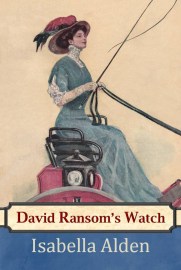
Now Available: David Ransom’s Watch

Cover_David Ransoms Watch resizedDavid Ransom’s Watch is now available!

Miss Hannah Sterns received plenty of marriage proposals in her time. There was Ben Ransom, the fickle, restless charmer who cheated his older brother David out of his most beloved possession—their father’s watch. And Ray Prescott, the minister who dreamed of the good works he could accomplish for Christ with Hannah by his side. Yet Hannah remained unmarried in the big house on the farm just outside town . . . until the fateful day that Hannah’s heart was finally touched by love in a most unexpected way.

But old beaux have a way of coming back, and after years of separation, Hannah finds herself mired in Ben Ransom’s troubled life. Soon, Hannah realizes that the future of the one she loves most is inextricably tied to Ben Ransom, his brother David, and David’s beloved silver watch.

This edition of the 1905 classic Christian novel includes a biography of the author and additional bonus content.

Click on the cover to read sample chapters on Amazon and learn more about Stephen Mitchell’s Journey.