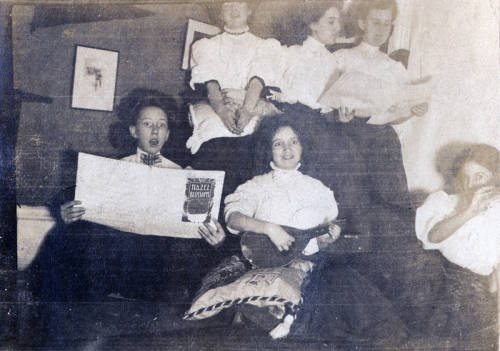
Pansy Approved Bicycles

Did you know Chautauqua Institution had its own commercial printing office? It produced brochures, maps of the grounds, programmes, daily schedules, and a newspaper called The Chautauqua Assembly Herald.

Published six days a week, The Chautauqua Assembly Herald filled eight to ten pages of every issue with news about Chautauqua, including the comings and goings of some of its residents and visitors.
On July 24, 1895 one of the newspaper’s reporters spotted Isabella’s familiar face at a concert in Chautauqua’s amphitheater:

Pansy’s placid, pleasant face was seen in the veritable sea of faces at the concert in Chautauqua’s amphitheater Wednesday. From her very looks one would judge Mrs. Alden as a woman who loves little people, even if one had never heard of the famous Pansy books.

Naturally, the reporter sought Isabella out as soon as the concert was over, and asked about her summer plans and whether she was writing anything special. Isabella confirmed she was indeed working on a story, and added:

“All of my stories, you know, are published in serial form in my magazine before they are put out in book form. My magazine work occupies most of my time.”

“For the past 19 years we have spent every summer at Chautauqua. We have our summer home here, but for many years past I have had to give up my Assembly work. I am much interested, however, in the Woman’s Club here.”

Knowing the Woman’s Club was to meet the next day, the reporter asked Isabella if she was going to read a new, unpublished story to club members.

“It is a story which not only has not been published, but which is not yet all written,” replied Pansy smiling.

Their conversation drifted into other topics, including an observation about the new phenomenon of women using bicycles as a means of getting around Chautauqua.

Studio photograph from late 1890s of young woman posed beside her bicycle. She is wearing a long dark dress with long sleeves and a high collar, and a bonnet.

Progressive-thinking Isabella had no problem with the new “wheelwomen” (as lady cyclists were called in 1895):

“I think the bicycle must offer a pleasant, healthful form of recreation to women, but I do like to see them dress inconspicuously and neatly when riding, and I do not like to see them wear bloomers.”

Photograph dated 1912 of woman standing beside her bicycle. She is wearing a long skirt, long-sleeved shirt with high collar, and a bonnet.

Any guesses which story Isabella was writing and publishing as a serial in The Pansy magazine during the summer of 1895?

It was Reuben’s Hindrances! Chapter eight of Reuben’s Hindrances appeared in the July 1895 issue of The Pansy; monthly installments continued into 1896 until all twenty-four chapters appeared in the magazine.

Advice to Readers on Praying Aloud in Public

For many years Isabella served as an editor and contributor to a Christian magazine in which she had a very popular advice column. She used the column to answer readers’ concerns—from a Christian perspective—on a variety of topics.

One letter came from a woman who was having trouble overcoming a very common problem: She was terrified of praying aloud in front of other people.

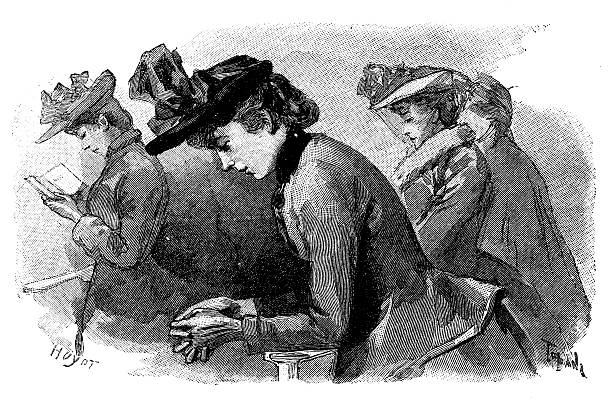
Antique illustration of women praying in church.

The writer described herself as a grown woman, “not very young” of age. She believed it was her duty to pray before others in Sunday-school class or at prayer meetings, but she found it “almost impossible” to do so. Even when she planned out what to say ahead of time, she would forget, and stammer and stutter; and she often ended her prayer feeling embarrassed and pledging never to pray before others again.

Here is the advice Isabella gave her:

First, let me assure you that your “name is Legion.” As a worker among those that are moving toward middle age, I have found this feeling a constant hindrance.

My friend, by all means persevere, no matter how much you stumble, nor how many carefully-thought-out sentences you “forget.” Stammering lips often carry a message straight to the throne of God, and it is to God that we speak when we pray.

Do not let Satan blind you with that specious argument of his that you cannot pray to “edification.” That is not the first object of prayer. Moreover, God often uses the stammering tongue for his glory. I remember and am helped to this day by the thought of the hesitating, sometimes broken, sentences of a dear father who thought that he could not pray aloud.

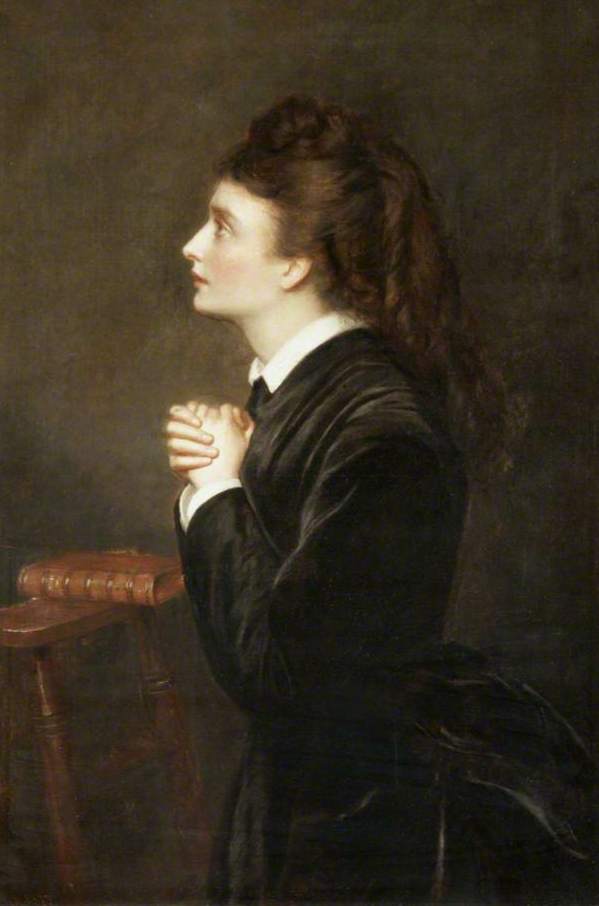
Young woman dressed in black with white lace collar and cuffs is seated at a table. A Bible is open on the table and her hands are clasped together on top of the open Bible.

Now for a few hints that I have found helpful:

First: Cultivate the habit of praying in an audible voice when alone in your room. Perhaps no one thing will give you self-control more speedily than this. We are creatures of habit, and when we have grown accustomed to the daily sound of our own voices when on our knees, habit, after a little, asserts itself when we kneel before others. Because of habit, the kneeling posture is, I think, the most helpful one to assume, even in public prayer, wherever this is feasible.

Next, grow very familiar with Bible prayers, those terse sentences pregnant with meaning:

“Create in me a clean heart, O Lord.”

“In thee, O Lord, do I put my trust.”

“Be thou to me a strong rock.”

“Send out thy light and thy truth.”

The Bible is very rich as a prayer-book. If we linger much among such petitions, habit will again come to our aid, and the Bible words will rush in upon us when we pray before others. When I was a beginner in public prayer, I used to write out certain of these Bible prayers that voiced my desires, and spread them before me, lest my memory should prove treacherous. I found this a good crutch for a time.

For a like reason I used sometimes to write out my own form of prayer, carefully avoiding set phrases and sentences that I should never think of using if alone, going over and over the form to make it simple and direct, and to be sure that it expressed only what I really felt. This I would read aloud, with bowed head; and it helped me in overcoming timidity.

Let me close as I commenced, with an urgent appeal to you to overcome the temptation to shirk this duty; and to resolve to conquer in His name.

Pansy

What do you think of Isabella’s advice?

Do you think her suggestions were helpful?

A Chorus of Four-Thousand Voices

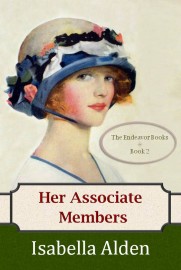
Isabella Alden was deeply involved in the Christian Endeavor movement that took root in America and swept around the world in the late 1800s. She regularly contributed to the Christian Endeavor newspaper; and she wrote about Christian Endeavor in of her novels Chrissy’s Endeavor, Her Associate Members, and others.

E-book cover of Chrissy's Endeavor by Isabella Alden.
Image of e-book cover of Her Associate Members by Isabella Alden.

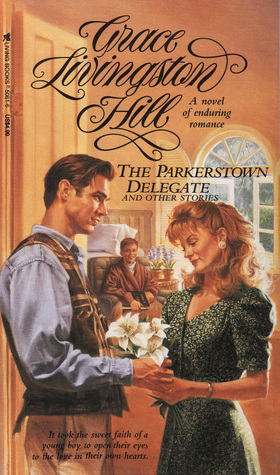
Isabella’s family was involved in Christian Endeavor, as well. Her niece, Grace Livingston Hill, served as president of a Christian Endeavor chapter. One of Grace’s early novellas was a Christian Endeavor story called “The Parkerstown Delegate;” and with her husband Grace published a guide for Christian Endeavor leaders that was widely used by C. E. chapters.

Cover of paperback edition of The Parkerstown Delegate by Grace Livingston Hill.

The Christian Endeavor Society held regular annual conventions in the U.S. that were very well attended by people from all over the country; but in 1896 the society held an international convention in Washington D.C. Thousands of Christians of all ages, nationalities, and denominations, descended upon the U.S. Capitol for five days of non-stop meetings, worship services, training classes, and Bible studies.

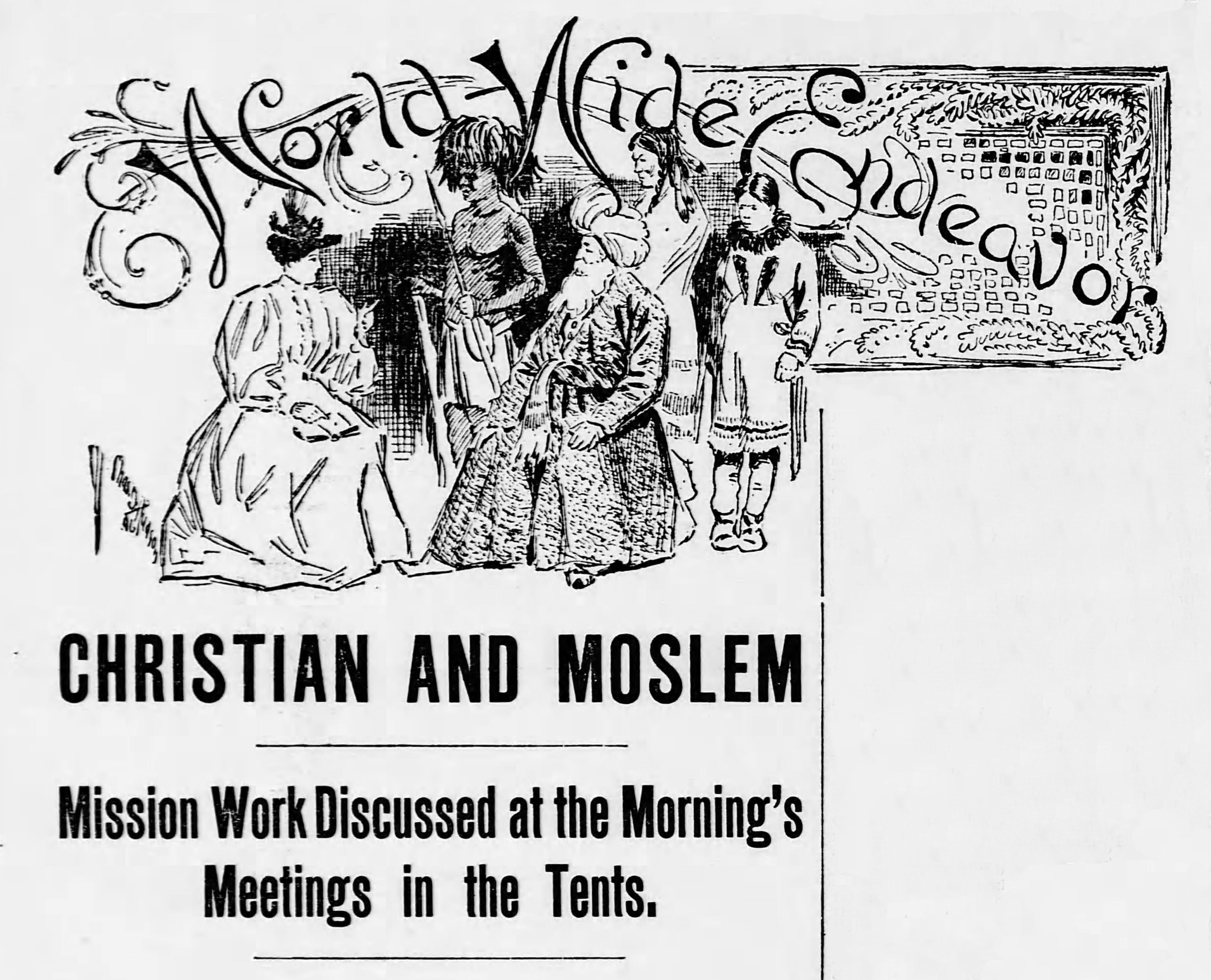
Image depicting American woman with Bible open in her lap speaking to people dressed in attire Africans, Middle Easterners, and Native Americans. "World Wide Endeavor" is written above the drawing. "Christian and Moslem" is written below the drawing; and below that "Mission Work Discussed at the Morning's Meetings in the Tents."
Newspaper headline about the convention, from the Evening Star, Monday, July 13, 1896.

Isabella knew Washington, D.C. very well. She and her family lived there for three years when her husband served as assistant pastor of The Eastern Presbyterian Church, located just blocks from the Capitol building (read about her D.C. home here). In early 1896 the Aldens moved to New Jersey, just a short train ride away from Washington; so it’s entirely possible the Aldens attended all or part of the international convention that year.

The convention opened on Thursday, July 9 and ended the following Monday. Convention attendees were given a schedule of events and a map to help them travel from venue to venue, most commonly by foot.

The Christian Endeavor Society distributed this map of Washington, D.C. to conventioneers in 1896.

Attendees braved the heat, the humidity, and the stifling crowds of fellow Endeavorers that thronged the mall from the Lincoln Memorial to the Capitol building.

Sepia photo of a crowd of people packed tightly together.
“The Army of the King.” Christian Endeavorers crowd Washington, D.C. in 1896. From the New York Public Library Digital Collection.

On The Ellipse, located between The White House and the Washington Monument, enormous tents were erected where meetings and lectures were held.

Black and white photo of two large tents set up at the base of the Washington Monument.
A newspaper photo of the meeting tents, with the Washington Memorial in the background.

Each tent was designed to hold hundreds of people, but some evening gatherings drew enormous crowds. At times there were so many people, and the interiors of the tents became so hot, the tent sides had to be raised to allow fresh air to circulate.

Drawing showing oval shaped tents. On one end is a stage flanked by two rows of chairs. Behind the stage and in front of it are tightly placed rows of seating for audience.
A tent interior layout, printed in the Evening Star on Wednesday, July 8, 1896.

But of all the activities that took place over the five-day convention, there was one event that stood out and was talked about for months afterward.

On Saturday evening, July 9, a patriotic service was planned to take place on the east front of the Capitol Building.

The east front of the United States Capitol building, photographed in 1904.

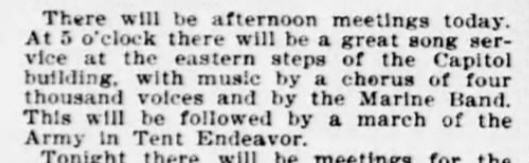
The service was described as “a great song service” of patriotic songs and hymns led by a chorus of four thousand voices.

There will be afternoon meetings today. At 5 o'clock there will be a great song service at the eastern steps of the Capitol building, with music by a chorus of four thousand voices and by the Marine Band. This will be followed by a march of the Army in Tent Endeavor.
An announcement of the service in the Evening Star on July 11, 1986.

A photographer captured this image of the chorus assembling on the steps of the Capitol:

A large crowd of people fill the steps of the Capitol Building.

One newspaper enthusiastically wrote that the patriotic service was “grand music to listen to, and something to remember.”

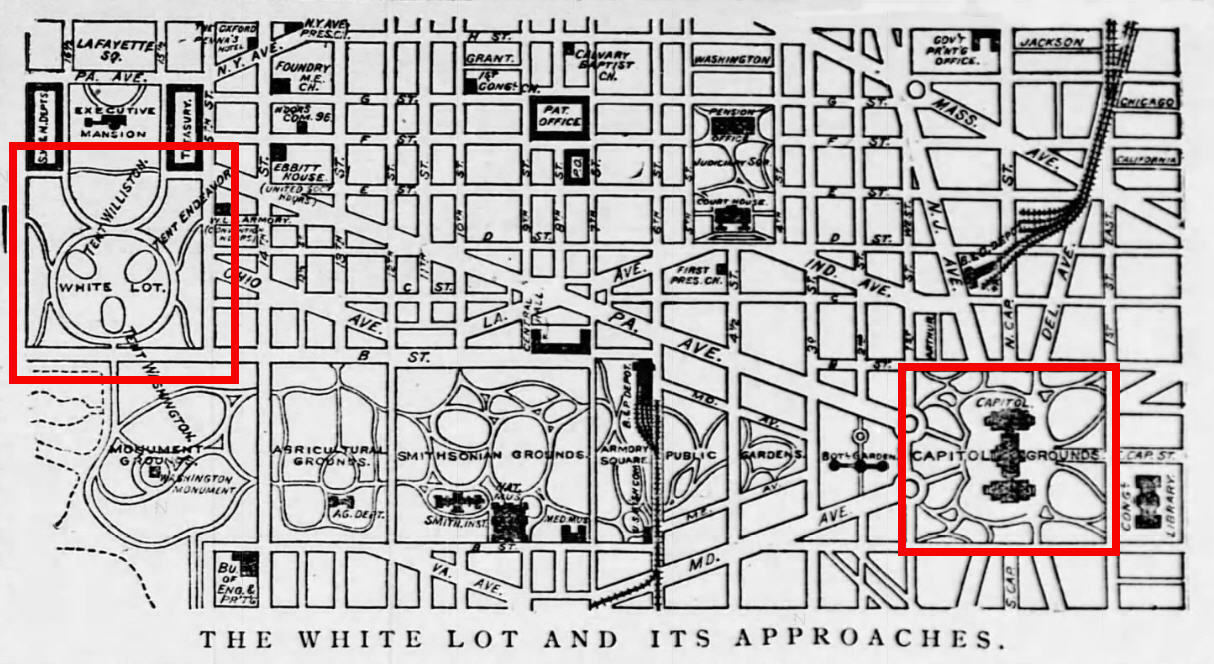
At the conclusion of the service, the chorus, the Marine band, and the audience left the Capitol steps to march down the National Mall to the Ellipse, where they gathered at Tent Endeavor.

Map showing the streets around the National Mall. The Capitol Grounds and The Ellipse are circled in red to show their locations and distance.
The Ellipse and the Capitol Grounds shown on a map published in the Evening Star.

The song service was a tremendous success! While there was no official count, attendees believed there were just as many singers among the audience as there were on the Capitol steps.

If that’s true, there were over eight thousand people at the service, all raising their voices together in songs of praise!


What do you think it was like to sing hymns with thousands of other people?

Have you ever participated in an outdoor sing-a-long where your voices could be heard for blocks?

New Free Read: The Forman Family’s Sacrifice

Talk about found treasure! This month’s Free Read is The Forman Family’s Sacrifice, a story Isabella wrote as a serial in 1916 for a Christian magazine.

It’s a full-length novel (fifteen chapters in all), but it wasn’t published in book form for eleven years. When Isabella finally published it as a novel in 1927, she gave it a new title: The Fortunate Calamity.

Here’s a brief synopsis:

“Aunt Elsie—coming here!”

Isn’t it enough that the Foreman family has fallen on hard times? They already have to count every penny; must they also take in an elderly aunt none of them remember and who is already making demands before she even arrives on their doorstep?

Of course the Formans will make the necessary sacrifices to do their Christian duty by Aunt Elsie, but that doesn’t mean they have to like it. And if Aunt Elsie happens to overhear their grumblings, maybe she’ll get the message and cut her stay short.

But Aunt Elsie overhears more than the family realizes; and she soon discovers a long-held secret she’s been keeping just might be the key to solving the Forman family’s troubles.

You can read The Forman Family’s Sacrifice for free!

Click here to go to BookFunnel.com where you can choose the reading option you like best:

  • You can read the story on your computer, phone, iPad, Kindle, or other electronic device. Just choose your preferred format from BookFunnel.com.
  • Or you can choose the “My Computer” option to read a PDF version, which you can also print and share with friends.

Grace’s Chautauqua Delights, Part 5

This is the fifth and final installment of Grace Livingston Hill’s 1894 article about Chautauqua. If you missed them, you can read Part 1 here. Read Part 2 here. Read Part 3 here. Read Part 4 here.

Recreations at Chautauqua

The Chautauqua Christian Endeavour Society should not be forgotten as a helpful influence in bringing not only the young, but all classes of people together, and making them acquainted. This society not only includes all members of the Young People’s Society of Christian Endeavour who visit at Chautauqua, but also members of any denominational societies doing similar work.

A Christian Endeavor group, 1905

Here, in the white-pillared Hall of Philosophy, they meet for an hour just at early evening, every week, and hold their prayer-meeting; and the voice of prayer and song or words of cheer, of comfort, of consecration, come from many. One other hour each week is also given to a conference, where the members compare notes on the best ways of working in various lines.

In 1892 Grace was president of the Chautauqua Endeavor Society.

Last summer the plan was enlarged and a Working Committee formed. The grounds were divided into districts, and each Member of the Executive Committee became responsible for the work in one district; putting a topic card and notices in every cottage on the grounds, and giving to all strangers invitations to Meetings and Socials of the Society. Much good work was accomplished, and many strange young people made to feel at home.

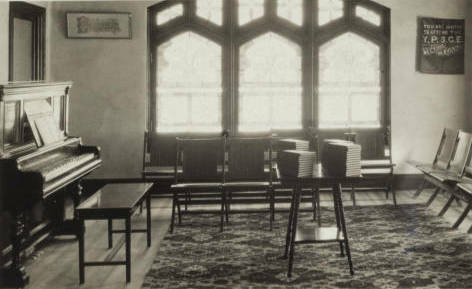
The banner on the wall reads, “You are invited to attend the Y.P.S.C.E. meeting this evening.”

There was also a room used as Headquarters, where were books and other literature relative to young people’s Christian work, and where could be found stationery and a quiet place to write or read. The registry book showed that a goodly number of young people availed themselves of this privilege.

A quiet place to read.

This Society held an Autograph Social during the season in the parlours of the hotel, which was a great success.

The Athenaeum Hotel, about 1915

Here and there you might have seen some favourite professor backed up against the wall with a double semicircle of his devoted students about him, eagerly holding their cards up, and he writing as if for dear life. But it was everywhere noticeable with what heartiness each one entered into the spirit of the hour, and demanded a name on his own card in return for every one he gave.

A collection of autographs from the early 1900s.

From this gathering it was difficult to send the people home, even after the solemn night-bell had rung; and the small boy who collected the pencils was very sleepy when the last couples left the parlour, smiling and chatting of the pleasant evening spent.

And the chimes make a beautiful ending to a day at Chautauqua. Whether you are wandering by the lake shore, or through the lovely avenues, it matters not; they are sweet. Sweeter, perhaps, just a little, as they ring out over the water, calling you in from a moonlight row or yacht ride. “Bonnie Doon,” “Blue Bells of Scotland,” “Robin Adair,” “Long, Long Ago,” all the old airs, and by-and-bye growing more serious— “Softly Now the Light of Day,” “Silently the Shades of Evening,” “Glory to Thee, my God, this Night,” and the “Vesper” hymn for good-night.

The Miller Bell Tower.

In 1894, when Grace wrote this article, collecting autographs was a popular way to preserve memories of an event. It wasn’t until 1900 when Kodak introduced their Brownie box camera that the average American could commemorate travels, celebrations, and other events with photos they took themselves.

Did you enjoy this tour of Chautauqua through Grace’s eyes?

Hopefully, her words gave you a sense of what it must have been like to visit Chautauqua 127 years ago!

Grace’s Chautauqua Delights, Part 4

This post is Part 4 of an article Grace Livingston Hill wrote about the delightful offerings for young women at Chautauqua Institution. The article was published in an 1894 issue of the YWCA newspaper.

If you missed them, you can read Part 1 here. Read Part 2 here. Read Part 3 here.

Recreations at Chautauqua

Chautauqua has attractions and social possibilities all her own. There are innumerable receptions and class gatherings, where one meets not only one’s own associates, teachers and leaders, but also many distinguished men and women from all parts of the land.

The gymnasium holds its annual reception generally with some entertainment.

The choir, under Dr. Palmer, has a reception.

Occasionally a class in botany or geology takes a day off and goes in a body to Panama, or some other interesting place, for a good time with a little study mixed in.

A Natural Science class trip, 1906.

There are receptions of all sorts and descriptions. Two years ago, one was given in honour of several returned missionaries.

To the members of the Chautauqua Literary and Scientific Circle—and there are many—there is no more interesting night on the whole programme than the one given up to their class receptions.

CLSC Class of 1913 and grads of earlier years in the Hall of Philosophy, 1913.

One of the latest developments of this place of many new ideas is the Girls’ Outlook Club.

Five mornings in a week last summer, the girls and young women gathered in a pleasant room and discussed things useful, ornamental, or nonsensical, about “Ourselves, Our Homes, and Our Neighbours.” There they compared notes on all sorts of hobbies, and carried away many helpful hints for life, the gaining of which had been but the pleasant passing of an hour together; their talk interspersed with music by some of their number, or bright, interesting speeches of a few minutes from different notable men and women.

This club filled a long-felt need in the heart of every girl who attended it. But this was not all. The entire membership was divided into small circles, with a leader at the head of each, and with some certain work for each to do. These circles were named from well-known women.

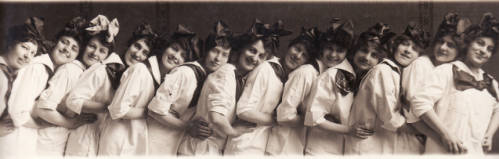
A girls’ club in 1911.

And this charming company did not keep all their good times to themselves. Once a week they had a social; a Colonial Tea, or a Cap and Gown Tea, or a Musical Tea, or a Tennis Tea, to which they invited all their friends, men and women. These were most delightful occasions. At the Cap and Gown Tea a number of college girls were attired in their caps and gowns, and were ranged in a row and called a library. The volumes were all named, and anyone in the room was allowed to draw a book and talk with her for five minutes, provided the theme of conversation was her college. Each girl had bits of ribbon in her college colours to give as souvenirs to the friends with whom she had conversed. Tiny paper caps were given as badges to all college people. The tea was voted a success.

None the less so were the entertainments which followed in the next few weeks. The Colonial Tea, where all the girls were transformed into ladies of that old-time period, with high powdered hair and short-waisted dresses, and where one circle had some mysterious symbolic puzzles arranged, was most charming.

A 1906 Colonial Tea, with guests dressed in period costume.

Indeed, both the young women and young men of Chautauqua were delighted with the Girls’ Club.

wasn’t it a clever idea to arrange college grads in a row like a library? what’s the most clever party idea you’ve ever encountered?
join us tomorrow for the final post in the series when Grace focuses on a subject dear to her heart: the young people’s society of Christian endeavor.